Awkward Mother
Margaret Evans arrived unannounced. Even she knew this wasnt the done thing. That a grown, married daughter deserved a text first, then a call, then a reply, and only then would it be reasonable to trek across half of London, changing buses twice. But it was exactly that expectation that had set her on edge that morning, standing by her window sipping cold tea and looking over the sodden garden. Why should she text first? She was the mother. She had the right.
The intercom didnt buzz straight away. The long pause, then her daughters voice: dry and a little surprised.
Mum? Are you on your own?
On my own, Sophie. Let me in.
Another pauselonger than necessary. Margaret could read the pauses; she collected them, the way others collected grudges.
Sophies flat was still newjust its third yearand Margaret hadnt really got used to it yet. Not the flat itself; it was lovely, so spacious, on the ninth floor with a view over the park. No, she still couldnt get used to the non-smell of it. No aroma of stew or pies, not even a hint of fried onions that would sting your eyes a bit but meant there was life in the home. Here there was only the faint, bland scent of a floor cleaner, and a ghost of coffee from a pod machine. Not even real coffee, Margaret reckoned, just some expensive fake.
Sophie opened the door in joggers, mobile in hand. Her hair pulled up, face cleanno makeup. Thirty-four, and still a girl, Margaret thought fondly. But that thought quickly twisted into another: a girl regarding her mother like an awkward problem.
Ive brought pie, Margaret said, holding up her bag.
Mum, I did tell you we had…
You told me last time. That you had something. I cant remember what.
James is working from home. Hes on conference calls until three.
Ill keep quiet.
Sophie stood aside. Not right away, but she did.
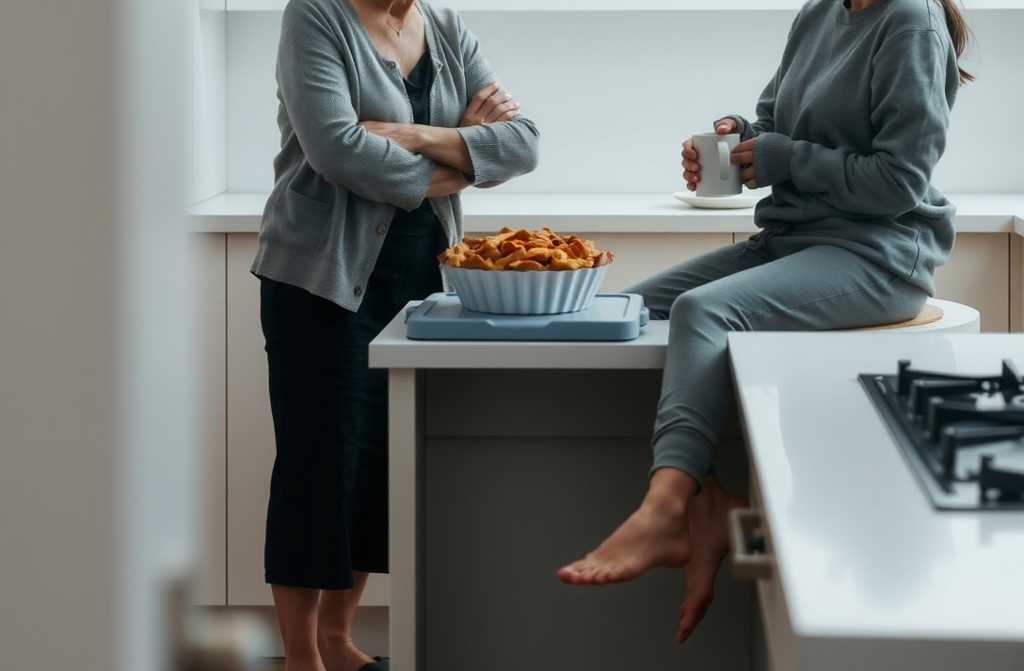
The kitchen was brilliantly white. Everythingunits, worktop, tiles, even the fridge, save for the chrome handle. Not a thing out of place on the surface. No mug left from the morning, no tea towel thrown across the sink, not a crumb. Margaret set down her bag and looked about, swept by that same conflicted feeling: admiration, envy, and something very like grief.
Sit down, Ill put the kettle on, Sophie said, not looking up.
Ill sit. Where shall I put the pie? On the board?
Yeah, on the board. That ones for raw meatcolour-coded, remember? Use the grey one, please.
Margaret took the grey board, laid out her pie, hot still beneath a tea towel. She hovered, unsure where to put her hands.
Its cabbage. Your favourite.
Mum, Im not eating wheat at the momentI did mention.
You said, a month ago. I didnt think it was serious.
It isnt serious, its just my choice.”
Sophie landed on the word choice with a special firmness. Margaret had long noticed: as if it were a shield kept close at hand.
Alright, Margaret said. James can have it. Or you can have it tomorrow. Cabbage pies are even better the next day.
Sophie set out two mugs. The pod machine hummed; coffees powdery aroma briefly won out. Margaret gazed at the white surfaces, trying to recall the last time she and her daughter had sat in a kitchen without a tightness between them. Just sit, for the sake of it. Not because it was needed, or because there was some official reason.
Youve lost weight, she finally said.
No, I was like this last year.
I dont think so.
Mum. Sophie looked up, eyes tired in a way Margaret could read all too well. Lets not start with my weight.
I wasnt starting. Im only saying.
Youre always just saying. Then the conversation starts.
Margaret wrapped both palms around her mug. The coffee was good, she had to admitbitter and strong, the way she liked. Maybe it wasnt just imitation.
Im not here for a row, she said quietly.
Fine.
I just I havent seen you in ages. Three weeks.
Mum, we spoke on Sunday.
On the phone. Its not the same.
Sophie didnt answer. She sipped her coffee. Margaret watched her hands: long fingers, manicure, a touch of clear polish. Same smart hands Margarets mother Ellen had. And Margaret herself, oncebefore her hands roughened, the knuckles swelled, never fully soft again no matter how much cream she slathered on.
Soph Margaret began.
Mum.
They spoke together. Both broke off.
You first, Margaret said.
No, you go.”
I was only going to ask about Christmas. Are you coming to me this year?
Another pausethe kind Margaret knew too well.
We havent decided, Sophie said.
Its practically November.
Christmas is still nearly two months away, Mum.
Not to me. I need to planwhat to get in, what to cook.
Well let you know.
Alright, Margaret said, keeping her voice even as something small shifted insidea pebble, sliding out of place. So youll decide, and let me know. As you do.
What does that mean, as you do?
Nothing. Just a statement.
Mum.” Sophie set the mug down, harder than she meant to. You do it again.
Do what?
You say something neutral, but your tone makes it obvious it isnt. Its criticismyou just never name it.
Margaret looked at her daughter, then at the pie, then at the spotless white counter.
Maybe so, she said.
***
She left an hour later. The pie sat under its towel, a bit deflated, on the grey board. James never came out of his office. Sophie walked her mother to the door. They hugged, brieflythe sort of hug people use when words are too much.
In the lift, Margaret found an old Argos receipt in her coat pocket and began to scrunch it between her fingers. Just something to do with her hands.
It was drizzling outside. Under the small awning, as she did up her coat, she thought: its always the same. You set out with a pie. You return with nothing. Not quite empty-handed, but with some heavy nothing inside younot easy to leave behind, not easy to put in a bag.
Thirty-four years shed raised her. Thirty-four.
No, thats not a fair thought, Margaret told herself. Shed learned to notice sometimes when a thought wasnt fair. It didnt mean shed abandon it, just admit as much.
***
At home, the first thing she did was get out yesterdays soup, set it on the hob, and watch as it heated. Her own place was ordinary, two rooms, built in 84. The kitchen was small, window over the communal gardens. On the sill, three pots of geraniumsone in bloom, two lagging behind. The table always sported a faded plastic cloth, flowery, slightly frayed at the corners. She changed it every couple of years for much the same pattern. She couldnt have said why.
The soup boiled. She switched off the gas, ladled herself a bowl, sat down.
Wasnt hungry.
Her mind turned to Sophies kitchen. That blinding whiteness that irritated her so. Why, exactly? Cleanliness was goodorder was good. Margarets mum, Ellen, loved a tidy house too. But her mothers kitchen always had a kitschy salt cellar shaped like a rooster, bought from a craft fair in the seventiesits glaze cracked and peeling, yet never to be thrown out. The salts inside and out, Ellen would say. Thats not something you chuck away.
Sophies kitchen had nothing salted through. Everything proper, everything logical, each chopping board in its colour-coded place, each object with a home it never left. Margaret understood: her daughter was made that way. There was nothing wrong with it, really. But it was cold.
No, youre being unfair again, Margaret chided herself. Shes her own person now, her own job, her own James and conference calls til three. You turned up out of the blue, after all.
Yet inside, another voice insisted: Im her mother. Not some stranger. Why do I have to make an appointment?
This argument had rattled round for years, ever since Sophie moved to this new flat, along with a whole set of unspoken rules which Margaret was supposed to follow, never having been handed the instructions.
She cleaned her dish, then absent-mindedly reached down flour, butter, got out the yeast. Her hands set to work almost before shed decided. Sometimes you mix dough not because you want to bake, but because your hands need to do something if your mind cant.
She took a block of fresh yeastdissolving it in warm water with a pinch of sugar. As it began to fizz, she gazed out the window. Leafy yard, empty play area, drizzle still falling. Old Mrs Jenkins sat on the bench with a tiny dog in a tartan coat.
Mrs Jenkins was seventy-two, lived alone. Kids moved offher son in Manchester, her daughter out to Canada. They ring, shed say, but a calls just a call. Margaret would nod. Now she nodded with a deeper understanding than a year ago.
The yeast was ready. She tipped in flour, began to knead.
The dough was rough at first, clinging to fingers, sticking to the worktop. She sprinkled more flour, kept at it. Gradually it softened, becoming springy, alive, slightly warm. She knew that feeling by heart, as well as any words.
She thought, as she kneaded.
It hadnt really started three years back, as she liked to tell herself. No, it began earlierwhen Sophie was about twenty-seven, and first declared: Mum, I can do this myself. It wasnt snippy, just matter-of-factsomething to do with a GP appointment, nothing serious. I can go on my own. Margaret had been truly hurt, for days. Because behind I can do this myself, what she heard was: Youre not needed.
Though all Sophie likely meant was: Im an adult now.
Maybe, theyd never understood the same words in the same way.
She covered the dough, set it aside to rise. Sat at the table, hands folded.
The flat was so quiet. Not a lonely silence, but her own. Margaret had got used to the quiet in six years, after Alan died. No, not diedleft. She caught herself and corrected. It mattered to name things clearly. Alan had died, and hiding behind other words didnt help. She didnt want to linger on it today.
But she did.
Alan had been a gentle man. Not weakgentle, like good dough. Life was easy alongside him. He could hear Sophie out without taking sides, which was rare. Youre both right, hed say, and youre both wrong. Thats normal. Margaret used to get cross at that. Now she thought he was the wisest of them all.
After he was gone, Sophie had changed too. Gradually. Without Alan as a bridge, some talks became impossiblethe two banks left separate.
An hour later, she checked the dough. Risen well, soft and yeasty as she remembered from childhood. She breathed it in and began shaping little pasties.
Sophie rang.
Margaret wiped her hands, answered with floury fingers.
Yes?
Mum, did you get home alright?
I did. Rainy, but fine.
Good. Pause. We tried the pie in the end. James and me. Tastes great. You do make a brilliant cabbage pie.
Margaret stilled, looking at her pasties lined up on the board.
Thank you, she said. You always used to love it.
I still do. Im justtrying to go gluten-free now, mostly.
Right.
Oh, dont be cross.
Im not.
Mum.
Sophie.
Another silence, this one softer, not the chilly kind from earlier.
Ill call at the weekend, Sophie said. Well have a proper chat.
Of course. Ring any time.
She hung up and sat for a while, just looking at the pasties. Then put them in the oven.
***
Next week Sophie rang at the usual time. They had a decent seven-minute chat, but something went wrong.
It began with a tiny thing. Margaret offered to help tidy up before Sophies birthday dinnera few friends coming round. Mum, were fine, Sophie said. I know, Im only offering, said Margaret. Sophie responded, When you offer, its really because you think my flats a tip. Margaret denied it. Sophie said, You always do this. Margaret asked, Do what, exactly? Sophie began explainingat lengthwith the word control at the core.
Control? Margaret repeated. I offered to help clean, and thats control?
Its always the same. You turn up without warning, bring food I never asked for, ask about Christmas in October because you need it all set out the way you want.
My way?
Your plans. The way you prefer. You dont ask what I want. You inform me how thingsll be.
Margaret sat at her kitchen table, phone clamped in both hands. The geranium on the sill glowed in the thin autumn sunone, the flowering one, was already dropping petals.
Im not telling you, she said, voice measured with effort.
Mum. You arrived yesterday without ringing first.
Im your mother.
I know youre my mother.
So I cant visit?
You can. Just ring first.
So you have time to prepare? For me?
So I know whats coming! Sophies voice rosea giveaway signal shed held her temper all call and only just let go. You come in, look at my kitchen, look at meand I feel judged. Whatever I do, whatever my life looks like, theres always some standard I dont quite reach.
What standard? Margaret felt a stab, sharp in the chest. Youve imagined that.
I havent. You just told me Ive lost weight.
Because you have!
Because you looked me over, then found something to critique. You always do itabout my cooking, my tidiness, or needing to commit to Christmas plans. You arrive with a pie, and it feels like an accusation.
It was too much.
An accusation, Margaret echoed, quietly dangerous. I bake a pie at five in the morning and haul it halfway across London, and its an accusation?
Mum
No. You brought it up; Ill finish it. Ive baked you pies all your life. When you were ill, at exams, or heartbroken after Mark, I brought cabbage pie and you ate half of it straight from the tin. Do you remember that?
Silence.
Do you?
I do, Sophie said, so softly.
And now its control. Accusation. Fine. Understood.
Mum, you twist everything.
Maybe. Margaret stood and looked out the window. The garden was empty. Mrs Jenkins and her dog had gone inside. Maybe I do twist everything. Or maybe you grew up and now its inconvenient to have a mother who knows you used to adore cabbage pie.
Thats not fair.
I know. Sorry.
She hung up first. Then sat, phone in hand, waiting to see if Sophie would ring back. She didnt.
***
Two weeks passed.
This silence felt strange. However bad their talks got, usually one or the other would be in touch within days, under cover of triviaWhats the name of that cleaner again? or Mum, you didnt leave a scarf here, did you? Little excuses that worked as ways back, nothing important to be said out loud.
Not this time. Neither reached out.
Margaret went to work as usual. She did three shifts a week at the local library. She genuinely loved books, and even more, the visitors. There was Nina Roberts, for instance, sixty-eight, always borrowing crime novels and then spoilering the endings before Margaret could ever ask. Margaret didnt mind; it was easy company, straightforward, without subtext.
In the second week of silence, she did message Sophie. Not callmessage. Some part of what Sophie had said about phone calls had really stung, though shed never confess that aloud.
She typed: How are you, Soph?
Three words. Waited.
Reply came four hours later: Fine, Mum. Flat out at work. You?
She wrote: Me too. Made some dough for pies today. So chilly out.
Sophie sent back a smiley: just a yellow, blankly cheerful face.
Margaret stared at it, unsure what to do. Was it peace, or just politeness? She couldnt read emojis as easily as she could read pauses.
She ate this pie herself, slice by slice, with tea.
***
At the end of November, Sophie rang. She actually rang, rather than messaging. Margaret was in the staffroom at the library.
Mum, quick question.
Im here.
Can you show me how to make your pie dough sometime? The yeast one.
A tiny silence.
I can. When?
Weekend? James and I can come, hes been meaning to for ages.
Alright, Margaret said. See you then.
She put the phone away and stood in the dusty room among back-issues of Country Living. Then allowed herself a small, honest smile.
***
They arrived at noon.
Margaret had been up since eightnot because she needed to, but because she couldnt sleep. She tidied, though really it was already tidy. Dusted shelves that were already dusted. Put out a brand new tablecloth, saved since summer, with slightly bigger daisies. She set out some nice mugsthey werent for guests, just favourites: blue and white, bought years ago at a market on a road trip with Alan.
At eleven she put the kettle on, then off againit was still early.
At ten to twelve the buzzer sounded.
James was tall, a bit shy. Margaret always suspected he was shy just with her, different with others. He brought grapes, and something else in a bag. Turned out it was plain old yoghurt.
Sophie said you needed yoghurt for the dough. I didnt know what kind.
Thisll do perfectly, Margaret said. Come in, hang your coat.
Sophie hugged her in the hall. Not briefly, but properly. Margaret caught the faint scent of her perfumesomething clean and lightand her hair tickled Margarets cheek. They said nothing more; sometimes theres no need.
The kitchen felt full now. It was fine for two, tight for three. James slipped off to the lounge to look at his phone. Margaret set out the ingredients.
Right, heres how, she began. Always use fresh yeastnot dried.
Whats the difference?
The result. Dried is easier but this just works. Its propermore alive. She smiled at the word.
Where do you find it? Nowhere seems to stock it.
The Polish shop by Asda. Small fridge at the back. She broke off a chunk, and the pungent yeasty whiff drifted round the kitchen, warm and nostalgic. Here, try.
Sophie leaned in, sniffed.
This is what your kitchen always smelt like when I was a kid.
Yes. And Grans as well.
I remember. It always smelt like this on Saturdays.
Baking day, yes.
They paused. Not the cold silence from the phonethe friendly, yeasty kind.
“So, dissolve it in warm water. Not hot. Just warmlike the inside of your wrist. Hot water kills yeast, remember: its alive.”
How can you tell its right?
By touch. No thermometer needed.
Sophie dipped a finger.
Too hot?
No, just right. Now a pinch of sugar. Just to get the yeast going.
They worked together. Margaret narrated, Sophie followed. Sometimes, when Sophie slipped up, Margaret gently correctednot with words, but by taking her hands. The gesture was oldlike fastening buttons for her as a child.
Flour bit-by-bit, Margaret said. Not all at once. Watch how it comes togetheritll tell you when its ready.
How does it tell you?
Stops sticking to your hands. Turns smooth. Not a scienceby feel.
Im used to recipes, Sophie confessed. Grams, minutes, timers.
Margaret smiled. I know. But good dough cant be rushed. It just needs attention.
Sophie started kneading. Awkwardly at first, dough creeping everywhere.
Dont rush it. The dough sets the pace.
Its actually warm.
Of courseits alive.
James poked his head in.
Want tea?
Help yourself, love. Teabags in the blue tin.
He nodded, made himself tea, and disappeared again.
Hes a good one, Margaret said, once hed gone.
Sophie kneaded quietly.
He is, she repliedno deflection, no caveat. Simply he is.
I know I hover, Margaret ventured.
Sophie looked up.
Mum”
No, let me say this. I know I get involved. I dont always see it, but when you said control, I really mulled it over. And perhaps youre right. Sometimes I hover.
I I was sharp too, Sophie began. Pie as accusation, I didnt really mean. You just brought a pie.
I brought it without warning.
Thats me. I really struggle with unplanned visits, thats allit doesnt mean youre unwelcome. Just its a lot, sometimes.
Margaret looked at Sophies hands, dusted with flour, dough at the cuffs.
Youre mucky now.
I know.
Best soak that cuff right away.
Mum.
Alright, Ill shush.
Both burst out laughing, quietly, easilyit just came.
When Dad died, Margaret began, then stopped herself. When Dad died I suddenly had nowhere to put all my looking-after. All that care. It didnt disappear, it all had to go… somewhere.
Sophie stilled, hands deep in dough.
I get it, she said at last.
And youre my only one. No one else to give it to.
I know, Mum.
Its not an excuse. Justexplaining.
I know the difference.
The dough had risen. Margaret covered it with a towel, tucked it by the heat. Sophie washed her hands, scrubbing the flour out of her cuff.
Itll still mark, Margaret said.
Never mind. Its a good stain.
***
With tea, James shared a story from worka colleague whod confused two addresses and turned up at the wrong office for a meeting. Margaret laughed out loud, genuinely. Sophie leant on her elbowglancing at husband, then mothera look Margaret couldnt quite name, but it was a good thing.
When the pasties were baking, the kitchen filled with their smell, Sophie strolled over to the window ledge.
The geraniums blooming.
The one on the left, yes. The others wont play along.
They maybe need something?
Ive tried everything I know. Maybe its just not their time yet.
Sophie stroked a leaf.
Maybe. Theyll get there.
***
The pasties were good. Sophie ate two, then a third. Doesnt countI helped this time, she joked. Margaret pretended not to notice anything about gluten. Sophie pretended not to mention it.
After lunch, James popped down to the shopMargaret never quite caught why. Alone, she and Sophie washed up together. Sophie did the washing, Margaret the drying.
Mum, remember when we argued about university?
Notting Hill?
Yes. You wanted me to do teaching. I went for business.
I remember. I was sure youd regret it.
I didnt.
I can see.
You didnt speak to me for a fortnight.
Three days, maybe.
No, at least a fortnight.
Margaret dried a plate, slid it onto the rack.
Maybe so. I was so certain I was right.
You always are.
Not always.
Mostly, Sophie corrected, gently.
Maybe. Dad used to say that too, that I was sure about myself, just not others.
Sophie handed her another mug.
Are you still sure about how we should live?
The question was serious. Margaret dried the mug, needlesslyalready dry.
No. Not certain. I dont like that you live off ready meals, or that your home smells of nothing, all so sterile, nothing alive. But thats just my taste. Not fact.
Thats… unexpectedly honest, Sophie said.
Well, Im learning.
I like your way, actually, Sophie admitted. Yours always smells of somethingfood, geranium, just home. I cant seem to manage it.
Youre different.
Or maybe I havent learned.
You did learn to make dough today.
One bit of dough.
Its a start.
Sophie dried her hands on the cloththe very one Margaret had brought the pie in before. Sophie had kept it. Margaret noticed, but didnt comment.
Mum, about Christmas. Wed like to come to you, if thats alright.
Margaret dried the last cup.
Id love that.
Can I make something too? Not from a packetfrom scratch?
Of course.
Youll show me?
I will.
They didnt hug again. They just stood side by side in the little kitchen, the yeasty scent all but faded, only its warmth lingering in the winter air. It was dark outside nowDecember poised at the doorstep, streetlights shining through the glass.
James came back, producing a bag of clementines out of nowhere. Set them on the table. The sharp, sweet scent filled the kitchen, fresh on top of the last hint of baking.
Clementines, Sophie said.
They just felt right, James replied. Smells like Christmas already, doesnt it?
Margaret peeled one. Handed a segment each to Sophie and James, and took the last for herself.
They ate in quiet.
***
That evening, after theyd gone, Margaret washed the dishes again, more for the ritual than out of need. Then padded into her little living room; flicked the lamp on. Picked up a book she hadnt touched in weeks.
Read a paragraph.
Put it down.
Sat in the hush, thinking of doughthat living thing. Leave it too long, sour. Rush it, it falters. It needs time. Just the right warmth.
She wondered if things were all right now. Perhaps not entirely. Sophie would still close herself off sometimes. Margaret would still turn up awkwardly, unannounced. Something between them would always jarbecause they were different, because they were alike, because being a mother and daughter means friction.
But today, theyd made dough together. And it had worked.
The geranium sat quietly on the sill. The flowering one sleeping, the others still waiting their time.
Margaret left the kitchen light offjust glanced through from the lounge, thinking: maybe it just isnt their turn yet.
Maybe it will come.