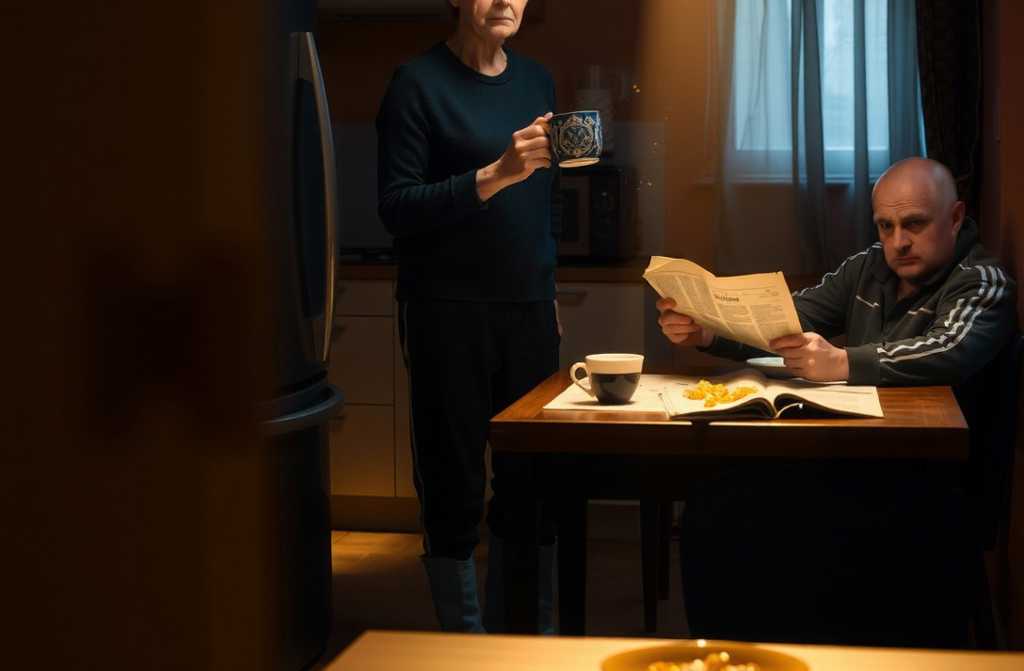
Olive, have you put the kettle on?
Olive stood at the window, watching a starling hop across the sill tiny, dusty grey, a bead of black glinting on its throat. It pecked; paused; pecked again, alive in that peculiar way birds are alive in dreams. Olive stared, transfixed, time slipping and circling, the world flattening to the birds erratic dance.
Olive!
Coming, she called, to a room filled only with air.
The starling blinked and vanished.
She drifted to the kitchen, set the kettle humming, found a muga hefty affair with Boss scrawled in chipped navy. Her daughter had lugged it home from London once, a daft gag that had lost its punch years ago, mug outlasting joke by miles.
Will you be long? Victor shuffled in, feet dragging in tired slippers, tracksuit misshapen at the knee, the *Daily Telegraph* clutched like a talisman. I asked for tea and you disappear.
I was at the window.
He stared: At the window?
There was a starling.
He lowered the paper, suspicion in his gaze, as if she conversed in riddles.
She poured boiling water and handed over his mug. Victor retreated to his armchair, the newspaper spreading out like wings around him. Olive remained by the sink, wanting tea herself but not movingnot yet. The kettle steamed, the world smudged, time staggered and doubled back on itself.
Both of them fifty-eight. Both. Theyd met at a factory party at twenty-three, married at twenty-five, and for thirty-three years Olive had set the kettle boiling at Victors merest suggestion.
She didnt recall when it started. It might never have started at alljust always been.
Her friend Grace, a few years back, had pointed this out. Theyd hunched over kitchen stools in Graces flat, drinking corner-shop wine from chipped teacups because, in the last move, every glass had perished.
Olive, listen to yourselfhe likes, he wants, its convenient for him. What do *you* want?
I want things to be all right between us.
Thats not wanting. Thats a function, love.
Olive had bristled. Claimed Grace was only jealous, alone as she was. Grace just topped up their wine.
Now as Olive stared at the kettles steam, the word circled back. Function. Like algebra. X depends on Y. Olive depends on Victor.
She made her own mug of tea. Sat. Unlocked her phone. Graces last message winked back: Are you still alive, Olive? Three weeks ago. Shed replied with a smiling emoji; Grace sent a raised eyebrow in return.
Now she wrote: Alive. Long time no see.
Grace: Saturday? Ill bake a tart.
On Saturdays, Victor expected roast dinner.
Olive replied: Ill come.
She tucked her phone away, finished her tea, and went to fuss with a frozen chicken.
Grace lived ten minutes walk away, in an ancient block smelling of dust and apple peel. Olive traced the staircases battered wooden railing, knowing every splinter as if each was a year on a growth ring. She arrived with a jar of gooseberry jam, uncertain why.
Ohyou cut your hair! Grace grinned, wide and ruffled.
Three months ago.
Well, it suits.
The kitchen filled with the perfume of apple tart cooling on a battered rack: cinnamon and a sweetness that felt impossible. Grace had divorced twice, moved four times, buried mother and father with only a year between. Yet her flat always smelt of something warm.
Go on, then, Grace said, sliding slices onto a plate.
Theres nothing to tell.
Everything.
The tart was still hot. Apples collapsed softly between crust and tongue. Olive swallowed, her throat tightnot from the taste, but from something unnamed.
He asked where the remote was yesterday, she said. It was right there, on the arm of his chair. I fetched it, passed it over.
And?
And nothing. He changed the channel. I went back to the ironing.
Graces gaze sharpened.
Olive.
I know what youre about to say.
You dont. What did *you* feel? Right then?
It was odd, how shed never thought about it. She just went. Fetched. Passed. Returned.
Nothing, she admitted. I felt nothing. I didnt even think. I just did it.
Theres the trouble, Grace murmured. Not that you handed him the remote. That you felt nothing at all.
Outside, a blue tit perched in Graces pear tree, bouncing lightly on a twig.
You have a blue tit, Olive said.
She comes every Saturday, Grace explained. I call her Daisy.
You give birds names?
I name whatever matters to me.
Olive considered this. Five-eight, she nearly said. Its not really the time for change.
But Grace handed her a fine cupblue-patterned, simple, no slogan. Olive took it with both hands.
You know what I think? Graces voice was gentle. This is exactly the time for change. Before now, you assumed thered be more time. Now, you know better.
Walking home, Olive felt the October leaves pressed thick and soft underfoota carpet woven by no one in particular. She realised she couldnt recall the last time shed walked simply to walk, not with a grocery bag in one hand or Victors meal on her mind.
Victor managed a car garage nowadays, more organiser than greasemonkey. Home each day before seven; into his chair, telly on, dinner expected. Not a demand, not exactlybut fixed as a railway timetable.
He looked up as she entered.
Whereve you been?
At Graces.
And the roast?
She paused in the hallway.
I didnt make it. I was at Graces.
So what am I supposed to eat?
For thirty-three years shed known his facecreases by the eyes like etchings in chalk, hands heavy on the chairs arms, king behind the desk.
Theres cold sausage and bread in the fridge, she said.
She took off her shoes, retreated to the bedroom, fetched her book, lay down to read.
Ten minutes later Victor came in with a plate.
These are cold.
Microwave them.
He stared. She didnt look up.
He left. The ping of the microwave. Silence.
She read. The novel was about a woman opening a pottery studio at fifty. Olive had purchased it half a year ago, always putting it off because there was never a right time.
Now she readand marvelled at how the woman in the story seemed to *know* what she wanted. Justknew. Make pots. Whereas Olive couldnt recall the taste for wanting, other than wanting things to continue untroubled.
Her name was Olive Jane Porter, née Hartwell. Shed grown up in the market town of Thirsk, moved to York to train as a bookkeeper, stayed after marrying. Worked twenty years with a construction firm, then a school, then finally, as Victor pointed out, something closer to home for tuppence, a part-time slot in an office down the road. Now shed been retired a year.
Retirement, shed thought, would mean rest. Instead, it was only more hours for the same chores: food, dust, laundering, the kettles endless rumble.
Sunday, she woke as always at six. Victor slept on. She stared at the ceilingunchanged in three decadesexcept the crack above the window had grown longer, a faint, slow river.
She dressed, donned her coat, and left.
The city just past dawn felt hollowed out, like a stage set for voices missing their cues. A cat slinked across a fence, purposeful and sly.
In the park, every bench glistened with last nights rain. Olive wiped one and sat. Just sat.
She thought of Grace: you name whatever matters. Olive had named nothing. Not the flat, which belonged to both. Not the tea set shed almost bought but Victor declared Why replace what isnt broken? Not the swimming pool membership shed treated herself toswimming just three times before feeling guilty for being out when Victor was home.
Piece by piece, shed vanisheda spoonful for roast beef, a pinch for trousers to iron, a slice for where were you, a crumb for what am I to eat now.
A woman approached with a chestnut dachshund, both ambling in a tide of fallen leaves.
Bites? Olive asked.
Oh no, she loves everyone, the woman smiled. Just stretching your legs?
You could say that.
I come every day. The woman hesitated. After Ron died, I got Daisy here. Now its routine. Rons gone, but I walk.
Dont you get lonely?
I miss Ronof course. But I miss myself, too. Near the end, I gave all of me away. Now I try to get bits back.
Daisy nuzzled Olives shoe and moved on.
How old are you? Olive asked quietly.
Sixty-three. Why?
Just wondered.
She watched the stranger go, Daisys lead bouncing behind.
Back at home, Victor awaited, expression soured.
Whereve you been?
In the park.
The park. He checked his wristwatch. At eight in the morning!
Yes.
Whats there in the park at eight?
To sit, she said. To think.
He dropped his eyes to the table. Waiting.
She boiled the kettle, made scrambled eggs, sliced bread, served it up.
He ate in silence, she opposite, cupping her tea.
Vic.
Mmm?
Do you remember why we married?
His head came up, surprised.
What sort of questions that?
Just why?
We loved each other.
And now?
He put his fork down.
Olive, what is it now?
Im just asking.
We well, we live. Family.
Family, she echoed, and let the word hang.
He finished, washed up, left the room. She stared at the crusts on his plate.
Monday, she rang up the swimming pool, renewed her card. Wednesdays and Fridays, she decided.
On Wednesday, she packed her bag. Im off to the pool, she told Victor. Your dinners in the fridgemicrowave it.
He peered over his spectacles.
That far?
Twenty minutes on the bus.
Whatever for?
I want to swim.
He said nothing. She left.
The bus rolled through autumn York: plane trees golden, café windows aglow, people walking with mysterious purpose. Olive felt a gladness just to be riding somewhere.
The Dolphin Pool boasted no dolphins, just turquoise tiles and the bite of chlorine. She changed, slid into the water, and swambreaststroke, gently, as always. Water pressed her in a familiar, comforting way, softening her thoughts.
Afterwards, a tiny café: coffee at a window, a waitress setting down a shortbread next to her cup. Olive ate. Just coffee. Just a biscuit. Just a window.
Victor sat in his usual chair at home, empty plate beside.
Heated it up? she asked.
Heated it. Bit salty.
She didnt answer. She bathed, changed, read her book.
A week later, she recounted the swimming pool, the walk, the coffee to Grace.
Good, Grace said. What else?
What else?
What do you want next?
Olive pondered. To learn something, maybe. Painting. I used to draw.
Then go.
To a class?
Theres loads! Studios. Google it.
At my age
Dont start, Grace interrupted. If you say at my age, you never will.
All right, Olive agreed.
Olive found the sign by accident: Watercolour for Adults. She walked in, asked. Classes Tuesdays and Thursdays, small group, any level. The teacher, Mrs. Annie Shepherd, was sixtyish, with silver-ball earrings and a brisk voice.
Any experience? Mrs. Shepherd asked.
Last time, I was a child. Forty years ago.
Perfect. No bad habits. See you on Tuesday.
On Tuesday, there were seven students: four middle-aged women, an older chap, a much younger woman, and a student.
Mrs. Shepherd set out an apple, told them to look.
They looked five minutes. Then painted. Olives apple came out like a knobbly potato, but she didnt care. She felt wonderful.
You have a sense for shape, Mrs. Shepherd told her. The rest follows.
Olive rode home pressing her childlike painting carefully.
Victor watched the news. Whereve you been?
Painting.
He turned, baffled. What?
Watercolours. Apple.
He eyed the page. Is that an apple?
The beginnings of one, Olive said. She made her tea.
That evening she rang her daughter EmilyEmily, who lived near London, managing a pharmaceuticals firm, mother of two, always busy.
Mummissed your call Wednesday.
No bother. I wanted to tell youIve joined a painting class.
A pause.
Painting?
Twice a week. Watercolour.
Thats grand! Emilys voice sounded unsure, pleased and bewildered at once. Does Dad know?
Hes aware.
What does he say?
He asked if my painting was meant to be an apple.
Emily laughed.
Thats Dad. Are you well?
Better, Olive replied.
Good. The kids are shoutingIll ring Sunday?
Of course.
She pressed her paper apple up with a fridge magnet: her own, next to a postcard of a Brighton shore.
Victor fetched a glass of water, paused, shook his head at the painting, said nothing.
November arrived sullen and wet. Olive swam, painted, lunched at Graces, readmore than she had in years.
One studio afternoon, Nina settled next to her. Nina was sixty-one, a former geography teacher, hair dyed autumn red, patchy, but joyful.
You new to painting? Nina whispered.
Third month.
Shows youre improving. Mine are still wobbly, after half a year.
Mrs. Shepherd says lines arent everything.
Mrs. Shepherds a philosopher, Nina smiled. She says painting isnt about renderingits about seeing.
Olive thought about that.
Thats true of living.
All true of living, Nina nodded. You married?
Thirty-three years.
Ive been twice. Alone now and actually, Im fine.
Dont you get lonely?
Sometimes. But its better than before. The first drank. The second treated me like a toaster: push the button, out comes toast.
Olive thought of herself.
Like an appliance, she echoed.
Exactly. Incidentallyyour tree there, its breathing. See?
Olive studied her painting. Yesher tree swelled with a strange inner light: breathing.
November brought small shifts. Victor got used to her being out thrice a week. Stopped asking whereve you been? Learned to microwave his own food. Once, she came home and found hed boiled potatoes on his own.
You cooked potatoes, she said.
I was hungry.
Thats good, she said.
Strangenot unpleasant. Just strange.
One evening, they both drank tea at the kitchen table. No telly, only the clocks hush.
Olive, he said, all at once.
Mm?
Youve changed.
She looked up.
In a good way or bad? she asked.
He thought. Dont know. Youre different.
She nodded. Me too. Im getting used to it.
He was quiet. Show me your paintings?
Shocked, she fetched them. He inspected slowly, stopping here and there.
Whats this?
A jug. We practised light and shadow.
And this?
My hand.
He lingered on her hand.
Thats good, he said simply.
She felt warmthnot the old surge of needing approval, but calm.
I know, she smiled.
December frost bit. Olive bought new boots, blue, shearling-lined. Victor eyed the receipta bit dearbut she replied, warm feet, and left it there.
In the studio, they painted icy landscapes. Mrs. Shepherd brought black-and-white photos: frozen fields, riverbanks, villages deep in drifts.
Winter isnt the lack of colour, she told them. Its every colour, only quiet. Find them.
Olive studied a photo, fished for blue in shaded snow, grey-pink on the horizon, a whisper of yellow in birch bark.
Beside her, Nina muttered. Mines all grey.
Look harder, Olive whispered back. Shadows arent just grey.
Nina dabbed on blue, gasped.
There, Olive said.
Afterwards, they sipped coffee in a tiny after-class café. Nina spoke of her daughter whod moved to Manchester.
Will you go? Olive asked.
Im not sure. Everythings strange there. Heres you, the studio, and Biscuit.
Biscuit?
My cat. Fat, ginger, very dignified. We rub along together.
My friend Grace names birds.
Absolutely, Nina agreed. You must name what matters.
Olive watched a woman in a red coat hurry past, hair wild.
Nina, do you regret your divorces?
Nina stirred her cup. The years, maybe. But never the act. You know, I woke one morning and realisedI couldnt remember the last time Id thought a thought just for myself. Not his dinner, not his mood, not his opinion. Just me. And Id vanished.
What did you do?
At first, froze. Tried to talk. He said, Youre imagining things. Thats all. I knew then: if he couldnt see me, I didnt exist. So I left.
They lapsed into silence.
Never mind, Nina said, brightening. Now its me, Biscuit, and watercolours. Suits me.
Snow drifted. Olive tipped back her head; a flake dissolved on her cheek.
Home: Victor chuckling into his phone. He waved as she tiptoed by. She boiled the kettle, drifted to the window.
Outside, the streetlight made a gold disc on dark snowmysterious and beautiful. She snapped a photo, set it as her phone wallpaper: her own picture, not the old family photo, not Emilys wedding. Hers.
In January, she painted the view from her own windowthe best thing shed ever made: streetlight, snowdrift, a hush in blue and gold. Mrs. Shepherd gazed long.
Thereyour voice, she said.
What do you mean?
Art has a voicetechnique is learnable. The voice is always there or never is. You have it.
I just painted my view.
Thats why it matters, Mrs. Shepherd nodded. Its yours.
She pinned the painting to the fridge, next to her apple.
Victor, morning, examined them both.
Whats this? he asked.
Just looking, he murmured. Good ones.
Thank you.
You always knew how?
I suppose so. Just never did.
He nodded, fetched cheddar.
Victor, she said.
Mm?
I want to go to the seaside in summer. Alone or with Ninaa week away.
He turned, cheese in one hand.
Alone?
Alone, or with Nina. I just want to.
A pause.
You have funds?
Ive saved my pension.
If you want, then, he said, uncertain, awkward. Not of course, darling but not dismissing. Something.
She texted Nina: Fancy the seaside this July? Thinking Bournemouth.
Minutes later: Sending Biscuit to the daughters! Im in. When?
February slogged. Olive swam, painted, saw Grace. Once, to the theatre with NinaVictor declined. Chekhov. Fifteen years since shed set foot in a theatre.
Afterwards, café.
Well? Nina asked.
I kept thinking about Irina. To London, to London! Always waiting for life to start.
Chekhovs cruel that way, Nina nodded. He shows people losing time so quietly it hurts.
I suppose Ive started living. A little, my own way.
Thats everything.
Victor doesnt get it.
Have you tried to explain?
I say Ive changed; he says he cant get used to it; I say he will. Hes quiet. But he boils his own potatoes now.
Nina laughed. Progress.
Nina, are you happy?
Im not sure what that word means. My knee aches, my moneys thin, my relationship with my daughter is complicated. But if happiness is being myself, not hiding or enduring, thenyes. I think so.
Good answer.
Youre thinking of leaving?
I dont know. Thirty-three years is a long time. Hes not bad, just cant see me. I dont know if that can changeor if I can teach him. If all I am is a kettle set boiling.
Sometimes you can. Sometimes you cant.
Yes. Sometimes.
In March, Emily visited with the children. Their laughter filled the flat. Victor sparkled, playing grandfather. Olive watchedthinking, *there!*, some bit of him lives, if seldom provoked.
After bedtime, they all drank tea.
Mum, you look wonderful!
Its the painting.
Show me!
Emily paged gently through each. Real talent, Mum! Proper paintings.
Mrs. Shepherd says I have a voice.
A voice? Emilys husband, Daniel, blinked.
In the painting. Like handwriting.
Never realised there was anything personal in it, Daniel mused.
Theres always something personal, said Olive.
Victor said nothingstared at his teacup. Then, She always could. Never did.
Emilystartled. You knew?
Victor looked at Olive. Sheepish. Saw it once. Before you were born.
She felt the ache of things unsaid. All those years. Neither speaking. She put the folder away.
As spring quickened, the flat quieted. One afternoon, Olive found a note from Victor on the kitchen counteruncharacteristic, but there.
Gone to Tims for a few days at the allotment. Soup in fridge, made it myself.
She checkeda pot of soup, pale and a bit salty, but made.
She ate it. Something important inside it, and not the taste.
She spent two days alone: swimming, painting, sleeping with book open, coffee at the window, long mornings drifting.
When Victor returned, she realised shed grown a little used to it. That solitude could taste sweet, too.
In April, Mrs. Shepherd suggested Olive for a group showjust a small one, at the community hall.
Me? Olive gasped.
You. Your paintings are alive.
She deliberated three days, then said yes.
Five to display: the snowy street, the hand, the breathing tree, the shadowed jug, and a new onea mug of tea, a book open, snow behind the glass.
Opening night: students, Grace, Nina (Biscuit left at home), even a voice memo from Emily, proud of you, Mum! Victor attended too, stiff and awkward in the crowd, but there.
He hovered by the snowy street scene.
Thats our road, he said.
Yes.
Didnt know you could paint that.
I did.
He looked at her.
Olive
Yes?
Ive missed… something important. I dont know what.
She watched him.
I know.
I dont know how to say these things.
I know.
They stood together in wordless hush, the pool of lamp-lit snow glowing before them.
Later Grace whisked her away to chat with the centres director about another exhibition.
In May, she and Nina bought train tickets: Bournemouth, early July, eight days, a modest hotel.
She told Victor, sitting across from him.
Booked the tickets. Eight days in July. With Nina.
He glanced above his glasses.
Eight?
Eight.
Rather a while.
It isnt.
He sighed. Well then. Maybe Ill go to Tims allotment those days.
Fine.
And be careful, by the sea.
I swim nowpool regular.
Fair enough.
She left for the kitchen, then doubled back.
Vic.
Hmm?
Can I ask you something?
He put down the paper.
Go on.
Do you see me?
He blinked.
See you?
Me. Not tea. Not dinner. Me.
He didnt answer. She waited.
Im not sure I understand, he said at last.
I know, she said. Thats what it is.
She returned to the kitchen, poured herself a cupin the blue-patterned mug shed bought for herself, February gone. Her cup, at last.
July arrived, and the city blazed. She packed a small suitcasesketchbook, paints, new brushes.
Victor saw her to the taxi.
Ring me, he said.
I will.
Take a sunhat.
Got it.
Taxi idled.
She put her case in the boot, glanced back.
He waited on the stoop, huge, uncertain, suddenly old.
Victor, she said.
Yes?
If you want things to change between us, we have to talk. Actually talk. Im ready. But I cant do it for both of us.
He stared.
Youll come back?
Im going to the seaside for eight days, she replied.
And got in the car.
He faded in the window, shrinking; then rounding the corner, vanished entirely.
Olive leaned back.
York sped past, streets gleaming, the citys face half-familiar: old trees, the scent of summer, buskers by the crossroads. Sunshine flickered on the glass.
She texted Nina: On my way. Where are you?
Nina: Already at the station! Gave Biscuit to my daughter, cried buckets. Waiting for you!
Olive grinned.
She opened another tab on her phone: online watercolour classes. Just to look. Just curious.
Then closed it again. Then opened it.
In a few hours, the train would hit the coastthe hills green and tumbling, sky meeting water. She would sit by the window, watching the world change tint by tint, patch by patch.
She would open her sketchbook and draw whatever she saw.
Not what was expected. Not what looked right. Justwhat was there.
Nina found her on the platform: small, russet-haired, rucksack already sliding off one shoulder.
Ready, then? Nina beamed.
Ready, said Olive.
And they left the station together.
Strangest thing wasshe didnt know if shed return to Victor in the old sense, the way you return to the known and finished. She only knew she was returning, wholly, to herself. And that, she would not surrender again.
The sun struck the platform, bouncing off the rails. Somewhere, a child wailed. Somewhere, the air smelled sweet and metallic and full of faraway things.
Olive walked on, the ground under her feet both strange and certain.
Just ordinary. Just her own.
The carriage slid forwardso gently, the world barely noticed. That was how you really left: not by changing places, but by stepping into yourself.
The platform slipped away: rooftops, then fields, then nothing but flooding light.
Nina nodded off, face pressed to the window.
Olive opened her sketchbook, reached for a pencil.
Outside, summer fields poured past: gold, flat, endless.
She started to sketch.
A horizon, neat as an idea.
Sky pressing dark at the edge.
The road vanishing into distance.
There were no people in this drawing at all.
Only soul-room.
What are you drawing? Nina asked, not opening her eyes.
A horizon, Olive answered.
Is it beautiful?
Olive considered the line, the pale sweep of land.
I dont know yet, she said. But its close.
Nina grumbled softly, drifting back to doze.
The train carried them on.
And Olive drew.