I hadn’t planned to leave before eight that day. My usual start was in place: coffee from the pot, a cheese sandwich, bag by the door. Andrew was still asleephis evening shift meant he wouldn’t stir until one. I pulled on my coat, took the rubbish bag, and stepped out.
By the bins I met Mrs. Eleanor from the third floor. She held a cardboard box and seemed keen to talk. Mrs. Eleanor always wanted to talk; it had been her main occupation since retiring six years before.
“Have you heard?” she declared without a greeting. “The CCTV camera’s been mended at last. The management company posted a notice yesterdaysays everything’s recorded now and kept for two weeks.”
“That’s good,” I answered vaguely. “Long overdue.”
“Long overdue indeed,” she repeated with satisfaction. “Recall last October when that bicycle vanished from the ground floor? Nothing came of itthe camera was useless. Now it’s working. Let anyone try something.”
I nodded, dropped the rubbish, and walked to the underground. Along the way I considered my client meeting, the bill to send before lunch, and a stop at the chemist for vitamins. The camera left my thoughts at once.
It returned only at four. I stood at the supermarket till, moving items onto the belt, when something jabbed mesoft yet clear. I froze with a milk carton in hand.
The camera.
Andrew rose at one. He stepped onto the stairs for a smokenever inside, as I’d banned it. Everyone in the block knew. He went out at quarter past one at the latest. Every single day. Five years in this place, and that pattern had held firm.
Yet today was his day off.
I set the milk down and took out my phone.
No answer. I tried once moreprolonged rings, then the machine. I put the phone away, paid, left the shop, and rang again. Still nothing.
“He’s resting,” I told myself. Late night after the shift, so sleeping now.
But I was already moving toward the underground faster than usual.
Our block was a nine-storey building from 1983. The lift ran only sometimes, the stairs carried the scent of paint and old wood. The camera sat above the entrancesmall, black, easy to miss. A red light had once blinked there, then stopped. Everyone had grown used to it being broken. Last summer someone had forced the mailboxes on the ground floor. We tried the police for the footage. They said the camera wasn’t working, nothing to see. No one was found. After that, few placed much faith in it.
I entered and glanced up without thinking. The red light shone.
Steady, calm, no flicker. Simply on.
I climbed the stairs to the fourth floor without calling the lift. The landing stayed quiet. Keys out, door open.
Unfamiliar boots stood in the hallway.
Not completely unknown. I’d noticed them earlier. Light brown suede, size nine. They rested beside Andrew’s slippers, toe to toe, lined up neatly as if arranged on purpose.
I remained in the doorway ten seconds. Just stood and stared.
Then I removed my coat and hung it on the hook. I placed the shopping bag on the floor. Everything done slowly and with care.
No sound reached from the room.
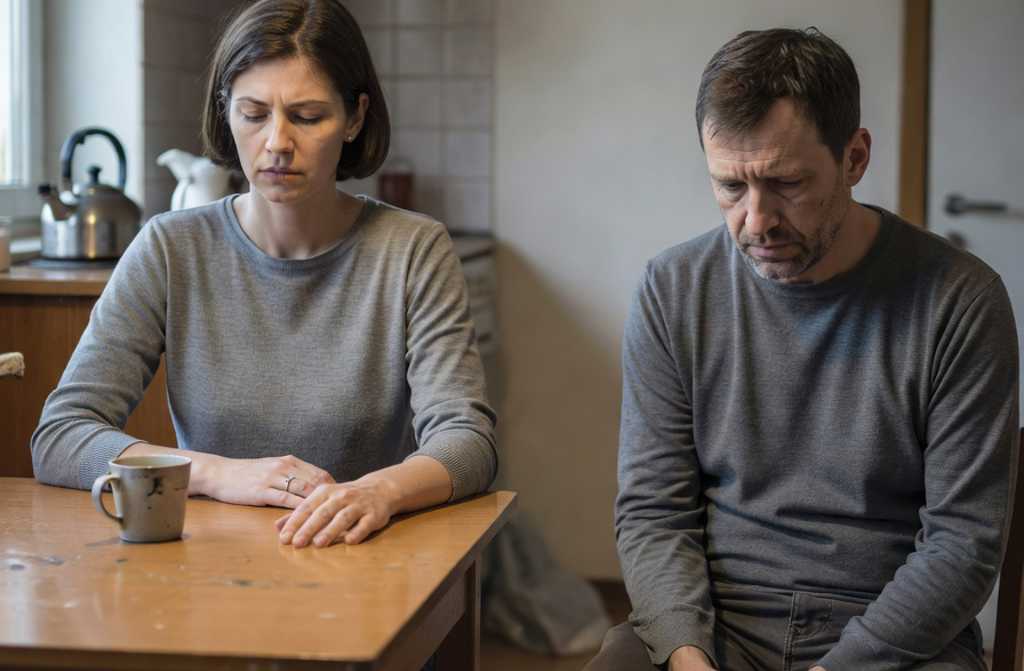
I went to the kitchen, set the kettle to boil, and sat on the stool. My hands rested on the table while I studied them like they belonged to another person. Long fingers, a silver ring with a small stone on the leftAndrew had given it for our third anniversary. We’d spent three days in Edinburgh then, in a small hotel near Princes Street, walking the streets. He bought the ring at a jeweller’s on Princes Street. I’d seen it in the window, called it nice, and left it at that. He had remembered.
The kettle boiled. I rose, poured water into a mug, added a teabag. All of it done with extra caution, as if handling something that must not spill.
I took the mug and moved into the hallway.
“Andrew,” I said quietly.
Nothing.
“Andrew, I’m home.”
Movement came from behind the bedroom door. The bed creaked. Then rustling, a pause, another sound I could not name yet understood at once.
The door opened.
Andrew appeared in a T-shirt and tracksuit bottoms, hair messy, eyes looking past me. That avoidance I spotted immediately. He had always met my gaze straight on, one of the first things I’d noted. Open and direct. Now he looked away.
“You’re early,” he said.
“Yes,” I said. “I finished sooner.”
“I was asleep.”
“I can tell.”
Quiet again. I drank tea and watched him. He stayed in the doorway without moving.
“David came round,” he said after a moment. “Rang from the car, so I let him in. We sat and chatted, then he lay down for a bit.”
“Right,” I said.
“What’s up?”
“Nothing.”
He walked past me to the kitchen, opened the fridge, and took out water.
“David!” he called toward the room. “Come out, Emma’s back!”
Another creak. Pause. Then David stepped from the bedroomDavid, who had worked alongside Andrew at the same company for six years. I knew him from work events and Andrew’s birthday last year. Tall, fair-haired, a little stooped. He looked freshly woken: red eyes, one cheek creased.
“Hi, Emma,” he said. “Sorry about this. I stopped by to see Andrew, and we dozed off.”
“It’s fine,” I said.
They both watched me. I kept my eyes on the mug.
“Best be off then,” said David. “Things to see to.”
“Yeah,” said Andrew. “Take care.”
David moved to the hallway, made some noise, then the front door shut.
Andrew and I were alone.
He poured water, drank it, and set the glass in the sink.
“Why the silence?” he asked.
“Thinking.”
“About what?”
I placed the mug on the table.
“Listen,” I said. “You know the camera in the entrance has been fixed?”
He went still. Something crossed his face quickly and almost unseen. He set the glass on the sink edge harder than needed.
“No,” he said. “Hadn’t heard.”
“This morning. Mrs. Eleanor told me.”
A pause.
“So what?” he asked.
“Nothing,” I said. “I only wanted to mention it.”
I avoided a row. Not from lack of things to say. I had plentya stack gathered over six months. Small oddities noticed and set aside. Phone always screen down, not merely now and then. Evening shifts more common than before. Replies to messages came laterby half an hour or an hour, yet I noticed. A scentnot cologne, something different and faint I could not name but knew.
One June evening he returned late and said work had held him. I asked nothing. I simply set a plate down and went to another room. On the sofa I wondered if I was only being paranoid. Perhaps tiredness or stress had me inventing things.
Later I rose and checked his jacket. Nothing there. That brought no peace. The act of checking itself showed something had shifted. Ordinary people do not search others’ pockets.
I held back the row because I needed time to consider.
That evening Andrew left for work. I sat in the kitchen with my laptop, acting as if busy. Near nine I sent Helen a message: “Can you talk now?”
She rang within three minutes.
“What is it?”
I described the boots. How he had come from the bedroom. How he had claimed to be asleep. And the camera.
Helen listened without breaking in. That was why I valued her above the restshe could hear without interrupting or adding her own tales.
“Are you sure?” she asked once I finished.
“No,” I answered honestly. “Not sure.”
“Well then.”
“But the boots sat exactly like that. Toe to toe. Neat. No one lines up boots that way for a quick visit with a friend.”
Helen waited.
“That shows nothing,” she said.
“I know.”
“You might be wrong.”
“I know, Helen. I understand I could be mistaken. Yet I looked at those boots and thought: I already know. Proof isn’t required. I simply know.”
“A feeling isn’t proof.”
“I know. But sometimes a feeling cuts truer than any proof.”
“What will you do?”
“Don’t know yet. Probably speak with him.”
“When?”
“Not today.”
We spoke a little longer about nothing, just to avoid ending the call. Then Helen said, “Above all, don’t keep it in. If it hurts, tell me.” I agreed.
He came back at half past eleven. I lay in bed with a book. He looked in and noted “not asleep”a fact, not a question. He showered, returned, and lay down with his phone.
I read without taking it in. Words passed but formed no sense. The same line four times over.
“Emma,” he said into the dark.
“What?”
“Are you cross?”
“No.”
A pause.
“Truly?”
“Truly.”
He turned over. Minutes later his breathing steadiedsleep or pretence.
I stared at the ceiling. White, with a small crack in the left corner from last autumn. Andrew had said it needed filling. It never was.
I was thirty-four and married eight years. I recalled our first look at this flatempty then, with old striped wallpaper. How I had wanted to redecorate before furniture arrived. How he had laughed and said wallpaper was minor, the real point was the sunny windows.
I remembered painting the bedroom. How he had splashed paint and walked about with a white mark on his temple. How I had laughed. How he had laughed in return.
I remembered our first real rowover his mother and money. Three days without a word, and it was terriblethree days of silence in one flat. On the fourth he left a packet of my favourite tea on the kitchen table and said nothing. I said nothing. We simply sat and drank, then began to speakfirst carefully, then as usual.
All of that had existed. It remained.
Yet the boots had existed too.
Next day I rang the management company.
“Hello,” I said. “I live at 12 Victoria Road, fourth floor. You repaired the camera at the entrance yesterday.”
“Yes,” the voice replied. “Has something occurred?”
“No. I only wish to check if the recording from the past twenty-four hours is still held.”
“It is. Fourteen days’ storage.”
“Thank you.”
I set the phone down.
Then picked it up and called Andrew.
“Hello?” he answered straight away.
“Hi. Where are you?”
“At work. Has something happened?”
“No,” I said. “Nothing has happened. Listen, do you recall I mentioned the camera yesterday?”
A pause, brief yet noticeable. I felt it sharply, like a marked gap on a recording.
“I recall.”
“The footage is kept for two weeks. I learned that just now.”
A silence longer than needed for “understood.”
“Understood,” he said at last.
“Yes,” I said. “Understood.”
His breathing came throughsteady, deliberate. The kind from someone forcing even breaths.
“Emma,” he said.
“Not now,” I broke in. “We’ll speak tonight. At home.”
I ended the call.
For several minutes I sat with the phone in hand. Light rain hung outside, not falling properly, just suspended. I watched and realised I had not needed the recording. I had needed that exact pause, that silence drawn out beyond what was required.
He arrived early, at quarter to seven. I had not eaten yet. He set his bag down, removed his shoes, and came to the kitchen. I sat with a cup of tea.
He took the seat opposite. No lead-in, no “how was your day,” no idle wordsjust sat and looked at me.
We stayed quiet perhaps three minutes. Long ones. I measured them by shifts in his face. First closed, then weary, then something else. I cannot name it better.
“It has been happening a while,” he said.
“How long?”
“Seven months.”
I nodded. Seven months meant since February. I tried to recall February. We had visited his parents for the holidays. He bought me flowers for my birthdaya large bouquet of yellow tulips. I placed them in a vase on the windowsill. Studied them for several dayslovely, bright, full of life. Seven months.
“Who is she?”
He gave a name. Claire. I did not know her.
“Does she work with you?”
“No. We met by chance.”
“By chance,” I repeated.
He stayed silent. Offered no explanations, searched for no phrasesjust silence, and that silence felt more truthful than words.
“Were you going to tell me?” I asked.
“I don’t know. I thought about it. Didn’t know how.”
“And now?”
“Now there is no choice.”
“Because of the camera.”
He met my eyes.
“No,” he said. “Not only the camera. I could not have continued this way even without it. I could not myself. It turned impossibleliving beside you like this while knowing that…”
“But you did for seven months.”
“Yes.”
The quiet grew so complete I heard the bathroom tap dripping. It had needed repair for agesnever found the time. A small regular sound: drip, pause, drip.
“Do you want to be with her?”
He took time to answer. I studied him and realised I knew his face completelyevery line, every crease by the eyes. Those creases had appeared three years earlier. I remembered him at the mirror saying something light about age, and my laughter. Now I saw the creases as if for the first time.
“I don’t know what I want,” he said quietly. “That’s honest. I’m not avoiding it. I truly don’t know.”
“That’s a weak answer.”
“I know.”
“Andrew.” I spoke his name slowly, testing the sound. “You see this is not merely ‘I don’t know’? It asks for an answer?”
“Yes. I see.”
“And?”
He looked at the table.
“I don’t want her,” he said. “It was something else. Nothing I could weigh against you. I’m not comparing. There it is altogether different.”
“But you went there seven months.”
“Yes.”
“And what made it special?”
He stayed quiet a long time.
“Easy,” he said finally. “It was simply easy there. No obligations, no weight. Meet and part. No one expects a thing from the other. Like air in another place.”
“And here there’s no air?”
“No. Here it’s real. And real is always heavier. My fault for not handling it. Not yours.”
I rose, went to the window, stood, and returned. He tracked me with his eyes.
“Very well,” I said. “Today you go to Tom’s. Take what you need for a few days and leave. I need to think.”
“Emma…”
“I’m not sending you away forever. I mean I need a few days alone. Can you allow that?”
He nodded.
“Alright,” he said.
He stood and went to the bedroom. I heard the wardrobe open and items being packed. Quiet, careful noiseshe avoided disturbance. He emerged with a small bag.
“Emma.”
“What?”
“I’m sorry.”
I looked at him. The regret was real, not just words. It showed.
“I know,” I said. “Go.”
Three days passed alone.
I called neither him nor Helen nor my mother. Work, home, meals for one. It felt strangeI had not cooked for one in years. I no longer knew the right amount of pasta. Always for two, or three at weekends with guests. Now half went into a container.
The first day I cleaned the flatfloors, dust, things long due for the bin. No anger, no effort to remove traces. Only a need to use my hands.
That evening I rang my mother. Not to confide, simply to speak. She spoke of the garden, neighbours, a television programme. I listened and noted her voice unchangedwarm, slightly tired. Some things stay the same.
The second day I rang the management company once more.
“Can I obtain the camera recording?”
“For what reason?”
“I need to see yesterday’s footage. Personal matter.”
They explained recordings were released only on formal request and for specific reasons theft or damage, that sort. A simple request to view was not allowed.
I thanked them and hung up.
The recording was not needed anyway. I had received what I sought the day I questioned Andrew about the camera. Not the footagehis response. The pause stretched too long. The breathing forced into steadiness.
I did not need the recording.
I needed the truth. And I had it.
On the third day I saw I must decide not about him but about myself. Not what he had done or how it had started. What I wanted.
I sat by the window with coffeethe familiar view of street, trees, part of the playground. Very known, very ordinary. I wondered: if he were gone tomorrowthis ordinary togethernesswhat would remain? What would I lose?
Eight years. Not just eight years side by sideeight years that had built something solid. The flat. The daily paths. The Friday film habit. The ease of shared silence without strain. He knew I could not speak in the morning for the first half hour. I knew he lost his way in large shops and grew annoyed with himself. Tiny, unremarkable facts about another person, gathered over years, that quietly form a base.
Could this be kept once broken? Or was it like a crack in the wallplasterable, yet always present beneath?
I did not know. Yet I understood I wished to try.
On the fourth day he wrote: “Can I come over?”
I answered: “Yes.”
He arrived that evening. Brought bread and milk, as if he had only gone shopping rather than left home. I did not remark on it. We sat in the kitchen with tea, and I thought the important parts of our life likely happened here, at this table.
“Have you decided anything?” he asked.
“Almost,” I said.
“And?”
I looked at my hands. The ring caught the lamp light.
“I need to know one thing,” I said. “Is she real to you? Or was it something you cannot clearly define?”
He stayed quiet a long time. Longer than thought alone would take. Longer than choosing words. I saw him searching for honesty.
“No,” he said at last. “Not real. It was an escape. I don’t know from what. From myself, perhaps. There it was simple. No responsibility, nothing serious. Just easy.”
“And here it’s hard?”
“Here it’s real. And real is always harder. My fault for not managing it, not anything you did wrong.”
I poured more tea. My hands stayed steadyI surprised myself.
“Have you ended it with her?”
“Yes.”
“When?”
“Day before yesterday.”
“So before I said come.”
“Yes.”
That mattered. I could not say why, yet it did. He had not ended it because I had called. He had ended it himself, earlier.
“Good,” I said.
“Does that mean…”
“It means we can try. Not at once. Not as if nothing occurredthat will never be so, and I want you to grasp that. But try.”
He looked at me. Something in his facenot relief. Something more layered. As if he had only now grasped what he would have lost. Not in the past, but right then.
“I need something from you,” I continued.
“Anything.”
“Not anything. Specifically: I want us to see a counsellor. Couples therapy. More than onceseveral times. Are you ready?”
“Yes.”
“You didn’t pause. Said yes straight away.”
“I’m ready, Emma. I mean it. Three days of thinking have shown me a lot.”
“What exactly?”
He looked at his hands, then at me.
“That I did this not because something was missing here. Because something was missing in me. Some skill to handle what is hard. To bear what is real. I ran where it was easy. That is cowardice, plain and simple.”
I said nothing. He went on.
“I need to work this out. Not to convince you. For myself. Because if I do not, it will happen again. Maybe not with her. Maybe something else. But it will happen again.”
Perhaps the most honest thing he had said all evening.
“Good,” I said again.
We sat longer. The talk shiftednot easy, yet different. Away from this. He mentioned work, I mentioned a client. Small, careful words about nothing of weight. Like people speaking after long silencestarting with something plain.
“One more thing,” I said as he prepared to stand.
“Yes?”
“The tap in the bathroom. Dripping two weeks now. Fix it tomorrow.”
He watched me a second. Then something moved at the corner of his mouth. Not a smile, but close.
“Alright,” he said. “Tomorrow.”
Mrs. Eleanor stopped me on Friday by the lift.
“Have you heard?” she said with the same solemn tone as the week before about the camera. “The camera’s off again. Some technical fault, they say. Second time this month. Outrageous! I wrote to the management companythey claim it will be fixed by week’s end. But we know their fixes.”
“Yes,” I agreed. “Outrageous.”
The lift arrived. I entered and pressed four.
“By the way, have you noted the dispatcher’s number?” Mrs. Eleanor called into the closing doors. “I have it, I can pass it on!”
Doors shut.
I studied my reflection in the metalblurred and faint, as in old lifts. Thirty-four, silver ring, coat from the wardrobe’s third shelf. Tired face, somewhat creased from recent days. An ordinary face.
The camera had worked for precisely one day.
One day out of eight years. One day out of nearly three thousand we had spent in one flat, one block, under one roof.
One dayand that had been enough.
The lift stopped at the fourth floor. Doors opened. I stepped onto the landing.
The flat was quietAndrew had not yet returned from his shift. I removed my coat, set the kettle on, and opened the fridge. Shelves held bread, milk, something in a container. A normal fridge. A normal kitchen. A normal flat.
A normal life, now holding a visible crack. Not new, simply seen.
I poured water into a mug and considered how life often works. Not everything fine or finished, but something between, where one must stand and sort matters. Where simple answers are absent, yet honest questions exist.
And sometimes honest answers.
The bathroom tap no longer dripped. Andrew had fixed it that morning, as promised.
This too held meaning. In that moment it struck me that life often grants brief openings to face concealed truths. The real lesson is that bonds endure not through avoidance or simple escapes, but through the courage to meet difficulties directly, mend what has fractured, and strengthen the whole with daily honesty and shared resolve. One short span of clarity can prevent years of hidden harm, showing that lasting connection asks for bravery and steady commitment.I hadn’t planned to leave before eight that day. My usual start was in place: coffee from the pot, a cheese sandwich, bag by the door. Andrew was still asleephis evening shift meant he wouldn’t stir until one. I pulled on my coat, took the rubbish bag, and stepped out.
By the bins I met Mrs. Eleanor from the third floor. She held a cardboard box and seemed keen to talk. Mrs. Eleanor always wanted to talk; it had been her main occupation since retiring six years before.
“Have you heard?” she declared without a greeting. “The CCTV camera’s been mended at last. The management company posted a notice yesterdaysays everything’s recorded now and kept for two weeks.”
“That’s good,” I answered vaguely. “Long overdue.”
“Long overdue indeed,” she repeated with satisfaction. “Recall last October when that bicycle vanished from the ground floor? Nothing came of itthe camera was useless. Now it’s working. Let anyone try something.”
I nodded, dropped the rubbish, and walked to the underground. Along the way I considered my client meeting, the bill to send before lunch, and a stop at the chemist for vitamins. The camera left my thoughts at once.
It returned only at four. I stood at the supermarket till, moving items onto the belt, when something jabbed mesoft yet clear. I froze with a milk carton in hand.
The camera.
Andrew rose at one. He stepped onto the stairs for a smokenever inside, as I’d banned it. Everyone in the block knew. He went out at quarter past one at the latest. Every single day. Five years in this place, and that pattern had held firm.
Yet today was his day off.
I set the milk down and took out my phone.
No answer. I tried once moreprolonged rings, then the machine. I put the phone away, paid, left the shop, and rang again. Still nothing.
“He’s resting,” I told myself. Late night after the shift, so sleeping now.
But I was already moving toward the underground faster than usual.
Our block was a nine-storey building from 1983. The lift ran only sometimes, the stairs carried the scent of paint and old wood. The camera sat above the entrancesmall, black, easy to miss. A red light had once blinked there, then stopped. Everyone had grown used to it being broken. Last summer someone had forced the mailboxes on the ground floor. We tried the police for the footage. They said the camera wasn’t working, nothing to see. No one was found. After that, few placed much faith in it.
I entered and glanced up without thinking. The red light shone.
Steady, calm, no flicker. Simply on.
I climbed the stairs to the fourth floor without calling the lift. The landing stayed quiet. Keys out, door open.
Unfamiliar boots stood in the hallway.
Not completely unknown. I’d noticed them earlier. Light brown suede, size nine. They rested beside Andrew’s slippers, toe to toe, lined up neatly as if arranged on purpose.
I remained in the doorway ten seconds. Just stood and stared.
Then I removed my coat and hung it on the hook. I placed the shopping bag on the floor. Everything done slowly and with care.
No sound reached from the room.
I went to the kitchen, set the kettle to boil, and sat on the stool. My hands rested on the table while I studied them like they belonged to another person. Long fingers, a silver ring with a small stone on the leftAndrew had given it for our third anniversary. We’d spent three days in Edinburgh then, in a small hotel near Princes Street, walking the streets. He bought the ring at a jeweller’s on Princes Street. I’d seen it in the window, called it nice, and left it at that. He had remembered.
The kettle boiled. I rose, poured water into a mug, added a teabag. All of it done with extra caution, as if handling something that must not spill.
I took the mug and moved into the hallway.
“Andrew,” I said quietly.
Nothing.
“Andrew, I’m home.”
Movement came from behind the bedroom door. The bed creaked. Then rustling, a pause, another sound I could not name yet understood at once.
The door opened.
Andrew appeared in a T-shirt and tracksuit bottoms, hair messy, eyes looking past me. That avoidance I spotted immediately. He had always met my gaze straight on, one of the first things I’d noted. Open and direct. Now he looked away.
“You’re early,” he said.
“Yes,” I said. “I finished sooner.”
“I was asleep.”
“I can tell.”
Quiet again. I drank tea and watched him. He stayed in the doorway without moving.
“David came round,” he said after a moment. “Rang from the car, so I let him in. We sat and chatted, then he lay down for a bit.”
“Right,” I said.
“What’s up?”
“Nothing.”
He walked past me to the kitchen, opened the fridge, and took out water.
“David!” he called toward the room. “Come out, Emma’s back!”
Another creak. Pause. Then David stepped from the bedroomDavid, who had worked alongside Andrew at the same company for six years. I knew him from work events and Andrew’s birthday last year. Tall, fair-haired, a little stooped. He looked freshly woken: red eyes, one cheek creased.
“Hi, Emma,” he said. “Sorry about this. I stopped by to see Andrew, and we dozed off.”
“It’s fine,” I said.
They both watched me. I kept my eyes on the mug.
“Best be off then,” said David. “Things to see to.”
“Yeah,” said Andrew. “Take care.”
David moved to the hallway, made some noise, then the front door shut.
Andrew and I were alone.
He poured water, drank it, and set the glass in the sink.
“Why the silence?” he asked.
“Thinking.”
“About what?”
I placed the mug on the table.
“Listen,” I said. “You know the camera in the entrance has been fixed?”
He went still. Something crossed his face quickly and almost unseen. He set the glass on the sink edge harder than needed.
“No,” he said. “Hadn’t heard.”
“This morning. Mrs. Eleanor told me.”
A pause.
“So what?” he asked.
“Nothing,” I said. “I only wanted to mention it.”
I avoided a row. Not from lack of things to say. I had plentya stack gathered over six months. Small oddities noticed and set aside. Phone always screen down, not merely now and then. Evening shifts more common than before. Replies to messages came laterby half an hour or an hour, yet I noticed. A scentnot cologne, something different and faint I could not name but knew.
One June evening he returned late and said work had held him. I asked nothing. I simply set a plate down and went to another room. On the sofa I wondered if I was only being paranoid. Perhaps tiredness or stress had me inventing things.
Later I rose and checked his jacket. Nothing there. That brought no peace. The act of checking itself showed something had shifted. Ordinary people do not search others’ pockets.
I held back the row because I needed time to consider.
That evening Andrew left for work. I sat in the kitchen with my laptop, acting as if busy. Near nine I sent Helen a message: “Can you talk now?”
She rang within three minutes.
“What is it?”
I described the boots. How he had come from the bedroom. How he had claimed to be asleep. And the camera.
Helen listened without breaking in. That was why I valued her above the restshe could hear without interrupting or adding her own tales.
“Are you sure?” she asked once I finished.
“No,” I answered honestly. “Not sure.”
“Well then.”
“But the boots sat exactly like that. Toe to toe. Neat. No one lines up boots that way for a quick visit with a friend.”
Helen waited.
“That shows nothing,” she said.
“I know.”
“You might be wrong.”
“I know, Helen. I understand I could be mistaken. Yet I looked at those boots and thought: I already know. Proof isn’t required. I simply know.”
“A feeling isn’t proof.”
“I know. But sometimes a feeling cuts truer than any proof.”
“What will you do?”
“Don’t know yet. Probably speak with him.”
“When?”
“Not today.”
We spoke a little longer about nothing, just to avoid ending the call. Then Helen said, “Above all, don’t keep it in. If it hurts, tell me.” I agreed.
He came back at half past eleven. I lay in bed with a book. He looked in and noted “not asleep”a fact, not a question. He showered, returned, and lay down with his phone.
I read without taking it in. Words passed but formed no sense. The same line four times over.
“Emma,” he said into the dark.
“What?”
“Are you cross?”
“No.”
A pause.
“Truly?”
“Truly.”
He turned over. Minutes later his breathing steadiedsleep or pretence.
I stared at the ceiling. White, with a small crack in the left corner from last autumn. Andrew had said it needed filling. It never was.
I was thirty-four and married eight years. I recalled our first look at this flatempty then, with old striped wallpaper. How I had wanted to redecorate before furniture arrived. How he had laughed and said wallpaper was minor, the real point was the sunny windows.
I remembered painting the bedroom. How he had splashed paint and walked about with a white mark on his temple. How I had laughed. How he had laughed in return.
I remembered our first real rowover his mother and money. Three days without a word, and it was terriblethree days of silence in one flat. On the fourth he left a packet of my favourite tea on the kitchen table and said nothing. I said nothing. We simply sat and drank, then began to speakfirst carefully, then as usual.
All of that had existed. It remained.
Yet the boots had existed too.
Next day I rang the management company.
“Hello,” I said. “I live at 12 Victoria Road, fourth floor. You repaired the camera at the entrance yesterday.”
“Yes,” the voice replied. “Has something occurred?”
“No. I only wish to check if the recording from the past twenty-four hours is still held.”
“It is. Fourteen days’ storage.”
“Thank you.”
I set the phone down.
Then picked it up and called Andrew.
“Hello?” he answered straight away.
“Hi. Where are you?”
“At work. Has something happened?”
“No,” I said. “Nothing has happened. Listen, do you recall I mentioned the camera yesterday?”
A pause, brief yet noticeable. I felt it sharply, like a marked gap on a recording.
“I recall.”
“The footage is kept for two weeks. I learned that just now.”
A silence longer than needed for “understood.”
“Understood,” he said at last.
“Yes,” I said. “Understood.”
His breathing came throughsteady, deliberate. The kind from someone forcing even breaths.
“Emma,” he said.
“Not now,” I broke in. “We’ll speak tonight. At home.”
I ended the call.
For several minutes I sat with the phone in hand. Light rain hung outside, not falling properly, just suspended. I watched and realised I had not needed the recording. I had needed that exact pause, that silence drawn out beyond what was required.
He arrived early, at quarter to seven. I had not eaten yet. He set his bag down, removed his shoes, and came to the kitchen. I sat with a cup of tea.
He took the seat opposite. No lead-in, no “how was your day,” no idle wordsjust sat and looked at me.
We stayed quiet perhaps three minutes. Long ones. I measured them by shifts in his face. First closed, then weary, then something else. I cannot name it better.
“It has been happening a while,” he said.
“How long?”
“Seven months.”
I nodded. Seven months meant since February. I tried to recall February. We had visited his parents for the holidays. He bought me flowers for my birthdaya large bouquet of yellow tulips. I placed them in a vase on the windowsill. Studied them for several dayslovely, bright, full of life. Seven months.
“Who is she?”
He gave a name. Claire. I did not know her.
“Does she work with you?”
“No. We met by chance.”
“By chance,” I repeated.
He stayed silent. Offered no explanations, searched for no phrasesjust silence, and that silence felt more truthful than words.
“Were you going to tell me?” I asked.
“I don’t know. I thought about it. Didn’t know how.”
“And now?”
“Now there is no choice.”
“Because of the camera.”
He met my eyes.
“No,” he said. “Not only the camera. I could not have continued this way even without it. I could not myself. It turned impossibleliving beside you like this while knowing that…”
“But you did for seven months.”
“Yes.”
The quiet grew so complete I heard the bathroom tap dripping. It had needed repair for agesnever found the time. A small regular sound: drip, pause, drip.
“Do you want to be with her?”
He took time to answer. I studied him and realised I knew his face completelyevery line, every crease by the eyes. Those creases had appeared three years earlier. I remembered him at the mirror saying something light about age, and my laughter. Now I saw the creases as if for the first time.
“I don’t know what I want,” he said quietly. “That’s honest. I’m not avoiding it. I truly don’t know.”
“That’s a weak answer.”
“I know.”
“Andrew.” I spoke his name slowly, testing the sound. “You see this is not merely ‘I don’t know’? It asks for an answer?”
“Yes. I see.”
“And?”
He looked at the table.
“I don’t want her,” he said. “It was something else. Nothing I could weigh against you. I’m not comparing. There it is altogether different.”
“But you went there seven months.”
“Yes.”
“And what made it special?”
He stayed quiet a long time.
“Easy,” he said finally. “It was simply easy there. No obligations, no weight. Meet and part. No one expects a thing from the other. Like air in another place.”
“And here there’s no air?”
“No. Here it’s real. And real is always heavier. My fault for not handling it. Not yours.”
I rose, went to the window, stood, and returned. He tracked me with his eyes.
“Very well,” I said. “Today you go to Tom’s. Take what you need for a few days and leave. I need to think.”
“Emma…”
“I’m not sending you away forever. I mean I need a few days alone. Can you allow that?”
He nodded.
“Alright,” he said.
He stood and went to the bedroom. I heard the wardrobe open and items being packed. Quiet, careful noiseshe avoided disturbance. He emerged with a small bag.
“Emma.”
“What?”
“I’m sorry.”
I looked at him. The regret was real, not just words. It showed.
“I know,” I said. “Go.”
Three days passed alone.
I called neither him nor Helen nor my mother. Work, home, meals for one. It felt strangeI had not cooked for one in years. I no longer knew the right amount of pasta. Always for two, or three at weekends with guests. Now half went into a container.
The first day I cleaned the flatfloors, dust, things long due for the bin. No anger, no effort to remove traces. Only a need to use my hands.
That evening I rang my mother. Not to confide, simply to speak. She spoke of the garden, neighbours, a television programme. I listened and noted her voice unchangedwarm, slightly tired. Some things stay the same.
The second day I rang the management company once more.
“Can I obtain the camera recording?”
“For what reason?”
“I need to see yesterday’s footage. Personal matter.”
They explained recordings were released only on formal request and for specific reasons theft or damage, that sort. A simple request to view was not allowed.
I thanked them and hung up.
The recording was not needed anyway. I had received what I sought the day I questioned Andrew about the camera. Not the footagehis response. The pause stretched too long. The breathing forced into steadiness.
I did not need the recording.
I needed the truth. And I had it.
On the third day I saw I must decide not about him but about myself. Not what he had done or how it had started. What I wanted.
I sat by the window with coffeethe familiar view of street, trees, part of the playground. Very known, very ordinary. I wondered: if he were gone tomorrowthis ordinary togethernesswhat would remain? What would I lose?
Eight years. Not just eight years side by sideeight years that had built something solid. The flat. The daily paths. The Friday film habit. The ease of shared silence without strain. He knew I could not speak in the morning for the first half hour. I knew he lost his way in large shops and grew annoyed with himself. Tiny, unremarkable facts about another person, gathered over years, that quietly form a base.
Could this be kept once broken? Or was it like a crack in the wallplasterable, yet always present beneath?
I did not know. Yet I understood I wished to try.
On the fourth day he wrote: “Can I come over?”
I answered: “Yes.”
He arrived that evening. Brought bread and milk, as if he had only gone shopping rather than left home. I did not remark on it. We sat in the kitchen with tea, and I thought the important parts of our life likely happened here, at this table.
“Have you decided anything?” he asked.
“Almost,” I said.
“And?”
I looked at my hands. The ring caught the lamp light.
“I need to know one thing,” I said. “Is she real to you? Or was it something you cannot clearly define?”
He stayed quiet a long time. Longer than thought alone would take. Longer than choosing words. I saw him searching for honesty.
“No,” he said at last. “Not real. It was an escape. I don’t know from what. From myself, perhaps. There it was simple. No responsibility, nothing serious. Just easy.”
“And here it’s hard?”
“Here it’s real. And real is always harder. My fault for not managing it, not anything you did wrong.”
I poured more tea. My hands stayed steadyI surprised myself.
“Have you ended it with her?”
“Yes.”
“When?”
“Day before yesterday.”
“So before I said come.”
“Yes.”
That mattered. I could not say why, yet it did. He had not ended it because I had called. He had ended it himself, earlier.
“Good,” I said.
“Does that mean…”
“It means we can try. Not at once. Not as if nothing occurredthat will never be so, and I want you to grasp that. But try.”
He looked at me. Something in his facenot relief. Something more layered. As if he had only now grasped what he would have lost. Not in the past, but right then.
“I need something from you,” I continued.
“Anything.”
“Not anything. Specifically: I want us to see a counsellor. Couples therapy. More than onceseveral times. Are you ready?”
“Yes.”
“You didn’t pause. Said yes straight away.”
“I’m ready, Emma. I mean it. Three days of thinking have shown me a lot.”
“What exactly?”
He looked at his hands, then at me.
“That I did this not because something was missing here. Because something was missing in me. Some skill to handle what is hard. To bear what is real. I ran where it was easy. That is cowardice, plain and simple.”
I said nothing. He went on.
“I need to work this out. Not to convince you. For myself. Because if I do not, it will happen again. Maybe not with her. Maybe something else. But it will happen again.”
Perhaps the most honest thing he had said all evening.
“Good,” I said again.
We sat longer. The talk shiftednot easy, yet different. Away from this. He mentioned work, I mentioned a client. Small, careful words about nothing of weight. Like people speaking after long silencestarting with something plain.
“One more thing,” I said as he prepared to stand.
“Yes?”
“The tap in the bathroom. Dripping two weeks now. Fix it tomorrow.”
He watched me a second. Then something moved at the corner of his mouth. Not a smile, but close.
“Alright,” he said. “Tomorrow.”
Mrs. Eleanor stopped me on Friday by the lift.
“Have you heard?” she said with the same solemn tone as the week before about the camera. “The camera’s off again. Some technical fault, they say. Second time this month. Outrageous! I wrote to the management companythey claim it will be fixed by week’s end. But we know their fixes.”
“Yes,” I agreed. “Outrageous.”
The lift arrived. I entered and pressed four.
“By the way, have you noted the dispatcher’s number?” Mrs. Eleanor called into the closing doors. “I have it, I can pass it on!”
Doors shut.
I studied my reflection in the metalblurred and faint, as in old lifts. Thirty-four, silver ring, coat from the wardrobe’s third shelf. Tired face, somewhat creased from recent days. An ordinary face.
The camera had worked for precisely one day.
One day out of eight years. One day out of nearly three thousand we had spent in one flat, one block, under one roof.
One dayand that had been enough.
The lift stopped at the fourth floor. Doors opened. I stepped onto the landing.
The flat was quietAndrew had not yet returned from his shift. I removed my coat, set the kettle on, and opened the fridge. Shelves held bread, milk, something in a container. A normal fridge. A normal kitchen. A normal flat.
A normal life, now holding a visible crack. Not new, simply seen.
I poured water into a mug and considered how life often works. Not everything fine or finished, but something between, where one must stand and sort matters. Where simple answers are absent, yet honest questions exist.
And sometimes honest answers.
The bathroom tap no longer dripped. Andrew had fixed it that morning, as promised.
This too held meaning. In that moment it struck me that life often grants brief openings to face concealed truths. The real lesson is that bonds endure not through avoidance or simple escapes, but through the courage to meet difficulties directly, mend what has fractured, and strengthen the whole with daily honesty and shared resolve. One short span of clarity can prevent years of hidden harm, showing that lasting connection asks for bravery and steady commitment.