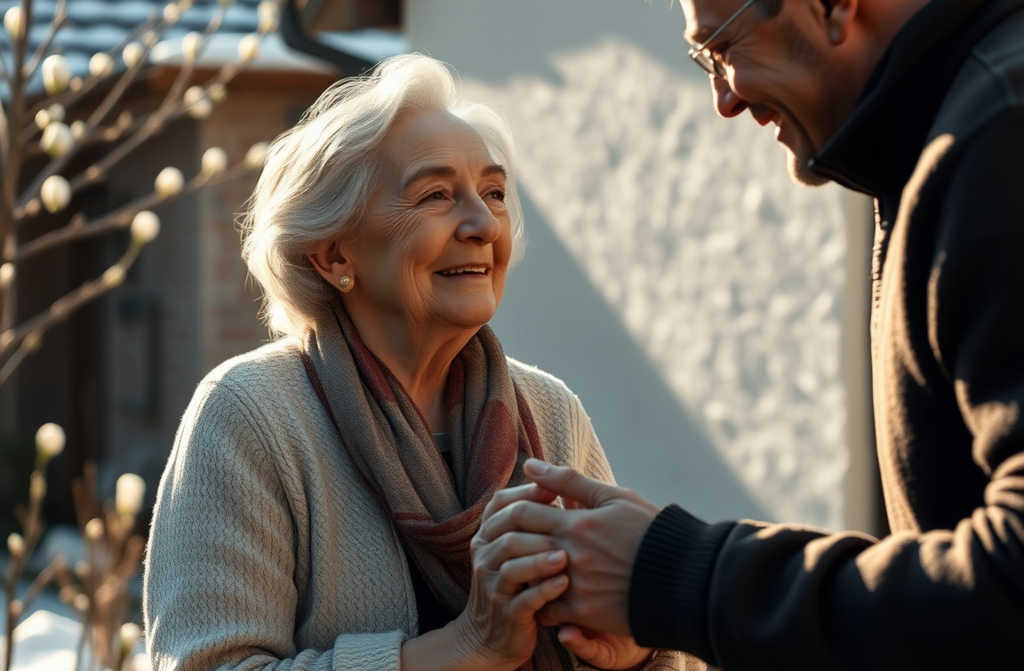
Let Me Go, Please — “I’m not going anywhere…” the elderly woman whispered, her words barely audible. “This is my home—I won’t abandon it.” Uncried tears trembled in her voice. “Mum,” the man replied gently. “You do understand that I can’t care for you here… You have to see that.” Alex was heavy-hearted, watching his mother’s distress. She sat on the worn, sagging sofa in the little country cottage she’d called home all her life. “I’ll manage on my own. You don’t need to fuss over me,” she said stubbornly. “Just let me be.” But Alex knew she couldn’t. This was a stroke. Svetlana had always been unwell, and he remembered well how he’d had to take time off work to care for her after she broke her leg—how, even if she’d tried to put on a brave face, at first she literally couldn’t take a step without help. Only recently had Alex begun to earn good money, and he’d planned to refurbish the old house that summer to make things easier for his mum. But then the stroke happened. Now, the renovation was senseless—a move into the city was unavoidable. “Marina will gather your things,” Alex nodded to his wife. “Let her know if you need anything special.” Svetlana said nothing, gazing out the window where the gentle autumn wind buffeted the yellowing leaves on the ancient trees she’d watched her whole life. Her stronger hand gripped the other, now limp, with all her might. Marina busied herself with the wardrobe, frequently asking her mother-in-law what to pack. Svetlana only stared silently through the pane, thoughts far away from old dressing gowns and broken glasses. …Svetlana had been born and spent all her sixty-eight years in a tiny, ever-emptier English village. She’d worked as a seamstress, first at the local tailor’s shop until it closed, then from home. As the years went by and work dwindled, she poured her soul into her little garden and her home—never imagining having to leave it for some unfamiliar, impersonal city flat. … “Alex, she’s barely eating again,” Marina sighed, setting an untouched plate on the kitchen table. “I can’t keep doing this. I haven’t the strength…” Alex looked wearily at his wife, then the ignored food, and shook his head in defeat. He trudged into his mother’s room, where Svetlana perched on the sofa, staring through the glass as if she were hardly blinking. Her faded grey eyes sought some distant point, her functioning hand resting on her motionless one, as if trying to breathe life back into it. Exercise gadgets cluttered the room; a stack of pills on her nightstand. Without Alex’s urging, she wouldn’t have bothered with any of it. “Mum?” No reaction. “Mum?” “My darling boy…” Svetlana’s voice was faint and slurred—she still struggled to speak clearly since the stroke. It was better now, but sometimes her words were muffled. “Why haven’t you eaten, Mum? Marina worked hard to cook for you. You’ve barely touched anything for days.” “I don’t want to, darling,” she whispered, slowly turning to Alex. “Truly. Don’t force me.” “Mum… what do you want? Just tell me…” He sat beside her and she grasped his hand. “You know what I want, Alex. I want to go home. I’m scared I’ll never see it again.” He sighed, shaking his head. “You know I work every day now, and Marina is always at the doctors. It’s winter—travel is tough. Let’s wait ‘til spring at least.” She nodded, and Alex offered a wan smile as he left. “Just… I hope it’s not too late, my son… I hope it’s not too late…” … “I’m afraid the IVF didn’t work—again,” the consultant said gently, removing her glasses and looking at the young woman. Marina gasped, covering her face with her hands. “But why? Why does it work for everyone else? You said after the first try it’s normal—only forty percent succeed. But this is our third and nothing! How?” Alex stayed silent, holding Marina’s hand, his nerves on edge—their time almost up, and his mother finishing her massage in the next wing. “Listen,” the doctor said quietly. “I understand; this pregnancy means everything to you, but your stress levels are off the scale. Your body can’t—” “Of course I’m stressed!” Marina snapped. “I’m working from home to afford these absurd costs! All the medication, procedures… then caring for your mother—one minute she won’t eat, won’t take her medicine… Yes! I want a baby—maybe then my husband would think of me as well as his mother!” She caught herself, grabbed her bag, and fled. “Sorry,” mumbled Alex. “It’s fine,” the doctor reassured him. “I’ve seen much worse. It’s okay.” Alex quietly followed. Marina sat in the waiting area, sobbing into her hands. She looked at him, her eyes red and streaming. “I’m sorry… I didn’t mean it. I just… watching someone waste away. Seeing one line on every test, draining our savings— I just… can’t do this anymore…” “If I could help—either of you—I would, but…” “I know,” Marina forced a smile through tears. “I really do.” They sat for a moment, hand in hand. Then Marina pulled herself together, smoothing her collar and offering a shaky smile. “Come on. Your mum must be finished her appointment. She hates hospitals—they make her so sad.” … “Your mother’s showing almost no progress,” the short, white-haired doctor said quietly, after Alex had drawn him aside. “Honestly, when you brought her to me, I thought she’d recover. Of course, stroke recovery rates are low, but she had every chance—no bad habits, no chronic illness…” “But nothing’s changed. I can see it.” “I think… she’s given up. There’s no spark left in her eyes. It’s as if she just doesn’t want to go on…” Alex nodded silently. He could see it himself. Svetlana had lost fifteen kilograms, grown unrecognisable. She simply sat, unmoving, staring out the window. No TV, no books, no conversations—just the world beyond the glass. “Stroke can cause behavioural changes,” the doctor continued softly. “But I didn’t expect such a profound effect in her case. When she first arrived, there was none of this.” “I think… It’s something else,” Alex murmured. … “Alex,” Marina’s voice trembled on the phone. “Can you cancel your trip? Your mother’s taken a bad turn. I’m scared you won’t make it back in time…” It was hard for her to say, given how much Alex’s mother meant to him—how difficult it was, too, for Marina herself to watch her mother-in-law lie immobile and silent on the sofa. Svetlana, who once watched the birds out the window, listened to the old records inherited from her husband—her father-in-law, the village music teacher. She now lay unmoving, gaze fixed on a spot only she could see, barely touching food, drinking only milk. Although she used to insist the taste was never the same as back in the village, now it was the only thing she’d take… Alex came that evening, sitting by her bedside all night long. “You know what I want. You promised.” He nodded. Yes, he’d promised. Next day, they drove to the old cottage. Svetlana refused the doctor. “I don’t want to go to hospital. Just… home.” It was March, muddy country roads surprisingly passable. Alex helped his mother into her wheelchair, rolling her to the door. Snow still clung to the hedgerows, thawing as the sun crept higher. The trees shivered under a light breeze. For hours, Svetlana sat in the garden, finally smiling. She breathed deeply, gazing at the sky, tears on her face—yet they were tears of happiness. She was home. She took in the crooked old house, the warming sun, the hushed sounds of nature, the chill of melting snow underfoot… That evening she ate, and the smile never left her lips. That very night, she slipped away. With the same gentle smile, she died peacefully—at home, at last, and happy. Alex and Marina took time away from work to say goodbye, bury her, and sort out the house. In truth, Alex just wanted to breathe in the sharp, heady air of home—he hadn’t spent more than a weekend here in years. …Shortly before they left, Marina felt unwell and dashed off to the bathroom, vomiting unexpectedly. She returned, eyes huge, hands trembling—the test in her hand had two lines for the very first time. “It’s her… it’s your mum. Svetlana’s given us this—she’s helped us,” Marina whispered through her tears. Alex looked up to the bright, flawless sky, nodded gratefully, and held his wife close. This truly was his mother’s final, most precious gift. Let Me Go, Please

Let me go, please

I wont go anywhere I kept mumbling under my breath. This is my home, and Im not leaving it. Unspoken tears trembled in my voice.

Mum, said my son, John, softly. You must understand, I cant look after you the way you need. Please, try to see my side.

John was clearly upset. He could see how hard this was for mehow anxious I was. I sat on the worn, sagging settee in the front room of my old cottage, staring at the faded wallpaper of the tiny Suffolk village where Id lived my entire life.

Ill be alright by myself, I promise. I dont need anyone to look after me, I said stubbornly. Just leave me be.

But John knew better. Id had a stroke. My health had always been patchy, and he remembered all too well that time hed had to take months off work to help me recover after I broke my leg. Even though Id pretended to cope, in truth I couldn’t even make it to the front gate alone for weeks.

Not long ago, John had begun earning well, enough to finally plan the renovations Id always wanted for my little home. This was supposed to be the summer of new beginnings. But after the stroke, all his plans were pointless. The only option left was to move me to the city.

Emily will help you pack, Mum, he nodded towards his wife. Just let her know if theres anything you need.

Emily was busy in my bedroom, digging through drawers and asking what I wanted to bring. I just kept staring through the window, fixated on the golden autumn leaves flitting down from the chestnut trees Id watched grow for decades. My good right hand clutched my useless left one.

Emily kept asking about blouses, slippers, and old spectacles, but I couldnt get my mind off what I was about to lose. My home. My life.

Id been born and had spent all of my sixty-eight years in this village, watching it slowly empty out. Id always worked as a seamstress, first at the local shop, then at my kitchen table when the last of the neighbours drifted away. Work thinned out and I put all my remaining energy into my garden, the house, the little things that made life worthwhile. Now, the idea of leavingof abandoning my garden for a strange, echoing flat in Londonwas unthinkable.

Shes not eating again, sighed Emily, setting a full plate down with a dull clink. I cant keep this up, John. Im out of energy

John just looked at her. Then he looked at the untouched meal, shook his head, and walked into my room. He found me on the settee, still staring at the fading light outside, barely blinking. My grey eyes had lost their shine. My right hand cradled my withered one, as if I could somehow will it back to life. The room was cluttered with therapy bands and medicine bottles, but if it werent for John, Id never use the lot.

Mum?

No response.

Mum?

My darling? My words were slurred now, still thick from the stroke. It was better than before, but even I could hear how hard I was to understand.

Why wont you eat for us, Mum? Emilys spent hours cooking. Its been days.

Im just not hungry, John. I turned to look at him, smiling weakly. Truly. Please, dont force me.

Mum well, what would you like? Anythingjust name it.

He sat beside me, and I squeezed his hand.

You know what I want, darling. I just want to go home. Im scared Ill never see it again.

He sighed, head in his hands.

You know Im working every day now, and Emilys off to the surgery or chemist more often than not. Winters coming, and its not safe. Lets wait till spring, alright?

I nodded. He smiled softly and left.

Lets hope its not too late, John Not too late.

Im sorry, IVF didnt work again, the doctor said, removing her glasses with a weary look, glancing at Emily.

Emily pressed her hands to her face in shock. But why? Why does it work for others? You told us its normal not to succeed the first timeforty percent, you said. But this is the third attempt and nothing! How could this be?

John squeezed her hand tightly, worry flickering on his face. I was in the clinics other wing, having physio, and soon hed have to go fetch me.

Look, the doctor said gently. I know how much this means to you, but youre so fixated, its turning into a constant pressure. Stress isnt helping your chances

Of course Im stressed! I have to work from home to pay for these outrageously expensive procedures! Im taking drugs that make me feel wretched, running from appointment to appointment, and caring for a mother-in-law who wont eat, wont take her meds, and wont even talk to me half the time! Yes, I want a babymaybe then my husband would spare a little attention for someone besides his mum!

Emily caught herself, cheeks flushing, and dashed out, bag in hand, slamming the door.

Im sorry, John whispered.

No need, sighed the doctor. You wouldnt believe the scenes Ive witnessed. Its alright.

He caught up to Emily, who was sobbing on a bench in the waiting room, her face buried in her hands. Her shoulders shook as she wept. She looked up at him, eyes red-rimmed.

Im so sorry, John I really am. I didnt mean any of that about your mum. Im just so tired. So tired of watching someone fade away, tired of seeing only one line on the test, of throwing all our savings at one more hope dashed. I cant do this anymore

If I could help you both, I would, truly. But Im helpless here

I know, Emily managed a watery smile.

They sat together, silent, hand in hand. Then Emily straightened up, fixed her blouse, and managed a small smile.

Lets go. Your mums probably waiting. She hates clinics. They always leave her low.

Theres been no real improvement, said Dr. Harris quietly, as John pulled him aside so I wouldnt overhear. Honestly, when you first came to me, I was hopeful. Recovery from a stroke is always a gamble, but your mum had no bad habits, no chronic problems. Every chance was on her side.

But nothings happening. I can see that.

I think shes simply given up. Theres no spark in her eyes any more. She just doesnt want to be here.

John nodded. He could see it too. Id shed nearly two stone, looked nothing like myself, sat unmoving for hours, always gazing out the same window. Books untouched, radio gathering dust, no conversation, no TV. Just that view of the garden.

Some people after a stroke can change, you know, even their personalities, Dr. Harris added, quietly. But I didnt expect your mum to be so deeply affected.

I think its something else altogether, John murmured.

John, Emilys voice came down the phone, thin and worried. Can you come home early? Your mum really isnt well. Im scared you wont make it in time

It was hard for her to say. She knew just how much his mum meant to him. And even she, after all theyd fallen out over, found herself heartsore watching me waste away. I used to stare for hours from the settee, sometimes popping on one of the old records from my husbands music dayshed been a school music teacher, and Id rescued the gramophone after he passed. But now, I mostly just lay there staring into space, not speaking, barely eatingexcept for the glass of milk I demanded each morning. Not that it tasted like the milk from home, Id say, but at least it was something. Now, suddenly, it was all Id drink.

John arrived by nightfall, sitting at my side until morning.

You know what I want, son. You promised me.

He nodded. He had promised, after all.

Next day we packed up for Suffolk. I refused a doctors visitI wanted to go home.

Its the only place I want to be. No hospital. Just take me home.

It was March, but the roads werent too bad, so we managed to drive all the way up the muddy country lanes. John helped me into my old wheelchair.

It was thawing at lastthe icicles dripping off the roof, snow shrinking back to reveal earth beneath. The trees tossed lazily in the mild breeze, and the sun felt warm instead of weak for the first time in months. I sat in the garden for hours, breathing in the scents and sounds of spring, watching the daffodils fight their way up through the lawn. At last, a smile appeared on my face, tears slipping down my cheeksnot of sorrow, but relief. I was finally home. I gazed up at the little cottage, at the golden sunlight, at the garden Id cherished. I was whole again.

That night I ate a good supper, then spent a long time outdoors, just soaking up the twilight. The next morning, I was gone. I passed with a smile. I left this world happy.

After the funeral, John and Emily took some leave to sort through the cottage, saying goodbye, clearing out what needed to go. Truth told, John just wanted to stay on, to soak up the clean village air for as long as he couldhe hadnt spent more than a weekend there since he was a lad.

Before heading back to London, Emily suddenly felt unwell. She ran to the loo and was sick. When she re-emerged, her eyes were enormous, stunnedand in her hand, a pregnancy test. She always carried one, more out of habit than hope. This time, though, there were two clear blue lines. Two!

Its her, John Its your mum Shes the one who helped us, I know it, Emily said through tears, still in disbelief.

John looked up at the clear English sky, nodded, and wrapped Emily in a tight embrace. It was a gifthis mothers last, and dearest.


Rate article
Add a comment

;-) :| :x :twisted: :smile: :shock: :sad: :roll: :razz: :oops: :o :mrgreen: :lol: :idea: :grin: :evil: :cry: :cool: :arrow: :???: :?: :!:

Let Me Go, Please — “I’m not going anywhere…” the elderly woman whispered, her words barely audible. “This is my home—I won’t abandon it.” Uncried tears trembled in her voice. “Mum,” the man replied gently. “You do understand that I can’t care for you here… You have to see that.” Alex was heavy-hearted, watching his mother’s distress. She sat on the worn, sagging sofa in the little country cottage she’d called home all her life. “I’ll manage on my own. You don’t need to fuss over me,” she said stubbornly. “Just let me be.” But Alex knew she couldn’t. This was a stroke. Svetlana had always been unwell, and he remembered well how he’d had to take time off work to care for her after she broke her leg—how, even if she’d tried to put on a brave face, at first she literally couldn’t take a step without help. Only recently had Alex begun to earn good money, and he’d planned to refurbish the old house that summer to make things easier for his mum. But then the stroke happened. Now, the renovation was senseless—a move into the city was unavoidable. “Marina will gather your things,” Alex nodded to his wife. “Let her know if you need anything special.” Svetlana said nothing, gazing out the window where the gentle autumn wind buffeted the yellowing leaves on the ancient trees she’d watched her whole life. Her stronger hand gripped the other, now limp, with all her might. Marina busied herself with the wardrobe, frequently asking her mother-in-law what to pack. Svetlana only stared silently through the pane, thoughts far away from old dressing gowns and broken glasses. …Svetlana had been born and spent all her sixty-eight years in a tiny, ever-emptier English village. She’d worked as a seamstress, first at the local tailor’s shop until it closed, then from home. As the years went by and work dwindled, she poured her soul into her little garden and her home—never imagining having to leave it for some unfamiliar, impersonal city flat. … “Alex, she’s barely eating again,” Marina sighed, setting an untouched plate on the kitchen table. “I can’t keep doing this. I haven’t the strength…” Alex looked wearily at his wife, then the ignored food, and shook his head in defeat. He trudged into his mother’s room, where Svetlana perched on the sofa, staring through the glass as if she were hardly blinking. Her faded grey eyes sought some distant point, her functioning hand resting on her motionless one, as if trying to breathe life back into it. Exercise gadgets cluttered the room; a stack of pills on her nightstand. Without Alex’s urging, she wouldn’t have bothered with any of it. “Mum?” No reaction. “Mum?” “My darling boy…” Svetlana’s voice was faint and slurred—she still struggled to speak clearly since the stroke. It was better now, but sometimes her words were muffled. “Why haven’t you eaten, Mum? Marina worked hard to cook for you. You’ve barely touched anything for days.” “I don’t want to, darling,” she whispered, slowly turning to Alex. “Truly. Don’t force me.” “Mum… what do you want? Just tell me…” He sat beside her and she grasped his hand. “You know what I want, Alex. I want to go home. I’m scared I’ll never see it again.” He sighed, shaking his head. “You know I work every day now, and Marina is always at the doctors. It’s winter—travel is tough. Let’s wait ‘til spring at least.” She nodded, and Alex offered a wan smile as he left. “Just… I hope it’s not too late, my son… I hope it’s not too late…” … “I’m afraid the IVF didn’t work—again,” the consultant said gently, removing her glasses and looking at the young woman. Marina gasped, covering her face with her hands. “But why? Why does it work for everyone else? You said after the first try it’s normal—only forty percent succeed. But this is our third and nothing! How?” Alex stayed silent, holding Marina’s hand, his nerves on edge—their time almost up, and his mother finishing her massage in the next wing. “Listen,” the doctor said quietly. “I understand; this pregnancy means everything to you, but your stress levels are off the scale. Your body can’t—” “Of course I’m stressed!” Marina snapped. “I’m working from home to afford these absurd costs! All the medication, procedures… then caring for your mother—one minute she won’t eat, won’t take her medicine… Yes! I want a baby—maybe then my husband would think of me as well as his mother!” She caught herself, grabbed her bag, and fled. “Sorry,” mumbled Alex. “It’s fine,” the doctor reassured him. “I’ve seen much worse. It’s okay.” Alex quietly followed. Marina sat in the waiting area, sobbing into her hands. She looked at him, her eyes red and streaming. “I’m sorry… I didn’t mean it. I just… watching someone waste away. Seeing one line on every test, draining our savings— I just… can’t do this anymore…” “If I could help—either of you—I would, but…” “I know,” Marina forced a smile through tears. “I really do.” They sat for a moment, hand in hand. Then Marina pulled herself together, smoothing her collar and offering a shaky smile. “Come on. Your mum must be finished her appointment. She hates hospitals—they make her so sad.” … “Your mother’s showing almost no progress,” the short, white-haired doctor said quietly, after Alex had drawn him aside. “Honestly, when you brought her to me, I thought she’d recover. Of course, stroke recovery rates are low, but she had every chance—no bad habits, no chronic illness…” “But nothing’s changed. I can see it.” “I think… she’s given up. There’s no spark left in her eyes. It’s as if she just doesn’t want to go on…” Alex nodded silently. He could see it himself. Svetlana had lost fifteen kilograms, grown unrecognisable. She simply sat, unmoving, staring out the window. No TV, no books, no conversations—just the world beyond the glass. “Stroke can cause behavioural changes,” the doctor continued softly. “But I didn’t expect such a profound effect in her case. When she first arrived, there was none of this.” “I think… It’s something else,” Alex murmured. … “Alex,” Marina’s voice trembled on the phone. “Can you cancel your trip? Your mother’s taken a bad turn. I’m scared you won’t make it back in time…” It was hard for her to say, given how much Alex’s mother meant to him—how difficult it was, too, for Marina herself to watch her mother-in-law lie immobile and silent on the sofa. Svetlana, who once watched the birds out the window, listened to the old records inherited from her husband—her father-in-law, the village music teacher. She now lay unmoving, gaze fixed on a spot only she could see, barely touching food, drinking only milk. Although she used to insist the taste was never the same as back in the village, now it was the only thing she’d take… Alex came that evening, sitting by her bedside all night long. “You know what I want. You promised.” He nodded. Yes, he’d promised. Next day, they drove to the old cottage. Svetlana refused the doctor. “I don’t want to go to hospital. Just… home.” It was March, muddy country roads surprisingly passable. Alex helped his mother into her wheelchair, rolling her to the door. Snow still clung to the hedgerows, thawing as the sun crept higher. The trees shivered under a light breeze. For hours, Svetlana sat in the garden, finally smiling. She breathed deeply, gazing at the sky, tears on her face—yet they were tears of happiness. She was home. She took in the crooked old house, the warming sun, the hushed sounds of nature, the chill of melting snow underfoot… That evening she ate, and the smile never left her lips. That very night, she slipped away. With the same gentle smile, she died peacefully—at home, at last, and happy. Alex and Marina took time away from work to say goodbye, bury her, and sort out the house. In truth, Alex just wanted to breathe in the sharp, heady air of home—he hadn’t spent more than a weekend here in years. …Shortly before they left, Marina felt unwell and dashed off to the bathroom, vomiting unexpectedly. She returned, eyes huge, hands trembling—the test in her hand had two lines for the very first time. “It’s her… it’s your mum. Svetlana’s given us this—she’s helped us,” Marina whispered through her tears. Alex looked up to the bright, flawless sky, nodded gratefully, and held his wife close. This truly was his mother’s final, most precious gift. Let Me Go, Please
“This is my home too,” said the man (age 52) after living with me for six months. That’s when I truly became afraid



