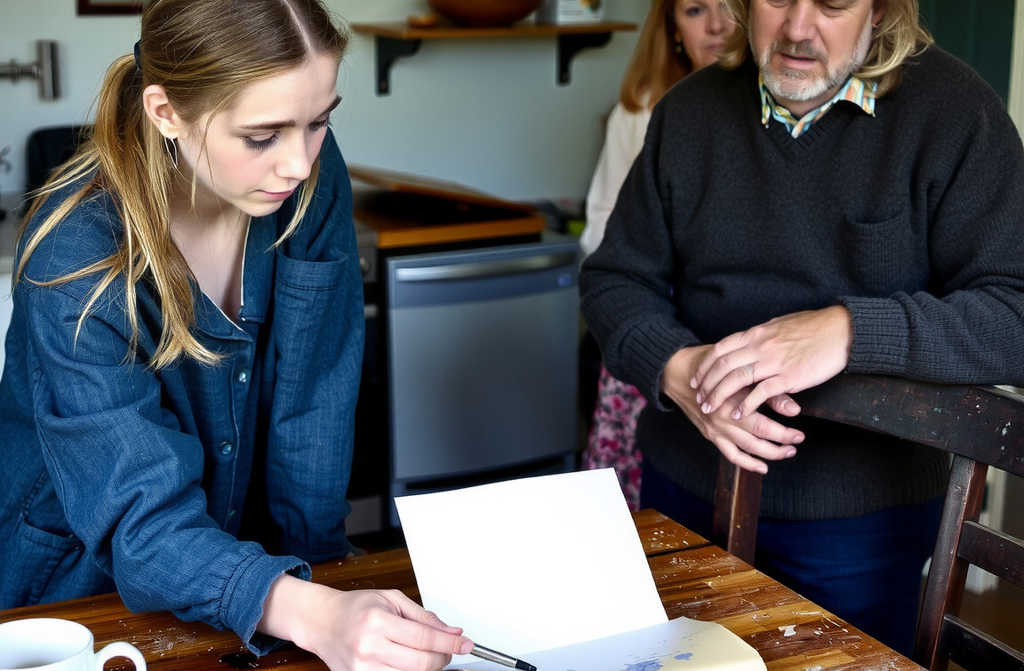
The salty breeze teased Eleanors hair as she halfclosed her eyes against the bright sun and laid another careful stroke upon the canvas.
Blue dissolved gently into indigo, capturing that singular hue of the sea at twilightso near, yet forever out of reach, as if one tried to hold light in their hands.
She was only twenty, but the sea remained a mystery to hera secret that called and inspired her.
Anne slipped up behind her, silent as a shadow, and rested her chin on her daughters shoulder, inhaling the familiar mix of oil paint and brine. She smelled of freshcaught mackerel and the comfort of a tidy cottage.
Its a little dark, she said softly, not reproachful, only with tender concern. The sea is calm today.
Eleanor gave a faint smile, never taking her eyes off the canvas.
Im not painting the sea, she replied. Im painting the sound it held in my memory.
Anne brushed Eleanors hair with a gentle hand. It had been fifteen years since she and Victor had found a shivering child on Whitbys beachwet, terrified, eyes reflecting a stormclouded sky. The baby could not recall her name, her past, or how she had ended up there, tossed ashore as if a broken piece of a boat.
They named her Eleanor. The name took root, becoming part of her very soul.
They waitedone week, a month, a year. They placed notices, alerted the constable, questioned anyone who might have seen a palehaired girl with eyes like a squall. No one came forward. It was as if the sea had simply left her there.
Your fathers back with the catch, Anne called, pointing toward the cottage. He says the sprats have leapt straight into the nets.
Victor was already at the fire pit, his hearty laugh echoing across the yard. He loved Eleanornot merely as a daughter but as a gift the tide had returned after stealing his own childhood dream.
Their life drifted peacefully, like a stream among coastal rocks. Summer meant gardening, tea on the veranda to the chirp of crickets. Winter meant mending nets, warming by the hearth while Eleanor read aloud, carrying them to distant worlds.
There were quarrels tooover forgotten bouquets, a young doctor at the village infirmary, divergent dreams for the future. Victor hoped she would stay close; Anne quietly set aside a few pounds for art school, knowing Eleanors talent should not be confined to a hamlet.
Yet every tension melted when they gathered around the same wooden table.
Eleanor laid down her brush and turned to her mother.
Mum have you ever regretted anything?
Anne stared at her for a long moment, her eyes soft. In them flickered the lingering fear of those first days and a love that knew no bounds.
Not for a second, my dear. Not a single one.
She pulled Eleanor close, inhaling the scent of linseed oil and sea salt. In that instant she felt their worldhouse, garden, daughterwas as delicate as a painting, and she felt ready to shield it from any storm.
Victor had first heard about the County Talent competition from a notice in the Whitby Gazette. He tapped the paper with a finger.
Here, Eleanor. This is your chance. Show them what you can do.
At first she had refused. To expose her inner world publicly felt like standing naked before a crowd. But Anne looked at her with a spark of hope and a prayer in her eyes.
Just try. For us.
And Eleanor relented.
She stayed locked in her modest studio for a whole week. Then, in the deep of night, inspiration struck.
She would not paint what she saw. She would paint what she felt.
Two pairs of hands, Victors weatherworn palms, gently holding a small seashell, and Annes soft ones, cradling that fragile treasure.
The painting was titled The Refuge.
It won the first prizeunanimously.
The local paper ran a photograph: a shy yet radiant Eleanor beside her work. The journalist praised her skill and briefly recounted the talea little girl found on the shore, taken in by a fisherman and his wife.
The whole village celebrated her triumph.
A few weeks later, Eleanor began to notice odd things. A sleek black car drifted slowly past the cottage. A sense of being watched whenever she painted on her favourite cliff. Then, one evening, she returned home to find Anne on the porchpale, trembling, holding an envelope with no return address.
Its for you, Anne whispered.
Eleanor opened the envelope. Inside lay a lilyscented sheet, covered in elegant script:
Dear Eleanor, you were born Anastasia. My name is Evelyn. I am your mother.
She read the line again, and again, the letters blurring as her chest tightened.
She lifted her gaze to Anne only to see the same terror reflected there.
The letter told a surreal story: a yacht, a storm, a loss of consciousness. Eleanor had been rescued two days later, suffering a head injury, a coma, and partial amnesia. Memories returned in fragments. Years of searching ended when an assistant suggested combing the old newspaper archives.
Thats how they had uncovered the article about the competition.
I dont want to upend your life, it read. I just want to see you. To know youre alive, happy. Ill wait three days, at noon, on your pier. If you dont come, Ill leave. Forever.
When Victor returned, he found two pale women and a crumpled letter.
He read it, then threw it to the ground.
No ones going anywhere! he roared. Fifteen years! And now that shes famous, she remembers? She wants an inheritance?
Victor, calm down, Anne said, though her heart hammered.
Ill go, Eleanor said, her voice sweet but firm. I have to.
On the appointed day, the three of them walked to the old wooden pier. A small boat glided toward a sleek yacht. A tall, elegant woman in a light suit stepped out. Her eyes, almost twin to Eleanors, shone with tears.
Emily, she whispered.
Eleanor stood frozen. She felt her fathers hand on her shoulder, her mothers hand on her back.
Good afternoon, she managed. Im Eleanor.
The conversation stumbled. Emily produced photographs: a smiling father, herself pregnant, a baby in her armsAnastasia. A whole world Eleanor had never known threatened to collapse.
Im not asking you to come with me, Emily said, but you are all I have left. I want to be near you, help with your studies, open doors I never could. Show you the world you missed.
Victor clenched his fists.
She doesnt need your money or your academies! She has a home! She has us!
Father, please, Eleanor pleaded.
She turned to Emily. In her mind a storm raged; in her heart a tug of grief. Two names. Two mothers. Two lives.
I I dont know what I feel. I need time.
Emily nodded, tears glistening.
Of course. Ill wait. Ive rented a flat in town. Heres my number.
The weeks that followed were filled with silence and sleepless nights. Eleanor could no longer paint. Victor wandered like a gale. Anne struggled to keep a fragile balance.
Two weeks later Eleanor called.
They met in a modest café near the harbour. They talked of lost years, the wreck, the amnesia. For the first time, Eleanor saw Emily not as a rich stranger, but as a wounded woman also trying to rebuild.
Then came a painful, honest conversation with Anne and Victor.
I want to see her, Eleanor said. It doesnt mean I love you any less. You are my parents, my haven. But she she is my mystery, my origin. I must know who I am.
Thus began a long journey.
Emily bought a small cottage nearbynot as a flaunting gesture, but as an offering of a hand.
The early months were awkward, tense, with forced smiles. Gradually the ice melted.
Surprisingly, Emily won Victors respect not with wealth but with the sea. She spoke of fishing, of winds, of nets. Anne, reassured, opened her heart.
Emily never tried to replace Anne. She became a friend, a keeper of memories.
She funded the art school, accompanied Eleanor to exhibitions, and recounted the story of her father, the house, the seaside walks, the childhood laughter. Bit by bit she returned to Eleanor what the tide had taken.
A year later Eleanor painted a new canvas: the old pier, two boatsone weatherworn, the other gleaming. Between them, three women hand in hand.
Title: Family.
Seven years later, a gallery in London hosted a vernissage. Eleanor, now twentyseven, confident and known, presented The Refuge and the Seaa show about love, loss, and what it means to be found twice.
She gave a speech, thanked everyone, smiled, yet her eyes kept drifting toward three figures standing apart.
Victor, hair now silver, a tootight blazer in his hands, gazed at the paintings as if seeking his daughters soul within them.
Anne, gentle and calm, watched Eleanorher posture, the light in her eyes.
And Emily, elegant, weary yet radiant, stood as familynot a guest, but a presence.
The path had not been easy. Yet love, patience, and respect had bound them.
It was not a blood family, but a family of heart.
The central painting displayed three women and a man, hands linked on the pier.
Your father would be so proud, Emily, Eleanor whispered.
For the first time, the name Emily did not wound her.
She settled gently beside Anne, took Emilys arm, and Victor wrapped his calloused handsthose that once lifted her from the wet sandaround them all.
In that suspended moment they were simply a family. Not perfect, a little strange, but whole. Forged by a storm, and nothing could ever break them again.





