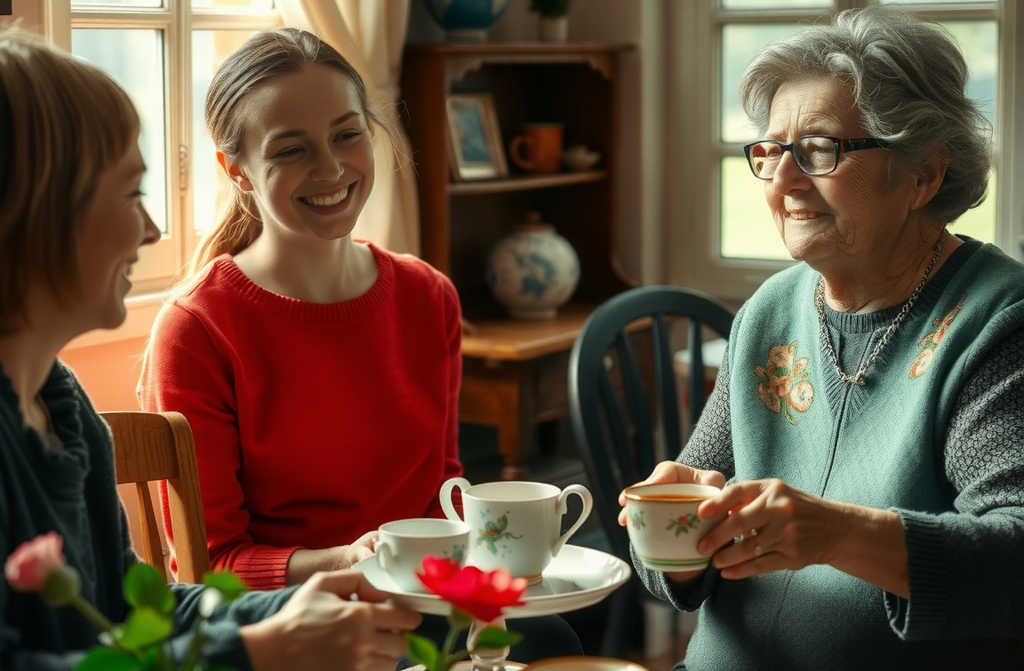
A young teacher, just nineteen years old, arrived at the delightful English countryside village where shed been assigned her first post. With nothing more than a modest suitcase, she made her way to the cosy cottage of a widowed old lady, who had agreed to take her in as a lodger.
Despite her ageshe was all of sixty-fivethe old lady was remarkably spry, with a warmth and elegance about her. The cottage was spotless and airy. From a small tiled hallway, Charlotte Hendersonthe teacherstepped into a room that featured a traditional English fireplace. There was a table in the centre, draped in a cheerful oilcloth scattered with tiny blue flowers.
To the right was the landladys private room; straight ahead was the parlour, where Charlottefondly called Charlie by her friendswould settle in. Her room came with a neat bed topped with perfectly fluffed pillows and a sturdy round table where she spent hours drafting lesson plans and jotting down notes.
Mrs. Agnes, as the landlady was called, turned out to be fine companycheerful and endlessly chatty. On evenings when Charlie wasnt off at the village cinema or devouring her beloved novels, theyd sit down together over a pot of tea. Charlie, in stories to her friends, called Agnes Gran. In actual conversation, Agnes preferred to be called Aunt Aggie.
For all her years, Aunt Aggie was still a beautytall, with a striking look about her and deep brown eyes, gleaming like ripe chestnuts. Beyond her appearance, she possessed an uncommon wisdom, and her turn of phrase often left Charlie amazed. For example, describing someone, Aggie might say, hes clevercunning, or, shes beautifulrobust. Charlie adored these simple yet loaded epithets, for they spoke volumes in just a few words.
One autumn evening, as they sat over tea, Aunt Aggie nibbled sugar and noisily sipped from a flowery saucered cup. She launched into an old tale:
You know, Charlie, back then things were different! No one bothered asking us girls who we fancied, who we held dear or not. Parents arranged everything. When I was fifteen, lads from neighbouring villages would come round on Sunday evening gatherings. One of themtall, handsome chap he wasoh, he spoke such sweet words to me! The other girls were green with envy, but he only had eyes for me. Hed plant himself by my side while I sat knittingsometimes for Dad, sometimes for my little brothers and sistersand hed just watch, smiling gently. There was such kindness in his gaze.
I grew so fond of him, I couldnt think of anyone else. He never came empty-handedalways with pockets full of hazelnuts, sweets, gingerbread, or boiled sweets, and I shared the lot with my friends. He brought me trinkets toonecklaces, earrings, scarves. Id start to refuse, and hed just say, Take it, remember me by it! and Id tell him, I dont need anything to remember. Then hed thank me, and Id ask why, and hed reply, For not rejecting my affection!
I didnt wish to hurt him, but I knew my parents didnt approve. One evening, he said, Ive told my family I want to marry youwill you? Suddenly, I was all churned up inside. Tears came and I told him, We can never be together.
Why not? he said. Because of your brother, I whispered. The thing is, this lads older brotherhe was once the most handsome in the county, every girls secret fancy. But tragedy struck. Out ploughing with their father, his horse got spooked and kicked him in the face. There were no doctors then, and things only got worse. Infection set in and when they finally got him to the hospital in the nearest town, the doctors saved his life, but his looks were gone. His nose was lost, his speech became nasal and garbled, and he took to wearing a handkerchief across his face so as not to frighten people. Folks started calling him Old Scarfno one used his real name anymore. People looked away when they saw him.
When my parents learnt who wanted to court me, they told me outrightnot a chance. Youre such a pretty girl, Aggie, imagine being married into that familytheyll call you Old Scarfs daughter-in-law. People will start saying theres something wrong with you, thats why you ended up in such a family. I couldnt understand itit wasnt Old Scarf I was marrying! But my words shattered that young man, Michael.
He saw right away that I couldnt go against my parents. He tried to plead his brothers innocenceand his own. But what could I do, still just a girl, entirely at my parents mercy? I told him, Im sorry for your brother, and to part from you feels like drowning, but my family will never let medont embarrass yourself by sending a proposal. His face darkened as if a storm swept through, and he walked out. I cried all night. When my parents found out I was weeping for him, they snapped at me, and I had no choice but to quieten down and accept my lot.
Just a couple of days later, another suitor came to call. I became a wife soon aftermy Andrew. He was shorter, not as sophisticated, but he did love me. I cared for him as a wife should, looked after him, and respected him. I was, I admit, embarrassed by his height. Whenever we visited friends, I stuffed straw in his wellies so hed look a bit taller. Hed always notice, toss it out, and say, Blasted kids, filling my boots again!
He never hurt me, except for one thing Ill never forget. When our first daughter took ill, I sat at the bedside, bareheaded, weeping, dreading to lose her. He walked by and said, Stop cryingtherell be plenty more children. I was so hurt! By grace she recovered, and soon after we had another girl, then a boyour little George. Andrew was so proud of his son! But times were hardjust before the war, in 1940, there was famine. The government requisitioned all the grain. How could we feed the children? Andrew worked grinding flour at the local mill day and night, paid with a bushel of grain. Someone reported the miller for theftenvys a terrible thing! All of them, Andrew included, were put on trial. They were sent away to the penal colonies in the north.
Andrew was allowed to say goodbyehe crouched down, set George on his knee (the boy was only six months old), stroked his head and sobbed, Farewell, George, my boy, theyre taking me. Dont know if Ill ever returnbe good to your mum! That was the last I saw of him. Years later, after the war, a high-ranking chap passing through our village stayed with us. I asked him if he could find out what happened to Andrew. A month later, I received a letter. He wrote that the forced labour was back-breaking, they were kept starved, and Andrew died of heart failurehe was buried up there. I was left to raise our three children on my own.
Aunt Aggie sighed deeply. Poor Andrewhe was so young, did everything for the family, and this was his end. Such is fates cruelty!
Charlie listened, completely absorbed in Aggies tale, with the sense that every detail had been lived. Now and then, shed toss in a question so the old lady would go on, as Mrs. Agnes could easily lapse into silent thought.
Did you ever marry again? Charlie once asked.
Oh, heavens no! After the war, there were hardly any men left in the village. With three kids and endless chores, there was no time to think about such things.
But Charlies curiosity was piqued about the boy from long agoher hostess had begun the story with him for a reason.
She stirred her tea thoughtfully, then glanced at Aunt Aggie. Aunt Aggie, do you know what became of the young man you couldnt marry?
Mrs. Agnes smoothed a crease in the tablecloth, her eyes following its faded patterns before she replied, Pour me another cup, would you, love? Our teas particularly good tonight.
What blend is it?
Blackcurrant leaf and mint!
Its so fragrant. I love it too!
Mrs. Agnes ran her hand over her face, seeming to brighten.
I did meet him again! By then, my children were all settled, with families of their own. One day, my son invited me to visit him in London. I went, and he took me to the cinema, the circus, the zoo, and museumskept me busy. And just then, wouldnt you know, that old sweetheart came back to the village. He asked after me, still unable to forget his first love even after so many years.
They told him: She lost her husband in the war, raised her children, now lives alone, but has gone visiting her son. He, too, had been widowedhis wife had passed, no children. He asked for my sons address and arranged a phone call. I went to the Post Office, thinking my daughter was on the line, but instead, I heard, Agnes, dearest Agnesmy one true love! Its Michael do you remember me? They kept us apart, but I found you!
There I was, Charlie, a four-times grandmother, standing in the phone booth, and hes declaring all this for the world to hear! My son was beside me, and everyone in the Post Office. I was mortified! I shouted down the line, Michael, I havent forgotten you, but its hard to hearwrite me a letter! and hung up.
Thats how fate brought me back to my first love, even in old age. We spent twelve wonderful years togethernever once did he call me a fool, never an unkind word. To him I was always Agnes, Aggie, dearest. I called him my Michael. Sadly, illness eventually claimed him, but Ill remember those bright years for the rest of my life, a gift of happiness I got for my patience.
She paused, eyeing Charlie as though checking whether the story sounded too fanciful, and added, If someone else had told me such a tale, Id not have believed ittruly!
Charlie replied, I do believe you, because itd be wrong if youd never met again!
Are there rules for such things, love? Nosometimes, fortune simply blows our way, bringing the chance we never dared expect.
Charlie had never heard of such a returning wind, but thought not to question or look it up. I wouldnt recommend you try eitherlife has more to say than any dictionary can hold!
Those days have long gone, but even now, I can see it clearly: the lodger, the old lady, the porch, the scent of freshly brewed tea and cherry jam with a hint of wild herbs, and a gentle promise that if the winds turn, good things can surely come again.





