A Step Into the Void
“Emily, wheres your sister got to? You two are always together!” blurted out Aunt Margaret, noticing her niece dashing past in the hallway.
The girl stopped suddenly, spun round, and, with barely-concealed irritation, pronounced crisply, “Im Alice.”
The glance she shot her aunt was so sharp that Margarets smile faltered. Alice continued, barely holding back a tide of annoyance, “Were not that similar, you know. I wish everyone would stop mixing us up all the time!”
Margaret raised her eyebrows in genuine surprise, as though trying to see afresh the details shed always overlooked in the girls face. “Oh, darling, dont be like that,” she said gently. “But youre twins! When youre sat quietly together, its impossible to tell you apart. Only when you start speaking does it become clear whos who.”
Alice felt frustration welling inside her like a wave. She bit her lip, anxious not to betray how much she cared, then hurried to the door. Without another word, she slipped from the room and drew the door behind her with a firm click.
Left alone, Margaret shook her head, slowly, still bemused by Alices sharp reaction. Meanwhile, striding down the corridor, Alice echoed to herself those painfully familiar refrains: “Like two peas in a pod.” They stung like a curse, clinging to her shoulders inescapably. How much longer? Why couldnt anyone see the differences? Why, to the world, did they always remain just “the twins”nameless, characterless, devoid of their own interests? Questions swirled in her mind, heavy as summer rain, with no answers to be found…
***
Alice perched on a park bench, arms locked round her knees. Dappled sunshine flickered through the elms, drawing strange arabesques on the gravel, but she had no care for the beauty. Once more, she was confiding in Hannahher voice a whisper, flat, almost hopelesshow unbearable it was that everyone constantly confused her with her sister.
Hannah listened intently, chin propped on hand, her eyes brightening suddenly with a flash of inspiration. She straightened up. “Alice, why dont you do something bold? Cut your hair really shortdye it some mad colour. Then nobody will muddle you two! Emily wouldnt dream of such a thing, shes far too proper.”
Alice glanced down at her long hair, instinctively flinging it over her shoulder. Some flicker of interest sparked in her eyes, but quickly fizzled. “Mum would never give me money for that,” she replied sulkily. “She likes that we look the same. She never takes my wishes seriously.”
But Hannah waved a hand, determined. “Ask for something else! Pretend its a birthday present for a friend or whatever. You could go to that cheap salon on the High StreetDad took me once. Mum moaned aftersaid it was far too short. Just what you want!”
Alices brow furrowed in intrigue. She was torn, but the idea wasnt quite as foolish as it first sounded. “How much is hair dye?” she asked, trying to calculate if it was possible.
Hannahs enthusiasm flared. “Dont worry, my big sister can do it shes brilliant. You just need to buy the dye.”
There was such confidence in Hannahs voice that Alice couldnt help but smile. Maybe, finally, she could step out from her sisters shadow? Maybe, now, people would see her as someoneherself? A tiny spark of hope flickered, though she scarcely believed such a small act could alter anything.
Several days later, the girls set their plan in motion. Alices nerves busied themselves in her stomach but, outwardly, she gave nothing away.
The salon itself was humblelittle more than an untidy back room, mirrors smudged, old magazines stacking the windowsill. The hairdresser, a tired-looking woman with silvering hair, glanced up and asked gruffly, “How short, love?”
Alice stammered for a moment, then found her courage: “Short. Really short.”
The woman nodded, taking up her scissors wordlessly. She worked swift and silent; each long lock fell to the floor, and Alice watched in a queer mixture of horror and release. Too late to turn back now.
When she finally peered in the mirror, it was short, a trifle lopsidedbut serviceable. “At least they wont mistake me for Emily now!” she thought, heart pounding.
With excitement burning in her chest, Alice hurried round to Hannahs. Hannahs older sister was waiting, dye in hand. After some debate, they went for neon pinka choice that would most certainly attract attention.
The outcome went above and beyond their expectationsbut, unfortunately, not in a good way. The colour was garish, almost electric; with the crooked cut, her hair seemed almost chaotic. Alice cringed involuntarily, but steeled herself. There was no turning back, not now.
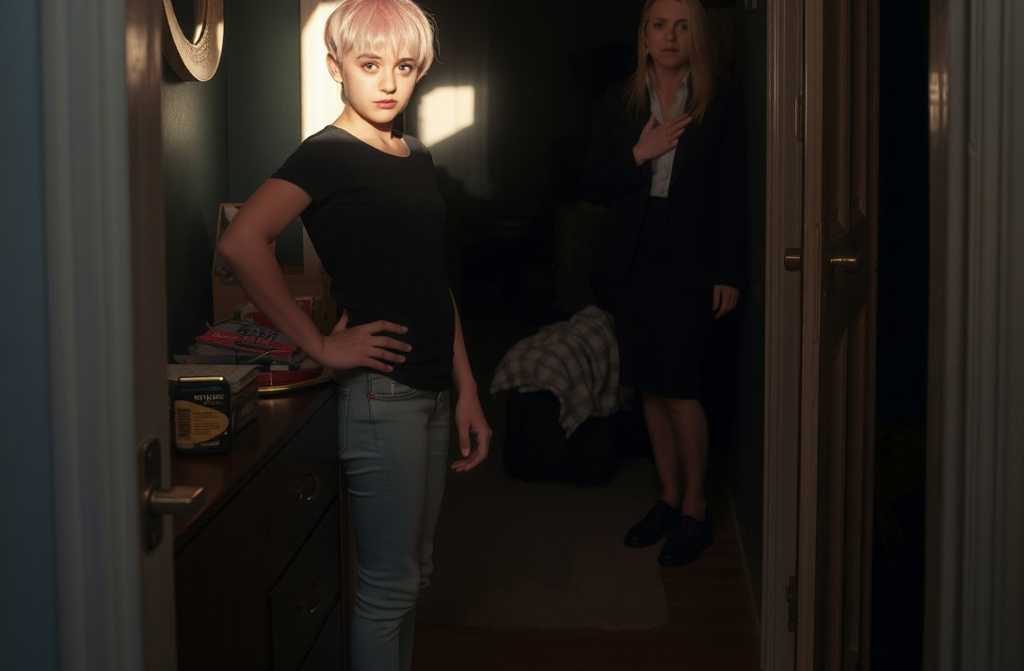
Mum was waiting at home. As soon as Jane caught sight of her daughter in the doorway, she went pale, clutching her chest. Gone was the tidy girl she saw every morning; this was a stranger, with a jagged haircut and brash pink hair.
“Alice, what have you done?!” It was the first time Jane had ever raised her voice at her daughter. Her hands quivered, panic in her eyes. “Have you looked in the mirror? This is a disaster! How on earth are we going to fix it?”
Alice set her jaw, determined not to show how desperately she disliked her new look. She tilted her chin up, and retorted defiantly, “I like it! At least no one will mix me up with Emily now!”
Jane shook her head, as though refusing to believe that this odd, pink-haired girl was her own. Hands still trembling, she grabbed her phone, rapidly tapping in the number for her trusted hairdresser. “We need this sorted… This could have been sorted with a new hairstyle! You didnt need to go this far,” she muttered woefully.
Alice gave a dismissive snort, sneaking another glance at her reflection. Deep down she hated the shrieking colour and uneven cut, but she couldnt admit it aloud. “You would never have agreed,” she mumbled, looking away.
“Of course I would! What makes you think otherwise?” Jane replied, confusion clouding her features, and pressed the phone to her ear, voice tinged with frantic urgency as she waited.
At last, the familiar voice chirped down the line, and Jane launched in, anxious, “Hi! Are you free? I need your helpmy daughters changed her look and you have to see it to believe it. Well be round in an hour.” She shielded the phone and addressed Alice, “Go on, fetch your coatlets get you sorted.”
Alice folded her arms, frowning. She wanted to argue, to insist this was her decision, her right, but an uneasy feeling gnawed within. The vivid pink hair and wild cut hadnt brought the joy shed wanted; instead, they filled her with an awkwardness she hadnt expected.
“Its fine. I like it this way,” was all she mustered, feebly.
Jane was already bustling about, gathering necessities, “Well talk in the car. Cant leave it like this…”
Half an hour later, they were in the car, heading toward the salon. Alice stared out at the blurred trees and houses streaming by, mind spinning. She tried to convince herself she had no regrets, but she could feel the experiment had failed.
The salon on the corner welcomed them with a kind smile from her mothers trusted stylist, Susan. She inspected Alice, one eyebrow subtly arched, but said nothing harsh. Instead, she offered a gentle smile, “Lets see what we can do, shall we?”
It took two hours. With deft hands, Susan neatened the cut, toned down the brash colour, leaving just a thin pink streak at the templea sweet, subtle touch. Alice watched herself in the mirror, wary at first, then warming to the transformation. The chaos was gone; what remained was neat, contemporary, flattering.
When Susan finished, Jane sighed in relief, “There, now you look like a real person again!”
Jane poured out gratitude and compliments, “I dont know what Id do without you! Youre a miracle worker.”
Alice said nothing, running a hand through her hair, assessing the new style. It looked decent, actually. But her mothers words still rang, stinging faintly: “look like a real person.” What was she before, then? Would they ever say such things to Emily?
Silent, Alice rose and made for the door. Thoughts whirled, but she kept them to herself. She only wanted to get home and look in the mirror once morewithout frustration, but with cold scrutiny.
It seemed to Alice that, no matter how hard she tried, she could not escape comparison with Emily. Emily never wouldve done something as foolish as she had. Emily was made for setting an exampleshe aced her exams, mastered dance steps, was always buried in Austen or Dickens, planned everything, kept her books immaculate, and was meticulously tidy.
Alice was no fool herself. She could dazzle teachers on a good day, answer clever questions, pick things up quickly. But it was precisely this similarity that rankledany achievement was met with, “Of course, just like Emily!” Fail, and it was, “Emily would never have done that.” The unspoken comparison ate away at her confidence.
After the hair fiasco, Alice felt she had earned an unspoken permit to experiment with her own life. If once she clung to standards, tried not to slip in school or shirk chores, now she seemed to resolve to prove to everyoneand mostly to herselfthat she was not Emily. She would make that as obvious as she could.
Schoolwork swiftly deteriorated. Her grades fell awaynot from lack of ability, but lack of care. Alice missed homework, daydreamed through lessons, openly yawned in tests. Once shed fretted about poor marks; now she greeted them with cold indifference.
Naturally, her parents tried to intervene. At first it was gentle talks, calm reasoning, examples, stressing the value of effort. Then stricter discipline: after-school lockdowns, confiscating her mobile, banning outings. Every new restriction, though, only steeled Alices resolve. She didnt throw tantrums or slam doorsjust stubbornly did as she pleased.
“You have one perfect daughter alreadyEmily,” shed say to her parents, staring them dead in the eye without a hint of shame. “Isnt that enough? Im clearly not made for greatness. Youll just have to accept me as I am.”
Her parents exchanged helpless looks, watching their child dismantle her own world with a blank intensity not knowing how to stop her.
Eventually, they took her to see a psychologist. The therapist, a kindly woman with soft eyes, spent long hours trying to unpick the knotsprobing gently, listening, seeking the source of Alices rebellion. Alice answered calmly, with neither hostility nor interest. She did not blame her parents or Emily; she laid it out, flat and matter-of-fact.
Whether the psychologist wasnt up to the task, or Alice simply played the unconcerned rebel too well, nothing seemed to change. After several sessions, the therapist suggested softly, “Perhaps ease off a little. Teenage years are a time for finding oneself. Sometimes you have to let them make their own path.”
Her parents looked at each other, unsure whether to be relieved or even more worried. Now, the only help they could offer was to just be therewithout lectures, without new rulesand hope that, one day, Alice would find her way.
Gradually, they let her school reports slide. They still fretted, but gave up the nagging. They hoped Alice would simply come round and recover in her own time. But soon, more troubling issues emerged.
One day, her mother happened upon Alice loitering with a gang of unknown kids by an abandoned railway arch. They smoked, joked, spoke in loud, easy slang. When Alice caught her mothers gaze, she slunk awaybut it was obvious this was not a one-off.
Later, over supper, her mother couldnt help but comment, “Emilys friends are so lovelypolite, clever, going to museums, talking about books. But you, Alice? Who even are your friends?”
Alice chewed her fork, saying nothing. The words stung more than she expected. In her head, the comparison drummed again: “Emilys perfect; Alice is the opposite.” If Emilys crowd were model children, hers had to be the black sheep. Just another way to prove she was nothing like her sister.
So, she slipped into that crowd. First she hung back, then joined in the banter, then the nights out. Before long, Alice was skipping classes to hang around with her “friends.”
Sometimes, alone, she would scold herself, “What am I doing?” She realised none of it brought her contentment, but stopping seemed impossible. If she even thought of leaving those friends, Emilys serene, successful face loomed upand Alice would veer away again.
So it went, the twins lives drawing ever apart. Emily entered the Upper Sixth, while Alice, after her GCSEs, forced her way into a lacklustre sixth-form college. She insisted on it, despite her parents pleading. She imagined freedoma new beginning. But reality wasnt so easy.
Emily finished school with top marks, sailing off to a Russell Group university. She excelled, juggling coursework, societies, volunteeringall busy, all purposeful, all perfectly planned.
Alice limped through college, barely scraping together passes. Motivation eluded her; lessons slid past in a haze. She missed lectures, shrugged off missed chances. Even as her tutors worried, she clung stubbornly to the right to be “not like Emily.”
After college, things didnt improve. Emily walked straight into a promising job at a reputable London firm. She was noticed at once for her reliability and willingness to learn, rising quickly. Alice drifted from one job to anothera café, a shop, an office temp. Each post soon grew intolerably dull, the people irritating, the pay not what she hoped. She never stayed long, always finding another excuse to move on. Her parents suggested ideas, offered help; she waved away their concern. “Ill sort it myself! I dont need you fussing.”
Still, she hoped one day shed find her own waysomething not resembling Emilys at all, but finally, something fulfilling. Every step toward independence, though, led to new blunders, and the feeling she was only ever pushing against got heavier by the year.
Alice could never quite explain why she acted like this. Inside her was a hidden mechanism: each time Emily won a prize, earned a first, gained a supervisors praise, Alice automatically took a step in the opposite direction. Sometimes she resolved, “Tomorrow Ill start over, Ill be better.” Morning came, and still, she found herself in the same rut, caught in an invisible netthe harder she fought, the tighter it bound her.
In time, a numbing apathy set in. She stopped calling her parents, shunned family gatherings, refused to hear how “well” everything was going for Emily. Shutting herself off, she built invisible walls, shut and sealed, letting no one in. Strangely, it was then that things began, imperceptibly, to shift for the better.
For one, she landed a jobnot glamorous, but honest, with steady hours and a liveable wage. Alice was surprised how smoothly she fit in with her new colleagues. For the first time in years, she came home feeling her day had been worthwhile.
Then she met Simon. It happened entirely by chanceat a coffee shop near her office. He was unlike anyone shed dated before: gentle, reflective, calm. He didnt overdo the charm, which, oddly, made her want to see more of him. They went for endless walks through city parks, talking about everything and nothing, and Alice found herself, finally, at easeno longer striving to prove anything.
Tentatively, she began to make plans. Not grand schemes, not for decades ahead, but practical ones: to save for a holiday, learn to cook, even think about a better flat. For the first time, life seemed steady, worth living.
But one night, a phone call shuttered the calm. Her mothers voice was hushed, holding something back. “Alice, darling, could you come over? We need to talk.”
Alice arrived to find her parents waiting, unusually grave. Her mother hesitated, then managed, “Emily cant have children. The doctors sayits hardly possible.”
Heavy silence filled the room. Alice didnt know what to say. All sorts of thoughts jostled: pity for her sister, anger at fate, a desperate urge to offer comfort. But soon, that old, irrational urge reignitedsomething shed tried for so long to snuff out.
Within a year, Alice became a mother herself. Then, not long after, she had a second child. She cherished her children, thrilled at their laughter and first steps. But an unworthy thought crept at the edge of her mind: “Now I truly have something Emily never will. Now, no one could mistake the difference.”
She knew deep down this was wrong. You cannot build a life in oppositionseeking to be “not her.” Yet gazing at her children, she excused herself: “I did this for me. I wanted children. This was my choice.”
And all the same, she knewhad she never heard Emilys news, things might have turned out so differently…
***
Emily, meanwhile, listened as their mother once again relayed stories of Alices exploits, voice tinged with anxiety and quiet confusionhow to reach her youngest, to bring her back from the edge.
When her mother fell silent, Emily murmured, gentle but precise, “Please, dont tell Alice anything about me.”
Her mothers eyes widened. “But why not? Youre sisters”
Emily sighed, choosing her words carefully. Shed thought it over for months and was certain. “Shes tearing herself apart trying to be the exact opposite of me. Every single time she hears about my achievements, its as if it only drives her to act out all the more. She doesnt want her own pathshe only wants the one Ive never taken.”
Her mother tried to protest, but Emily pressed, “If you care for her…dont bring me up at all. For her sake! Let her forget about me and live for herself.”
Her mother regarded her, trying to absorb the firmness in Emilys voicea voice usually so soft. “Do you really believe itll help?” She could not hide her doubtbut also her hope.
“I dont know,” Emily replied honestly. “But we tried everything else, didnt we? Advice, persuasion, explainingit never helped. Maybe, if she stops comparing, shell finally find herself.”
Her mother nodded slowly, uncertain, but understanding. It would be tough, but worth trying, for Alices sake.
Emily stuck to her promise too. She didnt call, avoided meetings, never interfered in Alices life. Sometimes it hurt, the growing gulf between them, but perhaps, just perhaps, distance could be a gift.
P.S.
With Simons encouragement, Alice began seeing a proper therapist. Step by stepslowly, carefullyshe moved towards a happier future. A future where Emilys shadow would no longer follow her, even in dreams.