The cemetery, for most people, is a place of farewells, grief, endings. For Tom it feels more like a home. Not literallythere is no roof over him, except the crumbling granite mausoleum he only enters on the harshest frosts. Yet in spirit and in soul he feels as comfortable here as anywhere else.
Silence dominates the grounds, broken only by birdsong and the occasional sniffle of mourners paying respects. No one looks down on him, no one points a finger at his threadbare coat or his scuffed boots. The dead are indifferent to everything, and that impartiality offers a strange, calming sense of justice.
Tom wakes shivering; a thin layer of morning dew has settled on his cardboard blanket. The air is crisp, and a low fog rolls over the graves as if trying to hide them from the world. He sits up, rubs his eyes and, as every day, scans his domainrows of crosses, monuments, all overgrown with grass and moss.
His morning does not begin with coffee but with a round of inspection. He must check that wreaths are untouched, flowers not overturned, that no foreign footprints have marred the ground overnight. His closest companion and de facto supervisor is Harolda greyhaired, gruff caretaker with a rough voice but kind, watchful eyes.
Back again, youre planted like a tree? Harolds croaky voice crackles from the little keepers hut. Go have a hot cuppa, or youll catch a chill.
On it, Harold, Tom replies without pausing his work.
He makes his way to a modest grave at the far edge of the cemetery. A plain grey slab bears the inscription: Agnes Mary Williams. 19652010. No photograph, no comforting words. Yet for Tom this is the most sacred spot on earthhis mother rests there.
He can hardly recall her face or voice. His memory starts with the childrens home, with institutional walls and strangers faces. She died too early. Still, beside her stone he feels a warmth, as if an invisible presence stands with himshe is still caring for him, his mother, Agnes.
He gently pulls weeds, wipes the stone with a damp cloth, adjusts the modest bunch of wildflowers he brought the day before. He talks to her, mentioning the weather, the wind that rattled yesterday, the cawing of a crow, how Harold gave him a bowl of soup. He complains, thanks, begs for protection. He believes she hears. That belief is his anchor. To the world he is a drifter, a nobody. But here, at this stone, he is someonea son.
The day moves on. Tom helps Harold repaint the fence around an old grave, earns a bowl of hot soup for his labour, and returns to his mum. He crouches, describes how sunlight pierces the mist, when suddenly the quiet shatters with the crunch of tyres on gravel.
A sleek black car pulls up at the gate. A woman steps out, looking as if she has walked off a fashion magazine covercashmere coat, flawless hair, a face that shows sorrow but not defeat, more dignity than despair. In her hands she clutches a massive bouquet of white lilies.
Instinctively Tom hunches, trying to melt into the shadows. But the woman walks straight toward him, straight toward his mothers grave.
His heart tightens. She stops before the headstone, shoulders trembling with silent sobs. She drops to her knees, not noticing the dirt staining her expensive coat, and places the lilies beside his simple bouquet.
Excuse me Tom whispers, unable to stay silent. He feels the weight of being the graves guardian. You youre here for her?
The woman flinches, lifts her watery, shocked eyes to him.
Yes, she murmurs.
Did you know my mum? Tom asks, his voice trembling with genuine wonder.
For a heartbeat confusion flickers across her face. She scans his ragged clothing, his gaunt features, the plain look of trust in his eyes, then reads the inscription again: Agnes Mary Williams.
And suddenly everything clicks. She inhales sharply, her face blanching, lips quivering. Her eyes roll back and she begins to collapse. Tom catches her just before she hits the stone.
Harold! Harold, over here! he yells, panic rising.
Harold rushes, breathing heavily, and immediately knows what to do.
Get her to the caretakers hut! Why are you standing around?
Together they haul the woman into the cramped room that smells of tea and tobacco and lay her on an old settee. Harold douses her with water, hands her a bottle of spirit. She groans, slowly opens her eyes, looks around as if disoriented, then fixes them on Tom, who stands nearby clutching his battered cap.
She studies him for a long moment, as if trying to read something in his face. The shock fades, replaced by a deep, unbearable sorrow and a strange recognition. She lifts herself, reaches out, and whispers the words that upend Toms world:
How long how long have I been looking for you
Tom and Harold exchange a stunned glance. Harold pours water into a glass and offers it to her. She takes a few sips, regains composure, and sits up.
My name is Natalie, she says softly, then firmer. To explain why I reacted that way, I need to tell you everything from the beginning.
And she does. Her story drags them back over thirty years.
Natalie was a young girl from a small market town who came to London with a dream of a better life. Penniless and without contacts, she took a job as a maid in a wealthy household. The mistressa cold, domineering widowkept everyone in fear. The only light in Natalies bleak existence was the son of the house, Ian. He was handsome, charming, yet weak, wholly obedient to his mother.
Their love was secret and doomed. When Natalie became pregnant, Ian panicked. He promised to marry and fight, but under his mothers pressure he broke. The widow wanted neither a poor daughterinlaw nor an illegitimate child.
Natalie is left in the house until birth, promised money and exile afterward, while the child is meant for an orphanage. The only person who truly supports her is another maid, Martha. Martha is quiet, always nearbybringing food, offering comfort, sharing in the little joys Natalie finds in that foreign home. Unseen, however, a deep envy festers in Martha: jealousy of Natalies youth, beauty, love for Ian, even of the unborn child she herself can never have.
The labour is arduous. When Natalie finally regains consciousness, she learns the baby was born weak and died within hours. Her heart shatters. Numb with grief, she is pushed out the front door with a small sum of money. Ian never appears to say goodbye.
Years pass; the pain dulls. One day Natalie discovers the truth. Martha resigns soon after Natalies departure, leaving a note for a fellow servant. In it, torn by conscience, she confesses everything: she had swapped the living infant for a stillborn one bought from a hospital clerk, paying a bribe to a sanitation worker.
She had stolen Natalies son out of a twisted mercy, out of longing for a child she could never have. She wanted to be a mother, to love, to possess something from a life she could never touch. In the note she writes that she will raise the boy as her own, love him with all her heart, then disappears.
From that moment Natalie searches. Years, decades. She follows every lead, interrogates people, hires private detectivesnothing. Her son seems to have evaporated.
Now she finishes her tale, looks directly into Toms stunned eyes. Harold stands mute, having forgotten his pipe, its thin wisp of smoke curling toward the ceiling.
Agnes the woman you called mother Natalies voice trembles, she was my friend and my executioner. She stole you from me. I dont know what became of her. Perhaps the weight of her lie crushed her, and she left you in the orphanage. That grave she may have bought it early, coming here to atone. Its the only explanation I can give.
Tom remains silent. The inner world he built on a simple, bitter truth collapses. Everything he held sacred turns out to be a lie. The woman he bowed to each morning was not his mother but a kidnapper. The real mother sits before himwealthy, scented with expensive perfume.
But theres more, Natalie continues softly, seeing him shrink with pain. A few months ago Ianyour fatherfound me. Hed lived all those years with guilt. His mother died, he inherited the estate, yet never found happiness. Doctors recently gave him a terminal diagnosis. With his last days left, he decided to make amends. He spent a fortune, hired the best detectives, and they tracked me down. Then they traced you, Tom. They found the orphanage where Martha left you. Ian gave me everything he owned and begged for one thing: to find you, bring you to him. He wants to see you, to ask forgiveness. Hes in a hospice, Tom. He has only daysmaybe hoursleft.
Her words falter. The room hangs heavy with the ticking of an old clock and Toms laboured breathing. The truth is too massive, too brutal to fit into a single moment.
He sits, head bowed, eyes on his dirty handsnails broken, trousers torn, boots with frayed laces. His whole life flashes before him: hunger, cold, contempt, solitudeall built on lies. The woman he loved turned out to be the one who stole his mother. The real mother stood beside him. Somewhere, his fatherwho never existed to himdrifts toward death.
Tom Natalie whispers his name pleadingly. Please. Lets go to him. Hes waiting. He must see you. Until the very end.
He lifts his gaze. In his eyes a storm ragespain, anger, disbelief, shame. Shame burns for his ragged clothes, for his appearance, for showing up before a dying man he never imagined.
I I cant, he stammers. Look at me
It doesnt matter how you look! Natalie erupts, almost shouting. Youre my son! Hear me? My son! Were going. Now. Immediately.
She rises, extends her hand. Tom looks at herwellgroomed fingers, tears glistening, resolve hardened. Something inside him cracks. With an unsteady, trembling hand he places his filthy palm in hers. Harold, standing in the corner, nods briefly, approving.
The drive to the hospice stretches endlessly. At first there is only silence. Tom sits on the soft leather seat, afraid to move, as if his presence might dirty the world that isnt meant for him. Then Natalie asks quietly:
Were you very cold this winter?
Sometimes, he replies in kind.
And were you alone all that time?
I had Harold. And her, he says, nodding toward the cemetery that now lies behind them.
In that instant something breaks open. Natalie weeps softly, holding back sobs. Tom cannot hold back either; silent tears track down his cheeks, he wipes them with the sleeve of his torn jacket. They talkabout lost years, about pain, about how loneliness burned them both. In that moving car, two strangers become something like family: mother and son.
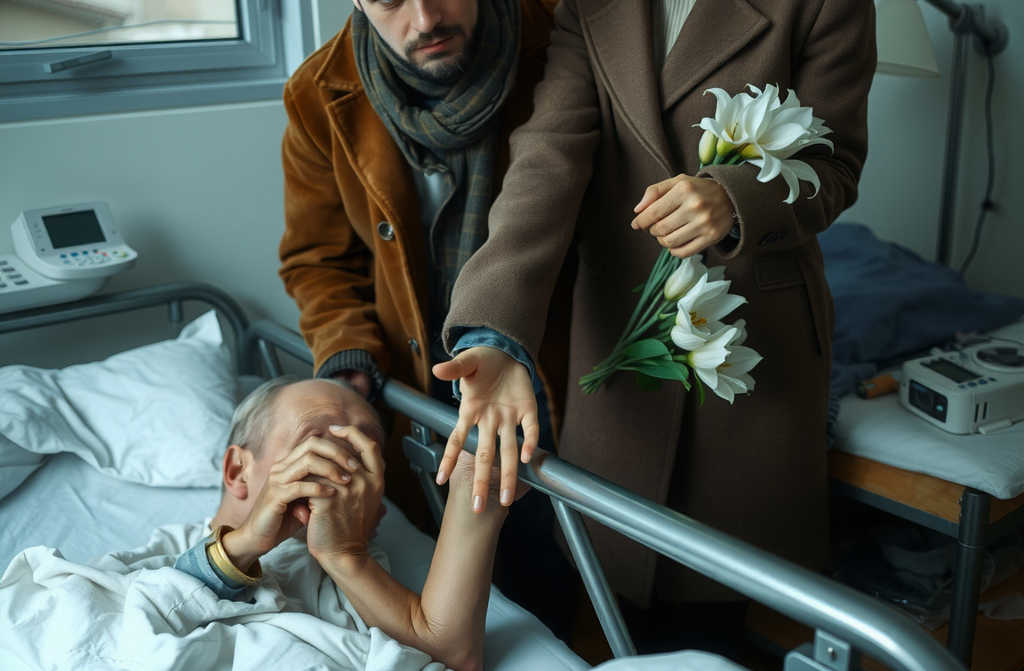
The hospice greets them with quiet and the smell of medication. They are led to a private room. On the bed, wrapped in wires, lies a thin, almost translucent man. Ians face is gaunt, hair sparse, skin pallid. His breathing is shallow, irregular.
Ian, Natalie whispers. Ian Ive found him. Ive brought our son.
His lids flutter. With great effort he opens his eyes. His gaze sweeps over Natalie, then settles on Tom. He studies Tom for a long moment, trying to understand. Then recognition flickers in those tired eyespain, remorse, and finally relief. He weakly lifts his hand, reaching.
Tom steps forward, clasping the frail, cold fingers in his own. No words are needed. In that touch lies forgiveness Tom never asked for, and love a father never thought he could give. Tom watches the fading eyes and sees his own reflection staring back. In that instant all bitterness, all resentment dissolve, leaving only a quiet, tender sorrow.
Ian squeezes Toms hand faintly. A hint of a smile ghostwrites itself on his lips before his eyes close. A monitor hums a steady tone. Ian passes away, holding the hand of the son he never knew until the very end.
Natalie slips behind Tom, wraps her arms around his shoulders. They stand togetherin the hush of a new reality where lies have no place, only truth, pain, and a beginning. A beginning of a life where they will no longer be alone.