A Letter Without an Address
I stumbled upon the letter in a battered cardboard box full of ancient bills and crusty appliance warranties, all unearthed while decluttering the loft after our renovation. The envelope was neither sealed, nor stamped, nor addressed. On the front, just a shaky line: “For Mrs Edith Clarke. Private.” That was it. No surname (beyond Clarke), no road, nothing resembling a postcode. At first, I chalked it up to a prank or a half-finished draft thatd wandered into our house by mistake. But the letter inside was real enoughtwo closely written pages pulled from an old school exercise book, folded into a tight square.
I couldnt place the handwriting. Inside it simply read, Mrs Clarke, if youre still alive, forgive this late note. I should have told you back in 1987, but I lost my nerve. Your husband did not miss his train that day. He didnt board because he ran into me. I asked for his help, and because of me, he was there for what happened next. You may have thought otherwise all your life. It isnt true. Had I not stopped him, he would have caught that train. Forgive me.
Signed at the end: “Roger, son of Peter from number six.” That was all.
I sat down flat on the footstool in the hallway, a bit winded. Mrs Clarke had been our neighbour downstairs for as long as I could remembereven when I was a child there with my parents. She was a quiet woman, always in a sensible cardigan, her hair gathered away from her face just so. Her husband died when I was about ten. The grownups only whispered, calling it an accident. Someone else mentioned hed apparently missed his train, popped back, headed through a building site, and there a slab fell on him. I grasped little at the time, except that Mrs Clarke would gaze through her kitchen window at the back garden for years after, rarely speaking to anyone.
The odd thing was, our old building had been knocked down a dozen years ago. Wed all been moved elsewhere. My parents relocated to another part of town. When they passed, the flat came to me. It was in their things that the envelope turned up. How it ever ended up there was a mystery.
I handed the letter to my husband. He read, shrugged, and said:
Chuck it. Why hold onto it?
I dont know. But if shes still alive, surely she ought to have it.
And if shes not?
Well, at least I might work out who dropped it off.
He shrugged again. To him, it was some dim, ancient soap opera. But the whole thing niggled at me. Maybe because I remembered Mrs Clarke so wellno children, any relatives a mystery. After everyone was rehoused, she vanished, just the way neighbours do: you live above someone for twenty years, know their coughs through the wall, their bin routine, then suddenly you cant even say which corner of the city they washed up in.
I started with the obvious: I rang Aunty Margot, an old neighbour famed for her encyclopaedic recall. She mulled it over for a while, then said:
Edith, hmm, she was moved to Croydon Or was it Dulwich? Hang on, my address books in here somewhere.
A day later, she rang back and dictated a landline, marked Edith C. new flat. I called. Number out of service.
Next, I trundled over to our old neighbourhoodor rather, to the shiny new flats now sticking up where our building once stood. Where our garden used to be, there were now only a few scrappy poplars by the car park. I loitered pointlessly (as if the pavement would help), then ducked into the corner shop nearby. The lady at the till must have been about sixty; I asked if any of the old crowd still worked there. She summoned the security guard, who turned out to be the son of our buildings cleaner. He didnt recognise me, but did remember my parents surname.
Mrs Clarke? Still alive, I think. She was moved to Sutton, not Croydon. My mother had her new neighbours contact they used to exchange Christmas cards, I think.
Even I began to wonder why Id fastened onto the letter so fiercelybut I couldnt let it go. Two days later, I had an address for a woman who shared Mrs Clarkes landing at her new place. I called; she was wary, then softened:
Mrs Clarkes alive. Doesnt get about too well, but manages. Now, who are you and what do you want? You can’t be too careful nowadays.
I confessed: once her upstairs neighbour, now the surprise bearer of an addressless letter. Not even sure if I should deliver it.
There was a pause.
Bring it by. Just, not too late in the evening.
So, off I went that Saturday. The journey took the best part of two hours and three trains. Her new block was tall, bland, and utterly unremarkable: pristine entrance hall, plastic daffodil stuck on the windowsill, childs scooter abandoned by the lift. Something in me hoped for a whiff of our old place, but of course, it was nothing alike.
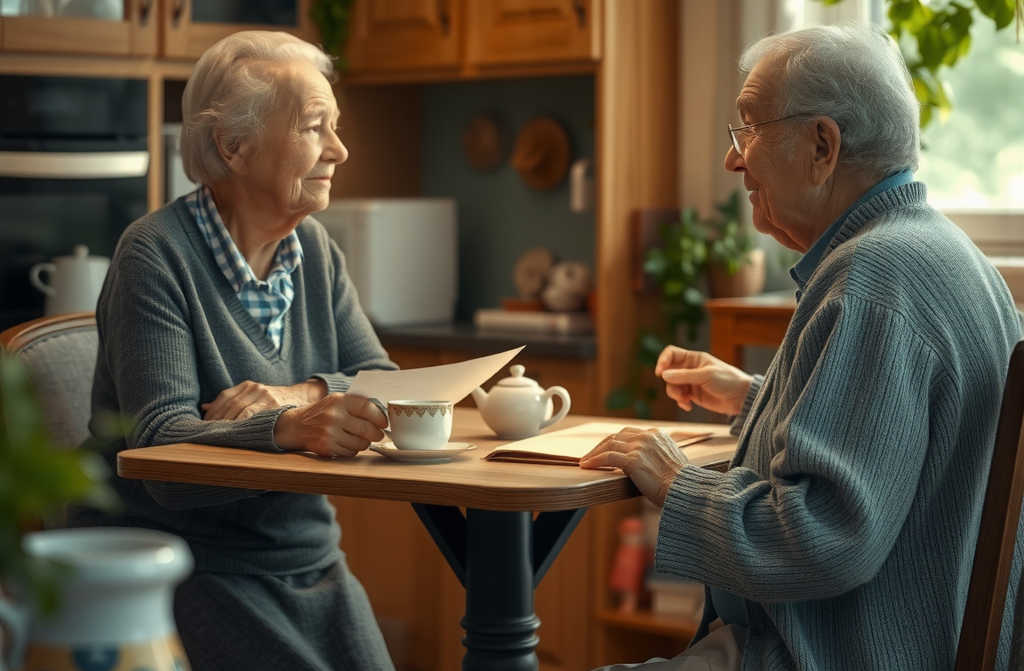
Mrs Clarke herself opened the door. At first, I didnt recognise hershrunk, wizened, but the eyes were exactly as I remembered: sharp and slightly wary. I introduced myself, mentioned my parents. She nodded and stepped back.
Come in. I remember your mothers cabbage pies on Sundays.
Her flat gleamed with that particular pensioner shine. On the table, a newspaper, specs in their case, a fat geranium on the sill. I produced the envelope and felt instantly awkward, as if Id brought old guilt instead of correspondence.
I found this in Mum and Dads things, I explained. No idea how it wound up with us.
She took it, studied the inscription without opening it. After ten seconds, she asked:
Did you read it?
I could have lied, but didnt.
Yes.
Quite right. Too late for secrets at my age.
She read the letter slowly, twice through. No tears, no melodrama. Setting the sheets gently on the table, she smoothed them as though they were a utility bill.
I always knew something wasnt right, she said. Not just thiseverything.
I said nothing.
They told me he missed the train. But he was never late. Never. Always left early, always first to arrive, even if it meant traipsing across town. I went over the story a thousand times, but everyone just said anyone can get sidetracked. Maybe, but not him.
She fetched an old photograph from a cupboard: a stern man in a short-sleeved shirt, a younger Mrs Clarke at his side, half-smiling as if someone had called her name.
Thats why I never quite believed it, she said, He was the sort to do what he said, every time. Youd say hed catch the 2:20, and by 2:05 hed be there, ticket in hand. It was easier for everyone to accept unfortunate accidentand eventually, easier for me to let them.
I asked if she remembered Roger, Peters son from number six. She even gave a wry smile.
Of course I do. Ginger lad. Later did an apprenticeship. His dad and my Ernest used to go coarse fishing together. So, its him then.
Then came an unhappy twist. A decade and a half ago, someone rang her doorbell, but she hadnt answered. Later, a neighbour found a note in her postbox: Mrs Clarke, I need to tell you about Ernest. No signature. Mrs Clarke, rattled after a spell in hospital, assumed it was a scam or a crank and binned the note.
I get dizzy spells, you see. Thought it was just crooks. But looks like he was really trying, poor fellow.
We sat in her kitchen, chat naturally drifting away from the letter. She admitted she struggled to settle after the move; in her old block, shed known every step by heart. The pension only just stretched, but she felt too embarrassed to complain. The woman next door sometimes fetched her medicine. Suddenly she said:
Youre probably wondering why all this matters now.
I was honest.
I did wonder.
Because when everyone insists on a story where your loved one is somehow to blame, you end up arguingnot with them, but with yourself. It’s exhausting. And nownow I see I wasnt inventing things after all.
That was when I understood why Id gone halfway across London with that silly envelope.
Before I left, she asked me to keep the letter with her. In the hallway, she turned to me:
How do you reckon it ended up with you?
Suddenly, I remembered: in his last years, my dad often helped neighbours with paperworkforms, complaints, letters. He had patient hands and neat handwriting, so everyone brought him their admin headaches. Maybe Roger found my parents, asked them to pass the letter on, and then something happenedDad got ill, the chaos of moving began, and the envelope got swept up with the rest and sat ignored for years.
I said as much to Mrs Clarke. She nodded.
Sounds right. Your father was a reliable man.
Youd think that would be the end of it, but life had other plans. A week later, Mrs Clarke called me herself, tone brisk, almost businesslike.
Ive found him.
Found who?
Roger. Through my neighbour. Her nephew works for the local council where Roger has his allotment. Worlds smaller than you think.
I was a bit floored.
And?
Hes coming by on Tuesday. Said hed like to see me, if I dont mind. Id rather not be here alone. Could you come too?
I took half a day off from work and turned up. Roger was hardly the ginger kid from my memorieshe was a hefty man pushing seventy, clutching a bag of apples, looking so mortified I wanted to look away. He began apologising soon as he crossed the threshold, but Mrs Clarke cut him off.
Sit first or youll just babble nonsense.
They sat across the kitchen table. I felt surplus to requirements, but to leave wouldve been unthinkable. Roger spoke in stops and starts. Hed been 19 that day. His father had fallen off the shed roof and broken his leg. No one else around; mum was working late. Hed spotted Ernest, Mrs Clarke’s husband, on his way to the station and begged for help to get his dad into a neighbours car. Ernest helped, missed his train, decided to cut through the building site to catch the bus instead. The rest had happened in minutes. Roger found out about his death the same day, was terrified hed be blamed. He tried to approach Mrs Clarke at the funeral but panicked. Later married, moved away, took up and quit drinking, fell ill, put it off some more. And carried the burden of a conversation never had, for years.
Mrs Clarke listened, expressionless. Only breaking her silence to ask:
Why not come even a year later, or five?
Roger answered simply.
The shame grew every year.
There wasnt any tearful forgiveness, no heroic closurejust her asking after his fathers health (gone long ago, he replied). She made tea for all three of us, fetched out a tin of biscuits. Nothing remarkablejust tea and biscuits, a standard kitchen, but the conversation left us sitting up straight, studying the tablecloth instead of each other.
After Roger had gone, Mrs Clarke lingered by the door, steadying herself.
How are you? I asked.
All right, she said. Properly all right, now.
I helped her clear up, wiped the table. The letter sat beside the newspaperno longer a stray bit of someone elses past, just a piece of paper that had finally reached its rightful home.
Just as I was leaving, Mrs Clarke tucked the envelope in her sideboard drawer and remarked:
Strange, isnt it? All those years a letter wanders London with no address, and still finds its way.
Now and then, we call each other. Not often, and never mawkishly. If Im passing her way, Ill bring biscuits for her neighbourhoods stray cats. Shell ask after my kids and whether my backs surviving all that time at the computer. And, once in a while, as Im sorting through yet another box of useless paper, I think of that envelope. All those years, it was just another bit of forgotten clutter, easily binned. Yet inside, there could be someone elses unfinished businesswaiting, all that time, for someone to carry it that last little bit home.