They used to laugh, saying my parents from the countryside wouldnt have a clue which fork to use first. Yet when Mum and Dad entered that hall with their natural dignity, dressed smartly and smiling, the whole room fell silent. Because, in truth, real culture is not sewn into a cashmere coat but lies firmly in human kindness.
Our sons first real milestone his fifth birthday has become a special event I begin planning months in advance. Each day brings him new discoveries, but this birthday means something profound to me. I want it to be a bridge between two very different worlds the two branches of our family. My dream is to gather everyone dear to us around the same table, giving our son warmth and love that will stay with him for a lifetime.
My parents live far from the citys hustle, in a small English village amid rolling hills and open fields. They have always worked the land: first for the old county farm, then for themselves, building up a modest but thriving smallholding. My husbands parents by contrast are quintessentially urban with established careers, status, and clear notions about “propriety.”
My husband, lets call him William, tries to keep the peace, but I sense his unease. He truly respects my parents, cherishes their kindness and honesty, but quietly fears their straightforward ways might not blend in among the formality of his family.
“Darling, are you sure you want to invite them?” William asks gently as we arrange the seating plan.
“Its our sons birthday,” I reply calmly. “Theyre his grandparents. Why would their presence even be a question? Theyve been looking forward to this as much as we have.”
“Of course,” he hurries to reply. “Only… it will be quite a formal affair: banquet hall, waiters, atmosphere… I just dont want them to feel out of place.”
“You think they dont have anything decent to wear?” I fix him with a steady look.
He falls silent. That silence says everything: the fear his refined parents might find another reason to sneer.
The next evening, over supper, his mother lets call her Margaret gives a small, knowing smile and says, “Im rather curious to see how your country relatives manage with crystal glasses. I do hope they wont be flustered by the array of cutlery on the table.”
I dont bother answering. Deep down, I know she has no idea what sort of people my parents truly are.
The next morning, they arrive. I come to greet them and stop in awe. There stand Mum and Dad so dignified, neat, and striking. Mum, in a sandy-coloured suit, pearl necklace, her hair styled just so. Dad, in a navy jacket, crisp white shirt, a smart watch at his wrist. They radiate confidence and composure.
“Are we presentable, my dear?” my mum smiles.
“Youre wonderful,” I whisper, barely holding back tears.
The “Imperial” Banqueting Hall is luxurious: high ceilings, chandeliers, golden tablecloths, the scent of coffee and flowers in the air. Guests begin to gather, including Williams family.
Margaret is impeccably dressed, straight from a fashion magazine: a camel cashmere coat, little hat with a netted veil. Her husband, Sir Charles, sports a double-breasted overcoat and a classic bowler, worn “for traditions sake.”
“Well, are your… parents here yet?” Margaret comments, emphasising the word.
“Yes, theyre just coming,” I respond levelly.
“Im looking forward to meeting them,” Sir Charles mutters, trying to sound casual. “Lets hope they can navigate the table setting.”
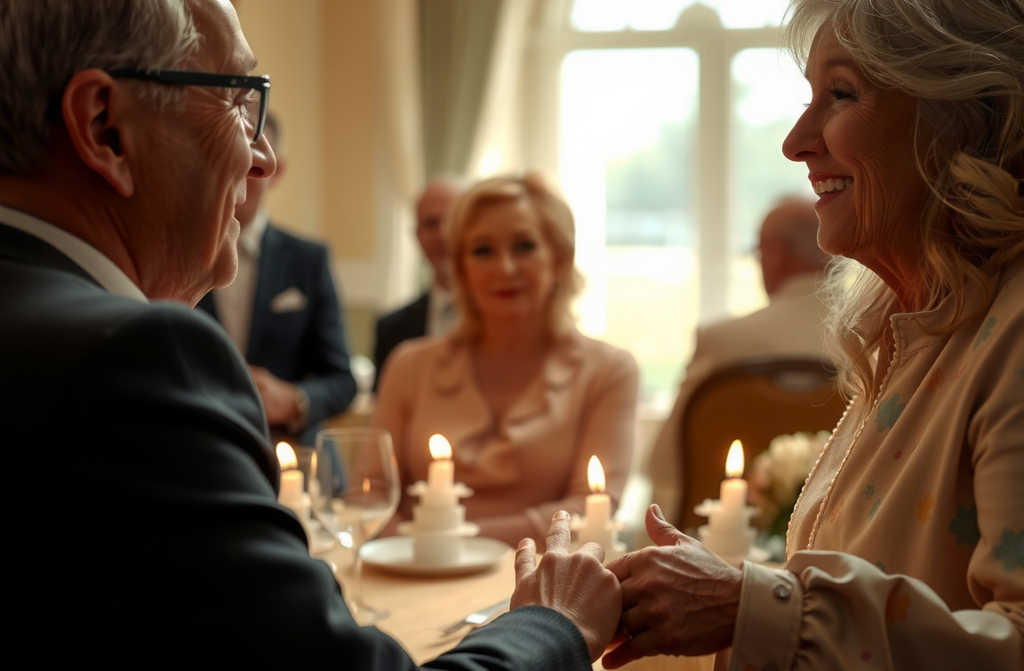
When the doors swing open, all chatter quiets. My parents walk in calm, confident, bright. They move to the table displaying photos of their grandson. Mum adjusts a frame with delicate care and smiles.
“Good afternoon!” she says warmly. “Thank you for sharing the joy of our dear grandsons birthday with us.”
Margaret, holding a glass of sparkling wine, freezes mid-pose; surprise flickers in her eyes. Sir Charles opens his mouth as if to speak but cant get the words out. Their expressions are priceless gone is the vision of simple-minded villagers in rough, ill-fitting clothes. Standing before them are people whose posture, composure, and graceful manner reveal a quiet sophistication and real inner culture.
Mum looks so harmonious and elegant that, despite knowing her style for years, I admire her anew. Dad stands there, completely at ease, as though hes been attending affairs like this all his life: poised, dignified, no trace of awkwardness or arrogance.
“Good afternoon,” Margaret finally manages, her voice uncertain. “Youre really from the countryside?”
“Indeed, from Greenfield,” my dad replies with assurance, offering a handshake. “We run a small farm livestock, vegetable plots, greenhouses. We live off what we grow.”
“Oh…” Margaret hesitates, searching for words.
“We even supply town with organic produce,” Mum adds, her smile kind and open. “All above board, with the paperwork to prove it. Were up to speed with technology too: we use the internet, manage a website, share our achievements.”
Sir Charles nearly splutters on his champagne.
The celebration continues. Guests chat and laugh, children dart between tables, waiters serve new dishes. But I keep noticing Margarets gaze fixed on my parents. She watches the way they hold their forks, how naturally they converse with Williams colleagues, how they joke gently, wittily, never at anyones expense. Her eyes linger on Mums perfectly fitted suit, on Dads purposeful composure their quiet self-assurance palpable.
Then comes the moment for toasts.
My father stands first. Calmly, he surveys the room, meeting our boys beaming eyes.
“Im not one for grand speeches,” he says in a steady voice, “but today my grandson celebrates his first big birthday five years. I want to thank my daughter and her husband for the love and warmth they show this boy. For raising him to be kind, compassionate, and respectful.”
He pauses. The room is still.
“My wife and I spent our whole lives in the country. We worked for the county farm, then built our own business. We had to learn everything anew: bookkeeping, selling, even online promotion. Were not wealthy, but we live honestly, by our own hands, and that is our pride.”
His words are quiet and sure, neither defensive nor boastful.
“Many presume that if youre from a village, you must be uneducated or naive. Thats a mistake. Weve simply chosen a different path, a different pace of life. And Im happy my grandson is growing up surrounded by a family who values people not for their postcode or their status, but for their actions and their hearts.”
The silence is deep enough to hear someone set down their glass. Then, applause breaks out genuine and warm. Even Sir Charles joins, albeit politely.
As guests begin to leave, Margaret approaches me. She hesitates a moment, then quietly says,
“Im sorry. We… may have misjudged things.”
“In what way?” I ask gently.
“In thinking you could judge someone simply by where they live. Real worth… thats something else entirely.”
I smile.
“My mother always says, Its not about where someone comes from, but what they leave behind.”
“Please, tell her,” Margaret says, “Id like very much to visit their farm. If theyll have such company.”
“They welcome all who come with a good heart,” I assure her. “And believe me, theres much to see.”
A year passes. Margaret and Sir Charles do visit Greenfield. Dad proudly shows them the farm: healthy animals, glasshouses, solar panels on the roof, rainwater system. Mum serves homemade yogurt and raspberry tart from her own garden. They return quite changed warmer, more open-hearted, more at ease.
The following year, it is Margaret herself who suggests, “Perhaps this time, we celebrate our grandsons birthday in Greenfield? Its peaceful, beautiful… so authentic.”
We all agree; now, when everyone gathers at my parents homestead, no one looks down their nose. Everyone understands: real life isnt measured by the label in your coat or your address, but by who you become, your work, and how you respect others.
My parents are more than just country folk. They are stewards of their land, enterprising, wise, sincere. People unafraid of change who have built their future with their own hands. And if anyone still thinks the countryside means backwardness, let them come see Mum in her favourite dress, Dad at the wheel of a modern car, their orchard, their smiles.
Because real prosperity is not about the weight of your wallet, but the depth of your dignity. And how well you keep it, whether you live in a bustling city or amongst serene green fields and ancient woods.