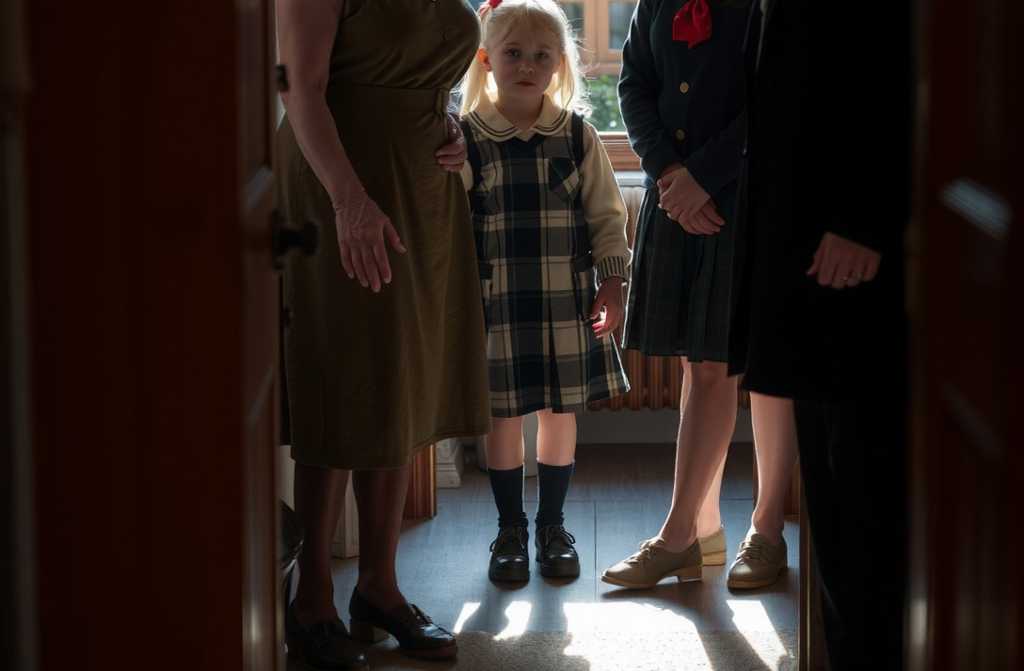
Find your sister, darling.
Lucy, look. Isnt that our Steph? Sophias eyes widened as she raised her hand, pointing into the crowd, mouth agape and frozen mid-gesture.
Where? Lucinda scanned the assembly of children in red neckerchiefs, standing in tidy rows, but couldnt spot who Sophia meant. Which Steph is this?
Sophia didnt answer. She simply kept her unwavering gaze fixed on the formation, careful not to lose sight of the little girl shed just heard recite a poemthe one shed caught with her eyes and feared to let slip away.
Still silent, Sophia began to squeeze her way sideways across the large sports hall through the audience toward the group. She did this despite the challengeSophia, a childhood invalid, was exceptionally short and frailbut she moved rather deftly.
Children from orphanages and boarding schools across the county had gathered there. The National Festival of Children’s Amateur Arts had just reached their school. It hadnt passed by their own home: Willow End Orphanage Number 129. Sophia Briggs had been its director for many years.
Before the war, shed been a teacher at a school near Liverpool. When the bombs fell and the front moved in, shed evacuated with the children, and theyd later been sent to Birmingham, but then returned and landed here in Yorkshire.
Theyd been relocated several times. Those years brought horrors: childrens bodies taken to unmarked graves with her own hands, mothers collapsing from grief, lice, scabies. She remembered her hands thenhow theyd changed, their coarsenessand often caught herself staring at her palms, recalling those days. A farm manager who came once to visit had offered a handshake but recoiled at the sight.
But those same hands cherished children and worked ceaselessly to keep them alive. Sophia no longer knew the number of children shed comforted, or the heads shed stroked over the years.
Over a decade had passed since the war, and still she carried that ache, best forgotten. Why recall the misery? Only at night, settling into bed, did memories float before her eyes in every detail: the gaunt, starving blond toddler they couldnt save, a young mother beating her head against a wall.
She remembered StephStephaniewell. She thought of her often, a symbol of hope and happy endings, forever in her mind. But how on earth was she here in this hall? She and her foreign father had left England more than five years ago.
Portrait by artist Martin Harris
This is what happened.
In spring 1945, the older children were moved to an adjacent home, leaving Sophias care for the littlestthe under-sevens, with even a nursery. Children were frequently moved between homes then. One day, a foundlingabout two months oldwas brought to them. Shed been abandoned at the Harrogate market. Some street boys had left behind the bundle.
Sophia remembered how they marvelled at the babys fine linen. They hadnt seen such blanketsa snowy white quilt, each stitch holding a tiny blue flower. Someone suggested naming the baby Stephanie, after the flowers, and gave her Sophias own surname, Briggsas she often did for her orphans.
Children arrived constantly and stole a piece of their hearts. Steph, with her pale hair and sapphire eyes, quickly became a favourite. She had such striking looksgentle, quiet, and clever, always slipping into Sophias office, smiling shyly as if Sophia were her mother.
But she didnt stay until five. What happened next both terrified and thrilled them.
One afternoon, Valerie the matron rushed to Sophia with news from the councilsomeone was making enquiries about the girl brought in March 1945. All evidence pointed: they were searching for Steph. The council secretary himself was coming to visit, with guests.
Their humble orphanage had never hosted such dignitaries. Preparations began in earnest, and the council sent not just funds but workmen as well. The grounds transformed overnightbetter than theyd ever hoped.
The reason: foreigners.
The day came. The council secretary and his companions climbed out of two sombre black carsmen in broad shouldered jackets. With them were a man and woman, unmistakably not British. The man wore an open plaid jacket, colourful braces holding wide trousers, and the woman
Sophia couldnt look awayshe resembled a film star. Clearly siblings, they had matching, meticulously coifed hair, hers topped by a pillbox hat with black net, a tailored grey coat and pointed pumps. In her handa neat red handbag with a gleaming gold clasp, which for some reason Sophia couldnt stop staring at.
Their translator was an older lady in a blue suit, looking exhausted.
The visitors were greeted by a row of children in the garden, all singing The Song of Friendship. Steph was placed in front, joining in as her white ribbons fluttered against her fair hair, singing with such effort she quivered. She had no idea all this fuss concerned hernot even five years old.
The council men glanced nervously about, watching the foreigners reactions. The man in plaid watched Steph without blinkinghed have found her even if unprompted. You didnt need special training to see they were father and daughter: the hair just a shade darker, the same bright blue eyes, the distinctive chin, that angle of the headSteph through and through.
He endured the song, shook hands with the staff, tasted bread and salt, and sat through official speeches about party policies, the international conference from which these guests had come, the fortitude of the British spirit. The translator murmured the essentials for him, but appeared to skip much of it.
The woman in the pillbox hat stood a little apart, spine straight, clutching her handbag, frozen in place. Sophia noticed tears streaming silently down her cheeks as she fixated on Steph.
The children behaved, though they were tiny and had no idea what was being saidstanding still as best they could. When at last the children were led away, Steph’s hand was taken by Mrs. Oliver, her carer. Other staff gatheredtheyd never had an orphan belonging to foreigners before.
The council group stepped aside while the man and woman, with their translator, approached Steph. The woman knelt, reaching for Stephs hand.
Mother? Sophia whispered to the translator.
Aunt, came the reply, the connection clear now: the foreigners were brother and sister.
Sophia leaned down to help the translator.
Aunt wants to knowwhats your name?
Steph, overwhelmed, looked up at Mrs. Oliver.
Go on, dear, tell them, the carer encouraged.
Steph, the little girl whispered.
Stephaniethe name we gave her. There were no documents, Mrs. Oliver added, as the translator explained.
The woman spoke with Steph at lengthasking her age, which was her favourite toy, where she slept. Steph grew livelier, answering shyly. The group moved into the home. Sophias heart pounded; she braced herself for disaster, envisioning being blamed for a poor welcome or not impressing the foreign dignitaries.
But the man and woman smiled around the tidy nursery, discussed the toys with Steph, and soon even the formal translator seemed at ease, smiling broadly.
Where are all the children? the translator relayed.
Council officials dashed off to fetch them from the quiet room where theyd been keeping still. Soon, the foreigners met all the children. Four-year-old Lizzie promptly grabbed the red handbag, and the foreign woman opened it, removed some items and handed the bag to Lizzie after speaking to her brother, who pocketed the items. Staff grew concerned, but a child is a child; Sophia wiped her brow.
Remarkably, theyd kept the quilt Steph arrived in; it had been used for other babies and was threadbare, the blue flowers faded. They cleaned it as best they could and presented it to the guests. The man stared at it, unblinking.
Steph was to leave. Of course, everyone came to see her off.
One council official brought the red handbag from the homes doors. Sophia sighed with reliefat least that awkwardness had been handled for her.
He passed it to the woman, who hesitated, gestured toward the orphanage, but took it with sadness.
Sophia watched them go, exhausted, hoping Steph would be happy. Yet she couldnt help thinkingwhy cant all her children be so lucky? Why must so many suffer other fates?
With leaden legs, she returned to her familiar orphanage corridor and went to the childrens room to help settle Lizzie and the excited little ones, then joined the staff to discuss the day.
No harm came from it, in the end. She was summoned to the county office, praised, held up as an example, awarded a certificate. Sophia crossed herself with relief. Later, new bedding and toys arrivedthe foreigners doing, she heard.
***
And now, almost five years onSteph was here. Not in Belgium, not on the continent, but here in Yorkshire, taking part in a national arts festival. It had to be her, though six years had passed; Sophia couldnt be mistaken.
She forced her way through the crowd, gently moving aside teachers, reaching out and touching the girls shoulder.
Steph, Steph!
The girl turned, blinking curiously.
Steph, do you remember me?
Suddenly, someone tugged Sophia from behind.
Excuse me, what are you doing? asked a young womanmost likely a teacher.
Hello. Im the director of Number 129. This girl was one of ours. I cant understand I had to come.
What girl? Nina?
No, not Nina. This is Steph. But she was taken away years ago. I cant make sense of it.
The schoolgirl looked between Sophia and the teacher, confused.
Youre mistaken. This is Nina. Shes never been in a home. She has a mother, havent you, Nina?
And a father, Nina added.
There you have it. You must be mistaken.
Sophia saw her orphanage coming onto the halls stage for their performance, but her thoughts were elsewhere.
That was Stephof that she was certain. Taller, older, but the chin, the unique face, the white-blonde hairall exactly as she remembered. It was Stephanie.
Sophia leaned against a tall, battered radiator, its warmth comforting. Suddenly, she recalled her talk with the translator.
When theyd left, Sophia asked:
What was Stephs real name? Surely shell be issued papers, but I’m curious now.
They dont know, the translator replied, nodding to the happy pair settling Steph into their car. Either shes Norah or Yvette.
How so? Sophia frowned.
He lost his wife and the twin girls during the war, and searched ever since. You know what it was likewifes grave found only recently. Most likely, one daughter died with her mother, and the other landed here. Theyre anti-fascists, lived in Belgium back then, the wife was in a camphad the girls there. Now the father lives in eastern Europe. It’s complicated. The search was long. The translator hurried off.
That memory had faded amid relief and daily dutiesuntil now.
***
Kate? Kate! Are you heading to the green? Linda called out to her neighbour, as the whole village celebrated May Day.
No, LindaIm baking, Katherine swept a geranium aside and leaned on the sash window, Pop in later if you like.
What about the children?
Ann and Victor rushed off already, and Ninas gone to the festival with the others.
They took her then?
They did! Can you believe it? Quiet as a mouse, that one. You cant get a word out of her, and yet she stands up and recites poetry better than anyone in her class.
Katherines pride was obvious. Linda, too, was pleased. She had no children herself and had watched Katherines grow up as if her own. Nina especially neither of them were family by blood, but only recalled that over a glass of sherry at Christmas, their eyes brimming.
They were setting up for a cosy gathering. Ann and Victor had run off to the green, Lenthe husbandwas outside hanging bunting, and Katherine laboured in the kitchen.
Folk streamed down the street toward the festivities. Linda set off as well.
Katherine continued her work, festive spirit in the air. The radio broadcast the parade and commentary. Popping a pie in the oven, she wiped her hands on her apron, went to the parlour, and sat down on the settee.
The sounds of the parade from Whitehall filled the quiet cottage, mingling with familiar comforts. Suddenly, the door burst open and Victor tumbled in.
Mum, can I nick something to eat?
What for?
After the speeches, were off to the river for a fire with the boys, Victor was already stuffing potatoes into a linen sack.
Whatever for! Katherine exclaimed. Heres me baking and slaving, thinking wed celebrate as a familyand you all clear out?
Muuum! Were having a bonfire, baking potatoes, Alexs bringing his guitar, he said, grabbing things for the road.
Waitcome here, sit! Ill pack you something properly, Victor collapsed onto a stool as Katherine took charge. Who else is going?
Oh, Rob, Mike, and the girls everyone really.
She sliced off bacon, bread, bundled pies, went out to the garden for onions. Oh, Victor! Always off adventuring instead of a quiet family do.
“Mumoh, and Anns going to the pictures with that boy of hers,” Victor said, refusing to even name his sisters suitor. “She said not to wait supper for her.”
Katherine tossed her hands skywardwho was she cooking for? Four children, and no one home for the holiday. Colin was married and living with his wifes family nowtheir grandchild growing up far away. Nina was off to town with school, and these two had vanished.
Len, her husband, and Linda, her friend, were her only company. Nina would be home late, Ann and Victorno telling when theyd appear.
Elsewhere in the village, the homes were merry, windows open, music and accordions spilling out.
Katherine lifted the pie from the oven. So much work! Up at dawn to knead the dough, but look how quickly theyd all scattered. Ah well, may as well rest. She reclined on the settee once more.
Victory Day a happy day made bittersweet. How did they ever survive those times?
Her thoughts turned back, especially to the day a new childNinacame to them. Katherine remembered refusing at first, her heart ragged and exhausted.
Theyd been starving. She alone with three young children, a telegram reporting her husband missing in action. That day, returning from the river where shed been washing, she discovered her three half-starved children had found and devoured the scone shed meant to stretch over two days.
Gannets! Little gannets! Nothing ever fills you lot! Scamps! And you, ColinI’ll not give you a crumb for three days, youll see. I warned youtheres just enough flour left for the broth. You wretch, did you hear? She swatted her eldest, twelve-year-old Colin, with a teatowel.
He grumbled about finding potatoes under the snow, fishing. Seven-year-old Ann wailed on the floor.
No ones giving us more flour, do you lot realise? Stop crying! she bellowed at Ann, causing four-year-old Victor to join in, howling. Do you think Im hiding food for myself? Well starve to death as it is
Into this scene walked Mr. Simmons, the parish warden, barely knocking.
Hello, Katherine.
He looked wrecked, defeated by the war, shuffling the leg hed injured, never sent to the front because of it. He seemed to cough more these days, a deep, hacking cough from years of pipe smoke.
Behind him in the porch stood a tall, fair-haired woman with a child.
Mr. Simmons settled heavily on the wooden bench.
“Take her in, Katherine. And dont start shouting. I know how many youve gotknow theres not enough to eat. Ill help as much as I can, but the parish is fulleveryones hosting evacuees but you and Mrs. Evans, and shes down with illness, might be typhus. So you must take them.”
Have you lost your mind, Mr. Simmons? My own are half-starved!
But he pushed himself to his feet.
You must. This is Theresa, her English isnt great.
The woman came indoors. Tall, blonde, from somewhere else entirely.
How do you mean? Katherine asked, puzzled.
But Mr. Simmons had turned to leave. Katherine chased after, never one to back down.
Give me extra milk! How will I feed the baby? I know youve potatoes put by
There arent any. Anything left is for planting.
Well all starve, then! Im warning youIll not give the evacuee a crumb if it comes to that! she shouted.
He turned, a weary look in his eyes.
“Dont carry on like that, Katherine. Well lose your children to the parish, too. I said Id help. The poor woman and baby are your charge now. Shes not local
He hobbled off down the snowy path, then turned back.
“Ill try my best. But she’s not right in her mind.”
Katherine rushed indoors. The evacuee sat quietly, rocking on the bench. The children whispered from the stove top.
Well, come on, off with your coat. Lets get the baby settled.
The woman lifted troubled blue eyes to her. Her white hair was streaked with dust and soot. Katherine wonderedhow, in winter?
Come now, let me take your baby. Get yourself comfortable.
As if awakening, the woman looked at the bundle, handed her the child, and then, struggling up, said,
I must find my daughter. My daughter is lost and walked toward the door.
Oi! Where do you think youre going? Thats your baby! Katherine rushed to stop her.
Yvette Yvette is missing. I must find her the stranger said, and then collapsed to the floor.
With Colins help, Katherine half-carried the woman to bed and sent Ann to fetch Mr. Simmons for the doctor.
The baby seemed barely alive, silent the whole time. Katherine unwrapped her and marvelled at the fancy quiltsomething shed never seen, pink flowers stitched all over. The girl was paper-thin. Colin stoked the fire; together they cleaned the baby and tried to feed her, but she barely sucked.
The woman revived slightly after the doctors visit, but her milk had dried up. Katherine was sent to the dairy, running as soon as she could leave. The warden had arranged for her to get a whole pint of fresh milkshe stretched it with water so all the children and the unwell evacuee could share.
Theresa stayed for two days. Linda, wonderful as ever, came to help nurse her. All they learnedsnatching at her broken Englishwas that theyd been prisoners in France, twin girls, Norah and Yvette. Yvette was lost somewhere during repatriation, snatched from her hands, and Theresa could barely explain in words.
A few days later, Theresa was taken to hospital; a week on, word came she had died. Her full name was Theresa Peterson, buried in the parish cemetery with a wooden cross and no photograph.
If Linda hadnt been called away to help on the farms in the north, shed have adopted the girl herselfshe and Katherine had already made arrangements. But fate intervened. And so, Norah Peterson, by the paperwork, became the child of Katherine May Somers and her late husband killed at Dunkirk.
No one ever questioned how a girl could be born after the fathers death noticeMr. Simmons, by then, had passed away and there was a new warden. The certificate was made out. Only her name might one day raise eyebrowswhat English child was called Norah in this part of Yorkshire? So Norah became Nina.
All of Katherines children survived. Even though she sometimes sobbed, begging the warden for food, she managed. Three years after the war, her neighboura man sent away to the north in 38 for speaking out of turn, but returned a little greyer and ten years olderbegan helping quietly with the house and children. Soon, Len Parfitt was part of the family. Though he and Katherine were never officially wed, her children loved him and he became their dad in every way. He softened Katherines sharp tongue, and in time she cared for him more dearly than shed imagined.
Let the children run wild, the more the better. All four of them.
The radio blared the latest rocket display as the parade overtook the cottage, washing through the room as Katherine soaked in Victory Day. Tears ran down her cheek, dampening the cushion beneath her.
Shed won her own war. Her children were alive. If that wasnt victory, what was?