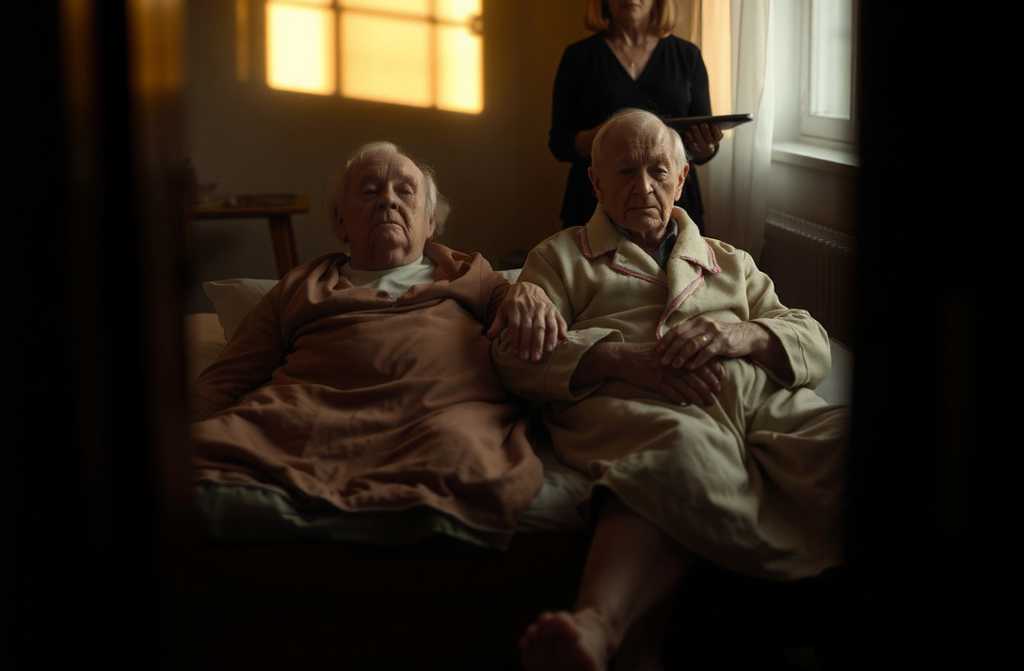
En god kvinna

En god kvinna.

Vilken fin kvinna hon är. Vad skulle vi göra utan henne?
Fast du ger henne bara två tusen i månaden.
Men Agneta, vi har ju skrivit över lägenheten på henne, det vet du.

Erik reste sig långsamt ur sängen och gick med tunga steg ut i det svagt upplysta vardagsrummet. Med trötta, halvt grumliga ögon såg han på sin hustru, som låg där så stilla.

Han satte sig vid hennes sida, lyssnade och kände efter.
Det verkar lugnt, tänkte han, och reste sig upp, plockade på sig morgonrocken och masade sig mot köket. Han öppnade filen, drack några klunkar, och gick sedan in i badrummet. Därefter tillbaka till sitt rum.

Han låg i sängen, sömnen ville inte komma.

Agneta och jag, vi är båda över nittio nu. Hur länge har vi levt? Snart är det vår tur, och det är ingen kvar här med oss.

Döttrarna, Emma är borta, hon hann inte ens fylla sextio.
Vår son Mats, han finns inte heller kvar han slarvade bort sig på sitt sätt. Barnbarnet, Josefin, hon har bott i Tyskland i över tjugo år. Tänker knappt på farmor och farfar. Hon har väl vuxna barn nu också, tänkte Erik.

Plötsligt, utan att han märkte det, hade han somnat.

Han väcktes av en hand på armen.
Erik, är allt som det ska? hördes en tunn röst.

Han slog upp ögonen. Hans hustru böjde sig över honom.
Vad gör du, Agneta?
Jag såg att du låg så stilla och tänkte att något hade hänt.
Jag lever än! Sov du nu.

Snart hörde han hennes steg mot köket. Hon drack lite vatten, gick på toaletten och försvann till sitt eget rum. På sängen låg hon och funderade.

Så en dag vaknar jag, och då är han borta. Vad ska jag då göra? Eller kanske går jag före honom.

Erik har redan beställt minnesstunden hos begravningsbyrån. Sånt hade jag aldrig trott man kunde göra i förväg, men det känns bra på ett sätt. Vem skulle annars ha brytt sig om allt sånt när vi inte längre finns?

Barnbarnet har vi inte hört av på länge. Bara grannkvinnan, Ylva, tittar förbi. Hon har fått våra extranycklar. Erik ger henne tusen kronor av pensionen varje månad. Hon hjälper till med mat, handlar, fixar det vi behöver. Vad ska vi annars göra av pengarna? Vi tar oss ju inte längre ner från fjärde våningen själva.

Erik vaknade av solens strålar genom fönstret. Han gick ut på balkongen. Han såg hur rönnen nere på gården grönskade så vackert, och log för sig själv:
Vi klarade av ännu en vinter. Sommaren är här!

Han gick och hämtade Agneta, som satt tankfullt kvar i sin säng.
Kom nu Agneta, sluta grubbla! Jag vill visa dig något.

Jag har knappast krafter kvar, mumlade den gamla kvinnan och pressade sig upp. Vad har du hittat på nu?

Följ med nu bara!

Han stöddade henne ut till balkongen.
Ser du, rönnen slår ut! Och du sa att vi inte skulle få se en sommar till. Men titta vi gjorde det!

Åh, det är sant. Och solen skiner!

De slog sig ner på soffan på balkongen.
Kommer du ihåg när jag bjöd dig på bio? Det var på gymnasiet. Den där dagen sprack rönnen ut i samma gröna.
Hur kan man glömma sånt? Hur många år är det nu?
Över sjuttio… Sjuttiofem minst.

De satt länge och mindes sin ungdom. Mycket försvinner med åren, man glömmer ibland till och med vad man gjorde i går. Men ungdomen, den minns vi.

Nu har vi pratat bort hela morgonen! utropade Agneta och reste sig. Och vi har inte ens ätit frukost.

Koka lite riktigt te Agneta, inte det där blomsörjan.
Vi får ju inte längre.
Bara lite svagt, och en liten sked socker.

Erik drack det svaga teet, åt en liten ostsmörgås och tänkte på hur han en gång i tiden åt starkt, sött te till frukost, med bullar och pannkakor.

Grannkvinnan kom in. Hon log vänligt:
Hur står det till idag?
På vilket vis kan det vara med två gamla över nittio? skämtade Erik.

Kan du skämta är allt fint! Vad ska jag handla?
Ylva, köp lite kött till oss, bad Erik.
Men det där säger läkarna nej till.
Kyckling går väl?
Jaha då, jag kokar nudelsoppa åt er!

Ylva städade undan och gick ut med tallrikarna. Sen gav hon sig iväg.

Agneta, ska vi gå ut på balkongen igen? Värma oss i solen. föreslog Erik.
Ja, låt oss det.

Snart kom Ylva ut på balkongen till dem:
Här sitter ni och lapar sol minsann.

Det är härligt här, Ylva! log Agneta.

Jag fixar lite gröt till er nu och börjar på soppan snart.

Vilken fin kvinna, sa Erik och såg efter henne. Vad skulle vi ha gjort utan henne?
Du ger henne bara två tusen i månaden.
Agneta, vi har ju skrivit över lägenheten på henne.
Det vet hon inte.

De satt kvar på balkongen ända till lunch. Till middag blev det kycklingsoppa, god med köttbitar och potatis.

Jag brukade göra exakt sådan när Emma och Mats var små, mindes Agneta.
Och nu är det främmande folk som lagar mat åt oss, suckade Erik tungt.
Kanske, Erik, är det bara så det är menat för oss. En dag är vi borta och ingen kommer ens gråta.

Nu får det vara slut på grubblandet, Agneta. Kom, vi går och lägger oss en stund!

De säger med rätta: Gammal är som barn.
Hela vår värld är som på dagis: soppa, vilostund, mellanmål.

Efter en stunds sömn kunde Erik inte längre vila. Vädret ändras kanske? Han gick ut i köket. På bordet stod två glas juice, omsorgsfullt ställda dit av Ylva.
Försiktigt tog han dem och gick in till Agneta, som satt tankfull i sängen och såg ut genom fönstret.

Vad tänker du på, Agneta? log han och räckte henne glaset. Varsågod, juice!

Hon tog en klunk.
Kan du heller inte sova?
Vädret, du vet…
Jag har också känt mig konstigt sen i morse, sa Agneta sakta och skakade på huvudet. Det känns som att det snart är över för mig. Du får lova att ordna min begravning ordentligt.
Agneta, prata inte så! Hur ska jag leva utan dig?
Den ena av oss måste gå först, Erik.
Nog nu! Kom, vi sätter oss ute igen.

De satt där tills kvällen kom. Ylva lagade ostkakor åt dem. De åt och slog sig sedan ner framför tv:n. Varje kväll såg de på tv innan läggdags. De nya filmernas handling gick dem förbi, så de såg gamla komedier och tecknat i stället.

Den här kvällen orkade de bara en tecknad film. Agneta reste sig.
Jag går och lägger mig, är så trött.
Då gör jag likadant.
Låt mig bara titta på dig riktigt noga, bad hon plötsligt.
Varför då?
Jag vill bara det.

De såg länge på varandra, som om de minns tiden då de var unga, när allt låg framför dem.
Jag följer dig till din säng.

Agneta tog Erik under armen och de gick långsamt till hennes rum.
Han bäddade om henne varsamt och gick till sitt eget.

Det var tungt i bröstet. Han kunde inte sova. Han tyckte inte han sovit alls, men när han såg på klockan var den två på natten. Han gick till Agnetas rum.
Hon låg med öppna ögon.
Agneta!

Han tog hennes hand.
Agneta, vad är det? Agne-ta!

Plötsligt fick han själv svårt att andas. Han tog fram de förberedda pappren och la dem på bordet. Gick tillbaka till hennes sida. Länge såg han på hennes ansikte. Sedan la han sig bredvid henne och slöt ögonen.

Han såg Agneta, ung och vacker, som för sjuttiofem år sen. Hon gick mot ett ljust sken i fjärran. Han sprang efter henne, hann upp henne och tog hennes hand.
På morgonen öppnade Ylva dörren. Hon fann dem liggandes intill varandra. Leenden vilade på deras ansikten.

Ylva ringde till ambulansen.
Läkaren såg länge på dem, och sa sedan:
De gick bort samtidigt, antagligen älskade de varandra väldigt mycket…

De fördes bort. Ylva sjönk trött ner vid köksbordet och såg papperen och testamentet allt stod på hennes namn.

Hon la huvudet mot armarna och grät

Gilla gärna och lämna dina tankar i kommentarerna.

Rate article
Add a comment

;-) :| :x :twisted: :smile: :shock: :sad: :roll: :razz: :oops: :o :mrgreen: :lol: :idea: :grin: :evil: :cry: :cool: :arrow: :???: :?: :!:

En god kvinna
The Door Left Ajar He didn’t notice at first that something was wrong. He stepped out of the lift onto the ninth floor, reached into his pocket for his keys, and wandered towards his flat, the hum of champagne and salads still buzzing in his head. The hallway was quiet, unusually so for this night—the only sounds were laughter and slamming doors drifting up from a floor below. At his own flat, he paused, bracing his palm against the wall so as not to miss the keyhole, and only then caught, out of the corner of his eye, the flickering to his left. The neighbours’ door, just across the wall, was left slightly ajar, open by a hand’s width. In the dim corridor, coloured fairy lights were draped over the coat stand inside their hallway, and from within, almost inaudibly, drifted an old song—a woman’s voice singing, “Snowflake, snowflake, don’t melt away.” He froze with his key still in the air. The stairwell felt cool, scented with something fried lingering from someone’s kitchen, and the deodorant trapped in his jacket. Fragmented toasts from friends echoed in his mind: “To health, to us, to staying young,” and the emptiness pressed sharper for it. At the friends’ gathering, it had been noisy, the room bustling, children racing between beds and windows, someone setting off streamers. He’d laughed, drank, listened to chat about mortgages, Turkey, endless renovations. At midnight, glasses clinked, hugs were shared, tears spilled after the third glass. Then the taxi ride through a half-empty city, garlands twinkling in the trees, and here he was, in pinching leather shoes, a gentle throb in his temple and strange clarity: for all of it, he was going home alone. The neighbours. He knew their faces, not their names. The man was about sixty, greying at the temples, a slight paunch under his sweater, always nodded politely in the lift. The woman was a bit shorter, cropped hair and a mesh shopping bag, forever carrying groceries. They’d lived here before him. When he’d moved in fifteen years ago, their surname was already on the brass plate beside the door, but he’d never really read it. A hello, a nod, the odd exchange about hot water hoses, and that was it. He stared at the door left ajar. The music played softly. The fairy lights blinked as if half asleep. Inside it was dark, just the faint glow of a corridor lamp, and the door didn’t move. The logical first impulse was simply to walk past; maybe they were airing out the flat, maybe they’d forgotten, not his concern. He’d already begun turning his key in his own lock, but something pricked at him. An open door on New Year’s night, when everyone else was holed up with guests, wary of strangers and stray fireworks. Old songs drifting from the darkness, just like his childhood. And a nagging sense: if he simply disappeared inside his own flat, kicked off his shoes and set the TV to reruns, his life might remain just that—beside people he’d never really known, separated only by a wall. He withdrew the key and listened. No voices, no laughter, only the tail-end of one song and another starting, about a little blue carriage. He grimaced. What if something was wrong? Someone fallen, unable to reach the door? You read stories all the time about elderly neighbours only discovered after days. He remembered seeing the man a few weeks earlier, hunched in the pharmacy, fumbling for coins, apologising to the queue. “All right,” he murmured to himself and took a step towards their door. He tried gently pressing it with his fingertips. The door moved slightly, then stopped against something soft. Peering through the gap, more of the hallway came into view: a worn rug, a pair of boots, fluffy ladies’ slippers. It smelled of cold roast chicken and mandarins, the scent already fading but still holding on. Coats hung from the rack, the fairy lights dangling haphazard over hangers to the floor. “Hello?” he called, cautiously. “Er…are you at home?” No answer. The music played steadily, so electricity and devices were fine. He rapped on the wood. “Neighbours, you alright in there?” A muffled sound inside, then footsteps approached. The door widened and the lady of the house appeared in the gap: pink-cheeked, her eyes tired, festive curls falling limp. A sparkly sweater draped her shoulders, a thin chain at her neck. “Oh,” she said, instantly grabbing for the handle as if to close it. “Sorry, we were just…” He raised his hands, apologetic. “I…um…door was left open. Just thought…you never know. Is everything okay?” She gave him a once-over, clocked his slightly crooked tie, and the leftover salad bag in his hand—and seemed, finally, to recognise him. “Oh, you’re from the ninth, right?” she said. “Yes, yes, all fine. We just…had the window open and…” From deep inside, a man’s voice shouted: “Who’s that, Lyd–is it more party poppers?” “Neighbour!” she called back. “Ours, from the floor.” The door nudged wider and there was the man—shirt untucked, top button undone, clutching a glass of something amber. His face was creased, but his eyes clear. “Oh, hello,” he said. “Happy New Year.” “And you too,” replied Anton, realising he still didn’t know their names. “I…saw the door. Thought maybe a draft had blown it, or you’d stepped out.” “We just…” The woman—Lydia—smiled weakly. “Force of habit. I go to bin the rubbish and never bother to shut it all the way. Today I got distracted, left it open. Sorry if we startled you.” He nodded, already backing away. “Well, if all’s well, I’ll let you get back. Happy New Year…” “Wait a minute,” the man—Victor—suddenly said. “Come in for a minute, since you’ve stopped by.” Anton hesitated. “I…was just with friends. Ate, drank. I’d be intruding…” “No intrusion,” Victor waved it off. “Neighbours, aren’t we? Twenty years’ worth of hellos, never once sat down together. Lydia, let’s pour him a shot?” Lydia shrugged, but the gesture was more welcoming than not. “Come on in. Nothing fancy. Shoes off, kitchen’s through there.” Anton glanced reflexively at his own door. Keys heavy in his pocket, his leftover salad and unopened champagne still in hand. The cold emptiness of his own flat felt suddenly sharper. “All right,” he said. “Just for a minute.” He left his shoes by theirs: two pairs of men’s boots, old but smart, woman’s boots, but no children’s. Took his bag with him out of habit, not sure where to leave it. “Let me take that,” Lydia offered. “What have you got?” “Oh, you know,” he stammered. “Salad and champagne. Didn’t finish it.” “Perfect,” she smiled. “We’re out of bubbly. Looks like you brought a present.” The kitchen was small but welcoming; salads and herring under a fur coat, slices and tangerines still set on the table. Between the plates, a vase of fir branches with a couple of ornaments. On the windowsill, another set of fairy lights flickered. A woman of fifty or so sat at the table, glasses perched on her nose as she scrolled her phone. Next to her, an empty glass on a stool. “This is my sister, Tanya,” Lydia introduced. “Tanya, this is our neighbour from nine. What’s…” “Anton,” he supplied. “Anton Sergeyevich.” “Oh, so formal!” Victor chuckled. “We’re never that posh here. I’m Victor,” he said, reaching out. “Just call me Victor.” Warm, rough handshake. “Sit down, Anton,” Tanya said, pulling over a stool. “Lydia’ll get you a plate.” Anton settled in, self-conscious. He noticed the black-and-white photo on the wall—Victor, young, in uniform, Lydia with long hair, holding a boy by the hand. Magnets on the fridge of cities he’d never visited. “Well then,” Victor splashed glasses with clear liquid. “A toast—to opening doors sometimes, and not just closing them.” Anton smiled; it sounded grand, but Victor was sincere, more tired than pompous, somehow determined. They drank. The vodka was surprisingly gentle, warmth spread in his chest. From the next room, music played on—a man’s voice now singing of “three white horses.” “So, where were you tonight?” Lydia asked, doling out salad. “With friends,” Anton replied. “Busy, noisy, with kids.” “Home alone then?” Tanya peered over her glasses. He nodded, avoiding detail. “My daughter’s with her husband in Manchester,” he blurted, half out of habit, and checked himself—he hadn’t meant to talk about it tonight. “Family there, you know. And I’m…just me, really.” “I get it,” Lydia said quietly. “Our son’s out in Kent. Says he’s spending New Year’s with the in-laws. It’s fine – young people have their own plans.” Victor snorted. “We don’t mind,” he echoed. “Just, haven’t seen the grandkids in half a year. But we don’t mind, of course.” Tanya’s smile carried a flash of sadness. “How long have you lived here, Anton?” she asked, peeling a tangerine. “Fifteen years,” he said. “Since I…since I divorced. Bought the flat, moved in.” “Gosh,” Lydia shook her head. “I always thought you were new. You seem…young for it.” He grinned. “Thanks. I’m fifty-two.” “Victor’s sixty-two,” Tanya tossed in. “Keeps saying he’s just a lad at heart.” “And I am—at least inside,” Victor laughed, pouring another round. Quiet but genuine laughter. Anton felt his shoulders relax a little. He began to notice details: folded napkins, the old clean tablecloth lamped with beetroot stains, a plate topped by a cold, half-eaten drumstick. “I remember you,” Lydia ventured. “Saw you come up in the lift once, all boxes and books. Thought, ‘We’ve got a clever one moving in.’” “When I moved in, yes,” Anton nodded. “Did it all myself. My back complained for a week.” “I remember you came home one night covered in snow,” Victor recalled. “Ten years back now. I’d just come in, saw you wrestling a Christmas tree stuck in the door. Helped you free its branches.” Anton was taken aback. He’d vaguely remembered the tree, never thought anyone else had. “It’s odd,” he said. “We live side-by-side, but we only know odd fragments about each other.” “What else do you need?” shrugged Tanya. “As long as there’s no noise or rubbish left about.” “And flooding’s the main thing!” Victor added. “Students on the seventh floor—now them, we know all too well.” They laughed over tales of parties below, the old lady on eight who scolded for bin mess. The talk flowed, slow at first, then easier, like warm tea. Anton talked about the office, how he’d been switched to remote work and then hauled back in. About office parties he didn’t care for but attended (“got to show your face”). How it felt strange to be in a team where half were younger than his daughter. Victor spoke of the factory, of closures, attempts to find work elsewhere, finally patching up bits for neighbours. Lydia chipped in little stories—Victor wallpapering the neighbour’s lounge at midnight to fund a fridge, their weekends tending to an allotment they’d had to sell. Tanya recalled old New Year’s Eves—a trio in another flat, real pine tree, a houseful of guests. The guests had faded off over the years, everyone splitting for their own families, their own gardens and habits. “We always thought,” Lydia said, topping up his glass of champagne with his own bottle, “that you, Anton, were some important manager. Always so put together, suit and briefcase…” He snorted. “Not at all. Ordinary office person. Suit’s a dress code. Briefcase holds my laptop.” “Still,” she insisted, “you always looked like a man who knew what he was doing.” He pondered. Did he know what he was doing? Tonight, here, sitting at a stranger’s kitchen table, he felt more like a man who’d made a wrong turn and stopped in someone else’s story. “So—guessing games now—what did you imagine I did?” he asked. “I figured lawyer,” Victor admitted. “You have that walk…businesslike.” Tanya smiled. “I thought you were a teacher. Saw you once talking to a lad who’d drawn on the wall. You just calmly explained why he shouldn’t.” Anton remembered. That was the neighbour’s boy from six, ten or so. He’d intervened, spoken gently and moved on. Forgotten in a week—but not by everyone, apparently. “How strange,” he said. “We invent whole other people from little snapshots.” “And what did you think about us?” Lydia rested her chin in her hand. He hesitated, sheepish—he’d never really thought much at all. “Well…” he paused. “I figured…just an ordinary family. Children, grandkids, all of you together at holidays.” Victor sighed. “So you pictured singing and accordion, did you? But it’s just us—three at the kitchen table, telly on in the lounge.” “And the music,” Tanya said. “Had to have my songs on tonight.” A hush for a moment as another tune finished, the radio host introducing the next. “There used to be a full house here,” Lydia said quietly. “Our son, his friends, my parents visiting. We didn’t fit in the kitchen, had to use the table in the lounge. Now…well, everyone’s scattered. My parents gone, our son far off, his life elsewhere. Not saying it’s bad. Just…different.” Anton nodded, recalling his own lost holidays—back when he was married, a packed table, in-laws and friends. Then divorce, the odd years of visiting his daughter, sometimes alone, sometimes taking up colleagues’ invitations just to avoid his empty flat. This year he’d chosen a noisy party, still feeling a guest at someone else’s celebration. “When I left friends’ tonight,” he found himself saying, “it felt like I was heading to a hotel—not home. The flat, the stuff…it’s mine, but…” He trailed off, words escaping. “I understand,” Tanya nodded. “When my husband died, I lived like that a while. Everything was mine, but felt borrowed.” Lydia squeezed her shoulder, and Anton felt a knot in his throat. “Sorry,” he said. “I didn’t know.” “And why would you?” Tanya replied softly. “We only nod in the lift.” Talk lingered on, time stretching gentle and relaxed. They remembered old New Years: the blackout in the ‘90s warming food on a gas flame, the upstairs flooding that had Victor collecting drips in a bucket midnight, Anton’s year spent on a train home where everyone toasted with plastic cups. Gradually, the bottles emptied and salads cooled; the room slipped into slow songs as the clock pushed past three. No-one hurried to send Anton off. He realised he felt good—not jubilant like at the loud party, but peaceful. He listened as Lydia shared stories about working at the library, how fewer folk borrow books now. Victor joked about his ailments, comparing them to a car’s MOT checks. Tanya talked of her job in housing accounts—endless complaints from residents. “You know,” Victor mused at one point, “I always said folks in this building were like on the Tube: get in, ride along, get off. But here we are together, talking, and it doesn’t feel so scary—getting older.” Anton smiled. “Scary isn’t ageing,” he said. “It’s ending up alone.” “Exactly,” Lydia agreed. “Sometimes at night, I worry—if something happened and Victor was at the shop or the allotment, who’d know? And you, Anton—if something happened to you, who’d check in?” He hesitated. Colleagues, friends, his daughter—everyone far off, busy. “No one,” he answered honestly. “Maybe my boss if I missed a week of work.” “That’s just it,” Tanya replied. “There’s three of us right here. We could at least know each other’s numbers.” Victor snorted. “Now you’re getting ideas, sis?” “Just practical,” Tanya said calmly. “Not to ring all the time, just in case.” Anton nodded. It seemed sensible–but now, somehow, it felt important. “Let’s do it,” he agreed. “Would be silly not to.” They got their mobiles. Lydia dictated her number, Anton saved it as “Lydia, neighbour.” Victor gave his, “Victor, neighbour.” Tanya too, another new name in Anton’s contacts—not just a face in the corridor anymore. “Be sure to save mine,” he added. “If you ever need anything.” Lydia wrote his out, stuck it with a magnet on the fridge. “There—now we know your name, not just ‘the chap from nine’.” At four, fatigue washed over the group; Lydia yawned, Victor rubbed his eyes, Tanya watched the clock. “You should get home,” Lydia smiled. “We’ve kept you too long.” Anton checked his phone: twenty to five. He felt heavy from the day. “Yes, probably,” he agreed. “Thank you. For…” He paused, searching for the word—for food, for company, for letting him in. “For the company,” Tanya prompted. “We enjoyed it too.” Victor got up, swaying a little. “I’ll walk you to your door,” he said. “Can’t have you lost in the hall.” They stepped into the corridor; music barely audible, the fairy lights blinking lazily as if ready to sleep. Anton tugged on his shoes, zipped his coat. Victor leaned a hand on the wall. “Listen, Anton,” he said, lowering his voice. “If you ever—well, whatever—knock, don’t be shy. We’re right here.” Anton nodded. “You too,” he said. “If you need anything lugged, fixed, computer issues—I’m good with that.” Victor cheered up. “Ah, the computer! Our laptop freezes all the time. Lydia always says I’ve broken it.” “I’m not blaming you,” Lydia called from the kitchen. “Just stating the facts.” Both men grinned. “Deal,” Anton said. “I’ll pop round and look at it.” A handshake. “Happy New Year, neighbour,” Victor said. “May it be—at the very least—as good as tonight.” “And you,” Anton replied. “Happy New Year.” He stepped onto the landing. Their door closed softly, not guarded as before. His own door greeted him with its usual silence. He unlocked, switched on the light. The flat looked just as always: sofa, telly, table with his untouched morning mug. Tangerines on the windowsill, the empty vase. He hung his coat, sat for a moment on the edge of the sofa, eyes closed. Faces flashed—Lydia, kindly tired, Victor with rough jokes, Tanya’s attentive smile. Their stories, gripes, their laughter. For all these years, a whole small world had lived just beyond his wall. He glanced at the wall behind which their kitchen sat. Perhaps now, Lydia was clearing plates, Victor shutting off the music, Tanya laying out a bed. It no longer felt so impassable, but somehow thinner. He made himself a glass of water, set it quietly in the sink. Back to the lounge, lights out. Sleep arrived swiftly, but before it took hold, Anton promised himself: tomorrow he’d buy something for tea and drop by—no reason needed. … Three days later, coming home after work, the hallway smelled of boiled potatoes and something sweet. All was quiet on his landing. He slipped out his keys—just as the neighbours’ door swung open. Lydia, in a dressing gown, towel in hand. “Oh, Anton,” she said, already on first-name terms. “Good thing you’re—back.” He paused, key hovering at the lock. “Something wrong?” he asked, bracing for trouble. “Oh, no.” She smiled. “I made an apple pie. Remembered you said you fix computers. Fancy popping in for a minute? I’ll feed you pie.” Anton felt a gentle warmth uncurl inside. He nodded. “Of course,” he said. “Let me just drop my bag.” He went into his own flat, left his briefcase in the hall, and returned to Lydia. She carried a dish fragrant with home-baked apples and pastry. “Come through,” she said. “Victor’s already complaining at the laptop.” He crossed the threshold. The fairy lights were still looped over the coat rack, but switched off. No music tonight. The kitchen was plain and everyday. But Anton knew: that door, once left ajar on New Year’s night, would never close on him in quite the same way again. He smiled and stepped into the kitchen.