Looking back now, it seems a long time ago, yet the memory remains clear: a quiet sentence, a man stopped at the gate, and a big red dog who had waited four years too long.
Behind the tall green fence of the town shelter, there was always noise. Dogs barked with excitement whenever visitors arrived. Puppies bounced around their pens. Some wagged their tails eagerly, while others peered cautiously from their kennels. Every one of them hoped that today would be the day someone came back for them.
On Saturdays, families arrived in great numbers. Children laughed, pointed, took photographs, and chose new friends. But one kennel at the far end was almost always ignored. Inside lay a large russet dog. He was calm and silent, never throwing himself at the fence, never begging for attention. He simply watched every person who passed, with quiet, patient eyes. The little sign on his kennel read: “Rusty. Age around eight years.”
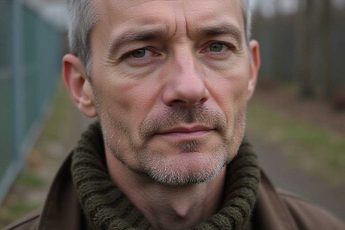
On that particular day, Arthur Bell came to the shelter. He was just past fifty, and since his wife had died, the flat had felt far too empty. His daughter lived in another city; friends telephoned often, but he never invited anyone round. A neighbour had told him, “Get a dog. At least you’ll have someone to talk to.” Arthur had laughed at the time, but a week later he was standing at the shelter gates.
A volunteer named Poppy Hart smiled at him. “Would you like a puppy?”
“I don’t know. Maybe I’ll just have a look.”
They walked along the rows of kennels together. Puppies jumped up joyfully. Younger dogs pushed their paws through the wire. Poppy told him a little about each one, but Arthur still could not make up his mind.
“Perhaps not today,” he said.
“Of course. These decisions shouldn’t be rushed.”
He had already turned towards the exit when he heard Poppy speak softly, almost to herself. “It’s only Rusty I feel sorry for…”
Arthur stopped. “Why?”
Poppy nodded towards the far kennel. “No one has taken him in four years.”
They walked closer. Rusty did not get up. He only looked at Arthur with the same calm, steady gaze.
“Is he ill?”
“No.”
“Aggressive?”
“He has never bitten anyone.”
“Then why?”
Poppy smiled sadly. “Because people want young dogs. Pretty dogs. Lively dogs. He is simply tired of waiting.”
Arthur crouched down by the wire. Rusty came over slowly, without barking or jumping. He sat down beside Arthur and rested his head against the man’s hand. The fur was warm, the eyes were honest, and there was a quiet trust in the way he stayed there.
“He is a strange dog,” Arthur said.
Poppy’s smile softened. “He is wise. He learned long ago that love cannot be begged. If someone wants to give it, they will come on their own.”
They stood in silence for a while. Then Arthur asked, “How did he end up here?”
Poppy sighed. “His owner died. The neighbours brought him in. At first Rusty sat by the gate every day, waiting. Then he stopped. But every time the door opens, he still looks. Somewhere inside, he never stopped hoping.”
Arthur felt something tighten painfully in his chest. “After my wife died, I could not get used to opening the flat door. I kept thinking she would be there, walking towards me.”
Poppy said quietly, “Then maybe you understand each other better than you think.”
An hour later, Arthur signed the papers. Poppy brought Rusty out of the kennel. The dog walked calmly beside her, but at the gate he paused. He turned and looked back at the other dogs, almost as though he were saying goodbye. Then he walked slowly to Arthur and, for the first time, gave a small, careful wag of his tail.
The first few days at home were difficult. Rusty barely ate and slept by the front door, as if he expected to be taken back at any moment. Arthur never hurried him. Every evening he sat beside the dog, drank his tea, and talked about his life. “I never thought I would end up alone, you know.” Sometimes he spoke for half an hour, sometimes only for a minute or two. Rusty listened without a sound.
Then one morning Arthur woke to a strange feeling. Someone had rested a head on the edge of his bed. He opened his eyes and saw Rusty standing there, watching him not with worry but with something that felt like home.
Arthur smiled quietly. “Well, hello. I think we are both home now.”
A year passed. Poppy saw a familiar car pull up outside the shelter. Rusty jumped out first—healthy, well cared for, with a shiny coat. He ran to the gate, not because he wanted to go back, but because he wanted to greet the people who had once looked after him. Poppy crouched beside him. “I hardly recognise you.”
Arthur laughed. “Nor me.”
“What do you mean?”
He looked down at Rusty. “I thought I came here to save a dog. As it turned out, he saved me.”
Before they left, Poppy hung a new sign near the entrance. It read: “Do not ask how old the animal is. Ask instead how much love it still has to give.”
Rusty’s photograph was later placed on the shelter’s website. After that, people began to adopt older dogs far more often. They had learned a simple truth: sometimes the one everyone walks past becomes the most loyal friend of all. True love has nothing to do with age. It simply arrives one day, and it stays.
And what about you? Could you give a home to an older animal from a shelter? Or perhaps you already have a story like that. Feel free to share it in the comments.