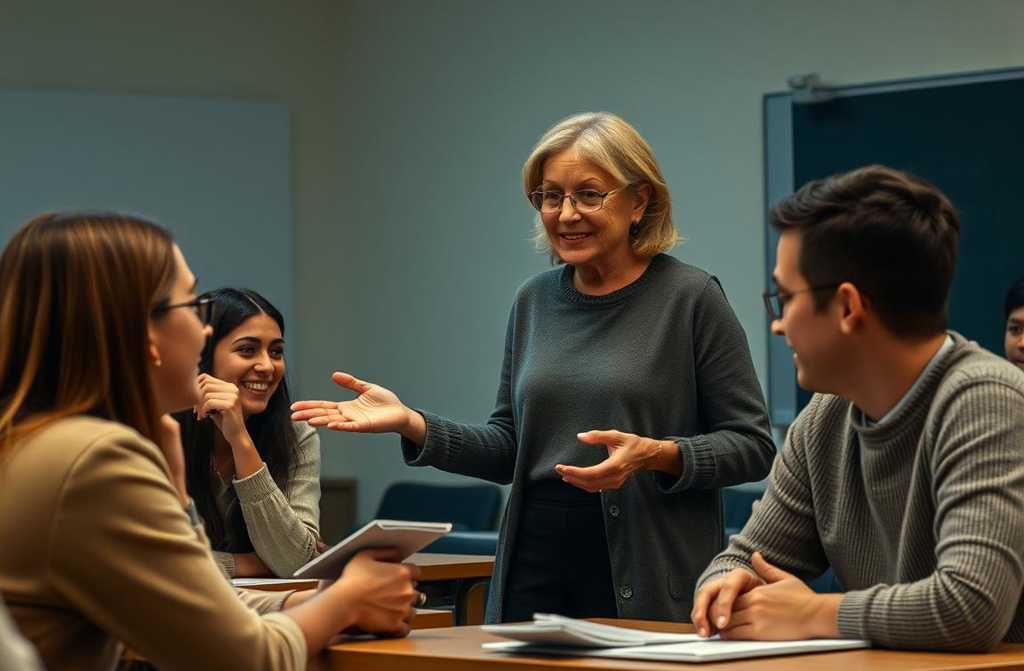
The key to the classroom always stuck a bit on the third turn, as if it too was weary by evening. I would lean in with my shoulderit was a habit by thenand step in first, before the corridor was filled with voices. At the university, lights were already being switched off in some rooms at this hour, and only the strip lights on our floor remained, making the whiteboard look uncomfortably honest under their glare.
I was forty-five then, fully aware of what a proper lesson entailed: structured plan, precise timings, model problems, time checks, homeworkeverything by the book. Ten years of teaching on the pre-university courses had made it less a craft and more a ritual that grounded each day. I could explain any topic just right for them to repeat it in an exam. Still, in recent months, Id caught myself talking at the board more than to my students.
The register held the names of my new evening classa group of adults. Not teenagers dragged in by anxious parents, terrified of not getting a place. These were people who came after a days work, shopping bags in hand, their phones still pinging with work emails. I had seen their kind before, but there were more of them that year, and the department was delighted: A strong recruitment. I thought about other things. How it was getting harder to keep the pace. The younger lecturers who were so good at engagement, talking about project-based learning, cracking jokes with easethey were popular. I worried that if I kept just drilling, one day Id simply be replaced.
By eight, almost everyone had arrived. A woman of about thirty-five, hair pulled back in a neat ponytail, with a childs bottle poking out from her rucksack. A man in his forties, wearing a work jacket, his hands bearing scrubbed traces of labour, though hed tried to clean them well. A young manperhaps thirtyhandling his laptop as if it was the one thing in his life that would not fail him. And another student, younger, but with a tense look, as though she expected to be found guilty of something already.
I introduced myself, listed the subject, the schedule, the rules. The words aligned as usual. Today well begin with a basic test. I handed out the papers, and the room settled into that familiar hush: someones long exhale, a chair creaking, a pen clicking.
After twenty minutes, I looked up and saw it everywhere: people staring at their papers as if written in a foreign tongue. Someones knee was jittering under the table. The man in the jacket gripped his pen so hard his knuckles whitened. The woman with the rucksack kept glancing at her phone but didnt unlock it, as if whatever waited there was too importantor too frighteningto acknowledge right now.
I collected the sheets and, not even glancing at them, said what I always did at moments like these:
This is just an initial assessment. Nothing to worry about.
But I heard it, really heard it, as I said it. Nothing to worry aboutwhen youre seventeen and your whole life is ahead of you, that can be comfort. At thirty-five, when youve come here after your shift, after your children, after your failuresthat phrase cant really lift the burden from your shoulders.
Excuse me? The young man with the laptop raised his hand. If Iwell, if I cant actually remember any maths, does that mean I shouldnt be here?
I nearly gave my stock reply: You can always catch up. But when I looked at him, I realised he wasnt just asking about maths. He was asking if he had the right to be a student again.
You should be here, I said simply. Well just start at a different pace, and well figure out where things break down.
The man in the jacket gave a sharp, sardonic smile. Pace, he echoed. I know about pace at work. But herefeels like being called to the blackboard again at school, standing there like a
He didnt finish, but in the silence that followed, the room seemed to nod in agreement.
Against my plan, I closed the register. Alright, I said, surprising myself by saying it aloud, lets change track. Ill ask just one question, and I want you to answer honestlyoff the topic of the test. Id like to know whats hardest about learning for you now.
A pause hung heavyinstantly I regretted it: perhaps theyd think me another teacher playing at armchair psychologist and decide to leave. But the woman with the rucksack raised her eyes.
Im scared I cant keep up, she said quickly, as if fearing she might reconsider. After maternity leave my heads just not working. I read and cant make sense of the words.
The man in the jacket added, Im scared Im too old for this. Been working with my hands for twenty years. Noweveryone says you need to keep learning, or thats it.
The young man spoke almost in a whisper, Im scared Ill just quit again. I tried beforedidnt make it. Now I Im embarrassed just to be here, to be honest.
Listening to them, I felt my own exhaustion slip from centre stage. It didnt vanish, but it faded. I stopped seeing a collection of adults, and instead saw a group of people, here on the dregs of their courage.
Alright, I said. Well learn so you can see whats workingnot just what isnt.
At the next session, I brought not just handouts but a stack of little cards with tasks of varying difficulty. There was no mention of this in the teaching guide. I felt slightly embarrassed, as if breaking an unspoken contract with the syllabus. But I remembered their faces and decided to give it a go.
Were working in pairs today, I said. Youll pick a card. If you take a harder one and cant manage, thats not a failureit shows us where you need support.
The man in the jacket frowned. If I pick an easy one, its like admitting Im dim, he muttered.
Its more like taking the handrail on the stairs, I replied. Were not in a competition here.
I watched as they glanced at each other. Grown adults dont like being taught not to fearbut they do appreciate clear steps.
The woman with the rucksack sat beside the man with the laptop. They were silent for a while, then she said, I used to love solving problems, until thoseproof thingscame in at school. And you?
He responded, I liked it until I realised I was the slowest.
I didnt intervene, walking between the rows, reading over shoulders. Some wrote, then crossed out fiercely. Some sat stock-still, staring at nothing. I felt an urge to grab the marker and quickly show the right waysave time. I checked myself. Here, time wasnt for getting answers, but for rebuilding confidence.
Half an hour in, the man in the jacket raised his hand. Ithink Ive got it, he said, passing up his notebook.
The solution wasnt perfect, but the logic held together. He had spotted and corrected his own error.
Thats right, I said. You caught yourself where you tripped.
He nodded, a childlike stubbornness in his gesture.
Later, he lingered by the door. Listen, he said, not quite meeting my eye, do you really think I need this? Its justmy wife reckons you need a certificate these days for anything
I could have trotted out the textbook answer about the importance of qualifications. But I saw how he hid behind that reason, not wanting to admit he hoped for more.
I think you need to see for yourself that you can learn, I said. The rest is up to you.
He left. I stood alone, gathering up papers. In the hall, someone laughed and doors banged. I realised I didnt want to leave just yet. Usually, at eight, all I longed for was the quiet of home. Now I wanted one last look at the register, to see whod turned upas if that, too, was proof, not for the records but for myself.
A week later, the departmental secretary emailed: The course is exam-focused. Please keep within the formal structure. The message was polite, but I stung a little. Someone had noticed. Maybe a student had commented there were not enough tests, or perhaps the secretary saw my reports were late.
At the next lesson, I tried to return to familiar ground: a big set of typical problems, timer set.
Ten minutes in, the woman with the rucksack raised her hand. Sorrycould we Im too slow. Everythings jumbled. I know I should be quicker but
She trailed off, head down. The young man slumped as if unstrung. The man in the jacket pressed his lips together.
I could feel irritation risingnot at them, but the situation. At being forced to choose between doing it right and doing it humanely. At my own fear: if my course isnt deemed efficient, I could be out.
I stopped the timer.
Alright, I said, with a firmness I hadnt tried before. Well keep the exam format. But well look not just at the answers, but how you got there. And make time for questionseven ones you think are silly.
What if we have loads of questions? someone called from the back.
Then well figure out just where things breakand fix that, not pretend its all fine.
Afterward, I went to see the secretary. Not to defend myself, but because I sensed if I didnt, my leeway really would be shut down.
She sat in a cramped office, surrounded by files. Are you adjusting the course content? she asked calmly.
I am, I said. This is an adult group. They need a different approach. Theyre not lazytheyre tired and afraid.
We have guidelines, she reminded me.
I follow them, I said. The materials covered. But if they drop out after three classes, the plan only exists on paper. I need them to finish.
She watched me carefully. You understand the responsibilitys yours?
I do, I said.
That I do felt like a signature. My hands were trembling as I left. The corridor smelled of bleach where the cleaner was mopping near the stairs. I went down a floor and finally let myself breathe.
Afterwards, classes were fuller, but more alive. I brought in a new rule: the first ten minutes for anything students couldnt get, without shame. People brought their mistakes, and we tackled them together. I encouraged them not to hide their crossings-out, but to show their thinking. That was hard for adults, whod learned that mistakes must be concealed or youd be judged.
One day, the young man with the laptop came to the board. He gripped the marker, hesitating.
Ill just forget everything, he murmured.
Start with what you know, I said. Any place is fine.
He wrote one stepsomething simple. Then another. At the third, he faltered.
I dont know what comes next, he said, half-looking at me, as if hoping to be rescued.
I could have just supplied the formula. Instead I asked, What do you want by the end? What sort of answer do you expect?
He thought hardand straightened a little. I want an expression without well, without this mess.
So, what can go?
He found the next step himselfnot right off, but he did. His face was flushed as he sat againnot from shame, but effort, which proved survivable after all.
Once, the woman with the rucksack arrived late, hair awry.
Sorry, she said, settling down, the child wouldnt go to sleep.
Take a seat, I replied. Were just reviewing.
Afterwards, she lingered. I thought Id never manage, she said with an apologetic smile. Today I realisedI can read a problem and not panic.
Thats a good skill, I said. Itll help in the examand elsewhere.
The man in the jacket changed, too, though in his own way. He never liked talking about worries. Instead, he once brought in a printout for a job vacancy.
It says, degree preferred, he noted, tapping the page. Used to not even look at that. Now well, I look.
I saw how tightly he clung to that paper, needing it to show his effort mattered.
Thats honest, I said. Youre aiming for something.
And if it doesnt work out? he asked.
I didnt give promises. Then youll know you triedand that you can try again.
By the end of the course, they sat a mock exam. I set out the variants, started the timer, and the hush returnedbut it was a different sort of quiet now. Not paralysed, but focused.
When time was up, I collected the papers, reading anxious faces.
Youll get your results in a couple of days, I said. But for nowevery single one of you finished the paper. All of you.
The young man looked up. Even if I got half of it wrong?
Even so, I said. You didnt quit at the first tough part.
I marked their work at my kitchen table. Darkness fell early; the lamp kept a circlet of light around the numbers and my notes. I ticked good approaches, even if the answer missed. Jotted short commentsno sarcasm, though my hand itched to write the familiar Careless. I found myself searching for where each person had grown, not just their errors. It felt unnatural, exhaustingyet strangely calming.
Next session, I handed back results one by oneno public ranking.
The woman with the rucksack stared at her results for a long time.
Did I pass the threshold? she asked.
Not this time, I replied. But youve made strong progress. And now you can see exactly where to improve.
She nodded, something stubborn flaring in her eyes. Again, then. I thought if I didnt make it at once, Id failed.
Its not all or nothing, I told her.
The man in the jacket huffed at his results. Well, I expected worse.
Thats a solid start, I said. Youve got a strong logical approach.
He paused, then added quietly, When Im showing a new lad the ropes at work, I get worked up at first. Then realise hes just scared. Maybe Im the same now.
I smilednot because it was the right insight, but because hed voiced it himself.
The young man studied his mark longest. I didnt fail, he said softly, tasting the words.
You didnt, I agreed. But you need more speed nowand to keep going after a stumble.
He nodded. I thought youd tell me I shouldnt be here.
If I did, Id never believe myself, I replied.
Before the real exam, we met twice more. The last class, I set no new material. Instead, I asked them to name, each one, a topic they no longer feared as they once did. It felt a bit like an auditbut not for the department.
The woman said, I dont fear the word problems now. I can work through them in steps.
The man said, I dont dread the blackboard. Well almost.
The young man said, Im not scared of failing on the first go.
I listened and thought about myselfmy own dread of becoming obsolete hadnt left me; it was merely no longer the only thing. I realised that my work didnt have to be just about scores and reports. That I could not only explain, but hold steady for others, so they neednt feel ashamed of uncertainty.
They sat the exam on different daysI couldnt be there. I just replied to their brief evening messages: Im in, Done, Not sure. I asked no more, not to stoke nerves.
Results came back a week later. The woman needed a few more marks to pass. She emailed, Gutted, but Ill resit. Sorted it so my husband will have the child this time. The man scraped the minimum to passsent a photo of his marks and the word: Worked. The young man did better than his mock, but fell short of the entry. He wrote, Im not quitting. Will you have me again in autumn?
I read those lines stood in a university corridor, by a window between lessons. Outside, day students were still laughing, arguing, eating on the gothey seemed light as only the very young can be. My evening class was heavier, perhapsbut more real.
The secretary told me later, No complaints. Attendance is excellent. But mind, stick to the syllabus.
I do, I said.
I left her office not feeling victoriousjust a quiet acceptance of my choices. The cost was clear: more effort, more responsibility, fewer illusions that I could simply tick off my duty and move on.
On the last night before break, I opened my classroom once more. It was empty now, the chairs set in straight rows. I went to the board and wiped away the remnants of daytime formulas; the chalk dusted my palm.
I set down the cloth, shut the window, and turned off the light. In the half-lit corridor, the key stuck again on the third turnbut I didnt rush now. I turned it gently, as if letting myself, for once, set my own pace.