I remember our village shop well enough—everyone simply called it the stores. Local children were always popping in to buy a few boiled sweets or a biscuit. For me, though, money for treats came rarely. Usually Mum would slip me a few pence behind Dad’s back.
Before going inside, the girl next door would always peer through the window first. She was checking whether my father was there. If he was sitting by the counter, I would turn round and go home, because I knew he wouldn’t like me turning up. But if it was our neighbour, George Carter, there instead, things changed.
He would notice me from the doorway, give me a genuine smile, and call over to Polly, the shopkeeper, to fetch me the biggest bar of chocolate in the place. Uncle George always said he’d pay for it himself, and he’d take out his wallet.
Polly once asked him why he so often bought sweets for Ivy’s boy, while all the other children just got a hundred grams of ordinary sweets weighed out. Uncle George simply shrugged and said he felt sorry for a child who rarely got such treats. Polly said nothing, because what mattered most to her was the day’s takings in the till.
Our house was never truly peaceful. My father openly disliked me, and I felt it from early childhood. He could lose his temper over any little thing: a pair of shoes left in the wrong place, a badly washed plate, or simply the way I looked at him. Whenever he raised his voice, Mum would try to stand between us. She would shield me with her own body and beg him to calm down and leave a child alone. At such moments Dad only grew angrier and said she’d brought some unknown person’s child into the house, and now she dared to speak against him. I didn’t understand half the words then, but I worried for Mum.
Mum’s beauty survived only in a few old photographs that she kept in a wooden box at the bottom of the wardrobe. In those pictures she was smiling, her face looking fresh and happy. At her age many village women still looked lovely, but Mum had faded far too young. The reason was her married life.
Dad always found something to grumble about, even when everything had been done perfectly. The neighbours often wondered among themselves what more the man could possibly want. He had a large, well-kept smallholding, a solid cottage, and a tidy yard. I did nothing but get top marks at school, behaved irreproachably, and later got into a university in the county town without any difficulty. Mum never contradicted him; she tried to carry out all his orders in silence so as not to provoke another row.
When I finally left for university, I felt an enormous sense of relief. Even in town, though, I couldn’t stop thinking about Mum, left alone in that house. During the rare phone calls or when I came home at weekends, I often asked her why Dad behaved the way he did. I told her straight that I couldn’t feel a single drop of love from him, and I suspected he didn’t love her either. Mum would only lower her eyes, try to change the subject, and say he simply had a difficult temperament that you had to get used to, and that everything would change over the years. She begged me not to think about it and to concentrate on my studies.
After university I decided not to go back to the village. I managed to get a job as an economist at a large firm in town. They gave me a small room in a hostel, and it felt like my own place, where nobody could tell me what to do. It was there that I met Emma, who had also joined the firm as a young graduate. We kept crossing paths at work, then started having lunch together and going for walks around town after our shifts.
When, after a year of seeing each other, I asked Emma to marry me, I felt incredibly happy. I immediately started picturing our future wedding, Emma in a beautiful white dress, dancing with her, and how glad Mum would be. I wanted to believe that at least this news might make Dad change his attitude and show a little fatherly warmth.
The following weekend I went to the village to tell my parents about my plans in person. When we sat down to dinner, I calmly announced that I was getting married. Mum burst into tears of joy, her eyes shining with a warmth I hadn’t seen for a long time. She immediately started talking about what had to be prepared and how best to arrange everything. Dad didn’t say a single word. He simply put down his fork, rose from his chair, and walked out of the house in silence. He didn’t come back into the room for the rest of the evening.
Later, when Mum and I were alone in the kitchen, she gave a heavy sigh and told me that my father had flatly refused to give any money for the wedding and wanted no part in it.
When I returned to town and relayed everything to Emma, she gave me a tight hug and said we didn’t need anyone’s money; we could organise it all ourselves. I felt terribly hurt and ashamed in front of her parents. I kept thinking about what they must think of my family, and why my father displayed his feelings toward me so openly. In the end we decided to have a modest lunch in the firm’s canteen, inviting only Emma’s closest friends and family. My father never came to the celebration. To every guest who asked where he was, Mum answered briefly that he had been taken suddenly ill and couldn’t face the long journey.
Just before the lunch began, when we were standing in a side room, Mum was helping Emma adjust her wedding veil. Her hands were trembling badly, and tears kept welling up in her eyes. She looked at me with such deep grief that I felt awkward. She whispered that she had a very great sin on her conscience and begged me to forgive her for everything. I thought she was simply upset by Dad’s absence and the modesty of our celebration. I put my arm around her and told her not to worry; Dad’s absence was on his own conscience, and Emma and I would still be happy. Mum only nodded, but her face remained pale and unhappy all evening.
After the wedding, Mum began to go downhill noticeably. She lost a great deal of weight, her movements became slow, and she complained more and more often of a general tiredness.
She came to visit me in town several times, sat for a long time at our kitchen table, started some important conversation, but always stopped halfway through, never daring to say what mattered most. In the end she simply ran out of time.
At Mum’s funeral, Dad behaved strangely. There was no emotion on his face; he did not shed a single tear and did not speak a word to anyone from the village. It was incredibly painful to watch such coldness. After the burial, when we returned to the empty house so I could collect my personal things, he stopped me at the door. He looked at me with those hard eyes and said spitefully that now that Mum was gone, there was nobody waiting for me in that house and no reason for me to be there. Those words put the final full stop on our relationship.
Years passed. Emma and I built a strong family, and we had two wonderful children. We had recently moved into a new flat, and life was going on in harmony and calm. But I never forgot Mum. I would regularly drive to the village to visit her grave, bring flowers and simply spend some time beside her. Every time I passed our old place, I saw Dad still busy in the yard, but I never stopped. That house had become completely foreign to me. I often thought that any other man in his place would have been glad of his child’s success, proud of his grandchildren, and happy to welcome them for a visit—but not him.
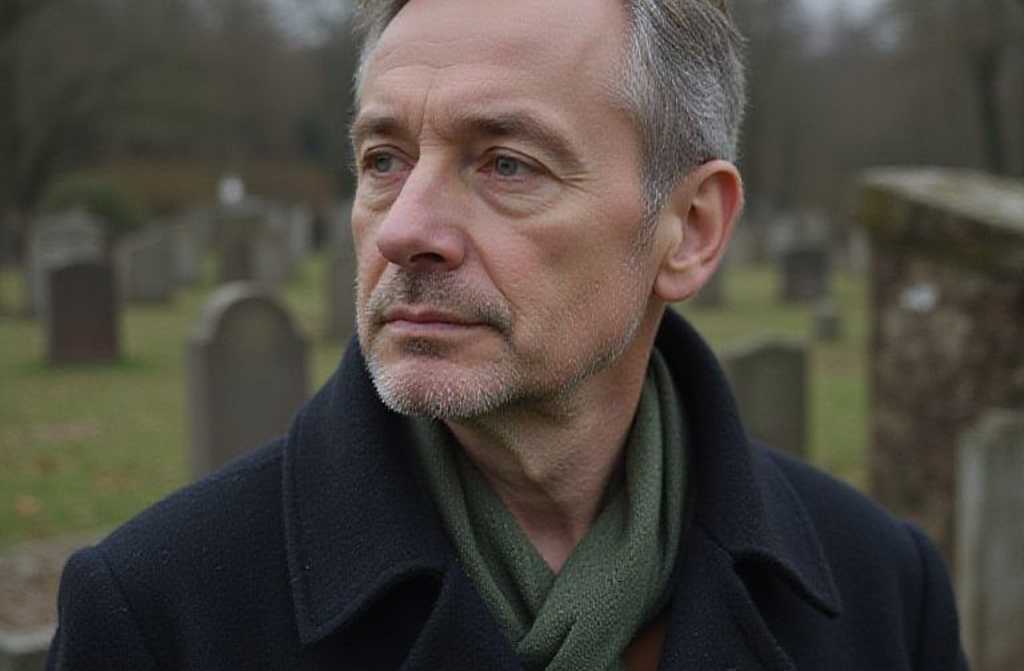
Last autumn I went to the cemetery again. The day was cold, with the sky thick with grey clouds. From a distance I noticed a man standing by Mum’s headstone, doing something there. At first I thought it might be Dad, and my heart tightened with an unpleasant sense of dread. But when I got closer, I recognised our old neighbour, Uncle George. He was wearing an old warm jacket and was carefully pulling out the dead flowers that the first frost had already spoilt.
“Hello, Uncle George,” I said calmly, stopping by the iron railings. “I didn’t expect to see you here. Have you come to help tidy up?”
The man slowly straightened, put his hands on his back and gave a heavy sigh. His face was covered with wrinkles, and his eyes looked very tired.
“Ah, hello, my little man,” he answered in a hoarse voice, using my old childhood pet name. “I thought I’d give a bit of help—all this dead growth is making the place look terrible. Best to put it to rights before the ground freezes solid.”
“I’m hardly a little man any more,” I said with a quiet smile, trying to keep the conversation light. “My eldest daughter is about to get married herself; we’ll be having a wedding soon. Time really flies.”
“It does, it does,” he agreed, rubbing his back again. “This back of mine has been playing me up lately—absolutely terrible. Especially when the weather starts turning. Look at these clouds; it’ll be snowing by tonight.”
Uncle George coughed hoarsely a few times, dropped his eyes to the ground, then looked at me again. His expression suddenly became very serious and tense. He shifted from one foot to the other, wiped his hands on his work trousers, and came closer.
“You see, Thomas,” he began, and the fact that he used my full name made me feel uneasy. “A very long time ago I made a solemn promise to somebody that I would never open my mouth, that I would keep it shut for as long as I lived. I kept silent for years. But now Ivy has been gone for a long time, and my own days are nearly over, I can’t go on carrying this burden. I have to make my confession, so that you finally know the truth. You have every right to know why Harold behaved as he did toward you and your mother all those years. He simply isn’t your real father.”
The words were so unexpected that at first I did not even take them in. I just stood there looking at the old man, feeling everything inside me go cold.
Uncle George went on talking, his voice flat and even, with no extra emotion, as if he were telling some ordinary story from the past. He told me that when they were young, he and my mother Ivy had loved each other very deeply. Mum lived in what was known as the “rich end” of our village, where only the wealthiest families built their houses. Her family was very proud; they looked down on the poorer villagers and dreamed of finding their daughter a respectable and wealthy suitor. Mum was terrified of her parents, so she kept her relationship with George a strict secret. Even her closest friend had no idea that they were meeting in secret. The whole district was racking its brains over why a young girl working in the village office was giving every local lad the brush-off. Everyone assumed she was waiting for some town suitor.
The truth came out only when Mum realised that she and George were going to have a child. When she confessed to her parents, a real scandal erupted in the house. Her mother was so frantic that she was prepared to go to any extreme rather than allow a marriage to a poor neighbour. She feverishly began looking for a man who would agree to marry Ivy quickly and take on another man’s child. Ivy’s father supported his wife completely, declaring that they were ready to give any dowry, sacrifice money and property, but George would never step across their threshold.
Their choice fell on Harold. He was much older than Mum, had a gloomy disposition, but was very practical and greedy for money. When he was offered a large cash payment and a new household in exchange for keeping quiet and going through with the marriage, he agreed at once. But Harold set one harsh condition: he flatly refused to live in the same yard as his in-laws. So Ivy’s parents had to leave their newly built house to the young couple and move into an old abandoned cottage at the other end of the village.
The news was a real shock to the whole village. Nobody could understand why a young beauty would suddenly marry this unsociable and openly rude man, from whom you could not get a single word. Uncle George remembered that on the day of their wedding a cold, heavy rain was falling from early morning, and that it was the hardest trial of his life. From the very first day of their life together, Harold began showing how he felt. He didn’t love Ivy, and when I was born, his irritation only grew stronger. Mum could not forgive herself for her weakness either; she did not love her husband and constantly blamed herself for not being able to protect her true love. She absolutely did not want to have any more children by Harold, because she was afraid they would inherit his difficult nature.
After a while, Uncle George was forced to build a family of his own. He married a woman who already had a son from her first marriage, raised the boy as his own son, and later they had another boy together. He tried to live a normal life, but every time he saw me in the street or near the shop, he felt a sharp grief. He knew very well that his own child was growing up in an atmosphere of dislike, but he could not change anything. The only thing he could do was secretly buy me that bar of chocolate in the shop, just to show a little care. Ivy’s parents had warned him very harshly at the time: if he ever tried to approach me or tell the truth, they would make sure he ended up without a roof over his head.
“So that’s the story, Thomas,” Uncle George finished quietly, with a heavy sigh. “Now you know everything, exactly as it was.”
I stood there utterly stunned by all I’d heard. My head could not take in these facts, which completely changed my idea of my childhood and my family. It became clear why Harold had disliked me so much, why Mum had always trembled in front of him, and why she had asked for my forgiveness before my wedding.
“Just don’t judge your mother too harshly,” George added quietly, adjusting his cap. “It was incredibly hard for her then.”
The old man slowly turned and walked off along the narrow path. He stopped at the very gate, lifted his head for a moment to the dark autumn sky, where the first thin snowflakes were already beginning to appear. He whispered something to himself, made the sign of the cross towards the old gate, and then slowly walked away in the direction of the village, leaving me alone with my thoughts and with Mum’s memory.