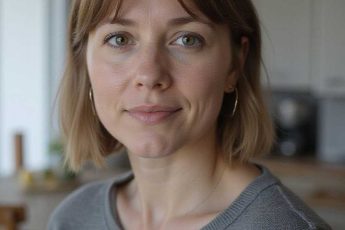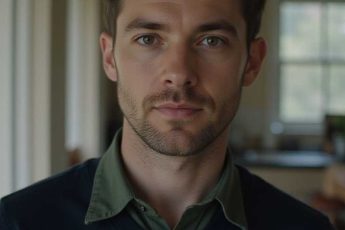
The morning after the wedding smelled of freshly cut flowers, expensive perfume, and coffee that had already gone lukewarm. Sunlight slanted through the thick hotel curtains in warm gold stripes across the floor and walls. On a chair lay a veil, still shoved carelessly aside from the day before, and beside it sat two suitcases, only half packed.
Audrey Whitmore sat on the edge of the bed and looked at her husband. Edwin Ashcroft was still asleep, looking so peaceful it was almost impossible to believe the day before had actually happened. Soon they were supposed to set off on the trip they had been planning and dreaming about for months.
Then the phone on the bedside table vibrated.
Audrey grabbed it quickly so the sound would not wake Edwin. The screen showed an unknown number with a local London code.
“Hello?” she said quietly, stepping out onto the balcony.
“Audrey Jane Whitmore?” said a woman’s voice. “Good morning. I’m calling from the central register office, where your marriage was recorded yesterday. I’m afraid we need to see you rather urgently. There’s a matter concerning your registration documents.”
Audrey’s heart gave an unpleasant lurch.
“What’s happened?”
“During the standard checks,” the woman said, “a serious discrepancy has come to light in the national records. We’ll need your personal attendance as soon as possible.”
“But we’re leaving today. Can’t it wait?”
“I’m afraid not. And one more thing: please come without Mr. Ashcroft. And perhaps don’t mention the call to him yet.”
That last bit sounded especially worrying.
“Why not?”
“I’d rather explain it all face to face.”
The line went dead.
For a while Audrey stood perfectly still, trying to make sense of what she had just heard. The more she turned the registrar’s words over in her head, the stronger the knot in her stomach became.
When she went back into the room, Edwin was awake.
“Morning, wife,” he said, smiling.
That one word made everything harder.
“I need to go out for a bit,” she said, trying to keep her voice level. “Work thing. They’ve suddenly decided they need a few signatures.”
“Today? Straight after the wedding?”
“Apparently so. They said it won’t take long.”
“I’ll come with you, then.”
“No, no. I’ll sort it and be right back.”
A little later, a taxi deposited her outside a familiar building. Only yesterday she had arrived here to music and smiles and well-wishes. Now she walked in through the staff entrance with a strange, almost physical sense of dread.
The corridors were nearly empty.
In room twelve, a middle-aged woman with a folder in her hands was waiting.
“Please come in,” she said. “My name is Edith Fairley.”
Audrey sat down opposite her.
“So, what’s going on?”
The registrar paused for a moment. Then she opened the folder.
“After a marriage is registered, we run an automatic data cross-check through the national databases,” she said.
“And?”
“During that check, it appears there is an existing valid marriage record linked to your husband.”
For a moment, the words did not quite land.
“Sorry?”
“According to the information that came in this morning, Edwin Andrew Ashcroft is officially still married to another woman.”
Audrey felt the room tilt.
“That can’t be right.”
Edith Fairley passed a copy of a document across the desk.
“We rather hoped it was an error too. That’s why we asked you to come in person.”
Audrey stared at the paper and could not believe what she was seeing. There was a date of registration. A surname. A female name. It all looked entirely official.
“Could it be a system glitch?”
“We checked that first. Unfortunately, the information is confirmed by several sources.”
“But Edwin told me he’d never been married.”
“In that case, either he genuinely doesn’t know about the problem, or he chose not to mention it.” Those words were particularly hard to swallow.
When Audrey left the office, she sat in the taxi for a long time, unsure whether to go back to the hotel at all. Her thoughts were all over the place. One by one, small things she had never paid much attention to came drifting back: odd phone calls, a reluctance to talk about the past, those suspiciously vague “business trips” that never seemed to have much detail attached. Things that had once looked like random details now arranged themselves into a rather alarming picture.
An hour later, she finally went back.
Edwin met her in the lobby.
“Where have you been? I was starting to worry.”
She looked at him carefully. His face was as calm as it had been that morning. As if nothing had happened.
“We need to talk.”
His smile faded.
“I wasn’t at work today,” she said.
He tensed. The movement was barely noticeable, but she saw it.
“Where were you?”
“The register office.”
A few seconds passed that felt considerably longer.
“I’ve been told you’re still married.”
Edwin went pale. And that reaction told her more than any words could have. It was not surprise. It was not indignation. It was fear. Genuine, unmistakable fear.
He sat down slowly.
“Audrey…”
“Is it true?”
He closed his eyes. That was enough.
She already had her answer.
A heavy silence settled over the room. Audrey felt something completely collapse inside her. Not trust, exactly. Not even love. It was the illusion in which she had been living for the past two years. The man she had believed was the closest person to her had turned out to be someone rather different. And the worst part was not the paperwork. Not the legal muddle. The worst part was that the whole history from the beginning had been built on a lie.
Audrey stood by the window of the hotel room, hardly noticing the sunlight or the soft carpet beneath her feet. Everything around her seemed to have lost its sharp edges. Only a few minutes earlier, Edwin had silently confirmed what, that morning, had felt impossible.
She sat down on a chair.
“Say something,” she said at last.
He rubbed a hand over his face.
“It’s more complicated than it looks.”
“Is it?” Audrey gave a bitter smile. “Because from here it looks fairly simple. You married me while you were already married to another woman.”
Edwin looked up at her.
“I haven’t lived with her for years.”
“But you’re still legally married?”
He nodded slowly.
That answer hit harder than any excuse.
“Why didn’t you tell me?”
“I was afraid.”
“Of what?”
“Of losing you.”
Audrey turned away. Strange, but there were no tears. The shock was too great. She had been ready to hear any number of things: a database error, a mix-up with names, somebody’s cruel joke. But the man sitting in front of her was calmly admitting the truth.
“When were you going to tell me?”
Edwin was quiet for a long time.
“I wanted to sort it all out before the wedding.”
“So you said. You were trying.”
“Yes.”
“But you didn’t.”
“I ran out of time.”
She turned sharply.
“You had two years of our relationship. And you ran out of time?”
He said nothing. In his silence, the answer was louder than any words.
Audrey sat down opposite him.
“Who is she?”
“Someone I used to live with.”
“Her name.”
“Daisy.”
“Where is she now?”
“I don’t know for certain.”
Audrey frowned.
“How can you not know where your legal wife is?”
Edwin let out a long breath.
“We separated six years ago.”
“Then why didn’t you divorce her?”
He pressed his fingers together tightly.
“Because it got rather complicated.”
Each new explanation made it worse.
“So you did nothing for six years?”
“I did do something. I tried to find her.”
“And you couldn’t?”
“No.”
Audrey could feel irritation rising in her chest. There were too many gaps, too few straight answers.
“Show me the documents,” she said.
“What documents?”
“Anything connected to that marriage.”
He was visibly uncomfortable now. And that only made her more suspicious.
“I don’t have them with me.”
“Then we’ll go and get them.”
“Now?”
“Yes. Right now.”
It was the first time in the whole conversation that Edwin looked genuinely caught out. He had clearly expected tears, hysterics, reproaches. What he had not expected was calm, quiet questions.
An hour later, they stood outside the flat he had been letting out to tenants since before he met Audrey. He had kept the keys. Under the pretence of checking the utility bills, he asked the tenants if he could pop in for a few minutes.
There was indeed a folder in the old built-in wardrobe. Edwin took it out reluctantly. Audrey opened it right there. Marriage certificate. Copies of statements. Some old paperwork. But among the papers there was something else. An envelope, yellowed with age. Edwin’s surname was written on the front.
Audrey looked at him.
“This wasn’t opened?”
“I don’t know,” he said.
His voice did not sound convincing.
She opened the envelope. Inside was a letter, several pages covered in a woman’s handwriting.
The first lines made her go very still.
“Edwin, if you ever read this letter, then enough time will have passed…”
She looked up sharply.
“Have you read this before?”
He said nothing. And then Audrey read on.
Daisy wrote about an illness. About treatment. About moving away. About not wanting to be a burden. About asking him not to look for her.
With every line, the picture shifted. But it did not become any clearer.
When the letter ended, Audrey folded the pages slowly.
“Was she seriously ill?”
“Yes.”
“Did you know about it?”
“I found out later.”
“And you still didn’t do anything?”
Edwin sat down heavily on a chair. In the space of one morning, he seemed to have aged several years.
“Because I was ashamed.”
“Of what?”
“Of not doing anything.”
There was another silence. Audrey felt they had still not got to the real truth. Too many pieces did not fit. If Daisy had left on her own terms, why had he not simply ended the marriage through the courts? If he had tried to find her, why had the letter sat unopened all this time? If he really had meant to sort everything out, why had he gone and registered a new marriage without finishing the old one first?
The questions kept coming. The answers did not.
That evening, she went to her parents’ house. Edwin did not try to stop her. He simply helped carry her suitcase to the car.
All the way there, Audrey stared out of the window.
Her mother opened the door. One look at Audrey’s face was enough.
And then, for the first time all day, Audrey started to cry. She was not loud about it. There was no scene. The tears simply ran down her face.
Late that night, when her parents had gone to bed, her phone buzzed with a message from an unknown number.
“Audrey Whitmore? The register office passed on your contact details. I think we should meet. It’s about Edwin Ashcroft and his first marriage. You don’t know the whole story.”
She read the message several times. Then she glanced at the clock. Nearly midnight.
A second message appeared.
“My name is Hilda Pemberton. I was Daisy’s solicitor.”
Sleep vanished instantly. Her fingers went cold. She typed a short reply:
“How do you know about my marriage?”
The phone rang almost at once.
“Good evening,” said a calm female voice. “I’m sorry to call so late. But we may have less time than we think.”
“What do you mean?”
There was a brief pause at the other end of the line. Then the woman said something that made Audrey’s heart freeze.
“The problem is not only that Edwin is still legally married. That is just one part of the story. The real reason the registry office called you in separately has to do with documents found in the archive at the same time as the record of your marriage.”
“What documents?”
“Those are the ones I would like to show you in person.”
“Why can’t you tell me now?”
“Because some things need to be seen with your own eyes.”
Audrey sank slowly into a chair. Outside the dark window, London went on with its ordinary life. Cars passed. Lights glowed in the windows of neighbouring houses. But inside her, she had the sudden feeling that everything was only just beginning. And the truth that had seemed dreadful in the morning might turn out to be merely the first page of a much stranger story.
She sat in the dark and did not turn on the lamp. The phone lay on the table, glowing with new notifications from time to time, but she no longer answered them.
Hilda Pemberton’s words kept going round in her head.
“You don’t know the whole history.”
It did not sound like a threat. More like a simple statement of fact.
In the morning, Audrey finally decided. An hour later, a taxi pulled up outside a small building in the centre of town. The sign on the door was discreet: legal services.
Hilda Pemberton was a woman in her fifties, sharp-eyed, composed, with the unhurried manner of someone who weighed every word before using it.
“Thank you for coming,” she said, closing the office door behind her. “I understand how all this must look from the outside.”
“Then explain it. Please. No riddles.”
The solicitor opened a folder.
“Daisy did not simply disappear,” she said.
Audrey tensed.
“She died.”
The silence in the room was suddenly very solid.
“Five years ago,” added the solicitor. “The official cause was an accident. But the paperwork was full of irregularities.”
Audrey sat forward sharply.
“Edwin told me she was alive.”
“He believed she was.”
“Are you sure?”
Hilda Pemberton slid copies of documents across the desk.
“There is the death certificate. And these are the records from the later review.”
Audrey’s hands went cold.
“Then why is Edwin still recorded as married?”
“Because the divorce was never registered, and the information about Daisy’s death was originally recorded incorrectly in the system. It happens when records are transferred between regions. Not often, but it happens.”
Audrey paused. It was a great deal to take in.
“What does that have to do with me?”
The solicitor looked straight at her.
“On the day of your registration, the archives received an update. The system flagged two valid entries: your marriage and the earlier one.”
“That’s why I was called in separately?”
“Yes. But that’s not all.”
Hilda Pemberton took out another document.
“There is one more important detail.”
Audrey took the page. And froze.
It was an application submitted by Edwin six months earlier. A formal request to have the first marriage declared legally dissolved with retrospective effect.
“He genuinely did try to put things right,” said the solicitor quietly. “He just ran out of time before the wedding.”
Everything inside Audrey was in a knot. Anger. Confusion. And a strange, reluctant relief she did not want to admit to.
“Why didn’t he tell me the truth?”
“Because he was sure it would all be finished before the wedding. And then matters moved rather faster than he expected.”
Audrey set the documents aside.
“I need to speak to him.”
“That is your decision,” said the solicitor calmly. “But there is one more file.”
“What file?”
Hilda Pemberton slid another folder closer.
“Daisy’s final letter. Written shortly before she died.”
Audrey opened it. And saw lines that stopped her breath.
“If anyone ever looks for Edwin, tell him: I forgave him long ago. It was not his fault he did not have time. I would not let him stay close.”
Audrey stared at the page for a long time.
“She knew?”
“Yes.”
“And she still left him in this marriage?”
“It was her choice.”
The silence stretched.
Outside the window, traffic went by. Life continued. But something inside Audrey was slowly changing. She had come expecting a story about deliberate deception. What she had found was something else entirely: a chain of delays, unspoken words, and other people’s decisions colliding at precisely the wrong moment.
That evening, she went back to her parents’ house, but she did not cry any more. She just sat quiet.
Her phone rang.
Edwin.
She watched the screen for a long time. Then she picked up.
“Audrey… where are you?”
His voice was tense.
“I know everything,” she said calmly.
There was a pause.
“About Daisy.”
He exhaled sharply.
“I tried to tell you…“
“You didn’t have time,” she said.
Silence.
And for the first time in that whole conversation, there was no fear in it.
“We need to meet,” he said quietly.
Audrey closed her eyes. And for the first time in all this, she felt no pain. No anger. Only clarity.
“Alright,” she said. “But not as it was before.”
She hung up.
The evening settled in beyond the window. London looked the same as it always did.
But her life no longer was.