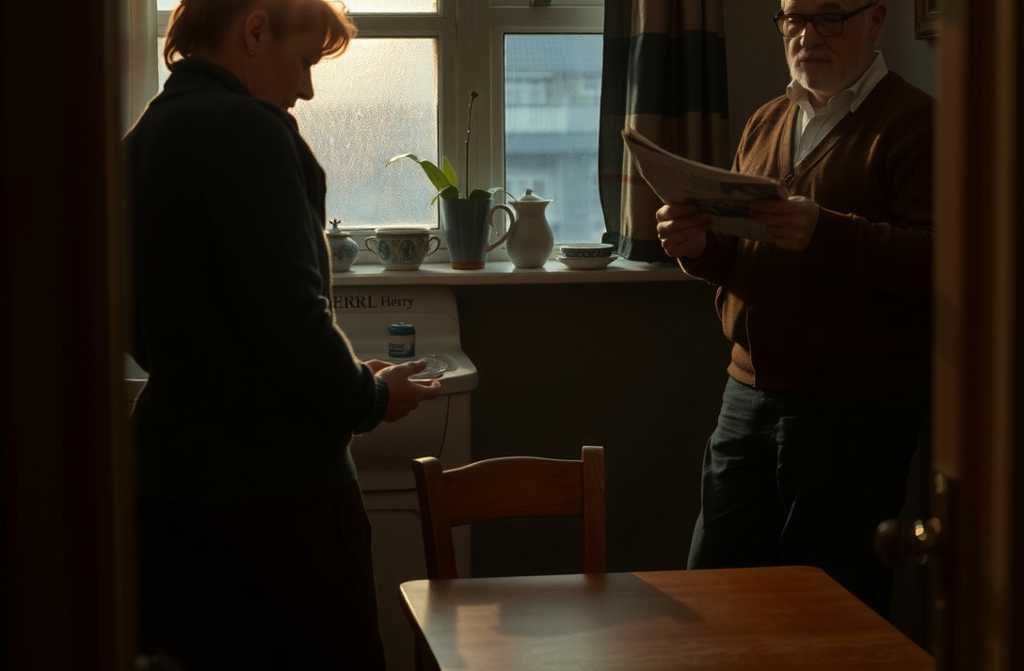
Henry, shall we get a divorce?
Margaret voiced it evenly and with hardly a trace of emotion, lifting the dinner plate from the table without meeting his eyes.
Henry, who had been buried in The Times, lowered it slowly. Silence filled the flat, disturbed only by the grandfather clock ticking in the hallway.
Yes, he said at last. I believe we should.
No tears. No recriminations. Only that brief, sighed word. Margaret felt a peculiar cold emptiness spread through her body. Twenty-three years of marriage, two grown children, their shared London flat, a battered Ford, a small cottage in the Cotswolds. And only one question, now at the threshold: not Why? but Why didnt we do this sooner?
She slid the plate into the sink. The tap ran, filling the kitchen with its familiar rush. Henry methodically folded his newspaper along the creases, as ever. He stood up, walked past without touching or looking at her, and closed the study door. Margaret remained by the sink, studying her blurred reflection in the window: fifty-four. Grey streaks in hair shed long since given up colouring. Wrinkles at the eyes. And this strange weightlessness, mingled with dreada trace of freedom.
The next day they spoke of practicalities. Sat at the kitchen table; notebook and pen between them. Henry scribbled away.
Well sell the flat, he said. Split the money.
All right.
The cottage. Do you want it?
No. You can have it.
Ill take the cottage, you have the car.
I dont drive.
Sell it, then.
Their mature-age divorce discussion was as perfunctory as the time they bought their first fridge. Splitting assets became dull arithmetic. Margaret watched his hand drafting sums and lists, recalled how that same hand, years back, had clasped her waist at their wedding. She was thirty-one, he thirty-fourshe a proof-reader at Penguin, he an engineer at Thames Water. Theyd met at a friends birthday in Camden. He came across as solid, quiet, reliable. She must have seemed gentle, homey, cultivated. Theyd married after six monthsnot out of wild passion, but with the steady conviction it was right.
We ought to tell the children, Henry murmured, pausing in his notes.
Yes.
Well ring them this evening?
We will.
Eleanor, their twenty-five-year-old daughter, lived across town with her boyfriendenergetic, busy, always in a hurry, working in advertising. George, their son of twenty-two, was finishing university, sharing a flat with friends. The children were long grown, long flown. And Margaret realised, with startling clarity, that the only thing keeping her and Henry together had been parenting. With children came shared goalsschool runs, assemblies, clubs, viruses, holidays. They had communicated through the children. When the children left, nothing remained but a void.
That evening Henry called Eleanor, switched to speaker.
Ellie, your mum and I have news. Weve decided to divorce.
A long pause.
What? Are you joking?
No.
But why? Has something happened?
Nothing at all. Its just a decision.
Just decided? Dad! After twenty-three years! Mum, whats going on?
Margaret took the phone.
Darling, its how things are. Weve simply grown tired of one another.
Tired? After all this time? Thats absurd! People get through these rough spells; everyone has them! You could talk, get therapy!
Weve already talked.
But youre not even fighting. Youre fine!
Thats exactly it, Ellie.
She could not comprehend. To her, her parents were the background of lifestable, undramatic. Grown childrens reactions to parental divorce, Margaret found, were more complicated than shed guessed. For Eleanor, it felt like betrayalas if her world had split apart.
George took the news differently. He came the next day, sat at the kitchen table, silent for a long time.
Perhaps you could just reconsider? A holiday? Separate breaks, even? he ventured.
George, weve made up our minds, Henry replied.
But why now? Why not before?
Because, previously, it was about you two.
George looked from father to mother, baffled and wounded. Margaret wanted to explain, but how could she express such private lonelinessthe ache of living beside someone, yet feeling unmistakably alone? How to describe the ache, night after night, as Henry retreated to his study and she sat alone with the telly, longing to scream at the emptiness of it all?
Mum, do you really want this? he asked, quietly.
I honestly dont know what I want, she admitted. But I do know I cant go on like this.
He left, dejected. Margaret remained in the kitchen, casting back to Georges birth. Henry had hovered at the hospital, anxious, and when shown his newborn son, his face melted into shy tenderness. Twenty-two years ago, Margaret believed that children would draw them closer. Make them a family.
They became soon paper, in others eyes. Not deep down.
The first fracture had appeared, she thought, four years into marriage. Margaret was thirty-five, Henry thirty-eight; Eleanor was three, George not yet born. Henry immersed himself in Thames Waters expansion, grew remote. Hed become a department manager, and more and more, work absorbed him. He came home late, tired, wordless; ate in silence, watched the news, went to bed. Margaret tried to talkto share her day, work at Penguin, the manuscript shed proofedbut he nodded, mind lost in blueprints and budgets.
She withdrew, silently, never voiced her resentment. When she conceived George, the bitterness was brushed aside by baby worries. Thats how marriage cracks, she realised: fissures you patch over with busyness, children, habit.
The flat went up for sale. The estate agent, a brisk young woman, paraded couples through their home. Margaret wandered the streets, unable to bear strangers weighing her life. The photo on the mantle of her and Henry by the sea. The corner where the cot once stood. The table round which theyd supper for twenty-three years. How does one begin life anew at fifty-four, when your whole history fits inside a three-bedroom flat?
She met her friend, Susan, for coffee. Susan listened, nodded.
I do understand, you know.
Truly?
Truly. I think about it myself all the time. But I lack your courage.
It isnt courage, Sue. Its desperation.
Maybe so. But youre stepping out. I just quietly burn out.
Susan had been married twenty-eight years. Her husband too, remote, lost in his own world. Theyd taken parallel paths for so long. Margaret saw the same emptiness in her friends eyes as in her own.
Frightened? asked Susan.
Terrified, Margaret replied.
How did you do it?
One morning I realised if I didnt, Id die having never lived.
What if it gets worse?
Worse than this? I doubt it.
They lapsed into silence as the waitress brought the bill. Margaret saw resignation in Susana tired acceptance, and fear, fear of being alone, of not knowing whats next, of judgement. Divorce at their age was not just paperwork, but the undoing of decades. The admission of a misdirected life.
A young family bought the flat. They were noisy, excited, talking plans for renovation. Margaret watched and recalled herself at that agefull of hope, convinced love and day-to-day living would coexist, sure shed never become one of those women who looked back at fifty and wondered what might have been.
They split the money precisely. Henry took the cottage, Margaret the careven though she hadnt driven since a fender-bender a decade ago. Perhaps Ill take some refresher lessons, she mused, see how it feels. Where do you start after divorce? Small steps: a car, perhaps.
She found a modest one-bedroom on a leafy street at the citys edge. Small, bright, empty. Standing there, she tried to imagine livingat fifty-four, alonestarting over. It seemed both absurd and deeply right.
The move went quickly. Henry rented a room from an acquaintance while he looked for a place. They packed quietly. Will you take this? No, you have it. This frying pan for you, these books for me. Twenty-three years of marriage pressed into cardboard boxes in a day.
Eleanor never accepted their decision, phoned rarely, her voice cool. George struggled to keep contact with both, but Margaret saw it weighed on him. The children could not fathom how a family might fall apart without some definite cause. In their eyes, no quarrels meant all was fine. They did not know the slow poison of silence and indifference.
Margaret lay on the new bed in her new flat, sleepless. The silence felt different. No faint sound of Henry shifting on the other side of the mattress. No creak of his armchair in the study, no late-night trips to the loo. Only the low hum of the city outside. She wondered if this emptiness after divorcethis hollownesswould ever pass. Perhaps it had always been there, masked by children, work, and hurly-burly.
She remembered, some fifteen years back, when Eleanor was ten, George seven. Theyd taken a seaside holiday, rented a cottage by the Devon shore. It seemed a pleasant holiday; the children happy, her cooking in the evenings, walks along the beach. But at night, after the children slept, she and Henry sat in silencethe quiet heavy between them. He read. She watched the sea. Shed thought then, Were strangers. Shed banished the thoughttold herself it was just fatigue.
The feeling never left. If anything, it deepened.
She left Penguin years ago after it folded; print was dwindling, the trade transforming. Margaret searched for similar work for a time, then gave up, became a housewife. Henry earned enough for the family. Her income became unnecessarya source, perhaps, of her growing sense of uselessness. The children grown, husband absent in spirit, jobless. She read, watched television, met Susan. Life slipped by, unnoticed.
Late realisation of mistakes is a slow-acting poison. You sense the detour you made, but you cannot retrace your steps. The years are irrevocable. You cannot whisper to your thirty-year-old self, Dont marry himhe is not your person. You can only accept what is and try to move on.
One Saturday, Margaret sat in her tiny flat sorting through old photos: their weddingher in white, him a little awkward but smiling. Baby Eleanor. George’s first tottering steps. Barbecues at the cottage, all sunburn and joy. When did it end, she wondered. When did they stop being a family and become two strangers under one roof?
Perhaps, she mused, it happened by imperceptible degrees: a complaint left unspoken, a sigh missed, a plea unheard, silence where words should have been, habit where love had once settled.
George called one Sunday.
Mum, are you okay?
I am, yes.
Are you alone?
Yes.
Shall I come round? Keep you company?
Come if you like.
He came with cream buns and bags of tea. They drank tea at the cramped kitchen table, George chatting about university and mates and plans. It was plain he wanted to distract her, cheer her up. She felt the warmth of his care and the sting that her son, still so young, felt obligated to look after her.
Mum, he said, when the teapot was empty. Do you really think this is for the best?
I dont know, George. But I can’t go back.
And Dad?
Hes all right, too.
Do you talk?
Now and then, about money, practicalities.
I meant as people.
Not as people, not really, for about ten years.
George hesitated.
I always thought you two were the ideal coupleso quiet, so calm, never any fuss.
Thats just it, George. No fuss. And no life either.
He looked at her, still not understanding. How could he? He was twenty-two, hopeful. He did not yet know how one could share a life and feel horribly alone. How mornings could start with the realisation that another day had slipped by anyhow.
Susan phoned a week later.
How are you?
Im adjusting.
Shall we meet?
Lets.
They met at the same café. Susan looked exhausted.
I envy you, she confessed.
What for?
That you went through with it.
Sue, you could too.
No. Im fifty-six now. Where would I go?
You could finally live for yourself.
I dont know how to live for myself. Ive forgotten.
Margaret saw in her friend the same hopelessness she herself had carried, the resignation, the fear. Divorce at this age upends not just the practical, but the sense of selfit is realising you bet your best years on the wrong certainty.
Margarets days passed slowly. She was learning solitude. Woke when she wished. Had what she liked for breakfast. Watched whatever she fancied on the television. Read late into the night, never worrying about disturbing anyone. It all felt oddsometimes even frighteningbut also liberating, as if some weight shed long carried had slipped away.
She started to walkparks, towpaths, along the embankment. Watching people, watching the city, thinking about what had been, what could have been, and, most troubling, what might be. Fifty-four; a pension in six years. Children grown, ex-husband living his own life, friends all coupled; no work. Money to stretch. What now? See out her days in solitude? Seek out new companionship at fifty-four?
Once, in Waitrose, she bumped into Henry. Both paused, nodded cordially.
Hello, he said.
Hello.
How are you?
All right. And you?
Also all right. Ive found a flat.
Good.
They stood amid the aisles, shoppers weaving around themtwo people who had shared twenty-three years, now with nothing to say.
Well then, goodbye, he said.
Goodbye.
She watched him go, oddly relieved. There was no pain, no sorrowjust an emptiness, as if shed glimpsed a stranger shed once known in another life.
Autumn faded to winter. Snow sprinkled the city. Margaret sat at her window, watching fat, slow flakes turn the world white. In childhood, shed loved winter. Later, it became only cold and melancholy, a symbol of time passing. Yet, as she watched the snow settle, she felt a kind of peace.
George visited regularly, bringing groceries, fixing what broke, just sitting nearby. Eleanor, by comparison, called rarely; when she did, it was brief and reserved. Margaret did not resent her; she understood that it would take time, if ever, for her daughter to come to terms.
Before Christmas, George called:
Mum, come celebrate with uswere all together; itll be fun.
Thank you, George, but Id rather be home.
On your own, Christmas Eve?
Thats all right.
Its a bit sad.
No, its just how it is.
She spent Christmas aloneset a tiny table, poured a glass of bubbly, watched the Queens Speech. As Big Ben struck midnight, she raised her glass.
To new beginnings, she whispered.
She drank, and the bubbles were bitter. She set the glass down and, for the first time in all those months, wept. For lost years, for unfulfilled hopes, for the life never lived. What might have been.
But, when the tears stopped, she dried her face, cleared away, and went to bed. In the morning, the empty space inside her head felt fresh.
January crawled by, bleak and black. Margaret ventured outside little. Read, watched films. Occasionally phoned Susan, but they had little to say. Life became waitingfor what, she wasnt sure.
In February, Henry rang.
Margaret, we need to wrap up the last bits of paperworkfinish it all off.
All right. When?
Friday. Ill come round.
And so he came. She had tea, papers ready. They sat and signed. The pen scratched, the pages whispered.
Thats that, then, he said. Official now.
Yes.
He drank his tea. Margaret watched himgrey hair, tired lines, familiar gestures. For twenty-three years, she had woken beside this man, stitched patches in his shirts, heard his silence.
Any regrets? he asked.
No. You?
Neither.
Silence settled.
You know, Henry began, I always thought we werewell, normal. No real problems.
That was the problem. No problems, but no feelings, either.
Perhaps youre right.
He fetched his coat.
All right then. Wish you all the best.
And you.
At the door, he looked back.
Ring if you need anything. Ever.
Thank you.
The door shut. Margaret was alone. She hugged her knees on the sofa. Twenty-three years, finished with tea and a polite word.
She picked up her mobile, found their wedding photo. Young, expectant faces. She gazed a while, then pressed delete. One by one, she erased every photo of them togetherthe faces fading, the past dissolving.
Afterwards, she stood on her balcony, the night wind raw. The city stretched below, vast and indifferent. Henry somewhere out there; Eleanor, George, Susan, other women her age, at their stoves, pondering: Could things have turned out differently?
She returned inside, shutting out the dark. She faced her reflection in the bathroom mirror: fifty-four years, grey hair, lines about the eyes. But something was new in her gazenot joy, not hope, but perhaps resolve, or merely acceptance.
She remembered how, at university, she had dreamt of being a writer. Short stories, poemsyet marriage and children had blurred ambition. Proofreading at Penguin was close to books, not quite hers. She edited others words, never wrote her ownno time, no voice, no memory of wanting.
Now, in a little flat off the North Circular, she thought, Why not? Fifty-fournot seventy-four, not eighty-four. Theres still a dash of time. Perhaps shed write that book shed always postponed. Maybe no one would ever read it. But it would be hers.
March arrived, casting off the frost. Snow melted to reveal the murk of springs promise. Margaret walked for hours, nowhere in particular, watching the reawakening city, the lighter sky.
One day, in Hyde Park, she saw an elderly couple walking hand in hand, stopping every few paces, sharing a joke, laughing. Margaret watched them, torn by envy and a subtle solace. They had found their way together, but she had chosen hersnot to see out her days in the cold presence of a stranger, but to face the unknown honestly.
Late in March, Susan rang.
Listen, she said, almost whispering. Ive filed for divorce, too.
Margaret stilled.
Truly?
Yes. I couldnt stand it anymore. You were right. Alone is better than this.
How are you?
Terrified. Yet lighter.
I know.
The two women held the receiver in silence, together but apart.
Thank youSusan said at lastfor showing me its possible.
It is. Terrifying, painfulbut possible.
April brought warmth. Margaret began seeking worknot purely for money, though it was shrinking, but because she needed purpose. She applied for jobs: at the library, a bookshop, as an editorial assistant for a small press. Each time came the old replywe’ll let you know. They never did.
Fifty-four. The job market considered her over the hill. Still, she kept trying.
George visited in May.
Mum, Ive met someone. Her names Alice. Been together three months already.
Margaret smiled.
Tell me about her.
He spoke, excited, full of plans. Margaret watched her sonso certain, so hopeful. This is how it begins, she thought: infatuation, dreams. What then? Would they be strangers, too, after twenty years? Or would they be luckier?
Mum, George asked, do you regret divorcing Dad?
Only that I didnt do it sooner.
Really?
Truly.
But youre not exactly happy now.
No. But Im not miserable as I was before. Its not the same.
He mused.
Do you think all marriages end like this?
No. For some it worksthey talk, listen, grow together. But your father and I didnt.
How can you know if you can?
I wish I knew, George. If I had, perhaps things would have been different.
He hugged her tightly as he left. Tears almost came, but she held them back. No need to load her children with her pain.
May drifted into June, the city glowing with green and sunlight. Margaret was called for an interview at a tiny publisher nearby. Only seven staff, specialising in local history. They needed a combined editor and proofreader. She visited, chatted with the silver-haired director, who after glancing at her CV declared:
Youll do nicely. Can you start Monday?
Outside, she paused, uncomprehending: Workshe had work again. A small pittance, a poky cubicle, but stillhers.
She rang Susan.
You wont believe itIve got a job!
Thats wonderful! Im thrilled for you!
And you?
Not bad. Hes left. The kids wont speak to me. But I can breathe, at lasttake a deep breath.
I get it.
They met that night, toasted with a cheap bottle of red. Talked of the future, of starting over, of how it was both terrifying and, somehow, necessary.
You know, said Susan, at fifty-six I know there are no fairy tales left. But, at last, Im meeting myself.
Yes, Margaret replied simply. Thats what matters.
July baked them. Margaret adjusted to her routine, to colleagues, the daily commute. Shed forgotten how bracing work could behaving a reason to get up, a place to go, people to speak to beyond her own four walls.
In August, Henry called.
How are things?
Fine. Back working.
Really? Good for you. I meant to say: Ive started seeing someone.
A jolt, brief and ambiguousnot jealousy so much as the confirmation of finality.
Thats good, Henry. Im glad for you.
Thought youd best hear it from me.
Thank you.
She hung up, sat gazing at the windowlife had moved on for him, for her too, in a different way. She didnt need anyone elseonly to be enough for herself.
September brought crisp winds and rain. Eleanor unexpectedly arrived for tea. She fidgeted, unsure where to begin.
Mum, she blurted at last, Im sorry. I was wrong. I was angry at you.
I understand.
No, truly. I thought you were selfish, thinking only of yourself. But nowIm struggling with my own relationship, and I see it. Sometimes, leaving isnt weakness. Its strength.
Margaret took her daughters hand.
Thank you for saying it.
Are you happy?
Im not sure what that is. But I can breathe. Its something.
Octobers gold. Margaret commuted, came home, read, and began to writea page at a time, awkward, halting, but hers. Maybe no one cared. The important thing was to try.
One evening at the window, she admired the city lights. People and machines, lives intersecting. She was part of that river of existencesmall, inconspicuous, but in the current.
Fifty-four: divorce, solitude, a one-bed flat, a junior job, unclear tomorrows. It wasnt happiness, but it was honest. Honest at last.
Perhaps this, Margaret thought, was the real beginningnot bright or sweet, just sincerely hers.
November: leaden skies, icy. She bumped into Henry in the streethe with a woman on his arm. They nodded distantly, passing like strangers.
No pain. Just a blanknessan emptiness unshackled, making space for the unknown.
December, and Christmas approached. Margaret bought a little tree, adorned her flat. George and Alice promised to visit for New Years; Eleanor too. Susan asked her to join them in celebration.
New Years Eve: Margaret looked back. A year ago, she had sat in that old flat, uttering Lets divorce. It had all started then.
Was it right? She didnt know. Maybe, years hence, shed regret it. For now, she could breathe.
This time, she didnt spend it alone. George, Alice, Eleanor, Susanthey gathered round her table. Laughter, sharing plans and doubts. At midnight, Margaret raised her glass:
To new beginnings.
The others echoed.
They drank. Margaret looked at her children, her friend, her small home. This was not a happy ending, nor truly a beginning, but a continuationhers. Not perfect, not what shed dreamed, but her own.
January. Unexpectedly, Henry rangdocuments to hand over, last keys for the cottage. They met in a café, by the window. He slid across the papers and keys.
Heres all thats left.
Margaret fingered the cold metal.
Thank you.
They drank coffee, silence settling.
How are you? he asked.
Living. Working. You?
The same. I remarried, actually.
Congratulations.
Thank you.
They finished, awkward, heavy with things unsaid.
You know, he said, perhaps we were hasty. We could have tried.
Margaret studied him. In his eyes, no sadness, only uncertaintyseeking validation.
Not hasty, she answered. Ten years too late.
Quite so.
He paid, they stood, parted on the pavementcold, bleak January air pressing between them.
All the best, he said.
And you.
He strode away; she in the opposite direction, feeling the finalitynot when papers were signed, or when he left, but now, as they parted like acquaintances.
She returned home, left the keys on the sideboard, sat by the window. The city sprawled, unfeeling. Henry somewhere, returning to his new wife; George and Eleanor, building their own lives; Susan forging hers.
Margarethere. A flat in outer London. Alone at fifty-four; the past behind, the future unclear.
Was she frightened? Yes. Was it right? Only time would tell. But it was her choice, her life. And perhapsjust perhapsthere is something ahead for her. Not necessarily joy, not perhaps another love, but something real. Her own.
She stood, opened her notebook, took up her pen. And began to write. Hesitantly, slowly, but writingher own story. Of a woman who lived twenty-three years in marriage and, at fifty-four, decided to begin anewnot knowing the ending.
It was a beginning, not an end.





