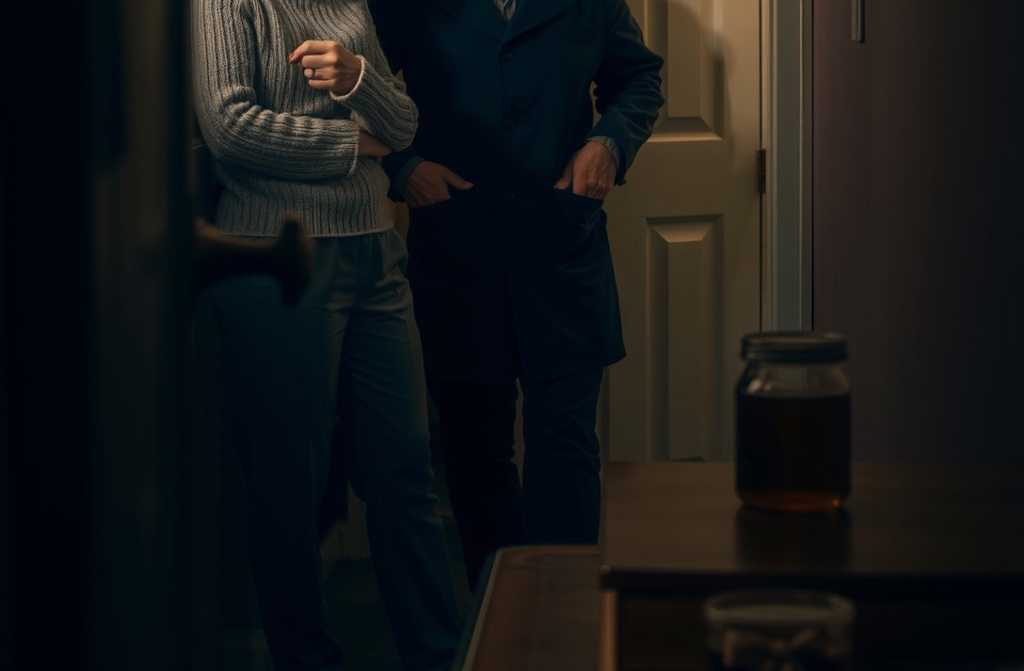
An Unclenched Fist
“Are you deaf? This is the twentieth time Ive called!”
“I dont wish to speak with you, Richard.”
“Thats a shame. Evelyn thinks we should talk it over like civilised adults.”
Marys fingers gripped the phone so tightly her knuckles blanched. “Like civilised adults” echoed hollowly in her mind. She stared at the rain-streaked road ahead, wipers spreading water in neat, almost hypnotic arcs. That steady rhythm was the only thing tethering her to reality. The tarmac gleamed dark as gunmetal, like the underbelly of the evening sky itself. Headlights split through the dusk and rain, not so much drops as glistening threads pulled tight between earth and the clouds.
“Mary. I can hear you breathing.”
“Can you?” she said. “Then I must still be alive.”
She ended the call, letting the phone fall silent on the passenger seat. It buzzed again, and she pressed her palm to it, as though soothing something wounded and trembling beneath her. She declined the call without looking. Outside, the rain was intensifying.
She couldnt remember leaving town. It had simply happened: gridlock faded, traffic lights disappeared, and drenched fields stretched away on either sideblack as ink. The road was almost empty. Now and then, a pair of headlights flashed by, painfully bright, forcing her eyes to squint, but she kept her speed constant.
A month ago, she had been trying on a dress. Simple, ivory, clean lines. The dressmaker had told her it caught the light. Mary had laughed then, preening in the mirror, feeling something warm rising in her chest. Now the dress hung pristine in its cellophane cocoon, untouched in her wardrobe. Shed not even opened the door since.
Two weeks back, Mary had gone to Evelyns flat after days of silence. Richard answered the door, dressed down, surprised in the way only those can be who both expect and dread a confrontation. Behind him, in the hallway, she glimpsed Evelyn, mug in hand.
Mary hadnt shouted. She stood for several silent moments, turned, and left. She called an hour later, once Richard had left. Calmly: “Your things are in the corridor. Leave the key under the mat.” Richard talked, explained, pleaded. She listened to his voice as if overhearing a radio in someone elses home. Finally, she said, “I understand,” and hung up again.
That had been a fortnight ago. Since then, she ate, drank tea, answered emails, and dutifully showed up at her modest publishing house. At night, she lay wide-eyed, counting the ceiling cracks. Each morning, she held her hands under hot running water, just to feel something.
Numbnessthe woolly, aching absencewas everywhere now. In her chest, behind her ribs, in the pit of her stomach and her mind. Not pain, not sharp and edged. Simply a space, vast and white, where something had stood before.
The wipers swept on. Mary had been driving two hours, she guessed, though she wasnt clock-watching. The road narrowed, then climbed, and suddenly the woods closed in on both sidesthick, dark walls. The rain drummed steadily on the roof, a strangely comforting sound. Here, finally, no one asked, “Shall we talk this through like adults?”
Thats when she saw her.
Or perhaps it was not so much seeing, but sensinga woman by the roadside, and the brakes juddered beneath Marys foot, slewing the car onto the wet verge. The woman didnt flinch.
Mary wound down the window.
The stranger wore an emerald coat, not just green but deepas if cut from antique glass. It fell to her ankles and wasnt at all damp, though the rain lashed down relentlessly. A neat brimmed hat had slipped to one side. She clutched a small leather bag, peering at Mary with composureno fear, no plea. Simply watched.
The woman must have been nearly eighty. Her face was welllined but kind, eyes clear as shallow water. Her mouth was set, not quite smiling, but gentle.
“Can I give you a lift anywhere?” Mary croaked. It was the first time she had spoken aloud for hours.
“Toward Willowby, if its no trouble,” said the woman.
Mary didnt know Willowby. Still, she nodded and unlocked the door.
The woman settled into the passenger seat with precise grace. Her bag remained on her knees. Mary noticed, offhand, that the emerald coat stayed dry; she didnt ask how. She put the car in gear and started off.
“My names Vera Penrose,” the woman said, without waiting for introduction.
“Mary.”
“I know, dear Mary.”
Mary glanced over. Vera was looking straight ahead.
“Do you know me?”
“No. But its a name that suits you. Honest and vital. Like bread.”
Mary said nothing. Normally, she would have been cautious, especially about mysterious strangers at night, but now a deep indifference held everything at bay.
“Its heavy for you just now,” said Vera. It was not a question. She said it the way one would mention the weather.
“At times,” Mary murmured.
“It happens.” Vera nodded. “The earth doesnt drop away at once. At first, you simply cant trust its firmness, walking on it, wondering if itll hold you up or not.”
Mary swallowed.
“Yes. Something like that.”
Silence. Endless threads of rain flickered in the beam of the headlights.
“Ill tell you a story, if you like,” Vera said. “Roads are long at night.”
“Please do.”
“I was twenty-three when I met my Henry,” Vera began. “He wasnt a looker, mind younot tall, wore his collar funny, always narrowed one eye when thinking. But his handshis hands were warm. I knew that instantly. First day I met him, he offered me my coat, and in that moment, I thoughtheres a man with warm hands. The rest came later.”
Mary drove on, listening.
“One day we fought so bitterly, I flung the ring hed given me straight into the sea. A garnet, it was. Rather lovely. I always regretted it. I stood on the shore watching it vanish, as though part of myself was gone too. But Henry wasnt angry. He pulled out a handkerchief, blew his nose, and said, Well, never mind. Well buy a new one. Thats when I knew he was mine forever.”
“And did you have long together?” Mary asked quietly.
“Fifty-one years. He went quietly, three years ago. I thought I wouldnt endure it. But you do, dont you? You survive almost anything. Its a surprise, and a bit of an injustice.”
Marys grip on the wheel eased. Something deep beneath her ribs ached, that frozen place she tiptoed around.
“Werent you afraid?” she asked, realising the question before shed intended it.
Vera studied her thoughtfully.
“Afraid? My whole life. I just got used to being afraid and opened up anyway. Thats all love is, Marydoing it though it terrifies you.”
Mary didnt answer. The road shimmered before her.
“Hereleft at this fork. Past the rowan youll see the sign. Do you see it?”
Mary spotted a faded white sign, nearly lost behind the branches: Willowby. She stopped at the turning. Vera collected her bag and slipped outside.
“Wait,” Mary called. “I dont know why you told me all this.”
“Why?” Vera set her dry coat straight. “Simply because, dear. Remember this: a month to the dayleave your top lock undone. Then the past will pay its debt, and the future will knock.”
“What does that mean?”
But Vera was already walking away, her emerald coat swallowed by the night woods before Mary could even climb out.
She sat at the fork for a long while, then eventually turned back for home.
***
A month is thirty-one days. Mary didnt count on purpose, but each morning she woke, she knew another had gone. Life after betrayal, she found, is relentlessly simple: Get up. Clean teeth. Stare in the mirror longer than neededchecking: is it still me? And on to work.
Mary was an editor at a small London publisher. She arranged commas, trimmed off redundancy, made order from words. It had always been an easy job, and now, easier still. Her mind was occupied, her fingers busy, and she didnt have to think. Colleagues glanced her way with an awkward concernwanting to show sympathy, not knowing how. She pretended not to notice.
Evelyn called just once. Mary saw her name, ignored it, and then deleted the contact. It wasnt an angry act, just exhaustion. There was neither energy for anger nor words for conversationa blank square where the name had been.
Richard sent her a long message. She read the first two lines and tucked her phone away. The next day another message, then another, and then silence.
Each night, Mary dreamed she was standing at waters edge. Grey, uneasy sea, persistentsomething tugging her gently under, not fearful, simply unrelenting as a hand pulling by the sleeve. She woke in the dark, listening to the flats silence, thinking of everything except the one thing she ought.
Gradually, drop by drop, life crept back. Not joy, precisely, but the capacity to notice: morning coffees taste, the skys subtle blue between clouds, the smell of book pages fresh from a parcel. Trivial things signaled: youre here, youre breathing, you go on.
Mary remembered Veras words. Not consciously; they would just surface like driftwood in a slow current: “The past will pay its debt; the future will knock.” She didnt believe in omens but nonetheless, soon left off bolting the top lock out of habitone of those things you do without knowing exactly why.
A month to the day of that night ride, she woke late, made coffee, opened the window to the citys bustle, and went back to work on a script due by Wednesday. At three oclock, someone knocked.
Not the bell, but a knocka clear, strong three taps.
Mary paused a moment, then went to the door. She peered through the spyhole. A man around forty, dark-haired and straight-backed, stood outside holding a wooden box and a glass jar filled with something translucent.
She opened the door without asking who he was. Then she rememberedthe top lock was unbolted.
“Mary?” he asked. His tone was certain, as if he already knew.
“Yes.”
“Im Daniel. Vera Penroses grandson.” He didnt hold out his hand, just offered his name. “She passed away three weeks ago. Im sorry.”
Mary was confused at first, then guessed he thought she had known Vera much better.
“Come in,” she offered.
He entered quietly, scanning the room out of habit, not curiosity. He set the box on her little table, placing the jar beside itwater, slightly golden, with fine sand at the bottom.
“Thats seawater,” he said, seeing her glance. “In her will. She was a singular sort, my grandmother.”
“I know,” Mary replied. “We drove together. A month ago.”
Daniels gaze sharpened.
“She offered you a lift?”
“I gave her one. To Willowby.”
He digested this. Nodded.
“That clarifies things. The will says this ring is to go to you.” He opened the box. Silver, with a garnetdeep red, almost brown at the edges, like baked cherries. “Both your name and address are here.”
Mary looked at the ring.
Something inside her shifted. Slowly, like a great sheet of ice stirred by currents far below.
Five years ago, she had stood at the seaside with Richard. Theyd rowedover what, she couldnt remember, only that it felt crucial. Shed pulled the ring hed given her, pre-love, impulsively, simply because she liked the garnet, and thrown it into the water. Not meaning it, just in pain; we all do foolish things, when wounded.
Afterward, shed felt ashamed. Theyd made up. The ring was lost.
And yet, here it was.
“Mary?” Daniel called softly. She said nothing. He waited.
“May I?” she whispered, reaching.
“Its yours.”
She cupped the ring in her palm. It felt unexpectedly warm, alive. The gem flared with a hidden light from the window: a spark at its heart.
“Theres one more thing,” said Daniel. His voice was practical, like reading legal terms. “The will says we must go together to Willowbysort out the house deeds. Youre listed as co-beneficiary. Dont ask me why. You could refuse, of course.”
“No,” Mary replied, perhaps too quickly. “Ill go.”
He observed her for a second; then his expression softened minutely.
“Next weekend?”
“Yes.”
He nodded, took the box (leaving her the ring), and moved to the door. He paused.
“The jars yours too. The instructions are in the envelope. I havent read them.”
“All right.”
“See you Saturday,” he said, and left.
Mary stood for a long time in her kitchen, clutching the ring. Then she picked up the envelope affixed to the jar. A few lines, hurried, in indigo ink:
“Mary dear, the sea loses nothing. It only holds until the time is right. This is water from that very cove. Just set it on your window. The sun will do the rest.”
***
Daniel arrived Saturday morning, exactly at eight. Mary was readybackpack, coat, keyspacked not for business but as though she might be gone a while.
He was waiting in a tidy Land Rover, dressed down, not as formal as last time, or perhaps she was just seeing him differently.
“About three hours drive,” he said, as if greeting required only weather and traffic.
“Saturday morningshould be clear,” she replied.
“Usually is.”
They set off in silence for forty minutes. Mary watched the city thin out, finally replaced by tilled fields. The sky was a soft, featureless grey.
“Were you often at your grans?” Mary asked at last.
“As a boy.” Daniel nodded. “Less, later. Especially lately. Work gets in the way.” He paused. “The usual story.”
“Was she often alone?”
“There were neighbours. Small villageeveryone knows everyone. She wasnt lonely. She had her garden, her journals, and the conviction that lifes arranged just right, even if you cant always see it.”
Mary smiled. It sounded just like Vera Penrose.
“Did she ever mention me?”
“No. Just the name and address in the will. She was always doing things that only made sense with time.”
“You dont believe in fate,” Mary said.
“I dont,” he replied. “You?”
Now Mary was honest. “I used not to. Now, Im less sure where chance ends and something more starts.”
He didnt answer, but seemed to think.
Willowby was no more than a cluster of old cottages. A lane led through pines, then burst onto a little green. Veras house sat at the enda weathered, two-storey whitewashed place, blue shutters, geraniums dry in pots.
Daniel opened up. The house smelt thick, safelavender, beeswax, wood, something like the memory of happy childhoods.
“No central heating,” he apologised. “Only the fireplace. Ill sort it.”
Mary wandered the cosy rooms. In the main bedroom hung a photograph of an elderly man in a crooked collarHenry, surely.
The sky outside suddenly darkened. Mary only noticed when she stepped onto the porch: a wall of black cloud was climbing up over the open country, swallowing the daylight.
“Daniel!”
He came, surveyed the horizon. His calm mask hardly shifted, but as he pocketed his phone and found no signal, she could see worry.
“Lets get inside.”
Together, they fastened shutters, fetched logs. The storm was abrupt, as if someone had opened a vast door. The house shivered with wind; trees bowed nearly double. Then the lights went out. Just like thatdark.
“No generator,” said Daniel. “Candles are in the dresser. She always kept a supply.”
He moved with practised certainty. The tremor in Marys hands took time to ease. Soon, candle flames sprang up, and Daniel nursed a fire into life in the grate.
“Wine,” he said, producing a dusty bottle. “Gran would stash it awaynot for visitors she expected, but for those she didnt and, it turned out, needed.”
“An old tradition?”
“Shed say: the best wines not for those you anticipate, but those fate brings you.”
Mary sipped. It tasted of strawberries and soil. She eyed the shelf stacked with battered notebooks.
“Her journals?”
“Looks like it.”
“May I?”
A pause. Then Daniel nodded. “She didnt lock anything. So, yes.”
Mary opened one at random. Veras handwriting was bold and uneven.
“Today I sulked over nothing. Three days of silencemy mistake. When you stop speaking, you think youre punishing someone. Really, you just lose three days you might have spent well.”
Mary read it twice, handed it over. Daniel read in turn, passed her another entry.
“My Danielbrilliant like Henry, stubborn like me. Bad mix for happiness. Clever folk look for explanations when they might surrender instead. Stubborn ones never back down, even when theyre right. Learn to admit mistakes aloud, my dearnot easy, but the only thing that helps.”
Daniel read it slowly, then rested the book on his knees as the fire snapped and hissed.
“She wanted you to read these,” Mary said softly.
“Of course,” he replied.
They read until late, alternately aloud and in silence. Veras life filled the pagesnot as story but as an inner voice on fears, joy, the day Henry brought home a stray cat without asking, and how love and fear are, sometimes, only a hair apart. She wrote, “The sea loses nothing,” in one.
Mary closed the cover, watching the flames.
“Daniel,” she ventured, though she wasnt sure what to say.
“Yes?”
“Are you lonely? In London, I mean?”
He was quiet a long time.
“Not lonely, as people generally mean it. Im occupied, but theres no one in particular. You understand?”
“I do.”
“And you?”
She smiled faintly. “There was someone. A fiancé. I found out, a month ago, that I wasnt the only one.”
He didnt say “Im sorry”just nodded. It was, somehow, the best answer.
“Does it hurt?”
“It did. Now its more likelike when youve been clenching your fist so long you finally let go. Youre not hurting anymore, but your fingers wont move right.”
“A good analogy.”
“Im an editor. Finding words is easier for others stories than my own.”
He watched her, shadows from the fire softening the set of his face. Perhaps she looked at him differently now, too.
“Gran wrote something else for you,” Daniel said. He hesitated, then produced a slip of paper from his pocket.
“Daniel, meet the girl with the garnet with an open heart. Shes as frightened as you. Thats nothing to fear.”
Mary folded the note, returned it.
They fell quiet. The crackling fire sounded louder now, the storms fury muffled outside.
What happened after wasnt destiny at work on a page. It happened because they were both human, both tired, both alive in the half-light, carrying something heavy for too long. Mary couldnt remember who leaned in first, only the warmth of his hand on her cheekand the absence of fear.
By morning, the storm had passed.
***
The lane was a little flooded, but manageable. Daniel drove quietly, Mary watching the woods glitter with drops. Every branch was laced with dew, ablaze in the pale sun.
He dropped her at her block of flats. Daniel carried her bag. There was a pause.
“Ill call,” he said.
“All right.”
But the way he said itthere was something closed, as though a door swung close but didnt lock. Mary nodded and went inside.
He called five days laterbusinesslike, questions about paperwork. She replied in kind. A text about a document. Another reply. Silence.
Mary tried to read that evening, but couldnt keep her place. She stared at the jar of seawater, now half-evaporated, leaving a delicate web of salt crystals on the inside of the glass.
She remembered the feel of Daniels hand in the dark. Not analytically; she simply sat with it, let it be. Warmth, and trusttrust she hadnt felt in a long time.
And now”Ill call,” and quiet.
She understood Daniel, maybe better than he realised. People who control everything are often just as scared, just better at hiding the tremble as distancecontrolled, cool, but afraid all the same.
But knowing isnt the same as accepting.
Two weeks later, Mary rang him. He answered right away.
“Daniel, I want to return the ring.”
A silence.
“Why?”
“I think its a mistake, me keeping it. Vera left it, but I dont know why. And about what happened between usI’m not going to pretend it was nothing. But if youve decided otherwise, Im not going to hang about, hoping.”
A long pause.
“I havent decided otherwise,” he said at last.
“Daniel.” Her voice was truly weary now, not bristling but flat. “You called once, texted three lines, and the rest is silence. If you wanted something more, you would have said.”
“Its not that simple.”
“I know. But silence means something too.”
Another pause.
“All right,” he said. “Ill come for the ring.”
He came the next day. Mary handed him the box at the door. He took it, remaining on the threshold. Looked her in the eye. She met his gaze.
“Mary,” he began.
“Goodbye, Daniel.”
She closed the door. Leaned against it brieflythen went to put the kettle on.
***
Three more weeks slipped by. The time after Richard had been numb, foggy. This was sharper now: pain with a name. She worked as much as she could, taking extra projectsediting a memoir about women finding themselves, real stories, and catching herself reading for meaning instead of errors.
Her mother called mid-week.
“How are you, darling?”
“Im all right, Mum.”
“You sound as all right as you used to when you were fourteen and said fine while sitting in your room in tears.”
“Im not crying.”
“Not sure thats better.”
Mary allowed herself to laugha brief, honest laugh. Something ached in her, but gently.
“Mum, Ive made a few mistakes, one on top of another. At first, someone elses, and now my own. Ill be all right.”
“Come for tea this Sunday. Ill bake cake.”
“Id like that.”
On Thursday, word reached her through an old contact at an architects office. They chatted idly, then the friend mentioned: “You know, Daniel Penrose, found your address through us a while backhes bought a ticket, I hear. Londons losing another soul.”
Mary took it in stride. “Yes, I know him.” Changed the subject. Hung up. Going for good.
She wandered to the window. The jar of saltwater was nearly empty now, an intricate white tracing left behind.
And just then, she remembered Veras words: “When youre silent, you think youre punishing someonebut youre really just losing your own time.” She remembered all the silence: hers, his, both waiting for the other to speak first.
Two stubborn souls. A bad match for happiness.
Mary returned to the table, opened her laptop. Typed: “Daniel, whats your flight?” Deleted it. Typed, “Can we talk?” Deleted again. Settled on, “Please call.”
Her phone stayed mute all evening.
The next morning, early, Mary woke before dawn. Stared at the ceiling. She reflected that real life isnt a noveltheres no neat ending, only a sequence of choices. Fear of being hurt twice after betrayal is natural, like an instinct. But fear lies: it says, “Dont open up; it will hurt.” In truth, staying closed only ensures a different painquieter, but real.
Mary rose, washed, drank her coffee. Put on her coat.
She didnt know Daniels address, only that he was flying. She remembered the architects office, rang up: “Sally, do you know when Daniels flying out?”
“Oh, he told Tomtomorrow morning, first thing, he said.”
Today was all she had.
She didnt drive to his flatshe didnt know where it wasand a letter seemed wrong. Instead, she went to Heathrow and waited by the London flight check-in, silly as it felt. He could have taken another entrance, might already be through, but she waited with takeaway coffee, feeling like the heroine of a bad romantic film.
Eventually, she gave up, walked out to her car.
Thats when someone rapped at her window.
She turned. Daniel stood there, bag in hand, ticket poking from his pocket. He was a little breathless, as though hed hurried.
Mary wound down the glass.
They stared a long while.
“I couldnt go through with it,” he admitted. “Waited at the gate, realised I had no real reason, only a contract, but not a reason. Here, I have one.” He held her gaze. “Gran was right. My walls come down.”
Mary said nothing, just opened the door and stepped out.
“Mary” Daniel hesitated. “I know youve had a rough year. That you might not trust. Im not used to trusting, either. I dont want Londonthat house in Willowby, I want to restore it. Gran left half to youwe can do it together. Not for paperwork, but becausebecause Id like you beside me.”
Mary took the box. Opened it. The garnet ring, fire at its heart.
She slid it on. It fit perfectly, as if it belonged there all along.
“Arent you frightened?” she asked softly, her lips tasting faintly of salt.
“Terrified,” he smiled, holding her hand. “But Ive learnedbeing afraid isnt running.”
She answered only by not moving away. The airport sky was pale spring, unremarkable, just another morning.
Just a beginning.
Much later, at home, Mary stood by her window. The jar remainednow nearly empty, only white salt veining the glass like frost.
She thought of what Vera Penrose had written: “The sea loses nothing. It holds until the moment is right.”
Perhaps thats all we docast precious things into the water, in anger or pain or youth, and the sea keeps them, returning them when we are able to receive them. Sometimes, in a different form; sometimes, in the warmth of someones hand who knocks on your car window and says, “My wall has come down.”
Mary smiledquietly, to herself.
The outside world murmured, the story of loss and forgiveness running on. There wasnt an endingonly the next page, and another, and thats the best thing of all: when a story doesnt finish where you expected.
Soulful tales are written, not in words, but choices. Small, daily choices, almost invisible. To open the door or to keep it locked; to step out of the car or turn away; to wear the ring, or forego it.
Mary looked at her hand. The garnet caught the lamplight, glowing deepalmost cherry-brown at the edges, and always, curiously, warm.





