The Unloving Husband

Linda, youve come back? Youre not telling me youre working with us again?
The entire office buzzed as soon as Linda stepped through the door. Colleagues turned away from their screens, curiosity sparkling in their eyes as they took in their former coworkers return.
Not at all! I just missed you all and thought Id pop by, Linda laughed.
She looked radianther hair freshly styled, a chic dress in the latest London fashion, a lovely new handbag slung over one shoulder. But admiration didnt last long: Rita and Julia swooped over, each taking an arm, as they spirited her away into the corridor.
No point letting them pick you apart like old hens, Rita quipped, tossing her auburn curls. Alright Linda, spill it! Why did you vanish without a trace when you got married? Not even a phone call! Where did you two end up? Do you have children?
I married, moved to Manchester, and yes, I have a sonhes five now. Another thing: Mum fell ill, so we sold our flat and moved closer to her. Bought a new place so I could help care for her. Theres not much else to say really. You must come over tonightIll lay the table and well have a proper natter.
Just us, or can we bring our other halves?
Just us, best keep it girls only, Linda replied, a little shyly.
All three friends had edged past thirty. Rita brimmed with mischief and tactlessness, forever saying the wrong thing and occasionally bruising feelings. Julia, in contrast, was gentle and considerate, always wanting to phrase things delicately. Each had a daughter from a previous marriage and was now establishing new relationships. That evening, Rita and Julia arrived clutching a bottle of prosecco, their voices echoing down the hall.
Shhh! Linda whispered, finger to her lips. Keep it down, lovelies. My husband and son are working on something in the living room. Come through to the kitchen.
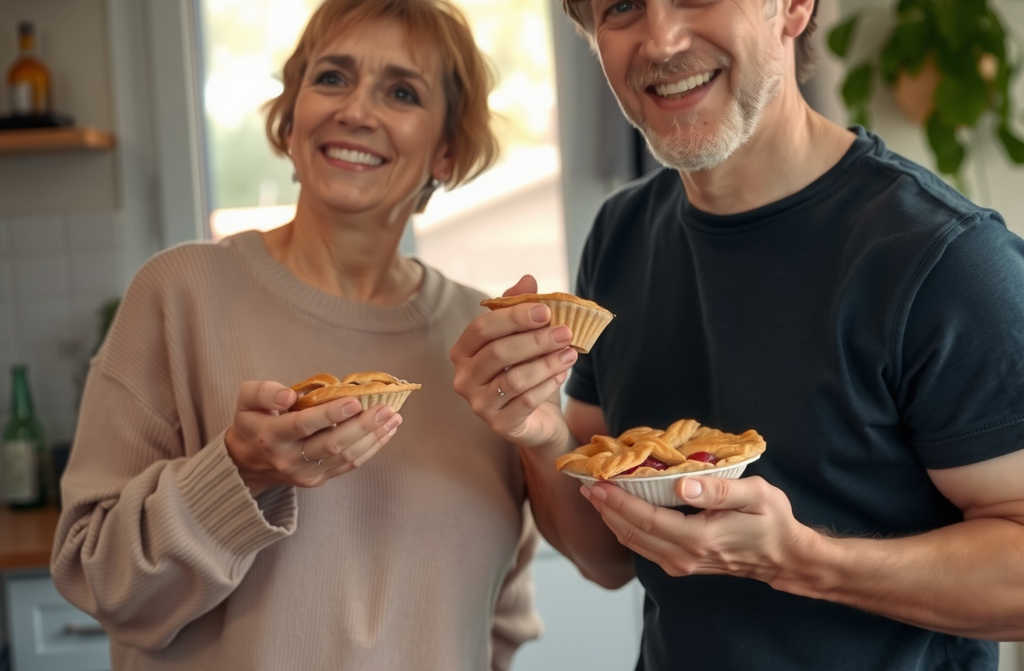
The kitchen table was set with an array of nibbles, and pride of place was a large cherry pie, its crisscross pastry glistening under the lights.
Simon made it, Linda admitted, smiling. I just stoned the cherries, that was my entire contribution. Hes the baker in the familyIm hopeless.
Oh, go on! Introduce us to this diamond who not only helps with the boy every evening but also bakes! Rita joked, waggling her brows.
No, nolets pour the fizz instead, Linda laughed, waving her hands dismissively.
They slipped into gossip and laughter for almost an hour before Simon finally appeared.
Evening. Hello. His curt nod was his only greeting as he filled his glass with water, then disappeared as quickly as hed come.
Rita leapt up, mimicking Simons bear-like stride, his grumpy look as he poured water, then vanished again. The friends howled with laughter.
Well, yes, thats himnever the affectionate sort, Linda conceded, a soft fondness in her eyes.
So youve ended up with a grump? Julia asked carefully.
Not at all, Linda shook her head firmly. Hes never once raised his voice to me. He just doesnt do the words, you know? Tells me he loves me quietly, just a handful of times since we married, and never in front of anyone. No soppy gestures, no public hugs or kisses. Hes all action, not talk.
Lindas voice grew steadier, full of gratitude: When I was pregnant and all aches and waddling, he took over everythinglearned to bake so I could have my cravings. When our son was born, he was up every night, not me, and he still went to work the next day. He remembers every date that matters to us, even the day we first metalways brings a thoughtful gift. Never flowers though, I told him theyre a waste of money, but he knows my shoe size, picks out dresses I actually like, fetches our son from nursery, reads with himMarks only five and he already loves books. And most of all, Simon makes learning playful, so Mark cant wait to learn with Dad.
At that moment, Mark charged in, barely pausing to say hello before thrusting his book at Lindaa new story he and his dad had just finished. When he bounded out, she continued:
My mum got very ill, and Simon didnt hesitatehe sold his own flat, found one so Mum could be as close as possible. He picks up her prescriptions, makes sure she has everything she needs. He lost his own mum youngbrought up by her aloneand thats why he cares so much for others. His job? Transferred to the Manchester branch, so no pay cut either. Not many loving words, but every day theres proof he cares.
Are you planning to start working again? Julia asked.
Yes, as soon as Ive unpackedlook at the boxes everywhere! I just want to settle us in first, Linda replied.
Come back to us?
Not a chance, not with that witch of a boss, Linda joked. You understand! Ill find something local. No point making Simon drive across town to fetch me and burn through petrol. Theres plenty of work round here for someone with my training.
Later, as she warmed milk for Marks bedtime, the friends rallied to leave.
Linda, wed better be off now, Julia said, rising. Rita followed.
Oh, dont rush! I was only getting milk ready for Marks nightcaphe cant sleep unless hes had it. Lets have a cuppa before you go. But her friends were already slipping on coats in the hall.
Out on the street, still buzzing from the reunion, they waited for a cab and launched into heated debate: Is it really better to be with a man like Simon? Julias eyes welled up as Rita teased her about her own ex-husband.
At least mine never pestered my friends! Julia shot back.
Please, he was all mouthnever did anything he promised. Still, Lindas husband is a real odd one.
A sulky silence descended as the cab drew near. Then, suddenly, Simon rushed out of the doorway, holding two large parcels.
You missed your tea, but I baked for you. Youve both got daughters waiting at homeIm sure theyll love a bit of cake. Take these, would you? He handed over the parcels and returned inside before they could thank him.
The friends looked at each other, stunned. For once, there was nothing left to argue about.

Rate article
Add a comment

;-) :| :x :twisted: :smile: :shock: :sad: :roll: :razz: :oops: :o :mrgreen: :lol: :idea: :grin: :evil: :cry: :cool: :arrow: :???: :?: :!:

The Unloving Husband
Midnight Callers! — “That girl will never amount to anything, pretty face or not,” the villagers would hiss as Varie bounded past them, chirping a cautious “hello” and hurrying on, her thick plait bouncing against her back. People would nod curtly and, once she was out of earshot, resume gossiping: — “Her mother was trouble, and she’ll turn out the same. The apple doesn’t fall far from the tree!” — “Exactly! That whole family’s odd!” Everyone only ever talked about Varie’s mother—that she was hopeless, and that nothing good would come of the girl either. Dragonfly, they called her! Varie’s gran, Alice, was heartbroken to hear it, for she knew neither she nor her daughter—Varie’s mum, Alina—were to blame for their fate: not her husband dying young, nor her daughter following soon after. Yet Alice made a silent vow: she’d see to her granddaughter’s future, whatever it took. People in the village whispered that Alice had lost her marbles in old age. Many crossed the road to avoid her cottage, muttering “witch,” though they remembered well the day she’d shut down wagging tongues. On the outside, Alice was just a typical country grandmother—a bit batty maybe, but always helping those in need, even though she lived on a tiny pension herself. She didn’t want for much—her beloved woods always provided. Her cupboards were full—potions, pickles, you name it. What vexed her neighbours most was that Alice welcomed lost ramblers as if they were long-lost relatives. The other, more well-to-do villagers (for although they lived deep in the woods, they weren’t poor, commuting to the factory miles away) rarely let strangers past the doorstep—if they offered a cup of water on the porch, that was generous. Let them stay the night? Not a chance. But Alice was different. She’d pour tea, serve whatever food she had, and tuck a wayfarer up if night had fallen. That’s why they called her strange, warned her that letting strangers in when she had a marriageable granddaughter was foolishness—even threatened her: — “Carry on like this, and we’ll see your Varie packed off to care! We’ll call social services and your precious granddaughter will be gone.” But that was the past. Once Varie came of age, they mostly left her alone. In the early days though, Alice was furious with her neighbours and nursed the hurt bitterly. Varie was her only kin, her treasure, her hope and support in old age. Alice had nobody left—she’d buried her husband (dead at 42 of a heart attack), and raised her daughter Alina alone. Alina was bright, made a good match, moved to town, and had Varie. Then the worst happened… Alina’s husband was a geologist, always away. Once he set off on a trip and never returned—missing, presumed dead, no body ever found. The search crews nearly got lost themselves. At least, that’s what Alina was told. Alina crumbled. A baby in her arms and no husband was too much to bear. Alice did her best: — “I raised you alone after your father died, and you’ll raise Varie. I’ll help.” Alina pretended to cope, but she was only putting on a brave face for her mum. A few years on, everything unravelled. She began to drink, first a little, then every single day. — “Life’s lost all meaning without my Andrey,” she’d wail as her mum tried to comfort her. “There’s no getting him back, no chance at happiness. What’s left to live for?” Alice’s every effort was in vain. Alina drank herself to death, condemned by all but perhaps fated so. At fifteen, Varie was orphaned. Alice got custody and brought her to the village. Varie resisted at first—she loved city life. But Grandma persuaded her: — “We can’t live on my pension in the city. Here we have a patch of veg, some hens, and the woods will feed us.” She’d also promise, — “You, my treasure, will have a different fate. Just wait, I’ll find you a husband yet!” — “Where’ll you find me one, Gran? This place is a dead end—just lost tourists or the odd hunter now and then.” — “Don’t fret, love,” Alice would reply. “I know what I’m about. Pay no mind to wagging tongues.” So they lived together in the little house at the edge of the village. Alice kept house, Varie went to the tiny country school, helped at home after lessons. Her classmates teased—everyone knew about her mum. Varie just held her head high and pretended not to hear. Alice eventually ignored the neighbours altogether—let them gossip. This irked them even more: what sort of woman cares so little for village opinion! Still, they couldn’t resist. If Alice took in a wanderer, the rumour mill started up: “There goes the witch trying to marry off her granddaughter to a random passing stranger. No village boy would want her, with that family’s reputation.” — “We don’t need your lads!” Alice would retort proudly. “My Varie’s meant for something else.” — “We’ll see about that!” neighbours would sneer, muttering “witch” as she passed. Time softened the villagers’ spite; less was said. It seemed they’d finally been left in peace. But it was calm before a storm that would change everything for granny and granddaughter alike. One wintry night as the village fell dark, strange noises came from beyond the fence—someone struggling to start a dead car. Gritty engine coughs, men’s voices complaining about weather, potholes, bad luck. The neighbour emerged, stubby and cross: — “Oi! Why all the racket? People are trying to sleep!” — “It’s only eight o’clock, mate, not exactly midnight!” — “And who are you anyway? You look like city folk. How’d you end up here in our back-of-beyond?” — “We’re hunters—took a wrong turn on the way to a winter shoot. Car trouble, you see. Any chance you could help us out?” — “Not my problem. I’ve got two daughters, and I’m not a mechanic. You’re on your own.” With that, he stomped off—then, perhaps feeling guilty, called back: — “Alright, try the old woman’s place on the edge. She’s barking mad, lets anyone in. Lives with her granddaughter. You won’t be bored!” He waved in the direction of Alice’s cottage, slammed his gate, and shut off his porch light, leaving the lane black as pitch. The hunters, though peeved by the lack of country hospitality, trudged to the edge of the village, found the gate, and knocked. — “Sorry for the late call! Could we come in and warm up?” one called out. — “What sort of person would turn good people away in the cold? Come in, come in! I’ll put the kettle on,” Alice replied at once, flinging open the creaky door. — “Where are you headed, dears? What brings you to our neck of the woods?” The young men exchanged surprised glances, introduced themselves as Victor and David. David cast his eyes to the carpet, sheepish. — “Why the bashfulness? Folk say what they like about me, but my home will always shelter a tired traveller. Too early for bed—let me fix supper.” That warm, simple meal—potatoes, preserves, homemade bread—tasted of a lost childhood. The hunters marvelled at dandelion jam—David gushed: — “Just like my nan used to make!” Alice glowed. — “There’s a meadow near here—come May, it’s a sea of dandelions. That jam’s pure gold.” The guests relaxed; the cottage felt magical. Only, whenever David rhapsodised about her food, Alice watched him intently, as if recognising something. Suddenly, a young woman’s voice called faintly from the other room: — “Gran, water please…” Their curiosity piqued, the guests guessed—Varie’s the granddaughter on the photographs? Still unwell from the night before, Alice explained, she’d tried chopping wood and now had a fever. David offered medicine from his bag. Later, Alice thanked them deeply, mentioning Varie was all she had left. — “Maybe let me sit with her so you can rest?” David suggested. — “Oh, I’ll rest when I’m dead. She’s all I have. Thank you though, love. Now get some sleep—tomorrow’s another day.” When the house quieted, David, sleepless, watched as Alice tiptoed in, took his jacket, and disappeared into the sickroom. He wondered—was she searching for documents? Did she want their cash? Or dare he believe the villagers—witchcraft afoot? In the morning, though, he found the tear in his sleeve expertly mended—a sign of selfless care. Humbled, he chopped wood for their hosts. Alice praised him: — “What a good lad! Haven’t seen a man’s hands at work here in years. Stay for Pancake Day?” David blushed—he’d more days off to use, why not? Victor refused; David could do as he pleased. A neighbour tried to lure him away with offers to meet his daughters, seeking to match them with the wealthy city man, having overheard David owned a chain of coffee shops. David demurred politely—he planned to return for Pancake Day, as promised. That morning Varie, recovered, came to meet them properly—she and David exchanged glances full of quiet hope. David asked, shyly, if he might invite her to the city when she felt well. Only if she wished, Alice murmured, but watched them both closely. Victor left for town, but David swore to come back for her in two days. Varie doubted—why would such a man choose her? Yet Alice smiled knowingly: — “He’ll be back for you, sweetheart. I can feel the spark between you.” Pancake Day dawned. Alice and Varie cooked together, waiting. Two days passed with no sign of David. Then the neighbour arrived, gloating: — “Your city suitor’s not coming. Why would he, with a fortune in coffee shops? What’s he want with you?” Neither Alice nor Varie had known. Varie ran off, heartbroken, but Alice stood firm: — “Don’t count your chickens yet.” Just then, a familiar car appeared. David stepped out, arms full of roses and treats. — “Grandma Alice, I love your Varie! Will you give her to me?” — “If she wants you, yes, David.” Varie burst out, her face aglow. She flung her arms around David, and from then on, they were inseparable. The village buzzed for months—Alice had bewitched a lucky match for her granddaughter, some said. None were more jealous than the neighbour, whose own daughters David had ignored.