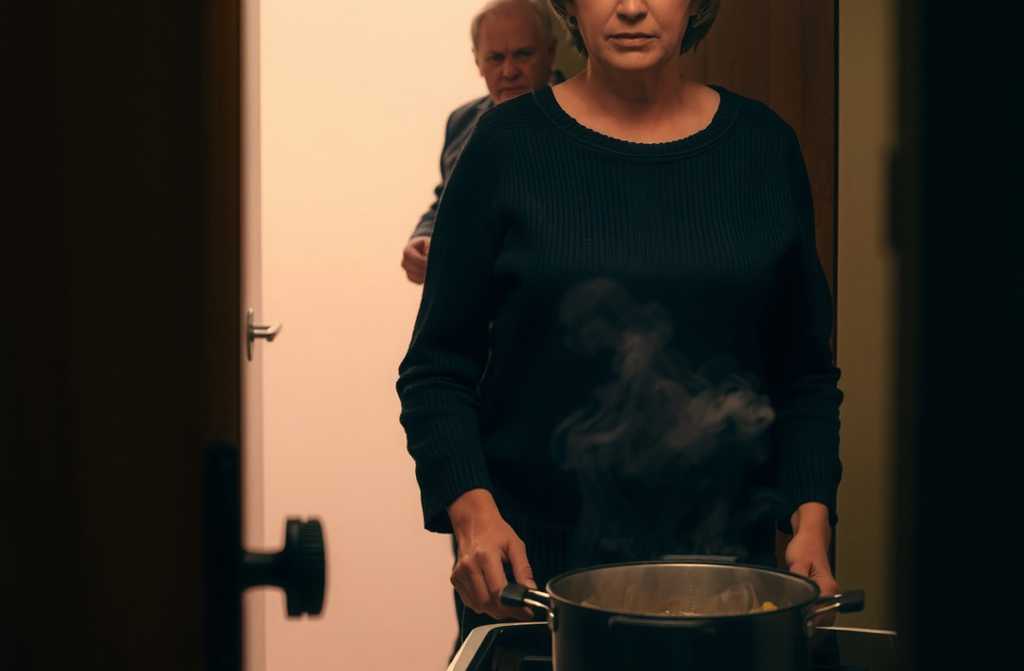
I overheard through an open window.
“Come on, be honestshe’s completely faded, hasn’t she?” My husband’s voice drifted muffled from the balcony, but every word hit like a slap. “She’s a homemaker, a mum, and truly nothing more. There’s simply nothing to talk to her about.”
I froze by the hob, a wooden spoon poised above the bubbling pan of stew, a drop falling onto the ring and sizzling sharply. I didnt move.
“Richard, that’s a bit harsh,” replied Simon, sounding apologetic, as if embarrassed by his friend’s words. “She’s raised the kids, manages the house”
“Raised the kids,” Richard echoed, with such weary condescension that I felt something in me go utterly still and terribly cold. “Exactly. They’re grown up, and shes well, shes just stayed put. You get what I mean? I spend days in London on business, then off to Frankfurt, building new teams, pushing my projects forward. And she keeps making stew. We’re living in parallel universes these days. I honestly dont know what to talk to her about over dinner.”
There was a pause. The click of a lighter, then the faint waft of tobacco drifting in through the open window above the sink.
“It happens,” Simon said, trying to keep the peace.
“It does,” Richard agreed. “Doesnt make it any easier, does it? Here I am, setting records, and shes stuck in the daily grind. It was her choice, mind. I never forced her.”
I set the spoon down gently, walked over, and quietly closed the window. I went back to the stove, turned down the heat. I looked at the stew, noticing the dark maroon sheen beginning to form on top.
“Her choice,” I repeated to myself.
Fifty-four years old, twenty-eight spent married. Two children, Henry and Alice, both grown and living in different cities. My flat in Sheffield, eighth floor, overlooking Norfolk Heritage Park. Beautiful, really. I looked at that view every morning, tea in hand, thinking about picking up bread, checking the Wi-Fi bill, calling Alice who was, once more, going through something but never saying what. That was my habit, my every day.
The stew bubbled quietly. I sliced bread, took out the cream, set out the bowls. My hands moved automatically, no thinking required. My head was filled with a deep, steady quietnot empty, just a stillness that comes when youre about to decide something.
When Richard and Simon came in from the balcony, I greeted them with a smile. I brought the pot to the table, portioned out the stew.
“Rosie, that smells wonderful,” Simon said warmly, no trace of condescension.
“Thank you,” I said evenly. “Please, sit.”
Richard looked at me. He always could read my mood by my posture, the way my shoulders sat. Today they were straight. He frowned slightly, but said nothing.
At dinner the men talked businessSimon told some story about a project, Richard laughed, chimed in. I ate my stew in small spoonfuls and thought about tomorrow’s trip to the bank.
That night, I lay awake. Next to me, Richard’s breathing was even. The room was dark, save the sliver of light beneath the hall door. I stared up at the ceiling and didnt pick over old wounds or that balcony conversationjust ran through facts. That I graduated from Sheffield School of Architecture with honours at thirty. Spent two years at a design firm, sketching housing layoutsone of my drawings was even chosen for a real project. My boss then said I had a rare sense of space. Then Henry was born, then Alice. Then we moved from Leicester to Sheffield for Richards work, then again within the city, into this flat. I kept my design portfolios in a folder at the top of the airing cupboard, under old duvets. Twenty-three years gathering dust.
At half six next morning, I was up before Richard. Made myself tea, stepped out on the balcony. The park stretched away below, silvered with mist. I stood there thinking, slowly, calmly, the way Id make a project budgetwhat I have. What I need. How to bring the pieces together.
A week later, I opened a bank account in my name only. Twenty-two years saved in dribs and drabs from the household money, from groceries, sometimes from birthday gifts after my parents had passed. My “rainy day” fund. It was a tidy sum. I transferred it oversteady hands, no trembling.
Next, I signed up for an online architecture and interior design coursethree months, practical assignments. I registered. Paid for it with the new card.
For two weeks, I said nothing to Richard. Evenings, while he shut himself in with his laptop, Id clear the kitchen table: notepads, laptop, mug of tea, gentle jazz from a tiny speaker, design software aglow. Something inside me finally began to stirit started so quietly I almost missed it, just noticed that I was falling asleep more content.
One evening Richard came to the kitchen for water, noticed the open laptop, the notepads, the ruler.
“Whats all this?” he asked.
“Courses,” I replied, not looking up. “Interior design. Im updating my certification.”
He paused, poured his water.
“Why?”
“I want to work.”
Another pause. I met his gaze. He looked at me the way you look at a child whos just announced something grown-ups decided long ago.
“Rosie, youre fifty-four. Work, really?”
“As an architect and designer,” I said calmly. “Or are you saying fifty-four is too old?”
He put down his glass.
“I mean, is it worth it? Weve no money troubles. If you want a hobby, go for it. Sketch, visit exhibitions. But turn it into a career at your age?”
“At my age,” I echoed, not as a question, just a statement. I turned back to my work.
He left. I sat still for a moment, then picked up my pencil and continued.
I finished the course. They sent a lovely new certificate with a shiny seal; I tucked it in the same drawer as my passport and marriage certificate. Then I created a profile on an online freelancer platformlooking for interior design jobs. Loaded old student projects, some course assignments, all done methodically, without bravado, no pep talk, just moving forward.
Three weeks later, my first jobyoung couple wanting to convert a tiny flat into a studio. Small fee, tight deadline. I visited, took measurements, photos. On the bus home, I thought about the light, how it streamed through certain windows afternoons, how removing a wall and adding vertical slats could open the space. My mind mapped it out automatically. It felt oddly sweet, like remembering a tune you once loved.
I didnt haggle over payment; I did a good job, they were pleased, left me a kind review.
Richard found out by chance, seeing messages on my phone while I left it on the table.
“How much did they pay you?” he asked over dinner.
I told him.
He smirkednot cruelly, but like it was settled. “Rosie, thats less than we spend on groceries in a week. Hardly serious.”
“The first job seldom is,” I said.
“At twenty, sure. At your age, its just a hobby. And thats fine, reallyif you enjoy it.”
I watched his face, busy with his plate, not once looking up.
“Richard,” I said, “could you not dismiss it?”
He glanced up, genuinely surprised.
“Im just stating facts.”
“No,” I replied softly. “Youre stating your version, because it suits you.”
He shrugged, kept eating. I ate too, though it tasted of nothing.
That autumn, I took on four more jobs. A small hair salon in the city centre, a childs room designed for low vision, a solicitors office refit, and finally a kitchen in a house on the south side. With every project, my hand remembered. Not just the handthe eye, and that sense Id once called “spatial ear,” the ability to hear what a place wants to become.
I hired a cleaner, Emily. She was twenty-six, came three times a week, did some cooking, collected the dry cleaning. Richard took it badly.
“Why? Its only a flat. You managed by yourself for years.”
“I dont want to manage alone,” I answered. “I need time for work.”
He smiled that same smile. “For work.”
“Yes. For work.”
Emily was quiet, discreet, careful never to shift my order on the worktable. Once, she asked what I did. I explained briefly. She said, “Lovely. I wish someone would do my flat like that.”
A small thing, but I remembered it.
In November, Alice called.
“Mum, Dad says youve done these courses and now youre designing flats?”
“Not just decoratingdesigning interiors.”
“Blimey. Hows it going?”
“Its interesting,” I replied, surprised at my own simplicity.
“Dads talked about it in a strange way. Like it annoys him.”
“I know.”
“Are you two alright?”
I paused.
“Were fine,” I said. Not quite a lie, simply not the whole truth.
Henry texted in December, sent a photo of his new place in Manchester. “Mum, can you check the layout? Want to do it up properly.” I took a long looklow ceilings, tiny windows, but an unusual nook by a diagonally set window. I wrote him my thoughts, three long paragraphs. He replied, “Mum, you really know your stuff. Honestly.”
“Know your stuff.” I laughed at myself, alone in the kitchen at seven in the morning.
Winter ran its course as I workedcarefully, no rush. The portfolio grew. Twelve reviews, all glowing. One client, Mrs. Harrington, a widow wanting to brighten her flat now the children were gone, wrote: “Rosie Green understood me instantly. She turned my home into somewhere I want to live, not just exist.” I read that over againnot to save it, but because it resonated.
In February, Richard came back from a business trip in a foul moodsomething about a failed contract, details not given. He snapped twice, once because Id moved a folder off the kitchen table so I could lay dinner.
“You cant move my things!”
“I just put it on the shelf while I set the table.”
“I said not to touch it.”
I looked at himtired face, tense shoulders, a man used to the world bending for him, furious now it slipped out of his hands.
“Richard,” I said, steady, “if you leave a folder on the dinner table, Ill move it. End of.”
He stared a beat longer than usual.
“Youve changed,” he said at last.
“I have,” I agreed.
He left for his study. I cooked, ate, washed up, then worked three hours on a new projecta small cafe in town whose owner wanted it “like Grans but not twee.” I imagined wooden surfaces, homey fabrics, lighting warm and gentle as dusk. I lost myself in it, finding quiet joy.
That spring, Lydia Hewson contacted me. A senior architect, a little older than I, she ran a modest design firm specialising in restoring heritage buildings and public spaces. She reached out after seeing my portfolio”Would you meet for a chat?”
We met in a coffee shop on Division Street. Lydia was brisk, sharp-eyed, direct.
“You have an unusual eye,” she told me, examining my printouts. “Especially this, the cafe designyour use of light is different. Not about decor, but about how a person feels in the space.”
“Ive always believed design is about the experience, not the shape,” I said.
She nodded. “Id like you to join our team for a competitionrevamping the Glenham Community Centre, that old town hall. City tender. I want you for the interiors concept.”
I hesitated.
“Its a big deal.”
“It is.”
“Its been a while since Ive done anything this scale.”
“I know you can. Question is, can you cope with the pace? Four months to deadline. A lot of graft.”
“Im ready,” I saiduncertain, but I said it.
I didnt tell Richard that night. Just mulled it over, studied the floorplanstwo-storey, seven hundred square metres, listed facade, interior fair game. I felt something I hadnt felt in decadesnot nerves, but readiness.
The next few months I worked harder than I had since my student days, when the world seemed limitless. I was at Lydias office a few times a week, worked the rest from home. Emily came more often; Id stopped feeling guilty.
One day Richard arrived while Id spread plans over the kitchen table.
“Whats all this?”
“A competition bid.”
“For what?”
“City contractrestoration of Glenham Community Centre.”
He stood there, brow furrowing.
“Thats a serious project. You know that, right? Its not painting a cafe. Theres politics, money, insiders.”
“Well see,” I said, and got on.
In May, we finally talked properly, the first real talk in a year. Late at night, as I was ready to sleep, Richard started.
“Rosie, we need to talk.”
I waited.
“Youre avoiding me.”
“Im working.”
“This isnt living. Were like flatmates.”
Silence.
“Weve lived like this for years, Richard. You never noticed because you werent bothered.”
He frowned.
“Thats not fair.”
“Its the truth.”
“Whats happening to you? Youre not you anymore.”
“I am who I always was. You just never noticed.”
A pause.
“Are you angry with me?”
I could have told him about the balcony, about Simon. I didnt. That wasnt the point any longer. The important thing was something else.
“Im not angry. Im just doing what I want with my life.”
“And what about our life?”
I looked at him, his face more drawn than a year ago, weariness and a hint of fear therethe fear that things change and he cant keep up.
“Lets leave it like this for now. We both need time to adjust.”
He left for the bedroom. I went out on the balcony, gazing at the city lights, leaves blossoming across the park below. It was quiet. I wasnt thinking about anythingjust stood and breathed.
The next day I slept soundly.
The summer was hot. Lydia and I shaped the final conceptmy responsibility was all interiors: flow, light, texture, how peopleold and young, slow and quickwould move through it. I thought about the old woman who wanted to see a concert but feared crowds; the child who needed a quiet nook to draw; the teenager wary of “old folks places.” I designed spaces for experiences, not just for appearances.
In July, Richards business took a turn: contract troubles, partnership disputes. He was irritable, snappish. One time, I walked out mid-sentence. He didnt apologise; I hadnt expected him to.
By late August, our team submitted the tender. Looking over the finished sheets, the portfolio, the jointly drafted proposal, I feltnot pride, not triumph, but a soft, full satisfaction.
Wed hear in two months.
I carried on with other jobs. My own earnings now covered my needs, Emily, more classes, stacks of new booksso many I bought a third shelf. Financial independence, something I never had while married (“shared” money always managed by Richard), now had a distinct, measurable shape.
Alice visited for the weekend while Richard was away. We sat late in the kitchen, eating homemade scones, drinking tea. She glanced at the shelf stacked with books, the tablet with blueprints, the new lamp I bought just for my workspace.
“Mum, youre different,” she said.
“Everyone tells me that,” I laughed.
“No, really. Youve found peace. You were always a bit on edge, always managing something behind the scenes.”
I considered it.
“I suppose thats true.”
“Not now?”
“Im in charge of my own life now. Not someone elses.”
Alice nodded, then paused.
“How are you and Dad?”
“We manage.”
“Mum”
She looked so like me at her agesame high cheekbones, the slight tilt of head when she listened.
“Alice, its a tricky patch. I really dont know how itll end. I dont want to give you false hope either way.”
“Are you thinking of divorce?”
“Im thinking of my life,” I said gently. “Thats a different matter.”
She nodded, as if she understood more than she could quite say.
We sat and chatted about her job, her new neighbourhood in London, Henrys plans to buy a flat. I realised that my children had grown up with me only ever as backgrounda fixture of home, like air, only noticed when missing. Now, they noticed. It was good, but also a little sad: it meant it had been otherwise before.
In October, the results came.
Lydia rang at half eleven in the morning as I was eating soup (with mushroomsjust because I fancied it, not for anyone else).
“Rosie,” her voice was calm but brimming. “Weve won.”
I set the spoon down.
“Say that again?”
“We won the tender. The jury gave us first place. They said our interiors concept set a benchmark for designing space by lived experience, not just function.”
Ten seconds. Then, at last, “Lydia.”
“I know. Me too.”
Afterwards I sat at the table. The soup grew cold. I looked out at the autumn parkfiery trees, grey sky, tranquil. Suddenly I laughed, alone, over my cold lunch.
Lydia sent a formal note: under the contract, Id join as Lead Architect for interiorsproper employment, a contract, salary. No longer a sideline or freelance hustle. This was my work.
I messaged Alice: “We won.” Her reply in two minutes: “Mum!!!!!” Henry texted later, “Mum, I always knew you were ace, just no one paid attention.”
I reread that a few times, then put away the phone.
I told Richard over dinner.
“Our project won the city contract. Glenham Centre restoration. Im lead architect for the interior.”
He glanced up, chewed, swallowed.
“Congratulations.”
“Thank you.”
“How long for?”
“Probably a year and a half. Perhaps two.”
He nodded, eyes dropping to his plate. We ate in silence. I cleared up, he went to his study. The normality felt final.
The project presentation to the City Culture Committee was set for November. A week beforehand, Richard said he wanted to come.
“Why?” I asked.
“To see. Its important to you.”
I hesitated.
“Alright.”
The hall held about forty peoplecity representatives, journalists, architects from other firms. Lydia and I presented together: she on concept, history, budget. I described the interiorhow wed shaped five different zones for varied people, how light would shift the main halls mood across the day, how corridors should invite pausing, not just passage.
I explained quietly, precisely, watching people listennot out of politeness, but intent interest.
Afterwards, at the reception, Richard found me. Several city officials were nearby, Lydia deep in another conversation.
“Rosie,” he said, voice unusually gentle, “you were brilliant. I didnt expect it.”
“Expect what?”
“That confidence. You come across like a professional.”
“I am a professional.”
He nodded, pulled me gently to one side.
“Look, I want to talk. Seriously. I think we need a fresh start. I see youve changed, and thats good. Really. I like it, actually. Carry on with your workIm not stopping you. But maybe dont throw yourself in so much? This is for you, for your soul. And we should fix what we had.”
I looked at himaged a year, more uncertain, his hand just touching my sleeve.
“For my soul,” I echoed.
“Exactly! You love it. Thats wonderful. But a proper career now, Rosie at your age thats a lot. The important thing is youve found some interest.”
I stared at him a moment, then said, “Richard, I overheard you and Simonyes, through the open window. You said I was stuck in domesticity. That there was a gulf between us because you climb mountains and I stir stew. That we had nothing to talk about. You said it was my choice. Well, Im making a different one, and this is mine, too.”
He fell silent. Conversation murmured nearby; someone laughed, glasses clinked.
“That was just private talk, Rosie, lads sometimes”
“Its not that talk. Its what you think, what you probably still think.” I eased his hand from my arm. “Im not doing this for my soul. This is my career. Im fifty-fourI decide. You either accept that or you dont. But I wont accept conditionsno more do a bit less so Im comfortable.”
“Rosie, please, lets go home and”
“Here or at home, its the same point. We need to talk properly.”
I walked over to Lydia.
The real conversation happened three days later, after a few false startsRichard circling the subject as if not used to losing ground.
At last, Friday evening, we sat in the kitchen, and I told him what Id long known but hadnt spoken.
“Richard, I want a divorce.”
He looked at me for a long time.
“Youre serious?”
“Yes.”
“Because of that chat on the balcony?”
“Not because of thatbecause of what it meant. Because in twenty-eight years I was just the backdrop. Im not angry. I just see it now, and I cant live that way. I know we cant change. Youre too set in your ways.”
“I could change.”
“Richard,” I said softly, “you told me at the presentation I could work for my soul, even after I won a major city contract. As if you were doing me a favour.”
He looked down.
“I didnt mean to hurt you.”
“I know. Thats the problem.”
Silence. Outside, dark; windows aglow in the neighbouring flats. The tap dripped; Id been meaning to ask for it to be fixed, never did.
“Where will you stay?”
“Here, if you agree. Its jointly owned, but I can buy your share. I have the funds.”
He studied me, as if only now understanding that Id thought it through, wasnt acting on a whim.
“Give me some time.”
“Alright.”
He moved in with a friend, then found a rental nearby. We saw each other for the paperwork, the handover of things, formalities. Always polite. Oddly peacefulalmost as if the ending had happened long ago, and we were simply acknowledging it.
Henry visited in December, sat in the same kitchen where Alice once had.
“Mum, are you alright?”
“Im fine, Henry.”
“Really?”
“Really.” I poured the tea, put out some biscuits Id baked, just for myself, fancying them. “Are you worried about me?”
“Of course. Well, yeah.”
“You dont need to.” I smiled. “Im managing.”
“Dad says he doesnt understand what happened.”
“I know.”
“Have you explained?”
“Yes.”
“And?”
I looked at himso like Richard as a young man, same broad shoulders, the same tilt of chin. Yet, more questions, fewer easy answers.
“Sometimes, Henry, its not about someone being good or bad. Sometimes two people just see life differently, and one day you cant pretend any more.”
He nodded slowly.
“Are you happy?”
I thought for a moment.
“I dont know if this is happiness. But I feel myselftruly myselffor the first time. That I know.”
He nodded again, took a biscuit.
“This is lovely,” he said.
“Mint,” I told him. “I added a bit to the dough.”
We chatted for agesabout Manchester, his flat, the refurb that I was already planning in my head, his hopes for next year. I could feel something subtle changing between usmore honest, not better or worse, just true. Neither of us pretending it was as it was.
The divorce went through in February, quietly, no drama. I left the district court and stood on the steps, cold, sleet falling. I tipped my face to the sky, let the flakes melt, then went to my car, drove to the officethere was a site meeting at Glenham, contractors waiting to discuss materials.
That spring, as building began and I walked through the empty main hall for the first timehigh ceilings, big windows, the scent of dust and old woodI paid attention to time itself. All the people whod gathered here for decades, plays, lectures, dance lessons. Now it was alive again, ready for a new story.
I opened my project file on the tablet. Then looked up. The sunlight poured through the southern window just as Id calculated. Just.
By summer Lydia asked me to become a partner in the firmnot an employee, but a true partner. I waited three days, then said yes.
We signed everything on a quiet August eveningLydia opened a bottle of dry white shed saved for something special.
“To space,” she toasted.
“To space,” I echoed.
She smiled. “When I first saw your portfolio, I thought: odd. Someone with that eye, that feel, sat on the sidelines so long. Why?”
“Its just the way it happened,” I said honestly.
“Do you regret it?”
I thoughta genuinely slow, honest thought.
“I suppose the time passed, yes. But not the children, not all those years. There was a lot there, too. Maybe things just couldnt be both ways. Or maybe I only thought that. I dont know. Its not simple.”
“Its the hard questions that matter,” she said, grinning.
“You do know how to compliment,” I laughed.
Autumn came; the first floor of Glenham was finished, and during a tour for the city reps, an elderly woman approached. Small, in glasses, with a sturdy shopping bagclearly a local.
“Did you design this?” she asked, nodding to a corner.
“Im one of the team who did, yes.”
“You added that little nook?” She pointed at the window alcove, soft benches, low table, away from the crowds.
“Yes. Somewhere to sit, read, be on your own if the crowds get too much.”
She nodded, eyes fixed on the spot.
“I used to come here as a girl for craft clubnever anywhere quiet. Always noise, bustle. I stopped coming. Now I think I might come back.”
“Please do,” I smiled.
She nodded, and trundled off. I watched her and thoughtthis is what its for.
That November, I rearranged the kitchennot a big change, just moving my worktable closer to the window, added another shelf for books, bought a new, warm reading lamp. Emily stayed on twice a week. I cooked for myself, when I pleased, what I pleased. Sometimes I made stew, because I liked it. Sometimes biscuits, for the smell. No schedule. No “should”.
One evening I stood by the stove, stirring soup as dusk fell; scents of thyme and cream warming the air. I was thinking over a new projecta rural guest house, owners wanted “lively and natural, not showy”. I was pondering textures, the right lighting for winter evenings.
My phone pinged. Alice: “Mum, can I visit next Friday?”
“Of course,” I wrote instantly.
Then added: “Ill bake. Preferences?”
A minute later, she replied with three pastry emojis: “I want all of it. Youre the best.”
I smiled, put away my phone. The soup was nearly done. I tasted it, added salt. Outside, darkness pressed against the glass, and in the reflection I saw myself: a woman in a thick jumper, soup ladle in hand, standing in a kitchen shaped just how she wanted.
I wasnt thinking of Richard, or the year gone by, or lost time, or what was coming. I thought about tomorrows site meeting at Glenham, about Alice visiting soon, about how good that soup tasted, exactly right.
Next morning at half seven, I stood with coffee at the open balcony. The park trees had turned, copperand gold crowding out green. The air was sharp and fresh.
My phone ranga number I didnt know.
“Is this Mrs. Rosie Green?” asked the caller.
“Yes.”
“My names Helen Foster, from Town & City magazine. Were featuring women shaping Sheffields landscape, and you came highly recommended for the Glenham project. Could you spare some time for an interview?”
I paused a moment.
“I could,” I said. “When would suit?”
She gave me the details, I wrote them down, said goodbye. I finished my coffee, watched the trees a while longer, then put my mug in the sink and grabbed my bag.