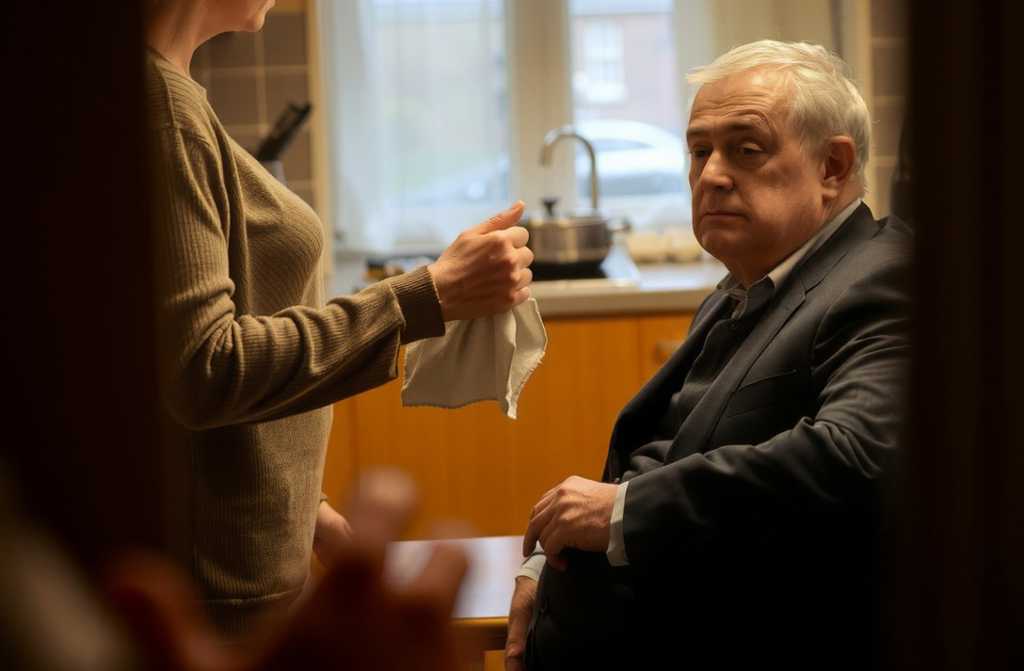
A Fixture of the Flat
You havent understood, Emily. I havent come to have dinner. Im here to tell you something important.
Emily Louise Bennett stood with her back to her husband at the stove. A wooden spoon hung motionless above the soup. The broth simmered quietly, tiny bubbles rising to the surface, the only sound in the flat. Then that too seemed to retreat, replaced by complete silence.
Whats so important? she asked, still not turning around. Her voice was steady, almost businesslike. It surprised her.
Thomas walked past her to the table and set down his briefcase on the stool. His habitual gesture: briefcase on the stool, blazer on the chairs back. Thirty years of movements, always the same. Emily knew them like the lines of a nursery rhyme she had learned decades ago the meaning long lost, but the rhythm engraved.
Im leaving, he said. No prelude, no hesitation. Simply: Im leaving.
The spoon clattered down onto its rest. Emily turned slowly.
Thomas sat at the table, blazer still on. Fifty-eight, and he was, in some ways, still the man she had once known, but in others, utterly changed. His hair was almost entirely grey now. Hands laid flat on the table, calm the hands of someone who has already decided what he is about to say.
Where to? She already knew the answer, felt foolish asking.
To Charlotte. You dont know her. She works in my department. Shes thirty-four.
He said it as though age was key to the explanation. Perhaps it was.
Emily picked up a linen napkin she had folded into a triangle an hour ago as she set the table. She twisted it in her fingers. The napkins were from a market in Cardiff, thick and comfortable in the hand. Thomas always crumpled them, left them in a heap by his plate. She smoothed them out, washed them. For thirty years she had smoothed and washed.
How long? She made herself ask.
A year and four months.
A year and four months. Emily counted in her mind. Last summer. They had gone to the Lake District together, the first time in years. Shed thought it was a new beginning. Apparently shed thought wrong.
You must understand, Thomas began, leaning forward slightly. He was looking past her, above her shoulder. This isnt about you being a bad person. Its just Emily, youre not present any longer. Youve become a part of this flat. A fixture. When I came home, all I saw were clean windows, ironed shirts, and perfectly arranged plates. It was all immaculate. But you werent there. Not as a living person.
She listened in silence, the napkin wound tightly in her hands.
With Charlotte, I feel alive. She cares about what I do. She asks questions. We have things to talk about.
And we didnt?
Emily. He paused. For the past decade, all youve said is about the flat, the children, and the neighbours. Sorry, but its true.
The children. Their son, Simon, lived in Manchester now with his family. Their daughter, Hannah, had moved to Bristol five years ago. They phoned most Sundays, sometimes came on holidays. Emily missed them every single day, but it was the sort of longing you never say aloud. You just live with it, like a faded scar.
Are you leaving tonight? she asked.
No. Not tonight. I need a few days to pack. I know its awkward. If you like, I can stay with Peter.
Peter. His best mate. So Peter knew, maybe for ages.
Stay, Emily said. Her voice remained even. No need to bother Peter. You can pack here.
She turned off the hob. The soup finished in the silence.
That night she lay on her side of the bed, staring at the ceiling. She thought Thomas fell asleep quickly, or pretended to. The ceiling was unchanged: white, a small crack in the right corner, which theyd meant to plaster over the previous autumn. She stared at that crack and thought she probably never would repair it now. There was no point.
Tears came at 3 a.m. Not loud. Just something warm ran down her cheeks. She didnt stop it just lay there, silent, until dawn began to lighten the sky outside the window.
Thomas left after four days, taking two suitcases, his laptop, some economics books, and his toiletries. Emily sat in the kitchen, making tea she couldnt taste, while he packed. When the door closed behind him, the flat became silentnot the quiet of night, but as if the furniture had been removed.
At first, she moved through the flat, doing what she had always done. Washed the dishes. Dusted the shelves. On Sunday she took his white shirts from the wardrobe and sat with them at the edge of the bed, unsure what to do. There were nine. Thomas always insisted on washing whites separately, special starch for collars. She had ironed these shirts every week for thirty years. They lay on her knees, and she was lost.
Eventually, she folded them back and closed the wardrobe.
Simon rang on Wednesday. His tone was that of someone who knows what to say, but not how to say it.
Mum, Dad phoned me. How are you?
Im fine, she replied.
What does fine mean?
Fine is fine, Simon. Everythings alright.
She could hear him holding back: that he wanted to suggest visiting, or having her come to Manchester, or offering advice she hadnt asked for. Instead, he just said:
Are you eating?
I am.
Alright. Call me if you need.
I will.
She hadnt eaten properly in nearly a week. Not because she didnt want to but whenever she opened the fridge, his food was still there: the cheddar he liked for breakfast, the little jar of mustard, the milk. She didnt throw them away. She just closed the fridge and left the room.
Hannah turned up that weekend unannounced, calling from the station.
Im in London, meet me!
Emily met her at the tube. Hannah looked just like a young Emily: dark hair, straight back, a slightly wary look. Just younger by thirty years and different inside.
Mum, youve lost weight.
Its fine.
Its not fine in two weeks. Hannah slipped her arm around her. Come on, I brought dinner.
Hannah stayed two nights, cooking, cleaning, watching films with her. The second evening, they sat in the kitchen late, and Emily just started to speak. She didnt cry or complainjust talked. About how Thomas was in the beginning, how they met at the library at university. How they married when she was twenty-seven, he twenty-nine. How she worked as a curator at the city museum and loved it. How Simon was born, then Hannah, and life changednot for the worse, just different.
You worked, Mum. When did you stop?
When you two were four and seven. Your dad said I should be at home, the kids were still young. I agreed.
And you never regretted it?
Emily considered.
Not then. Now Im not sure.
Hannah left Sunday evening. Emily watched her go, a small figure with a backpack, turning the corner out of sight.
The flat was quiet again. But the quiet was different. Not so heavy. Just still.
The next few weeks, Emily existed. Got up, washed, made coffee. Sometimes went out for groceries. Stared out the window. Ironed tablecloths no one dirtied. Watered her plants on the sill. Life carried on, indifferent to permission.
One evening she took down an old box from atop the wardrobe. She couldnt say why. Inside was her university dissertation, catalogues from exhibitions she’d once curated, and a pile of photos. In one, she stood in a museum gallery beside a Flemish paintingyoung, serious, pointer in hand. On the back, in her scrawl: Exhibition opening. March 1992. She was twenty-nine.
She stared at the photo for a long time, then left it face-up on the bedside table.
Gillian phoned late on Thursday. Gillian Archer, her friend from university history of art, their lives had followed different paths, but every few years their conversation resumed without awkwardness.
Em, I know. Hannah told me.
She did, did she? Emily almost smiled. Are you two plotting?
Were not. Shes just worried. So am I. How are you?
Surviving.
Thats not an answer.
Its all I have.
Gillian was quiet, then said, Ive been meaning to ask do you remember Mrs. Humphries?
Mrs. Humphries? The department?
No from Artspace. Gallery near Chancery Lane. We went to an opening there in 1998, remember?
Vaguely.
Shes looking for someone for the gallery. Some consultancy, talking to visitors on open days. Part-time. Em, this is your thing. You did it for twenty years.
Emily moved to the lounge. Sat in the half-light.
Gill, it was twenty-five years back.
Art doesnt age, Em. And nor have you. They have Flemish, Impressionists, modern art. You know more than half the curators going. Just go see Mrs. Humphries. Once. No promises.
A soft quiet filled the room. Outside, the city muttered.
Try, Gillian whispered, Em, why are you sitting in that flat?
Emily didnt answer at first. Alright. Give me her number.
She didnt sleep that night. She lay thinkingabout herself. About the photo on the table. The young woman with the pointer. She remembered knowing every inch of that Flemish gallery, could list every work, every detail. She remembered the lacquer smell of the old restoration rooms, the weight of catalogues, the voice of her old boss: Bennett, you have the eye. Thats a gift, not a skill.
That eye hadnt gone anywhere. It had just spent too long on linen napkins and white shirts.
Mrs. Humphries was a small, sprightly woman in bright red glasses, about seventy. She greeted Emily as soon as she walked in. So, youre Bennett. Gillian said youre just the woman. Come, let me show you the place.
As Emily followed her around the galleries, she felt something stir not at first sure what. Then she realised: she was breathing. Real, full breathing she hadnt felt for years.
The gallery was compact, elegant three halls: a permanent collection of European eighteenth and nineteenth centuries, a space for contemporary art, a lecture room. Pale walls, gentle lighting. Emily found herself checking the mounting: a painting needed shifting left, the lights angle was wrong.
We have trouble here, Mrs. Humphries said by a Dutch still life. Everyone walks by. Its a superb work, but wasted on this wall. What do you reckon?
Emily studied it. It needs lifting by a foot and moving to the end wall it was painted to be seen head-on, but now its at an angle and it loses its texture. Plus, the next canvas is too bright it overwhelms it.
Mrs. Humphries peered over her glasses, and then smiled. Come in Monday. Three days a week, to start.
Emily left the gallery and paused on the pavement. Marchstill cold, but already springy in the air. She stood holding her bag, thinking, for the first time in weeks, not about the flat, not about Thomas, nor the shirts, nor the napkins. Just stood, breathing.
She called Gillian.
Well? Gillian jumped in.
I start Monday.
Told you! Em, its the right thing.
Well see. But Emilys voice was differentshe heard it herself.
On Friday, she booked a haircut. She was passing a little salon, saw a woman with a short crop in the window, went in. The hairdressers name was Violet.
What do you want? Violet asked.
Emily looked into the mirror: dark hair, heavily streaked grey, always pulled back. Shed worn it like this for at least fifteen years.
Short, she said. And let the grey show. I mean, make it natural. Let the silver show.
Violet blinked. Are you sure? Most cover theirs up.
Im sure.
She spent nearly three hours there. When Violet finally spun the chair, Emily stared at someone unfamiliarshort, neat lines; dark-silver, the grey accentuated, not hidden. A clear forehead. A face that looked altogether different.
Thats good.
Very good, said Violet. Suits you. You know, your bone structure young girls never have that. It comes with time.
Emily paid, stepped out, and caught her reflection in a shop window. That woman looked at her without apology.
On Saturday, she headed to the shopping centre not for groceries, but clothes. For years shed bought practical things: grey trousers, dark jumpers, coats that didnt stand out. Everything blend-in, everything easy.
Now, she drifted through shops differently. Paused at the window of a small boutique. Inside: a sea-blue jacket, high-waisted pinstripe trousers, a long-sleeved linen dress.
She bought the jacket and trousers. In the changing room, she looked for a moment and realised she did recognise herselfshe just hadnt seen herself for a long time.
On Monday, she started at the gallery. Mrs. Humphries greeted her as if theyd planned it months before; introduced her to the young admin, Paul, and the restorer, Andy.
Andy, this is Emily Bennett. An art historian. Shes part of our team.
Andy looked up mid-thirties, beard, paint on his fingers. Good, he said, and went back to his frame.
Her first day at Artspace was calm. Sifting through old catalogues, reading about the current display, discussing the permanent collection with Mrs. Humphries what drew visitors, what didn’t.
Be honest, Mrs. Humphries poured tea into two little cups, the third gallery. Whats wrong with it?
Theres too much, Emily said. Youre pushing sixteen works into a space that holds ten. The eye gets lost. When theres nowhere to rest, the visitor walks out and remembers nothing.
Mrs. Humphries grinned with satisfaction. Exactly. Ive been telling the committee for three months; you know how to explain it. Thats valuable.
Nights, Emily returned home. The flat was unchanged, but she was not. Each day, something inside her thawed.
She phoned Hannah at the end of week two.
Mum, your voice has changed, said Hannah.
How?
I dont know Its just alive.
Meanwhile, Thomas was living at Charlottes place in Croydon. A small flat, which he hadnt expected. She worked nine to six, yoga on Tuesdays and Thursdays, drinks with friends on Fridays. Thomas had no idea what to do with evenings.
His whole life, someone was always waiting at homewith dinner. With Emily, everything in its place, invisible household magic. Now he came home to an empty flat and a barren fridge.
He couldn’t cookwell, scrambled eggs and toast. It was amusing at first, like an adventure; the novelty soon wore off.
Charlotte cooked sometimestrendy food from half the ingredients, recipes via Google. Not for him, for herself, sometimes sharing. It was a difference he couldnt put words to but felt keenly.
Thomas, could you go to the shop? shed ask on Sundays, matter-of-fact. Ive got friends meeting up.
So he stood in the supermarket, baffled by what to buy. Emily always knew. For thirty years, he never gave it a thought.
One evening, Charlotte came home late, bright-eyed. Weve got a new head of project at work. Thirty-one, from London. Fascinating chap, you wouldnt believe.
Thomas barely glanced up from his book. Good.
We talked all lunch about architecture! He went to LSE, his ideas are
Good, he repeated.
She looked at him oddly, something wary in her eyes.
You dont want to know what we discussed?
You just told me. Architecture.
She went to rattle pans in the kitchen. Thomas stared at his motionless book.
By April, Emily had been at the gallery nearly two months. She redid the third hall, removing six works, rearranging the rest so each breathed. Mrs. Humphries stood in the doorway, silent for a long while.
Emily, do you know what a pause in music is?
Yes.
Well, you can make pauses in a room. Very rare skill.
Mrs. Humphries began offering a series of talks: informal chats about pieces in the collection, every couple of weeks. Emily agreed, though she hadnt lectured publicly in twenty-five years.
Nervous? Mrs. Humphries asked.
A little.
Good. Means you care.
Her first talk drew twelve people. Emily began in front of the Dutch still life she had moved: at first, her voice was tight, but it soon softened. She spoke about how the painting showed ordinary thingsbread, jug, plums, a napkin at the table edgepainted so that they seemed to breathe. As if someone had just left, the objects retaining their warmth.
Afterwards, an older woman approached in a navy coat.
You know, Ive visited this gallery five times, always walked past that painting. You spoke of its warmth, and I finally saw it.
Emily walked home through a nearly warm April twilight, thinking about that woman. Someone just left, the warmth remains. Shed meant it for the painting, but in a way, it was about her. Someone had gonethe warmth was still there. And it wasnt pain, not as it had been. Something else.
Gillian visited in May. They hadnt seen each other in over a year, and when Emily opened the door, Gillian simply stared for a moment.
Youve had it cut, she said.
Ages ago.
My word. Gillian put down her bag. Em, you look well. I mean it. Not just for your ageyou look well.
Oh, stop.
Im serious. Somehow, youre different.
They stayed up talking past midnight. Gillian spoke of her life in Bristol, her grown children, university work. Emily told her about the gallery, Mrs. Humphries, the talks.
Gill, I opened my old student notes last week. Goodness I remember our trip to Florence in the third year. Remember?
The Uffizi. Gillian grinned. You couldnt leave the Botticelli room for three hours.
Two and a half.
Three. I had sore feet and sat on the bench watching you. You were rooted there, in front of Primavera.
Emily laughedgenuinely, for the first time in months. Later, she remembered that laugh and realised it was real.
Em, Gillian said softly, do you still resent him?
Emily held her glass. Sometimes. Less than before. The strange thing isI dont resent him; I resent myself. For not noticing sooner How I vanished. He saw it, though he said it cruelly. But still
That wasnt you, Gillian said. That was a role. Wife and motherall routine, all perfect, all on time.
Yes. But I chose that part.
Only in part, love. You never chose to disappear.
Emily looked out. The street was dark, lamplights gleaming. She knew Gillian spoke the truth. Itd happened quietly; no one ever said: stop being yourself. The daily routine simply thickened, until she was living inside itas if in a fog, aware of the world, but not quite seeing it.
By the end of May, a new exhibition opened at the gallery: urban markets photographed by a young Londoner. Emily arranged the display with him and the restorer, Andy. It was satisfyingclear, physical work, with immediate results.
On opening night, the place filled with visitors. Mrs. Humphries enjoyed such evenings: glasses of wine, soft music, conversations in corners. Emily stood by the wall watchinga visitors face would open, or close, in front of a photograph. The photos were good, that much she knew.
You work here? a man asked.
She turned. About sixty, compact, fair accentFrench or Belgian, perhaps.
I do.
I saw how you looked at the photographs. Not as a guest, as a specialist.
Im an art historian.
Jean-Pierre Morin. He offered his hand. Photographer.
Emily Bennett.
They stood together at a photo of an elderly market woman surrounded by tomatoes, staring at the lens. Black and white, the light falling so the wrinkles showed not as faults, but as architecture.
Very good, Emily said. Hes not afraid of faces with history.
Morin nodded. Exactly. Young photographers fear history on facesthey think beauty is youth. Error.
They spoke another twenty minutes. Morin was well-known in Europeexhibitions in Paris, Amsterdam, Berlin. He was in London several weeks, watching, planning a new project.
Im photographing women, he said. Women fifty-five and over. I want faces that have been through thingsstronger for it, not damaged. You see what I mean?
I do.
Your face is exactly that.
Emily did not answer at once.
Youre asking me to pose? she said.
To be part of it, yes. A few sessions, maybe an exhibition, maybe in print. I promise nothing now, but I rarely choose wrongly.
At that point, Mrs. Humphries drifted over with her glass of wine. Jean-Pierre, youve met our Emily? Good. Shes new but already indespensible.
Morin handed Emily his card. Think about it. You dont need to decide tonight.
She thought for two weeks.
Why did she hesitate? Not modestyshe had none left for that. Not camera shyness. Something else.
She phoned Gillian.
He wants to photograph you? Gillian sounded wholly unsurprised.
Yes.
And you cant decide?
I know I should, I just dont know why Im waiting.
Because you still havent quite accepted that you deserve it, Gillian replied.
Emily held the phone in silence.
You do, said Gillian. Just to be clear.
She messaged Morin on Friday evening: I accept. When do we begin?
Their first session was mid-June. Morin had rented a studio near Clerkenwell. Emily turned up in her sea-blue jacket and new trousers. No special make-up, just her usual.
Perfect, said Morin, eyeing her. Exactly so.
Working with him was easyhe never said, Smile, or Look here. Hed chat about gallery work, British painting, about Florence. She answered, forgetting entirely about the camera.
After an hour, he showed her a few shots. Emily studied them for a long time. It was her: a fifty-seven-year-old woman, short silver-dark hair, a face that showed its age. But Morin was rightit wasnt a wounded face. There was something durable there; like the woman among the tomatoes.
See? he asked.
Yes, she replied.
While Emily posed for Morin, gave talks at the gallery and rebuilt her life from parts always in the cupboard, Thomas was having his own reckoning.
Charlotte was clever, lively, warm. But she needed ones full attention silence unnerved her. Every night had to be filled: talking, planning, outings. If Thomas withdrew with his book, she took it personally.
He began realising things he never had before: silence comes in kinds. Silence with Emily had been gentle, companionable like being in a library, comfortable together for hours in shared space. With Charlotte, silence became a fault.
He also learned that daily life isnt automaticEmily made it invisible, as vital as breathing. Thirty years he never noticed. Now he did.
In July, he phoned the childrenSimon and then Hannah. Both were distant. Hannah said outright:
Dad, dont ring me for sympathy. Mums in a good place now. Leave her alone.
There was nothing to say to that.
Mrs. Humphries showed Emily a copy of Outlook in Septembera London magazine about culture and design. Not flashy; smart, discerning. Several spreads featured Morins project, History Without Translationphotos of ten women from across Europe. The first page was Emily; that shot of her half-turned to the camera, sea-blue jacket, shoulders squared, face composed. As the writer put it, not a single feature wasted.
Emily, Paul said when she arrived at the gallery. Youre all over the web.
He showed her the article online. Thousands had read it.
I see, she smiled.
You look terrific, honestly.
Morin messaged that evening: A Paris gallerys interested. Exhibition in February, perhaps. Would you go?
She sat in her living room with the phone. Outside, London went about its business. Her plants had thrived over the summer; shed bought and tended them herself. Without Thomas.
Later, Peter called Thomas.
Heard about Emily? Peter asked.
No. What?
Shes in Outlook. Whole feature. Some European photographer; its a serious piece. Shes the opening image.
Thomas paused.
Our Emily?
Emily Bennett. Your ex. Thats her. You should look; shes significant, you know? Worth seeing.
Thomas found the feature online. Stared at her photograph forever. Then closed it. Then opened it again.
He didnt recognise her at firstthe short hair, new look. Then he did. It was Emilynot the Emily hed left behind by the stove with the wooden spoon. Different. Maybe the woman he dimly remembered from the early years. Or maybe that woman had always been there, just mostly unseen.
Charlotte left in October. Or they both realised, by then, it wasnt what they wanted. She said it firstquietly, over dinner.
Thomas, we both see it. Were not right together. Youre not what I imagined.
What did you imagine?
Someone more involved. Youre always a little elsewhere.
She was right. He was elsewhere, though hed no idea where.
He rented a one-bed flat near his officea new building, quickly, without taste. Sofa, bed, table, fridge. Something felt off. The silencethis flats was empty, not quiet. Not the same.
He dreaded calling Emily. He actually felt feara word he hadn’t used about himself in years.
November arrived. Emily prepared for Paris. Not just for the exhibition: Morin wanted her to meet other gallery people, friends of his. Mrs. Humphries waved her off easily.
Go. Bring something back for us. Theres a Belgian artist, Lucas van den BergIve been trying to meet him for years. If you can make his acquaintance
Lucas, Emily wrote down. She didnt know if itd help. But she wrote it.
She booked her flight, reserved a modest hotel in the sixth arrondissement, by the Luxembourg Gardens. Shed been to Paris once, as a studentthirty years ago, fun, crowded, five to a room. This would be different.
Hannah called the day before her flight.
Mum, Dads emailed. He wants to talk to you.
To me?
He said discuss, his word. I said Id let you knowyou decide.
Emily thought. Alright. Tell him to call.
Thomas rang that evening, as she was finishing her packing.
Emily. Sorry its late. You fly out tomorrow?
How do you know?
Hannah mentioned it. Just that. Paris, then.
Yes.
A long pause. Emily sat on the bed by her case.
EmilyI wanted to talk. Face to face, really, but youre leaving. I I know Ive been an idiot. I realised, not just yesterday. Perhaps is there any chance? Could we try?
Try what?
To start over. Ive learnt a lot these months. I just want to talk.
She was silent, not because she didnt know what to say, but because she knew. She let him finish.
Weve both changed, he went on. You especially. I can tell. What I said before, cruel thingsI shouldnt have. About being a fixture in the flat. It was wrong.
It was.
I dont expect forgiveness now. I just asklet me meet you. When youre back.
Emily stood, crossed to the window. November in London: dark, slick streets, familiar lamps.
Thomas, she said at last, voice gentle, even. I hear you. I believe you mean it.
So then?
But let me finish. Im not angry now, truly. What happened was painful, but thats not the matter. I dont want to go backwards.
But
Not to punish you, nor to prove anything. I became someone else this yearmyself, again. And who I am, now, wont fit back into what I was. Youre asking me to return to a life that doesnt exist, to a role I no longer play.
He was silent a long while.
I understand, he whispered.
Youre a good man, Thomaswere, are. But what we needed from each other, weve already given. Thats enough.
The children
Theyre grown. They love you. That wont change.
Another silence.
Youre flying tomorrow? he said.
I am.
Safe travels, Emily.
Thank you.
She placed the phone in the bedside drawer, next to the photograph from March 1992museum gallery, young woman with a pointer. Emily held it for a moment, then closed the drawer. Not thrown outjust put away. Still there.
In the morning, Emily ordered a taxi to Heathrow. Her case was light a few jackets, trousers, the blue suit, books for the journey, a notebook for artists to see in Paris.
She landed at Charles de Gaulle in the afternoon. Taxi, looking out over boulevards. Parisian autumn was different: gold leaves, wet pavements, lighter air, or so it seemed.
The hotel was as imagined: old, small, wooden floors, the windows on a quiet courtyard. The porter spoke French and English; she replied in English. Her French was rusty but revived enough for shops and pleasantries.
Her room was on the third floortiny, warm, overlooking cobbles and a neighbours window ledge. A geranium bloomed. She set down her case, went to the window.
The courtyard was empty, except for a grey cat across the way gazing downward.
Emily opened the window. Cold air, an alien citys scentdamp stone, distant coffee. She stood, breathing: not thinking, not planning.
Morins exhibition would open in three days. The gallery walk-through tomorrow, several meetings after. Then the opening, then a week with no set plan.
She might stay a week, or two. She was in no rush. Back home, the gallery, Pauls new catalogues, Mrs. Humphries and Lucas van den Berg, were waiting. Simon had promised to visit with the family for Christmas. Hannah would visit in February.
All ahead, all hers. No one could take it away.
She closed the window, unpacked. Hung up the jacket, washed her face, put on a warm jumper.
Then, notebook and coat in hand, she stepped out. The Luxembourg Gardens were a ten-minute walk away. Shed checked the map back in London. It was an easy stroll through the old streets, into the gates.
The garden was nearly empty in November. Leafy paths, wet leaves underfoot. A few older folks on benches, one man with a dog. Statues stood deep in the walks, calm and indifferent to anyones troubles.
Emily found a bench beneath a great plane tree. Its green-grey trunk, patched from agealmost more architecture than plant. Old and very much alive.
She opened her notebook, jotted a few namesartists to see at the Musée dOrsay. Remembered Morin had mentioned a gallery in the Marais showing 60s photographers. She noted the address.
Then closed the book and sat in the quiet. Now and then a leaf dropped. Somewhere behind, voices in French, a womans laughter.
Emily looked up. The sky above was grey and blank as a slate, as it is in late autumn, but behind it, maybe, a hint of sun.
She took out her phone and messaged Gillian: Arrived safe. All well. Luxembourg Gardens. Gillian replied almost instantly: Envious, in the best way. Hello to Paris. Emily smiled and put the phone away.
The cat would be still sitting back at the hotel. The nine white shirts lay in the London wardrobe. Linen napkins in the sideboard. The crack in the bedroom ceiling she had always meant to fix.
All that still existed, left in its place. And here she was, in the Luxembourg Gardens, in November, holding a notebook of artists shed always meant to see.