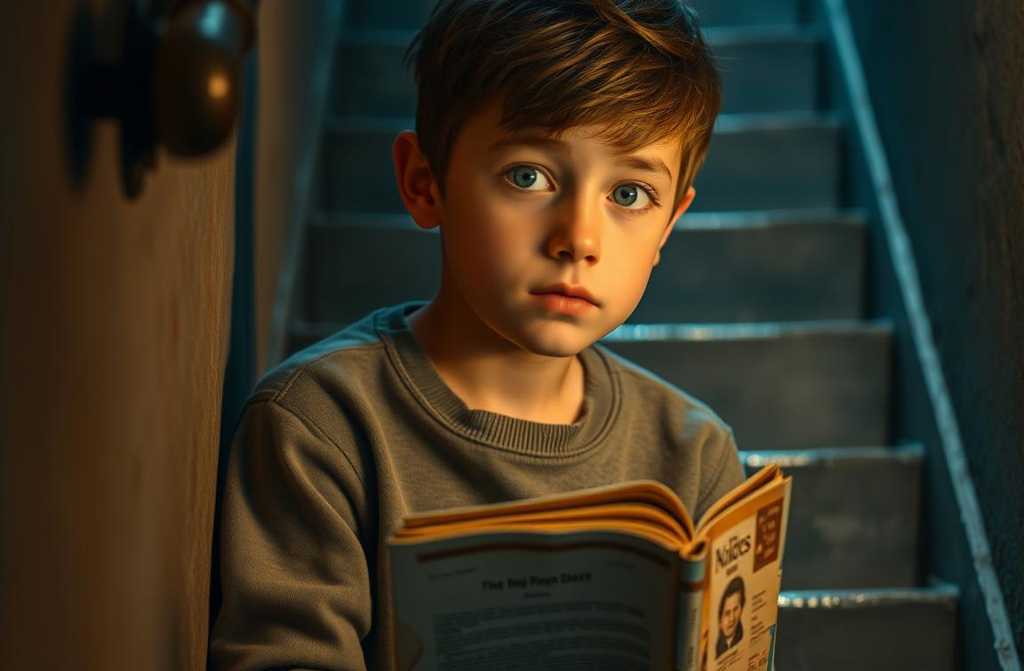
Sometimes Id look around my office and think, *I built this myself.* But deep down, that boy still sat inside methe one waiting to be called home.
They kicked me out at fifteen. Not with a suitcase or shouting, like in films. Just a quiet moment when Mum looked at me like I was a stranger and said, *”Jamie, its better this way. You dont belong here.”*
I stood in our cramped kitchen, the air thick with the scent of roast beef and something sour. The floor might as well have vanished beneath me. I kept staring at her handsthin, nails bitten down, clutching the hem of her apron. She didnt cry. Just empty eyes, like a switched-off telly.
Before that, I was just a normal lad. We lived in a two-bed flat on the outskirts, where the wallpaper peeled and the stairwell always stank of cat piss. I brought home top marks from school, fixed the sockets when she asked, washed up. Hoped even once to hear, *”Well done, Jamie.”* But that was before Greg came along. Mums new husband barged into our lives like a bulldozer.
When Sophie was borntheir real daughterI became a shadow. Pink booties, smiles, fridge magnets. Me? Spare parts.
Evenings, Id slip into the stairwell, sit on the cold steps, and listen to the lift hum. Out there, I could breathe. At home, the air felt like a coiled spring, ready to snap. I knew it would.
And it did.
*”Wheres the money from my wallet?”* Greg stood in the doorway, clutching his worn-out leather billfold like evidence. Two hundred quidhardly anything, but to him, a fortune.
I swore I hadnt taken it. He narrowed his eyes. *”Dont lie.”* Mum stayed quiet, then whispered, *”Jamie, just admit it. We dont want to call the police.”* I stared at her and didnt recognise her. Where was the woman whod stroked my hair when I was ill?
I said nothing. Packed a rucksackT-shirts, notebooks, an old MP3 player with a cracked screenand left. The door shut behind me like a gunshot.
The care home greeted me with squeaky metal bunks, bleach fumes, and concrete walls that never warmed. No one pretended to be family here. Older lads tested meshoved me in corridors, hid my trainers. Once, they left a dead mouse in my bed. I didnt scream. Didnt snitch. Just tossed it in the bin and learned: survive by being quicker, sharper. So I was.
I kept my mouth shut, learned whod lie and whod sell you out. Still, something ached inside, like pain left switched on.
The home had a computer roomold PCs that rattled like tractors and froze constantly. First time I saw code, it made sense. Like poetry, but betterit *worked.* I stayed up nights, till staff dragged me to bed. Mr. Harris, the IT teacherbald, coffee-stained, tired-eyednoticed. Once, he tossed me a dog-eared C++ book. *”Here. Read. Might get you out.”*
I did. Wrote my first programs: a calculator, then a simple game where a square dodged obstacles. Every time it ran without errors, something warm lit up in my chest. Like a voice finally saying, *You can.*
I made a friendTom, scrawny, with a mop of messy hair. The type who laughed at everything, even himself. Once, he nicked a bread roll from the canteen and split it with me. We sat on a windowsill, chewing, dreaming of escapehim as a rock star, me just wanting a normal life. Tom didnt make it out. Got mixed up with the wrong lot, then prison. But I never forgot that roll. Proof I wasnt alone.
Left school with top marks. Not for praisejust to prove I wasnt rubbish to be thrown away.
Got into a tech uni. Dorm smelled of fried chips, cheap aftershave, and unwashed socks. Lived on grants and odd jobsstacking shelves, mopping café floors. Nights, I coded websites for pennies.
First paycheque£200 for a garage sitebought me new trainers and a takeaway pizza. First real smile in years, cheeks aching with it. *My* money.
At uni, I found mates. Liam, an anime nut, showed me how to animate. Katy, a redhead with a laugh like a foghorn, taught me to scramble eggs without burning them. They saw me as a person, not a ghost. Still, I kept my distance. Scared if I let them too close, theyd vanish too.
By thirty, I had my own company. Small, but mine. Glass doors, a coffee machine that whirred like those old PCs. A team of ten who believed in me. I believed in them.
Sometimes Id sit in my office and think, *I built this.* But that boy still waited in the stairwell.
A journalist once asked, *”Jamie, howd you get here?”* I told her everything. Mum choosing Greg. Greg seeing me as a threat. The care home. The code. The article called me *”From Orphan to CEO.”* I read it and thought, *Orphan? Suppose so.*
A week later, an envelope appeared at work. Scuffed. *”Jamie. From Mum.”* Inside:
*”Im proud of you. Im sorry. Gregs ill. Sophies jobless. Were struggling. I want to talk. See you. Not for money. Love, Mum.”*
I stared at the words. No anger. No hurt. Just cold, like a light turned off inside. I spun a pen, watched the city through my window. Wonderedwhy now? But something made me go. Maybe to end it properly.
The flat hadnt changed. Same damp smell, dim hallway light. Mum opened the door in a faded dressing gowngrey hair, shaking hands. Greg wheezed in the next room, hooked to an oxygen tank. Sophie hunched over a tablet, eyes guilty.
We sat at the table. Mum talked non-stopGregs six-month prognosis, Sophies debts, medicine costs. Her fingers twisted the tablecloth like that day years ago. I remembered her teaching me to flip pancakes when I was seven. Laughing as batter smeared my cheek. Where was she?
Then she stopped. Looked at me. *”Jamie, we were wrong. I was wrong. I thought Greg meant security. Sophie was our fresh start. You… reminded me of my mistakes. Im sorry.”*
Sophie spoke up. *”I tried to stand up for you. But I was just a kid.”*
Something cracked inside. Not pain, not rage. Justrelease. Like standing on an edge and stepping back. I said, *”I dont hate you. But youre not my family. Youre my past. I came to say goodbye.”*
Mum cried. Sophie looked down. Greg coughed into his mask. The lift down felt slow, like a dream. For the first time in years, I breathed freely. No hurt. Justdone.
Now, I have my own life. I dont waste it on those who threw me away. Sometimes I donate to childrens homes. Not for karma. Once, I delivered laptops to a care home. A ladfourteen, scrawny, stubborntyped furiously. Saw that same fire in his eyes.
Another letter came. Mum wants to meet grandchildren. I dont have kids. Might never. I didnt reply.
Forgiveness isnt reopening the door. Its shutting it for good. And walking away lighter, like dropping an old rucksack.






