Three Threads. Three Fates
What did she say? Vera, I didnt catch that, sorry, what? Irene Watson leaned in, a little closer to her friend Vera Parker, who was walking alongside her.
Vera began explaining in detail what theyd just overheard as a mum and her little girl, about seven years old, had passed them by.
Well, apparently, theres some troublemaker at school, and she told him off
Veras got a loud voice half the street could hear her. Irene listened carefully, not interrupting, then glanced over her shoulder to spot the little girl, nodding approvingly after her.
Lovely, well-kept girl that, but oh, shes a serious one! she concluded.
Why do you say that? Irene asked, linking arms with her friend and urging her ahead; the crossing light had been green for ages, and the cars, lined up patiently, were waiting for these two elderly ladies to get across.
Sorry? I cant hear you, Irene! What was that? Vera called out, looking around distractedly, clutching her handbag as she shuffled forward in quick little steps, keen to reach the safety of the pavement.
I said, why serious? Irene repeated, loudly this time.
Oh Just because!
Sometimes, Irene couldnt be bothered with explaining her conclusions whether out of laziness, or because she thought it was really terribly obvious.
So the girls taken it upon herself to sort out the schools troublemaker? Telling him off, trying to raise him right? No, no, thats not how these things work, Irene thought, shaking her head in rhythm with her internal monologue, while Vera just sighed. Sometimes, Irenes mysterious, cryptic pronouncements were utterly exhausting. Still, without Irene, life in London this city thats become so noisy and strange would be far more complicated.
Irene and Vera were neighbours, you know, and they lived in rather peculiar flats: each with a door straight out onto the street no stairs, no lifts. They were part of what used to be a grand house in Notting Hill, which had once belonged to some rascally cavalry officer, later handed over to a famous cultural figure who, with his wife, turned the main house into a grammar school and gave the wings and outbuildings to some local artists. Time, naturally, had chopped and changed the estates gentle, measured rhythms. The old horseshoe-shaped stable block had been converted into little flats most people moved out ages ago for somewhere bigger and brighter. But Vera, Irene, and their friend Tessa still clung to their homes, tearing up offer letters to buy them out, swap flats, sweeteners thrown in, help with the move, keeping their names on the council register and all that.
Every estate agent and small business owner in West London had their eye on that patch such a prime bit of real estate, right in Notting Hill, feet from St. Johns Church and not far from Hyde Park. Sure, the main house was a school now, but there were still side buildings, studios, tiny houses no one had quite managed to wrest away yet.
But these three ladies delicate, frail, and quite at the mercy of their own old age still held on fiercely to their little nooks. Their whole lives had passed here, and here they intended to stay till the end.
Should we pop in on Tessa? Vera said, confidently striding ahead with a box of cake in hand. To wish her well.
What? Whats that, sorry, Vera can you look at me? Ill read your lips! Irene tugged at Veras sleeve. She hated that she made life difficult for Vera, worried her friend would lose patience and simply walk off one day. Of course, anyone would get annoyed at being constantly asked to repeat themselves, and Vera was only human
But Vera just stopped, bent down, and mouthing her words slowly and carefully, articulated:
Oh yes, Tessa invited us round I remember! Vera nodded, and the minor confusion was sorted; best to keep moving.
Today was a special day for Tessa Turner, a dear old lady now confined to a wheelchair her daughter Lydias birthday. Lydia herself wasnt young anymore, worked for a firm somewhere, rarely visited. They planned to celebrate over the weekend, then changed the date. But Tessa never minded.
Its my own doing, really, Tessa said, as they settled round the modest birthday table. And dont you say a word about my girl! she wagged a finger, but no one felt the need. Lydia was one of their own only good things to be said.
Vera reached out and gently stroked Tessas trembling, skinny hand the same hand young Tessa once used to weed the little back garden as a child, right after the war when they decided to plant vegetables at the back of the house. That tiny hand once clutched a heavy spade, battling the clay ground, and then, just like handling a bird, sprinkled seeds into the furrows. Tough times, those were hungry, cold, and hard. The mothers of all three worked in local clinics; the girls cooked and ate whatever they could find. Sometimes, the mothers brought home bread, maybe a bit of butter that always tasted odd, a bit like sawdust. Still, the girls didnt grumble it was the way for everyone back then. They were lucky to have a garden at all.
The seeds came from an old local gardener, Mr. Percy, who lived in the flat downstairs, always at odds with his neighbours and smoked like a chimney, but had a soft spot for the girls from the stable flats. They were full of life and curiosity.
Come here, love, he beckoned Vera over with his crooked finger. These are for you try planting them, and Ill help you.
They doubted anything would grow, but Mr. Percy was right: soon enough, there were a couple of fine cabbages and a trail of cucumbers flowering along the ground under massive, star-shaped leaves. The parsley, sadly, didnt take just a few pale shoots before it wilted.
Mr. Percy gave them an earful for that. Spoilt the crop, you did! hed shout. But hed soon calm down, hand them some dry crusts, and tell them to wipe their noses.
This will all end soon, just you see the warll be over, your dads will come home, and well make a proper garden everyone will envy us! hed say.
He didnt survive to see that. The three girls watched in horror as he was taken from the house, never to return. There was too much death in those days, but it stings worst of all when its someone you know. Their dads never made it home, and they built the garden by themselves.
Now here was Tessa, aged and shrunk into her wheelchair, Vera stroking her hand, and Irene fussing with the roast and slicing the salad. There were still little glasses set out. Tessa loved homemade sloe gin, wouldnt have a party without it. Theyd toast to Lydias long life, Tessas legs (which had given up five years ago), and hope the coming winter would be kind and not gnaw at old bones.
Tessa lost her mobility by pure accident, which made it all the more infuriating. She went out for a walk one winter, slipped, and fell. Nothing dramatic, a small ache in her back, but by the next morning nothing in her legs worked. Tessa panicked, cold sweat all over. She couldnt reach the phone too far. Maybe she could drag herself, crawling But she lacked the strength. As shed gotten older, shed spread about the hips, filled out, as the doctors called it hormonal changes, take these pills. She knew it was simply old age.
Tessa heard Vera go out to feed the pigeons in the yard, scattering crumbs. Then saw her silhouette sail past the window their flats were basically ground-level, making the floors freezing in winter, and everyone trudged about indoors in thick wool slippers. You could see all passers-by like watching TV.
There goes Vera Off to the shop, Tessa smiled wistfully to herself. I expect Irene will appear soon too she likes her lie-ins
Tessa lay still, shivering, longing for food and a trip to the loo
The friends quickly grew worried. When had Tessa ever skipped her morning radio or record during breakfast? Surely not. She always woke up at dawn, never late, as if she had an alarm clock inside her.
They started banging at her door, first Vera and then Irene, followed by the caretaker. He mumbled something about offering assistance, then said he was told to break in if necessary.
The flimsy wooden front door yielded to one strong shoulder, and the caretaker, followed by deaf-as-a-post Irene and then Vera, bowled into the flat like bowling balls.
Tessa! Where are you? What happened to you?! Irene called, almost losing her hearing entirely from nerves. In her words, her head just fizzed.
They found Tessa and sent the caretaker out straightaway.
Oh, goodness, girls, dont look at me! Please, leave Tessa gasped as Veras efficient hands changed her bedding, washed her, dressed her. Vera was used to it, having nursed her husband, whod fallen from scaffolding restoring a building. Vera buried him eight years ago, a mix of grief and relief.
He suffered, poor thing, shed say at the grave. Hes at peace now. Shed glance up Hell be brand-new up there.
Why a difficult, petty man Veras husband should go to heaven, the friends didnt know, but whats the point in arguing? Let Vera have her comfort.
Tessa was taken to hospital. The verdict wasnt good. She wept all night, thinking God was punishing her for her past.
But why would He? asked her ward-mates.
And there were reasons. Tessa had given birth to Lydia at nineteen, a delightful, red-haired girl, the result of a school romance. They went out, did homework together, and soon enough, the inevitable happened. After finishing school, Tessa found she was pregnant. Her mother hit the roof, insisted she get it sorted at the hospital, tried to bribe a nurse for a quiet solution, but time ran out. Tessa ran off to the country to stay with her great aunt, carried to term, gave birth to Lydia, and lived for two years on a little farm. Her mother eventually came round, gradually warming to her granddaughter.
But what of Lydias father? He washed his hands of it. He saw no reason to tie himself down, not when university and perhaps even the Foreign Office beckoned. Tessa and Lydia simply didnt fit. Dont involve an upstanding family in any such nonsense, please.
At two and a half, Tessas mother brought both of them back to the London flat. Vera and Irene were perfect nannies. Lydia bounced between flats, looked after by all three: Tessas mother, Vera (then still sharp-eyed), and Irene (gentle to a fault).
They found it funny and odd Tessa, only recently a girl herself, was now a mum as if shed gained a special new rank. But she was still just their Tessa, only a tired one.
Tessa studied through distance learning at the polytechnic, worked, and raised Lydia. She buried her mum when Lydia was nine.
At the printing works where Tessa was employed, a foreign delegation arrived, and among them a dashing Frenchman. No one not even the Home Office could stop him, or Tessa, though there were plenty of quiet chats. Love, though, can move mountains.
Vera and Irenes jaws just about hit the floor when Pierre turned up with great big gift boxes for Tessa: dresses, dolls for Lydia, china sets. Then he asked her to come with him.
Can you imagine, hes got a house just outside Paris everything, a room just for me, and Tessa told them, giddy.
What about Lydia? Vera asked immediately.
Shell stay here for now Ill get settled and then send for her, I promise Tessa tried to justify herself, her mind ablaze, wedding bells drowning out everything the others said.
Mum, wheres my ticket? Lydia demanded seriously, coming home from school. And dont I need to tell my teacher?
Youre staying here, Lydia. Its a big thing, much too hard for you right now. Ill come back for you soon. Youll stay with
The ornament that Pierre had given her exploded on the floor Lydia had hurled it with all her might. The gift china followed suit, smashing against the wall.
Lydia later told Aunt Vera it felt like something inside her died that day. Like her throat had been crushed and she just couldnt get a breath, and her hands clawed at the air, but her lungs just shrank and everything went black.
Your mum will come back, youll see. She wont be able to stay away, and then itll be your choice to forgive her or not, Vera said, once Lydias initial floods of tears were spent. Its up to you. Im not here to excuse or blame your mum. Its just that, well, after so many years of dull greyness, anyone might fall for the promise of happiness. Such is womens weakness.
Vera herself had been caught out once, when some stranger on the street offered her a lovely lambskin hat for a bargain. She tried it, paid for it, received a bag, and hurried home only to discover it was full of old rags. Not a hat in sight. Tempted by pretty things but it led nowhere.
Tessa left. Lydia didnt see her off at the station, didnt reply to letters. Tessa learned about Lydias life via the brief updates from her friends.
She came back after six months a lifetime to a teenager. Lydia despised her, wanted nothing to do with her, and threw all the presents in the bin.
So, did you get married, at least? Irene asked quietly.
No, Tessa shook her head. Pierres family decided a fiancée with baggage wasnt good enough they wanted me to cut Lydia off, called her a small detail. When I realised Pierre agreed, I just spat on their polished floor and left. Do you think Lydiall forgive me?
Irene shrugged. After a pause, she said:
In time. Shell have to grow up, fall in love, make her own mistakes. Then maybe shell understand. I cant pretend you acted well, Tessa. It was daft and cruel, if you ask me.
By then, Vera and Irene were both married with sons. The idea of leaving them, even for a couple of days, was unthinkable.
That was what Tessa blamed herself for, believed shed been punished; half her body no longer worked.
Lydia arranged a carer for her mum, but the woman was cold, efficient nothing more. Tessa kept silent; she couldnt get by on her own at all. One day, the carer accidentally poured boiling water over her instead of warm. Tessa screamed, sobbed as her skin blistered. Panicked, the woman ran out. Tessa was left alone in the bathroom, naked, scalded and crying, pain making the world spin and flicker.
The walls between flats were paper-thin. Vera and Irene heard the cries. By that stage, both had spare keys for Tessas flat. They came to her rescue, and saved her from then on, Vera became Tessas helper.
Oh, I cant, I cant! It isnt right! Tessa would protest. I must pay you, really!
Dont be ridiculous, Vera would hiss back. If you want to do something useful, spend your money on learning to be less daft. Weve known each other forever, why should we worry about that?
Theyd all bathed together as kids, queued at the clinic together, and knew every freckle on each other. Theyd pulled one another out of scrapes, covered for each other in the air raid shelter as bombs rumbled up the streets. After all theyd been through whod dream of talking about money?
That settled the money question. Vera helped Tessa, then took Irene out for her exercise. Irene with her hearing loss and slow reaction could easily walk out into traffic. Vera would take her by the arm, and theyd meander through Notting Hill, sometimes heading all the way to the Thames, or relaxing in a quiet square, watching the children play and reminiscing about how their lads used to tear their trousers climbing the limes. The area around them was thick with lime trees. When they flowered, the scent was intoxicating. Irene, in particular, loved to gather the blossoms, knew just how to dry and brew them. The three of them had a special lime blossom tea night always at Irenes, cramming round her little kitchen table with fine bone china cups, each bringing some fancy treat. Countless recipes were ruined by the chaos of boys underfoot, but whatever was served, it was always delicious.
Theyd sip tea and look out at the garden. The lime flowers danced like ballerinas, fragrant and beautiful. Their chats would range everywhere: Tessa on Paris; Veras stories about the artists she met working as an art historian; Irene, who worked at the rubber factory, mostly listened her hearing was already dwindling, and she worried her friends would notice.
During the war, Irene had nearly been injured by a shell. It left her ears aching for years, and her head constantly felt about to burst. She used to lie on the floor, holding her head tightly as though she might split like a watermelon. No one was home to rescue her; she took care of it herself. Over the years, her hearing gradually faded.
She met her future husband at the factory, a man twelve years her senior.
Why would you want me, really? hed turn from her, ashamed of his burnt face. Youll find someone younger and better looking, and thatll break me. I wont survive it, Ill die, Irene
When they married, on their first night (Irene was terribly proper had never let anyone that close), Ivan kept checking she was really there, pinching himself that it wasnt a dream. He lay awake listening: the clock in the kitchen, the scratch of a mouse behind the boards, rain drumming on the roof, the sound of Irenes breathing hundreds of nuances. He only slept when dawn broke and she was about to get up to make breakfast. It was her turn then, to gaze at him. She didnt mind the scars or grey at the temples; his eyes were always laughing, like a boys.
Ivan was Irenes only love. Heaven took him young just fifty-five. He laid down one night and didnt wake. Quiet and peaceful. Irene stood over him, tears rolling onto his cheek she kept wiping them, afraid theyd burn, that the salt would sting.
Their son, George, called the neighbours. Everyone grieved together. Lydia watched in fear, realising for the first time just how precious her mum was. Slowly, she began to forgive Tessa one drop at a time and started inching closer to her mum, the failed Parisienne.
Veras husband, Andy, had never suited the friends. Hes all smooth promises now, but a hard bed to sleep in, as Tessa put it. Calculating, always weighing, forever stalling. New curtains needed? Must. But later saves for a fridge. Fridge ready to collect? Must hire a van, but porters cost too much. Andy abandoned the curtain idea, tore up his queue ticket, waxing indignant about the cost of living.
Vera waited at home spot cleared, plug ready Andy would storm in, fuming, muttering about not permitting this, that he knew everything, that he wouldnt have it
Why did you marry him? asked Irene, quietly, after Andy refused to pay for a new wardrobe.
I was afraid no one else would look twice at me. You and Tessa beautiful, but Im just a mouse Who’d have me? Vera cried from powerlessness and humiliation.
Divorce him! the friends chorused. How much longer will you put up with this?
I cant. We have our son. You cant break the family because Im disillusioned. Michael likes his dad; they get on. He wouldnt understand. No, girls, no…
Irene and Tessa would click their tongues, mutter, and argue with Andy, but then something changed in Vera. She blossomed, smiling as she went down the street almost floating.
Whats with you? Irene demanded. What on earth have you got to be happy about, with a husband like that?
Blushing, Vera waved her hand, then admitted:
I fell in love. Someones been courting me a really good man. Now I know what a real man is.
She began to cry, and Irene just shook her head. With her principles, Vera would never divorce, just keep quietly suffering and him too.
The romance went on for years, only ending when Michael was grown and starting university, and Andy, her husband, was struck by a stroke at work, collapsing and never recovering. Vera became his nurse, blaming herself, begging his forgiveness he just grunted.
After he passed, Veras admirer asked her to marry him, but she refused.
Michael wouldnt understand; it would feel like betrayal. I already feel guilty enough towards Andy.
The man eventually left London for good, no word of where no letters, no calls. He couldnt free Vera from her cocoon of guilt and regret, which was a pity, because he was a good man. Hed even managed to get her the much-desired fridge, a smart table, and useful bits for Michael, all through his channels but never became the man of the house. What a shame.
Years slipped by. The neighbours aged, as did the house, still wrapping its curved arms protectively around their little garden and towering limes. The school next door grew new talents, actors, and musicians. At open concerts, three old ladies would gather to listen: Tessa in her wheelchair, legs wrapped in a warm throw, wearing a velvet dress with a lace collar; Vera, upright and neat in a chocolate-brown beaded dress and matching shoes; and Irene, more for the company, hardly hearing but loving the sight of young people on stage, dressed modestly in her faded suit and practical shoes, worn handbag clutched in hand, but with such contentment on her face that she was often mistaken for a retired famous pianist slipping in to listen.
Each wore lace gloves Tessas tribute to her Paris adventures.
Stop all this guilt, Tessa! Vera said, slicing the cake. Lydia is grown with her own family now. She knows about love. She may hate Pierre and quite right, but she loves you.
Absolutely! Irene nodded. Young people can be harsh, but life brings shades and subtleties. Lydia suffered but matured. And Pierre, well not much worth saying.
They plugged in the electric kettle again not as romantic as the old coal-fired samovars with their smoky pine tang, but it was lovely and welcoming all the same, pride of place in Tessas kitchen.
Outside, rain swished through the golden leaves, first frost threatening. The marigolds would soon blacken, calendula leaves curl up tight the air already tasted of autumn, lingering warmth barely hanging on.
A car rolled into the yard, tyres hissing on wet asphalt, headlights winking before they darkened. There was a quick staccato of heels on the path, then a knock. Tessa held her breath.
The bell rang. Vera answered, ushering Lydia in with a kiss and a gentle nudge towards the kitchen.
Shes been waiting, you know. Go, darling, go! Happy birthday, my dear heart!
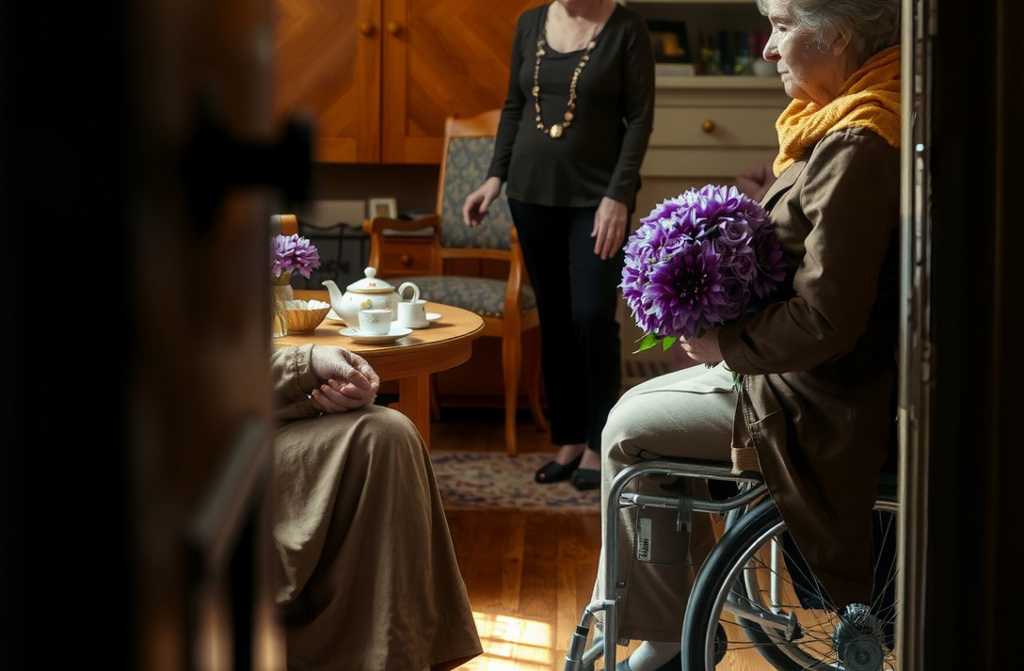
Lydia carried in her mums favourite dark purple dahlias with yellow centres. You couldnt see her for the size of the bouquet, and she cried as though she couldnt believe shed been forgiven at last. Or perhaps she just couldnt forgive herself. Yet there was happiness too: her own daughter had been born that very day, a ginger-haired scrap wrapped in pink pure joy.
If you were to peek through the window of the old stable block behind the main house tonight, youd see three lovely old ladies, laughing, sipping tea, reminiscing and waiting for children, grandchildren, great-grandchildren for everyone who makes life feel real and full. Their days are numbered, soon to fade away, but for now, they cherish every embrace, every family moment. Thats what truly matters.





