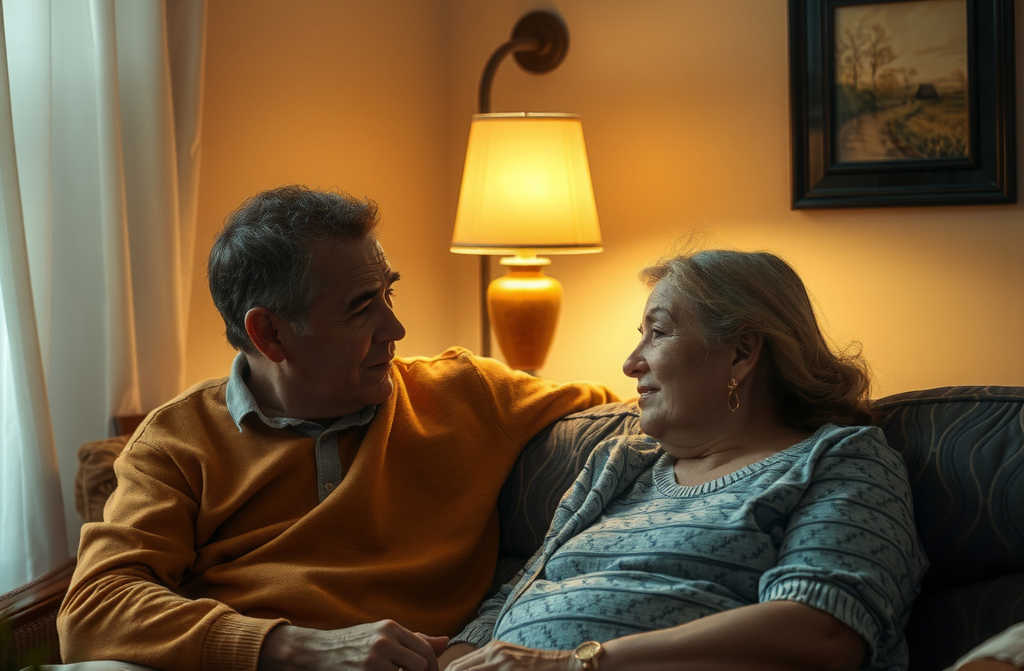
She was dying in the next room, and we kissed in the armchair
No, Doctor, were not sending her to a hospice. I promised.
I stood in the bedroom doorway, clutching my mobile so tightly my knuckles went white. My voice broke on the last word, slipping into a hoarse whisper. I leaned my forehead against the doorframe and closed my eyes.
I do understand your position, Mr. Turner, but please try to see mine too, came the tired voice of Dr. Brooks, the neurologist whod been seeing Margaret for nearly two years now. The prognosis isnt hopeful. The second stroke well, the chances are slim. You can see the progression yourself. Her quality of life
Shes my wife, I cut in. Shes my responsibility. Ill look after her myself.
But you, Andrew, you
I ended the call. My hand was shaking. Sophie, who was adjusting the pillows under Margarets head, looked around at me. Her dark hair was pinned up in a neat bun, her white t-shirt spotlesseven after twelve hours on shift.
Is it them again? she asked softly.
They dont live here, I muttered, staring at the carpet. They dont see what its like what I
Words failed me. Sophie straightened, picked up the thermometer from the bedside table, and checked the reading.
Thirty-six point seven. Thats fine. Blood pressure was one-twenty over eighty this morning. I gave her the Neuracalm at nine, as usual. Fed her at lunchshe managed half the FortiSip, the rest wouldnt go down, but thats fine. No bedsores; I treated her with Cavilon. Changed her pad twice.
I listened, as I had every day for over seven hundred days. Two years. Twenty-four months. I couldve counted the hours, if I cared. If I had any energy left to care about anything except for one thing: that it would all end, one day. And as soon as I thought it, I hated myself more than words could say.
Thank you, I mumbled. Ill sit with her. You go. Its after nine.
Theres another hour left, by contract, Sophie replied. And have you even eaten today?
I… cant remember.
Ill heat some soup. Just wait here.
She left the bedroom and I was left alone with the woman I had once loved so much I felt I could move mountains for her. Margaret lay on her back, the right side of her face slack, mouth open, breathing heavily through the medicine-induced sleep. On the nightstand was a framed photo: the two of us at the seaside, her laughing, hair flying in the wind, her tanned shoulders glowing, her bright white teeth grinning. She was forty then, a month before that day she collapsed in the kitchen, coffee cup slipping from her fingers, and I hadnt realised what was happening, thought shed just tripped.
I sank into the familiar armchair next to the bedthe spot where I spent most nights, so I could be near if anything happened. My back was always aching these days. I was only forty-two, but every time I looked in the mirror I saw an old mana grey face, hollow eyes.
Sophie returned with a bowl of soup and set up the little tray on the armrest.
Eat, Andrew. Ill stay with her.
No, really
Just eat.
Still gentle, but firm. I took the spoon. The soup was hot and tasted of home. Shed made it yesterday, I remembered. Sophie could cookshed told me stories in the kitchen when I asked once: a carer for eleven years, thirty-five, divorced, no children. Her ex couldnt stand her nights away, the hospital smell she “brought home.”
Tastes good, I said, though I barely tasted anything.
Youve lost even more weight, she commented. At least a stone since I started.
When was that?
Fourteen months ago. After the first carer left.
That first one had been brusque, uncaring. Margaret cried after her shifts, as much as a woman could, half her face unresponsive. Sophie had seemed a lifeline. She was gentle and patient, talking to Margaret as if she always expected an answer, reading aloud, playing music, insisting that hearing and understanding often linger. That Margaret felt more than she could show.
Sometimes I wondered if that made things worse.
Im done, I said, placing the bowl aside. Thank you.
You must sleep, Sophie said quietly, holding the empty dish but not leaving. When did you last sleep properly? In bed, for more than four hours straight?
I cant remember.
Andrew
I cant, I breathed out. I cant lie in that bed. I cant leave this room. What if she gets worse? What if
Im here, Sophie interrupted. Every day for twelve hours. You have the monitorif anything happens, youll know.
It doesnt help.
She looked at me silently for a long moment, then nodded and left. I leaned back in the chair, closed my eyes. Margaret was breathing steadilya rhythm that had become the soundtrack of my existence. In. Out. In. Out. I opened my eyes, looked at her. Her face in the glow of the nightlight seemed peaceful. She wasnt suffering nowthe medication was working well. She slept most of the day, only waking for moments, her gaze unfocused, struggling to say something, only jumbled sounds coming out. Id learned to understand a few: water sounded like wa-a, “pain” like “pa-a.” Sometimes she cried, and those were the worst moments of all.
Somewhere in the kitchen, pans rattledSophie washing up. Water running, her footsteps on the hallway floorboards, lighter than a whisper. Then she paused just outside the bedroom.
Andrew, she called softly.
Yes?
Can I come in?
Of course.
She entered, leaning against the frame. In the light, her face look warm, tired. Suddenly I realisedshe was just as tired as me. She came in daily, spent half her life here, bathed in medicines and sorrow, staying calm and gentle all the same.
Youre a good man, I said suddenly.
Sophie blinked, surprised.
How do you know?
Because you stayed. You didnt leave after the first week. Because you treat her like more than a job.
Shes not just a job, Sophie replied quietly. No one should be just a job.
We went silent. Margaret whimpered in her sleep, turned her head. I tensed but she didnt wake.
I should go, Sophie said. Tomorrow at nine, as usual?
Yes. As usual.
She nodded, but stood in the doorway, looking at me. Then, after a pause:
Do you have anyone? Besides her? Friends, relativessomeone you can really talk to?
My parents died years ago. My brothers up in Manchester, we call once a month. Friends used to have. They stopped calling, six months back. Cant blame them. Whod ring someone who never leaves the house and only talks about illness?
And work?
I work remotely. Software developer. I sit here, by the bed, write code. My boss understands. It pays less now, but it pays.
You should talk to someone, Sophie said. Properly. About something other than medicine.
I dont have anything else.
Everyone does. Youre not just a husband to a sick woman. Youre Andrew. Forty-two. Loved sci-fi once, cinema, rock music. I saw your shelf of books. The old guitar case in the lounge.
I gave a dry, bitter laugh.
That was another life.
Two years ago is nothing, Andrew. Youre not dead. Youre alive.
Doesnt feel like it, I muttered.
Sophie moved into the room, crouched at my chair so our eyes met. The closeness stung; I wasnt used to someone so alive and unbroken, looking at me so intently.
Youre burning out, she said. Ive worked with families like this before. Sometimes, the carer burns out before the patient goes. Emotional burnout, they call it. Youre at your limit. You know that?
I do, I nodded. But what do I do? Abandon her? Put her in a hospice, let her die among strangers?
You can let yourself be human. At least sometimes.
I dont know how, I breathed, suddenly sure I might cry. Ive forgotten.
Sophie reached out, touched my hand where it rested on the armrest. Her fingers were warm, alive. I flinched. When had I last felt someones touch, not through latex or clinical necessity?
Youll be all right, she whispered.
No, I said. I wont. Shes not getting better. Shell stay like this for another year, or five, until a third stroke or pneumonia or her heart just gives out. And Ill stay here and watch, hating myself for wishing it over.
The words tumbled outrotten and festering inside for months. I said what I woke to nightly in this chair with a twisted back and an aching soul. I waited, waiting for it to end, for Margaret to die. And I hated myself more than I could describe.
Its normal, Sophie said. To think like that. It doesnt make you bad.
It does, I argued. Im her husband! I swore through sickness and health. And I find myself wishing shed go.
Youre wishing her suffering would stop, she corrected. Thats not the same thing.
I looked down at our hands. Her palm still rested on mine. I shouldve moved. I shouldve thanked her, let her go. I shouldve been alone with my horror, as every other night. But I didnt move. I turned my hand, clenched her fingers tight, desperatelike a drowning man grabbing a lifeline.
Sophie, I rasped.
Shh, she whispered. Its all right.
She rose, kept hold of my hand, guiding me up. My legs felt like jelly. She put her arms around me, drew my head to her shoulder. I froze, lost. How long since someone had just hugged menot out of duty, not out of pity, but simply with warmth?
Thats when I finally broke. I buried my face in her shoulder and cried, silently, ashamed and unable to hold it back. She stroked my back and whispered meaningless comfort as I clung on, desperate, as though I might drown otherwise.
I dont know how long it lasted. A minute, ten. When I finally looked up, I meant to apologise, but she touched her finger to my lips.
No need, she said.
We were so close I could smell her skina faint floral lotion and the scent of laundry powder, edged by antiseptic. Margarets breathing hummed steadily behind us. In. Out. I shouldve stepped away, shouldve thanked Sophie and said goodbye. I should have.
But I didnt. I stood, looking at her lips, her dark eyesfull not only of sympathy, but of something else I didnt dare name. She brushed my cheek, wiped away a tear with her thumb.
Andrew, she whispered.
There was no reply in me. Everything wound tightfear, shame, need for simple human touch. She leaned in and kissed me, soft as air. I froze. My whole body screamed this was wrong, this was betrayal, that my wifehelpless, sick, the woman I loved or had lovedwas only two metres away.
But I didnt push Sophie away. I kissed her back, shy, awkward, forgetting how. She hugged me close, and in her warmth, I lost myself in the feeling that I wasnt alone, that someone still saw me, noticed me, wanted me.
We sank into the armchair. She perched on my lap. I held her, kissed her, ran my hand down her back and hair; every touch burned with shame and the equal need to keep going. I hated myselfevery second. But I couldnt stop.
Her hands slipped open my shirt buttons. Mine moved under her top. Behind me, Margarets breath kept steady, deep, sedated by the nights medicine. She slept. She didnt know. But I did. I saw, I heard, I knew.
Sophie I croaked, trying to stop her, stop myself.
Its all right, she murmured. Im here. Youre not alone.
Those wordsthe simplest, most human wordswere what finally undid me. I gave in. It happened in that armchair, by my wifes bed, in the hush of the night-light, to the monotone accompaniment of her breathing. I did what I shouldnt have done, what I thought unthinkable. I betrayed the woman depending on me completely.
And I couldnt stop myself.
Afterwards, we lay tangled in that chair, Sophies breaths slow, her head on my chest. I stared at the ceiling, unblinking. There was nothing left inside. No shame. No pain. Just emptiness, as if Id been burnt through and through, not even leaving self-hatred behind. Only the weight of it left, holding me in place.
Margaret breathed on. In. Out. She didnt wake, not even stir. I looked at her facepeaceful. She didnt know. She never would. Id live with this for the rest of my life, but shed never know.
For some reason, that was the hardest part.
I should go, Sophie whispered, sitting up.
I didnt answer. She dressed deftly, did her hair, and looked back at mea long gaze without shame or regret. Just kindness, understanding. That stung worst of all.
See you tomorrow, she said.
See you tomorrow, I echoed.
The door closed quietly. I listened to her footsteps in the hallway, the click of the front door as it locked. Alone, with my wifes steady breathing in the next room, I swayed to my feet. My body felt alien. I made it to the bathroom and dropped to my knees. I was sicklong, painful, until my stomach hurt and my eyes stung. I ended up scrunched against the cold tiled floor, staring at nothing.
I couldnt go back into the bedroom. Couldnt look at Margaret. Couldnt sit in the chair. I spent the night on the bathroom floor, drifting into a cramped doze, and woke to my phone alarm at seven. Time for Margarets tablets.
I washed my face in cold water, looked in the mirror. A grey face, red eyesunshaven, unwell. I looked like I hadnt slept in a week. In truth, two years.
The bedroom was quiet. Margaret lay there, staring at the ceiling. When she noticed me, she tried to move her working hand. I went over, sat at the edge of the mattress.
Good morning, I said, voice sounding like someone elses.
Ahh… Margaret replied, attempting a smile.
I poured water, fetched her Neuracalm, helped her up, supported her shoulders. She was so light these days. I gave her the tablets one by one, helped her sip water. She struggled, but managed. I eased her onto the pillows again and pulled up the blanket.
Ill get you some breakfast, I said, voice catching slightly.
She nodded as much as she could, closed her eyes. I left the bedroom, let the door quietly close, and braced my forehead against the hallway wall. Tried to steady my handscouldnt.
At nine, Sophie arrived. I heard the bell, answered without looking at her. She came in, hung up her coat, and slipped off to the kitchen.
Morning, she said.
Morning, I replied, avoiding her gaze.
We sat in the kitchen. She put the kettle on, took out her packed lunch. Everything ordinary, as if nothing had changed. I sat there, fists clenched, unable to speak.
Andrew, she said softly.
I looked up. She was calmneither judging nor pleading. Just watched.
I need to talk to you, she said.
I cant, I exhaled. Not now.
Then just listen. What happened last nightI dont regret it. I was there because you needed not to be alone. I saw it in you. So I stayed.
You dont understand, I muttered. I cheated on my wife. On my sick, helpless wife, who needs me for everything. I
Youre human, Sophie said. Tired, exhausted, at breaking point. Its not excusing it. It just explains.
An explanation doesnt make me better.
No, she agreed. But it doesnt make you a monster.
I shook my head, got up, went to the window. Outside it was an ordinary street in Readingbare trees, kids playground, benches. People going about their lives. Inside, I stood in this flat-turned-hospital-ward, falling apart.
I cant go on, I whispered. I cant look at her and know what I did.
So what do you want? Sophie asked.
I dont know, I admitted. I dont know anything.
She touched my shoulder from behind. I flinched but didnt step away.
Ill keep coming, she said. Ill care for Margaret. Ill help you. If you want to forget last night, Ill forget. If you want me to leave, Ill leave. But if you want me to stay, Ill staynot as a carer, but as someone who cares for you.
I was silent. Everything within was tangledshame, gratitude, despair, and the burning need not to be alone. I wanted her gone forever. I wanted her to never leave. Mostly I wanted the impossible: to go back to when Margaret was whole and I was just a husband who loved his wife.
Ive got to feed her, I finally said.
Sophie nodded, stepped aside. I left the kitchen without looking back. In the bedroom, Margaret watched the doorway. When I entered, she attempted a smile, tried to lift her left hand to me.
I sat beside her, took her handcold, frail, barely able to move.
Lo-ve, she laboured out. She was trying to say she loved me.
I closed my eyes. Something inside broke completely. I brought her hand to my lips and kissed her knuckles.
I love you too, I whispered.
And it was true. Awful and unbearable, but true. I loved the woman before medamaged, suffering, the one she was and the one she had become. I loved her with everything I had, and yet I had betrayed her. With another woman, who was now making tea in my kitchen, as if nothing had happened.
How do I keep living this way? How do I keep caring for her, feeding her with a spoon, changing her, comforting her at night, knowing what Ive done? Remembering every second of last night, every touch, every kiss?
Sophie brought the FortiSip in a bottle with a straw, set it down, and quietly left. I fed my wife slowly, carefully, dabbing her chin when needed. She drank poorly, choked often. Id stop, wait, stroke her thinning hair. Shed always prided herself on her thick brown hair. Now it came out in handfuls.
Its all right, I murmured. Take your time. Im not going anywhere.
She looked at me with such love and trust I couldnt stand to meet her gaze. I looked at the window, the photograph, the wallanywhere but into her eyes, which still saw someone worth loving.
The day dragged on. Sophie did her job as alwaysmeasured blood pressure, gave medicine, turned Margaret, changed the bedding. I sat at my computer, stared at meaningless lines of code until the letters blurred. I shut the laptop, went to the window. Children played below, laughing, chasing a football. Ordinary life, which I had almost forgotten.
At lunch, we all sat in the kitchen as we used to. Sophie baked a casserole, poured tea. We ate in silence. I found my eyes returning to herto her hands, her lips, her eyes. None of them showed shame, only something quiet and good.
District nurse is coming at three, Sophie told me. To set up a drip.
All right, I nodded.
And social services rang. Asked if we needed anything. I said were fine.
Thank you.
Silence. Only the clock ticking and a distant TV from a neighbour. Sophie washed up; her movements were routine, at home. Shed been part of our lives for two years. Now, she was something moresomething that shouldnt have room.
That evening, with Margaret asleep under her doses, Sophie got her things. I walked with her to the hall. She put her coat on, turned to me.
Andrew, she began.
I interrupted, unable to meet her eyes.
Last night it didnt happen. You owe me nothing. I understand.
She was quiet. When I did glance at her, for the first time that day, there was pain in her eyes.
All right, she said gently. As you wish.
Come tomorrow, I added, though I didnt even know why. Please.
I will, she promised. Ill be here.
The door closed. The only sound in my flat was Margarets regular breathing. In. Out. I couldnt go in there, couldnt take the chair. I slumped against the wall in the hall and sat there for who knows how long. Outside, dusk fell. I stared into the dark, thinking the life I knew had ended when Margaret dropped her coffee in the kitchen, and whatever life had replaced it ended last night. I didnt know where I belonged, or who I was. Not really.
A faint groan from the bedroom. Margaret. Waking up, or having a nightmare. I staggered to her side. The nightlight glowed. Margaret lay with open eyes, looked at the ceiling, then at me, moved a hand.
Ahh, she called.
I went over, sat at the edge of her bed.
Im here, I said. Its all right. Im here.
She watched me, her eyes so full of love and belief it made me want to scream. I wanted to drop to my knees and beg forgiveness, to confess everything, to let her hate meanything but this trust I didnt deserve.
But I said nothing. Just held her hand, tight, until she drifted back to sleep. Then I settled in the chair, pulled the blanket over myself, and closed my eyes.
Couldnt sleep. Just lay there, staring at the dark. Listening to her breath. In. Out. In. Out. That sound would stay with me for lifefor however long that might be. A month, a year, five. Maybe Id go first, burnt out to a cinder, and thered be no one left to sit here, to tell her it would be all right.
I thought about Sophie. About how shed said I needed to be human. About how easy, and frightening, it had been to let myself, just once. That shed be back tomorrow, and Id have no idea how to look at her, talk to her, exist with this between us.
I didnt know the answers. I didnt know what would happen next. Only this: tomorrow, Id wake in this chair, get up, wash my face, give Margaret her morning pills, feed her, log into work, write useless code. Sophie would come at nine. Wed talk about meds, about pads, about pressure readings. Wed smile at each other, cautiously, like people who know things they shouldnt. Wed continue this not-quite-life, this nightmare, without end.
And somewhere deep down, in the blackest corner of my soul, I knew last night would happen again. Maybe not today, not tomorrowbut it would. Because I was weak. I couldnt do this alone. Because I was human and humans crack under burdens they were never meant to bear.
Margaret kept breathing. In. Out. I closed my eyes and tried to sleep. But there was no sleepjust memories, and questions I could never answer.
How do you keep living?
How can you meet her eyes?
How do you forgive yourself for the thing you cant forgive?
I dont know. Tomorrow Ill get up and do what has to be done. Because theres no other choice. Because I gave my word. Because Im her husband, and thats the only thing I have left.
Everything else, let it stay in this night, in this armchair, in the hush broken only by the breathing of the dying woman I lovestill, despite it all.
In.
Out.
In.
And I suppose, after everything, thats what it means to be human.






