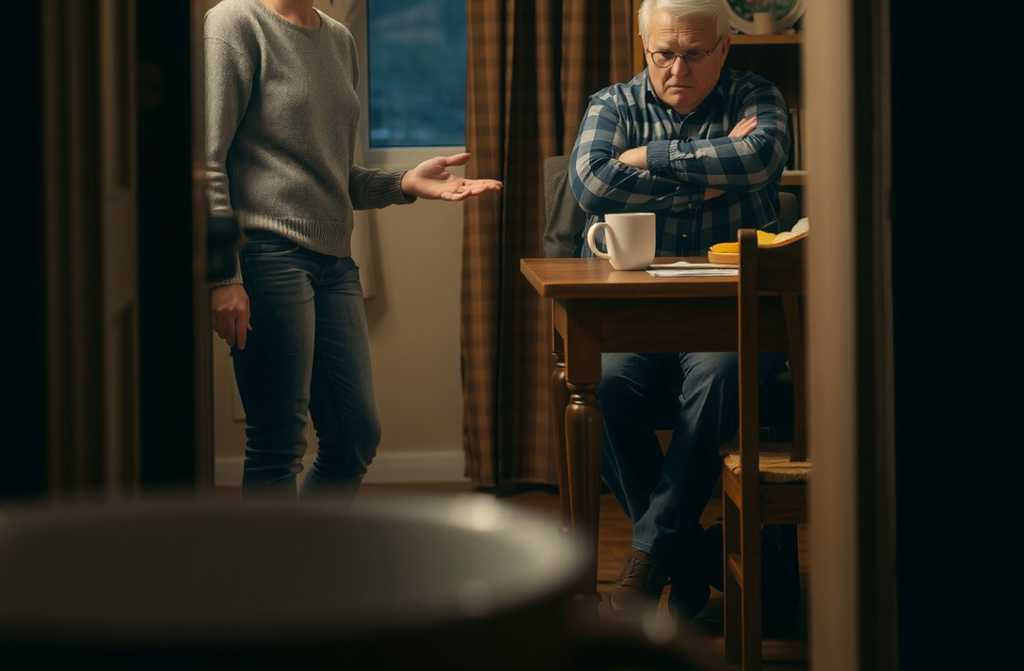
Behind the Closed Door
That evening began like any other. I was washing up in the kitchen; Andrew was in the lounge watching something, and Molly was doing her homework at the kitchen table. Everything was in its place. Even the smell was right: leftovers from dinner, and a faint aroma of coffee from the cafetière Id forgotten to turn off.
Andrew called out from the lounge,
Ollie, Ill pop in to Mums tomorrow morning. Shes asked if Ill have a look at the tap.
All right, I replied without turning around.
Molly looked up from her notebook,
Dad, can I come?
Not this time, sweetheart. Just a quick in-and-out.
He came into the kitchen for a cup of tea, leaving his phone on the worktop. I reached for the tea towel and, out of the corner of my eye, noticed the screen light up. A message from Mum appeared, wide open, no password. I didnt mean to read itmy eyes just caught the line: She rang again. Be careful.
I put the towel away and kept drying up. Andrew took his mug and went back into the lounge. Molly was buried in her maths.
Something shifted in my chest. Just slightly, as if a not-quite-shut window had let in a draught. I put one plate down, picked up the next.
Shewho?
I didnt ask that evening. I all but talked myself out of it. Probably nothinga neighbour complaining about noise. A client. A colleague. Could be anyone.
But the word careful stuck in my mind and would not budge.
I met Andrew when I was twenty-six. He worked for a construction firm; I was at a small travel agency. We met at a mutual friends birthday, started chatting about a city Id just come back from on business. He listenedreally listened. Laughed at the right places. Three months later, we moved in together.
We had a modest wedding; twenty people in a restaurant, a white dress from a local seamstress, a raspberry cake. No master of ceremonieseveryone made their own toasts. His mother, Janet, sat at the head of the table, looking at us with such pride I thought, Thats love. Thats how a mother looks at her child when she sees them happy.
The main thing, Olivia, is that you really hear each other, she told me as I touched up my hair in the ladies. In our family, weve always believed: whatever happens, family matters most.
I nodded. Seemed like good, solid advice.
Molly was born two years later. Then we opened our café. My idea, but Andrew was onboard instantly. We leased the place, painted it ourselves, found a coffee supplier. Called it The Yellow Door after the warm ochre-coloured entrance. Two rooms, ten tables, a small cake displaybusy, friendly. People kept coming back.
Andrew handled supplies and accounts; I managed the floor, the staff, the menu. We barely argued about work. We found our rhythm quickly. He knew I hated last-minute changes; I knew he needed peace in the mornings.
Family happiness isnt some grand, shining thing. Its knowing how each other takes their coffee, who needs silence in the morning, how to settle the child when theyre feverish. Small habits, weaving a stable pattern. I believed in that pattern. I cared for it.
Janet lived half an hour away. Early on, it was just visits once a month, at Christmas or birthdays. She looked after Molly if we were away buying supplies, brought jam, sometimes pies. I liked hergenuinely.
But then things started changing. Gradually, like water heating up in a pan. You dont notice it, until you burn yourself.
Andrew began visiting his mum more, then weekly, then twice a week, then sometimes hed leave Friday night and return Saturday afternoon.
Shes on her own, Ollie. I cant just abandon her.
I understand. Of course.
But something shapeless was taking root in me. Not jealousy. More a sense that I was becoming second on his list, always behind his mum.
One late summer day, Molly and I dropped round to Janets unannounced. I needed to return some books shed lent me in spring and kept failing to bring back. Outside the building, I met her neighbour, Mrs White, sturdy and cheerful, with a ginger dog.
Oh, Olivia! She lit up. Janets insaw her about an hour ago. Shes always busy with that girl, such a kind heart helping her.
I smiled, confused. Which girl?
Mrs White faltered, just for a second. Some youngster. Dont really know her. And hurried away, tugging the dog along.
I buzzed up. Janet was delighted to see Molly, made us tea, handed over the books. Everything seemed normal. I barely asked anything. Only, when Molly went off to watch TV, I said quietly,
Janet, Mrs White mentioned a young girl youve been helping. Someone local?
She looked at metoo carefully.
Thats Tanya from the fifth floor. I watch her daughter sometimes, help out when I can. You know Im no good at saying no.
I nodded. Sipped my tea. Gathered Molly. Drove home.
But that night, as I lay in bed, I remembered Janets look. Not warm, not coldmeasuring. The way someone checks if youve worked something out yet.
That autumn, Andrew changed. I cant describe it better. He was there: talking, eating dinner, taking Molly to swimming on Fridays. Same as always. But something in him closed offlike a window slammed shut.
A few times I tried to broach it.
Tired? Shall we step back from the café, go away?
Not now, Ollie. Too much on.
Too much what?
Justwork, Mum, everything.
He wasnt unkind. That was the problem. Always polite in the small thingseven brought me coffee in bed on Sundays now and then. But hed stopped really meeting my eyes. Just glanced off me, like water off glass.
I noticed. And looked away. Told myself: autumn, tirednessitll pass.
In October, one Tuesday night, he said his mum had heart trouble, needed him late. I didnt object. Called him at midnight.
How is she?
Better. Ill set off now.
He was home by one. Silent. I didnt ask questions. We lay side by side in the dark, with a distance between us that had never been there beforenot in inches, in something deeper.
I lay awake, listening to his breathingsteady.
I was cross with myself for not asking then. But the truth is, I was scarednot of the question, but of what he might answer.
In November the big espresso machine broke. Italian, leased three years earlier. The repair was meant to take a week, but dragged to two. I worked in the café every day, using our old back-up machine, manning the counter myself if we were short-staffed. Andrew helped too. We worked alongside each otherit felt just like before.
One lunchtime a woman came in, maybe forty, with a dark-haired little boy of about five. They ordered hot chocolate and a croissant by the window. I brought the order myselfthe waitress was on her break.
The woman smiled at mejust a normal, friendly smile. I smiled back and went to the counter.
Andrew was watching the table, or rather the little boy. He didnt know Id noticed. But the way he lookedit was like seeing something of your own.
I picked up a cloth and began methodically wiping the bar, corner by corner. Andrew turned away, started chatting to our chef about a delivery. The woman and her boy soon left.
That evening I asked,
Who was that woman by the window?
He pausednot long, a couple of seconds, but I noticed.
No idea, Ollie. Never seen her before.
You were watching her. Or rather, her child.
He looked a bit like Molly as a toddler, thats all. Sweet little lad.
I nodded. That was the end of that.
But the pause stretched between us, growing every day.
A week before Christmas, I visited Janet alone. Andrew knew I was going, but he had a meeting with a supplier elsewhere. I brought her a gift: a woollen blanket and chocolates. Shed said she was feeling unwell.
I got there at four, buzzed up, went to her flat. Janet was surprisedgenuinely so, I could tell straight away. Behind her, I heard Andrews voice, low, on the phone. Janet stepped aside to let me in and called him:
Andrew, its Olivia.
Sudden silence. Then a door opened and Andrew came out, phone in hand, looking at me as if I was the last person he wanted to see right now. That expression flickered away in an instant.
Oh, youre here. Great.
Brought the blanket. Janets been under the weather.
Yes, thank you.
We sat with tea, chatting about the festive season, Mollys school, new curtains. Janet was on edgeI could tell by how she held her mug and stared out of the window between sentences. Andrew acted so normal it seemed forced.
As I got ready to leave, Andrew followed me into the hallway.
Wait, Ill head off soon too.
Janet stayed in the kitchen. I heard her clattering about. Then, something in me snapped, and I asked quietly:
Who keeps ringing her? That text in NovemberShe called again. Who is she?
Andrew held my gaze for ages.
How did you see that?
I glanced at your phone. By accident.
He turned away, staring at the hall mirror. Long pause.
Thats a former colleague. She bothers Mum sometimes. Nothing serious.
Why would she bother your mum?
Ollie, not now.
When, then?
He shrugged on his coat and left first. I stood in the hallway for a moment, then left as well.
Driving home, I didnt put the radio on. I just thought. Carefully, like wiping a counter, corner by corner.
A former colleague, he said. That might fit the message, but not the look hed given the boy in the café.
Marriage isnt a science; its a skill. You take small tests every daymostly about trust. You choose: to trust, or to check. Trusting is easier. Checking is frighteningit might find something.
I kept choosing trust. Again and again.
But by January, I began changing, quietly, without conscious decision. One morning I woke before Andrew, made myself coffee and sat alone in the dark kitchen. Molly was still asleep. It was 5 a.m., snow outside. I quietly wondered: when did I last really feel he was with menot just beside me but truly with me?
I couldnt recall.
In February he went away on a business trip, five days in another citysuppliers, meetings, standard. Hed gone away before and Id never given it much thought. This time, I did.
On the third day, I found a receipt in the pocket of his old coathed left it home, I was putting on a wash. It was for a café in our town, dated that Tuesday hed said he was at his mums with a heart scare.
The café was just two streets over from ours.
I slipped the receipt in the desk. Said nothing when he returned. Just watched him at dinner and thought: you were in town, not at your mums.
Hows your mum? I asked.
Better, he replied. Called in to see her this week.
This week?
Yes. He ate his soup, not meeting my eyes.
I didnt ask again. Washed up, tucked Molly in bed, came back to the room. Andrew was scrolling on his phone.
Tired? he asked, eyes on the screen.
A bit.
Lie down, Ill be in soon.
I lay there, staring at the ceiling. The silence was thick. In a family, deceit isnt usually a shout or a row. Most often, its silence. Plain, nightly silence where everything is already wrong and no one will name it.
March arrived, bringing both a warming breeze and a resolve I didnt expect of myself. I made no plansjust started noticing things for what they were, without excusing them.
Andrew went to his mums every Wednesday. I started noting the time: left at seven, back around eleven. One night, I called Janet at 8:30.
Evening, Janetis Andrew still with you?
A tiny pause.
Yes, hes here. Theyve just gone out to the garden for a bit. Shall I get him?
No, thats fine. Thanks.
I didnt ring Andrew. He came home half eleven, said nothing about my call. So, Janet hadnt told him. Theyd agreed not to.
Thats when it got really cold. Not outdoorsinside.
Andrews mum and I had always had a trickier relationship than it might have appeared. Janet was charming. She never told me off straight; it was always through a smile, a gentle Well, you see She knew how to get you to agree without you noticing.
But in March, I started seeing her in a different lightas if someone had changed the lighting in the room.
She knew. Whatever it was, she knew. And she was keeping it.
I didnt know exactly what, but I understood: she was protecting his secret, not my peace of mind.
One warm April day, Molly at a friends birthday, I went to see Janet, alone, unannounced. Parked round the cornerno real reason, just didnt want to be spotted early. Climbed up to the third floor, stopped outside her door.
Voices behind itAndrew, low, not a whisper but gentle. Janet, measured and insistent. I listened. Not to the words, just the tones. Voices you use when a matter has long been a weightnot an argument, a negotiation. Tired people circling the same subject.
Then I caught a word, clearboy.
Andrews voice.
I stood with my hand on the doorbell.
We cant go on like this
Janets voice.
I know, Mum. But Oliviashe cant
I pressed the bell.
The voices cut off, dead. Silencethen footsteps. Janet opened the door.
She looked at me, I looked at her.
You didnt ring ahead, Olivia.
No. I didnt.
I went in. Andrew stood in the little lounge with a mug. He looked at me, I at him.
Tell me about the boy, I said.
Silence.
Ollie, he began.
Tell me about the boy, I repeated quietly, very quietly.
He put down the mug. Sat. Janet stood by the window.
He told me everything, and I didnt interrupt. I heard the words as if from underwater. Five years ago, work trip, three days, a fling. He hadnt known she was pregnant, found out months later, after she wrote to him. Hed gone to seemet the boy.
He was four now.
Youve seen him?
Yes.
How many times?
Pause.
A few.
How many, exactly?
Ollie
How many?
About twenty, I think.
Twenty times. In four years. Twenty times hed visited a child who didnt exist for me, not in our lifea child Janet knew about.
I looked at Janet.
You knew.
She didnt look away. I can never forgive that. She met my eyes and said,
I found out two years ago. Andrew told me himself. I didnt want to break up your family.
You already did, just without me knowing, I replied.
I stood, picked up my bag, headed for the door.
Olliewait, Andrew called.
I have to collect Molly.
I walked out. Down the stairsnot the lift. Each step was like moving through water, weighted chest.
It was April. Sunlight. Smell of blossoms. A mother pushing a pram, kids playing football.
I sat in the car, shut the door, hands on the wheel.
Didnt cry. Not immediately. Just stared straight ahead. The sun on the dashboardwarm, insistent, as if nothing had changed. As if April didnt know everything was now different.
I rang Mollys friends mum, asked if Molly could stay another hour. I needed that hour.
I sat in the car and breathed.
Deceit in marriage isnt born big. It starts with a small silence. Silence becomes habit. The habit becomes a wall. One day you realise youve been living on the other side of that wall, convinced it wasnt there.
Molly came home happy, butterfly painted on her cheek. I made her dinner, asked about the birthday, cake, gifts. She chatted away, arms waving.
Andrew got home at ten. I was in the kitchen pretending to read.
Shall we talk? he asked.
Mollys still up.
Later, then.
Later.
By half ten, Molly was asleep. We sat at the kitchen table. He talked a long time: said it was a mistake, he was afraid to tell me, feared losing me, loved me, family was everything.
I listened. Noticed how he said I was afraid, not I shouldnt have. How everything was about him, not me.
You lived with this five years, I said when he was done, and I was there beside you, not knowing. All that time you chose your own comfort over my truth.
Ollie, I chose our family.
You chose your convenience. Not the same.
He bowed his head.
What do you want to do?
I want you to leave.
He looked up.
Are you serious?
Utterly.
And Molly?
Shes with me. Youll see her, but you wont be living here.
He tried to talk me round, suggested therapy, talked about the family wed made. I just got up.
You can stay tonight. Tomorrow, while Mollys at school, pack your things.
I went to bed, fully dressed, lying on top of the covers. Staring at the ceiling. No fireworks, no floods of tears, no need to shoutjust bone-tired emptiness, like after a hard journey, only theres no relief, just the fact youve arrived.
Next morning, Andrew took Molly to school, came back, packed two bags, stood in the doorway.
Ollie, I dont want this.
I know.
Could we try differently?
No.
He hesitated, then left.
I shut the door, paused in the corridor, then went to the kitchen. Made a coffee. Opened the window. Sparrows were chirping outside.
So that was that.
Molly found out a few days later. I took my time, wanting words that didnt wound more than necessary. She was a clever child, our Mollynine, but wise.
We sat on the sofa, she fiddling with her tablet. I switched it off.
I need to tell you something.
She looked up, suddenly grown up.
Dads leaving, isnt he?
Dads already gone. Well live apart, youll still see himeverything will be fine. Just not together.
She was quiet.
Did you argue?
Yes. A proper argument.
Why?
Its grown-up stuff. When youre older, Ill explain.
She was quiet again, then snuggled in.
Mum, did you cry?
A bit.
Will you cry now?
I dont know.
Ill give you a hug, just in case. And she did, tight.
Thats when I criedquietly, into her hair. She was very still and very serious. I thought, how is it children know when you really need them?
Molly cried most evenings, the first few weeks. Called for him. I didnt stop herjust sat close, answered as honestly as I could. When she asked, Will he come back? I said, No. But he will always be your dad.
Andrew rang her every day. I valued that. Not him, perhaps, but that in him.
Janet called me three days after he left.
Olivia, we need to talk.
We dont.
You dont understand. Youve ruined his life.
Ruin his life? I repeated.
Hes lost everything. Mollys without her father.
She sees him. What I lost was five honest years. Thats not the same.
Youre heartless, her voice was trembling. I think she meant it.
Maybe. I just claimed my dignity. Goodbye.
I put the phone down. It rang againI didnt answer.
I never spoke to Janet again. She came to see Molly when Andrew had her at weekends. Id nod hello, then leave them to it. Molly hugged her gran, and I never got in the way. That was their story, not mine.
The first summer after the split was strangechaotic, yet very quiet at times.
I worked in the café more than ever. Looked over all our contracts. Realised there were things Id never really understoodwhat was in Andrews name, what in mine, the legal side. Wed set up the business together, but Andrew handled the paperwork. Id trusted him.
Now I had to sort it out. I hired a bookkeeper. Spoke to a solicitor. Transferred what needed to be transferred. It took two months of forms, phone calls, legal jargon that I Googled late at night.
Andrew didnt object. He rang once about it.
Are you sure? The cafés yours, but its a tough job solo.
Ill manage.
If you need a hand with suppliers
Ill sort it, thanks.
He was quiet.
Ollie, I still think we could
Andrew. Im not having that discussion.
He didnt raise it again.
Gradually I changed up the suppliers. Found better ones, expanded the menustarted serving iced coffee in summer, sourced rye bread from a local bakery everyone loved. People came in just for the bread, stayed for coffee.
The café was mine, properly mine.
For the first time in ages, I felt something like lightness. Not happiness, exactly, but a sense of standing on my own feethere are my hands, heres what Ive made. No one to help or hinder.
Freedom for a woman is like thatnot running off to the other side of the world, but looking at your life and saying: it works, because I made it work.
That autumn, Molly started year four. Made a new friend, Harriet, from art club. Most Fridays, Id pick up both girls, and wed stop by The Yellow DoorMolly with her hot chocolate and a little éclair.
Mum, you make the best hot chocolate in town, she declared importantly.
Oh? Where else have you tried it?
At Harriets, with Dad, at Grans house.
She spoke about her dad easily by then, and I was grateful for that. A child shouldnt have to choose sides; that mattered more than my pain.
Andrew rented a flat nearby. Molly went every weekend, sometimes sleeping over. I packed her bagfavourite pyjamas, toothbrush, all sorted. It was civilno drama. Looking back, its the one thing we truly managed in our new arrangement.
That autumn, my old friend Joanna rang. Friends since we were twelve, though life scattered us, we still called each other every couple of months.
How are you, really?
Im all right. Truly.
All right as in just about, or really all right?
Really. Tired, but all right.
Does he ring?
Sometimes. Mostly about Molly.
Only Molly?
He says he misses me, sometimes. I dont reply to that bit.
And do youdo you miss him?
I thought before answering.
Im not sure what it is I miss. Maybe the person he was, in my head, yes. The person he was for realno.
Joanna fell silent.
Youre strong, Ollie.
I just got tired of pretending everything was fine when it wasnt. Thats something else.
Getting over a divorcetheres no recipe. I managed by working, time with Molly, silent evenings. Silence suffocated at first, then it stopped. Then I came to value it.
I didnt look for someone new. Not out of some vow, but because first I had to figure myself outwhat I wanted from life itself, not from life with someone. Id confused the two for too long.
That winter, for the first time, I went away alone. Molly spent a week with Andrew. I took a train to a coastal town. It was cold, windy, the sea was grey and the promenade nearly empty. I walked for three days, drank coffee in unfamiliar cafés, read by the window. Ate fish at a little harbour restaurant.
No hurry, no explanations.
Second evening, as I sat in my room, I thought: maybe this is itnot a wild happiness, just this: Im here, Im peaceful, I owe nothing to anyone right now.
I hadnt had that for yearsmaybe never.
Molly rang,
Mum, where are you?
By the sea.
Cold?
Very.
Why did you go?
I just wanted to.
Oh, all right. Bring me back something seaside-y.
A shell?
Or a magnet.
Of course, love.
Mum?
Yes?
I miss you.
I miss you too. Three days, then Ill be home.
All right. Bye.
I put the phone down, listened to the sea. Dark, wintry, alive. Then I picked up my book.
The following spring, our card reader broke in the café. The repairman was young, about twenty-five, glasses. Fixed it quickly, had a coffee on the house. Smiledgood smile, nice lad.
Nothing came of it, but I smiled back, genuinely, not out of politeness.
A small thing. But I remembered it.
Something in me was still alivethat weariness hadnt frozen me through. That was good to know.
In May, there was a call from an unfamiliar woman.
Is that Olivia?
Yes.
Im Claire. You probably know who I am.
I did. Almost at once.
Yes, I know.
I just wanted to talk. Not to justify anything. Your husband said youd split. Its not why Im callingIm not at fault here. I just want you to know that.
I know.
And my sonhe doesnt know about any of it. Hes still very little.
I understand.
A silence.
Youre not angry with me? she asked.
I am. But not at you. Youre not the problem here.
She paused again.
Thank you. I wasnt expecting that.
Youre welcome.
We hung up. I dont know why she calledmaybe looking for permission to rest easy, or just needing to say it out loud. I didnt dwell on her motives, I just received the call.
Her name was Claire, she had a son. Andrew was part of a life Id never seen for five yearsa pain I couldnt change, but there was no hatred.
Hate requires more energy than I have to spare.
That summer, I hired a new café assistantPolly, twenty-three, with ginger braids. She settled in fast, bright and attentive. Molly took to her on sight.
Mum, Pollys brilliant, Molly told me, scraping her chocolate mug.
Shes great at her job, I agreed.
Noshes just brilliant. She can even make a cat out of milk foam.
I know. Thats why I hired her.
Molly laughedproper laughter, open laughter. That sound was one of those I stored up, precious.
The child coped. Sometimes she was sad in the evenings or cross if Andrew missed a festival because he was busy. Thats normalthe pain of growing up, but I tried not to add my own sadness to hers.
Marriage psychology, in many ways, is about how long you can ignore a crack. I noticed it and called it something else: fatigue, a phase, itll pass.
The lying wasnt only hisI lied to myself, too. Lied that you could get by not knowing. But you cant.
Knowing hurts. But its true.
That September, Molly started year five. I took her on her first day even though she really could go alone now. Just wanted to. Waited by the gate until she disappeared. She waved from the doorway, I waved back.
Back in the café, I opened up myself. Made the first coffee of the day and drank it in the peace before the staff arrived.
Life after splitting up is odd. You expect it to be worse, but it isntjust different. A new rhythm, new pace. Strange at firstthen it becomes yours.
Andrew sometimes rang just to talk, not about Molly. Said he couldnt accept things. Talked about us, how the whole thing was a horrible mistake.
I listened. Once, I asked:
Andrewdo you regret what happened, or just being found out?
He was silent a long time.
Thats not fair, he said finally.
Perhaps not. But I dont owe you fairness anymore.
After that, he only called about Molly.
That was right.
Autumn, year two: met Joanna at the airport. She was heading on a work trip, I was seeing her off. We had coffee before her flight, chatted fast.
You look good, she said.
Really?
Yes. Different. Lighter, somehow.
Maybe I am.
Whatve you dropped?
I thought for a moment.
The need to put on a front. We always actednormal couple, perfect family, I tried so hard. And then I realised it all didnt actually matter.
What now?
Just living. No more acting. Just living.
She smiled.
Thats good.
Its different, anyway. Maybe not good yet. But honest.
Her flight was called. We hugged.
Lets talk soon.
Definitely.
I walked through arrivalsa bustling crowd, people with signs, kids, bouquets. Expectation, reunion.
I was almost at the exit when I saw, from the corner of my eye, Andrew. Standing by the info desk, with a little dark-haired boy, about five. Andrew had a hand on his shoulder, said something to him, the boy laughed.
I stopped, watched for a few seconds.
No darkness, no lump in my throat, nothing dramatic. Just an odd calm sensation, as if looking at a scene from someone elses lifewell observed, well shot, but not mine.
Andrew didnt see me.
I left. Out to a taxi. Home.
There was regretnot for him, but for the years. For what couldve been, for what I should have known. But regret isnt sorrowit just passes through, leaves you changed but not broken.
I got home. Molly was at a friends. I changed, put the kettle on.
Texted Molly: Back now. Hows things?
She replied in a minute: Fine. Were painting. Mum, can I stay an extra hour?
Of course, I messaged back.
My phone buzzedAndrew. I saw his name, put it down, and went to the kettle.
Hed call again, maybe message. It changed nothing.
Life after a marriage isnt emptiness. Its a different fullness. Quieter, steadier, with fewer voices.
That winter, at the end of the second year, I took Molly for a little holiday. We went three days to a market town in the hills. Snow, winding streets, the smell of pines and baking. Molly ate waffles with jam and laughed when it splodged on her nose.
We walked the frozen riverside, Molly took my handher idea, not mine.
Mum, do you like it here?
Very much.
Are you happy?
I looked at herher serious face, so like mine at her age.
Yes. In my own way.
What does that mean?
It means Im happy right now, here, with you. Thats happiness.
She considered that.
And is dad happy?
I dont knowyoull have to ask him.
I will, she said matter-of-factly. Next weekend.
Okay.
We walked on, the snow crunching under our boots. She started humming to herself, and I listened to her small voice in all that quiet.
Thats all there was to understand. Nothing grand, just that.
That March, I finally got the cafés window done up. New glass, new lights, wooden shelves with flowerpotsa tiny fig, a couple of succulents, a long trailing ivy.
Polly said it made the café look alive.
It wasnt before? I teased.
It was. Now its even more so.
I knew what she meant.
That summer, third year, a woman came inabout fifty, unknown. Ordered a cappuccino and apple pie, sat silently by the window, then came to the counter for another coffee.
Are you the owner?
Yes.
Lovely placehow long have you been here?
Seven years now.
Run it alone?
Three years now, yes.
She nodded.
I get it. I ran my own years ago. Gave it to my ex in the divorce. Still regret it.
Regret what?
Letting him have it. Should have held on.
I nodded.
You hold on, she advised, and went back to her table.
I watched her leave, the yellow door gently swinging behind.
Not every conversation has a pointsome just happen, but I remember them.
That autumn, Janet finally phoned mefirst time in ages.
Olivia, its me.
I hear you.
I wanted to say. Andrews told me youre getting on all right. About Molly.
We are.
A pause.
Im sorry, Olivia, she said. I knew and didnt say. Thought I was protecting the family. Maybe I was just protecting him.
I said nothing.
You dont have to reply. I just needed to say it.
I hear you, I said finally. I dont know what to do with that. But I hear you.
Thats enough.
We said goodbye. I didnt call her again. Molly saw her through Andrew. That world was apart from minerightly so.
To forgive or not isnt about nobility. Its about how much of yourself youll give to an old story. I didnt forgive. But I didnt carry it like a stone, either. Just set it behind a closed door.
That November, I finally took a real holiday, my first in three years. Polly ran the café brilliantly, I trusted her. Molly stayed with Andrew, and didnt mind in the slightest.
Mum, go, she said solemnly. You need a break.
How do you know?
I can tellat dinner youve been staring at the same spot for weeks.
I laughed.
You notice everything.
I do. Im your daughter.
I went south for two weeks. Warm sea (for once!), sunlight, the scent of flowers, a little town of cobbled alleys. I browsed the market, brewed coffee in my room, read till noon. I made friends with a woman in the neighbouring room, Helendivorced eight years, lived with her student daughter.
You get used to it, she told me. Its scary at first. But then its just life. Your life.
Your own, I echoed.
It sounds trite, but its true.
I thought of that walking along the shore at night: my own life. Not empty, not lonely in that wayjust mine. I run it, it depends on me.
True loneliness, I realised, isnt being alone in a room. Its being with someone you cant trust, never knowing whats real and whats not, reading meanings into looks instead of just looking.
That was the lonelinesswhat went before.
What I have now is silence. A different kind.
I got home two days before Molly. Tidied, bought fresh flowers, made her favourite soup. When she burst in with her bag, beaming, I was stirring the pot.
Mum!straight to a hug.
Hello, you.
Youve got a tan!
A bit.
Smells amazing! Is it soup?
Your favourite.
She flopped at the table. Andrew stopped at the kitchen door. We nodded to each other.
Thanks for bringing her, I said.
No bother. She was great company.
I knowshe told me.
A pause. Plain, not awkward.
Id best go, he said.
Bye.
He left. Molly was already tearing at the bread.
Mum, Dad asked about you.
What about?
Wanted to know how you were. Asked if youve got anyone.
I looked over from the cooker.
And what did you say?
She shrugged.
Said I didnt know. You have me and the café. That seems enough.
I watched her butter her bread, perfectly innocent.
Youre a clever one.
I know, she said proudly.
I smiled and turned back to the stove.
Outside, snow was fallingthe first this year. The kitchen was warm, soup scented the air, and there was just a note of pine from the air freshener Molly bought all by herself a month ago.
My phone vibratedAndrew. I watched it for a moment, then set it face down on the windowsill and went to fetch the bowls.
Come for dinner.
Im already here, Molly grinned.
Wash your hands first.
Oh, Mum.
Molly.
All right, all right
She ran off to the bathroom. I laid the table, poured the soup, cracked the window open for a breath of fresh air. The snow outside drifted quietly, unhurried.
Molly came back, rubbing her hands, dropped into her chair, reaching for her spoon.
Mum, shall we go away somewhere next summer?
Maybe.
Will you take me?
Of course.
Where?
Not sure yet. Somewhere.
Somewhere she repeated dreamily. That sounds good.
She started on her soup. I took up my spoon too. Outside, the snow kept falling, gently. The kitchen was warm and peaceful.
And my phone on the windowsillsilent now.






