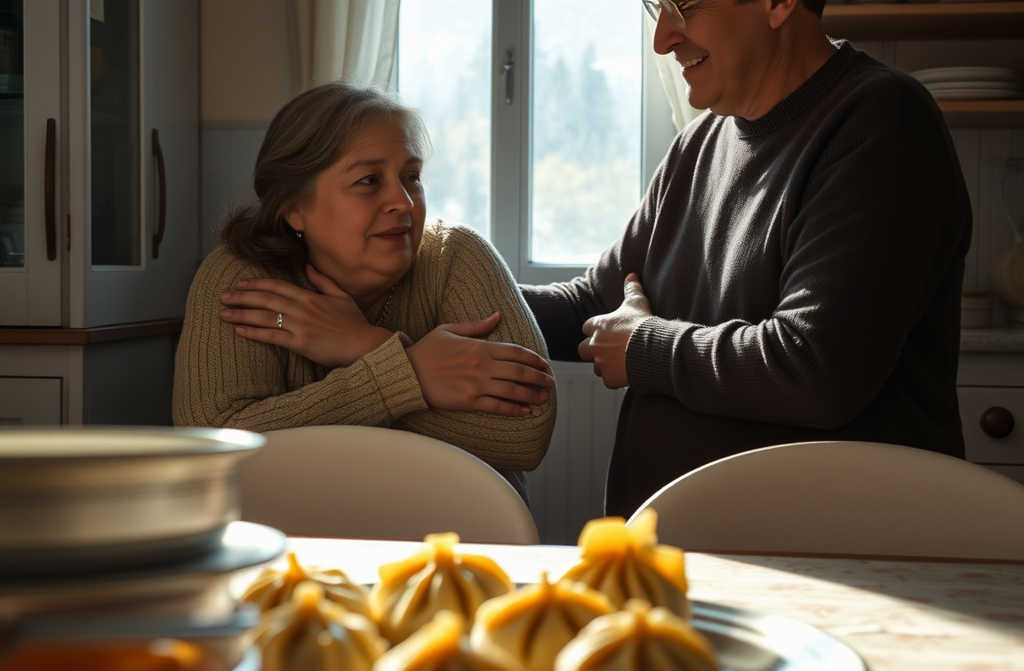
“If You’ve Come Here Just to Argue, Then Don’t Bother Anymore,” Interrupted the Mother-in-Law, the Son-in-Law Replied John stared out the window, his hands cradling a mug of cold tea. He wasn’t looking at the dreary cityscape, but rather the familiar battered blue Ford parked by the curb—a car he knew all too well. His stomach clenched in uneasy anticipation. “Mum and Dad are on the driveway,” he said quietly, looking over at his wife. Emily, busy at the stove stirring a pot, froze for a moment. Her shoulders tensed, then slumped in resignation. “Well, here we go,” she sighed, putting her spoon down. “Champagne for courage, or perhaps the Rescue Remedy?” John stayed silent, listening for the muffled voices in the hallway, then the telltale clink of a key—their in-laws had a spare “just in case,” courtesy of Mrs. Wilson’s insistence. The door swung open, letting in a gust of chilly air and an unmistakable tension. First through the door was Mrs. Wilson herself, a woman in her early sixties with a precisely coiffed silver bob and a sturdy autumn coat. She hefted an enormous Tupperware container in both hands. “Emily, darling! John!” her voice rang out, just a bit too bright and forced. “Here we are! Brought you some homemade steak and kidney pie, absolutely mountains of it. You two are always so busy, I know you’d never get round to making it on your own.” Behind her, lugging a heavy cool-bag, ambled Mr. Wilson: a large, slightly bedraggled man in a battered waterproof jacket. His cheeks were flushed with either cold or the first signs of an argument. “Honestly, Janet,” he grumbled as he plonked the bag down with a thud that rattled the hallway mirror, “are you planning to feed them for a week? That’s half the garden’s spuds gone, and I had to haul that bag like I was laying bricks.” Mrs. Wilson, removing her muddy boots with fastidious care, didn’t turn around. “Oh, for goodness’ sake, Owen. Everything’s a chore to you unless it’s for your precious shed. For that, you’d drag a dozen bags from the allotment without a squeak. Hello, children.” She gave Emily a brisk hug, nodded curtly at John, and strode into the flat, trailing a waft of overpowering perfume. Owen, unlacing his battered trainers, trudged into the kitchen and dropped into a seat. “Kettle on, Em? Parched. It’s like a wind tunnel in that car of ours.” “With your driving, Dad, it’s a miracle we don’t need something stronger than tea,” called Janet, “You take corners like you’re on the M4.” “You’d rather I doze off at the traffic lights, like you?” Owen shot back, sloshing tea into a mug. “We’d still be stuck in the Tesco car park then. Always nitpicking: ‘Mind the kerb,’ ‘Watch the kids,’ ‘Don’t miss the turning!’ I’ve been driving over forty years, you know!” Emily and John exchanged a resigned glance. This, they both knew, was barely the warm-up act. An hour later, everyone sat around the dinner table. Emily’s roast had been polished off, the pies safely tucked into the fridge. John valiantly tried to steer conversation into calm waters: work, football, the fact the potholes outside had finally been fixed. But each topic only led to fresh bickering. “You two love those ridiculous soaps,” Janet sniffed, sipping her tea from a china cup. “They’re all just shouting and slamming doors. When I was young, we had decent telly—The Good Life, Fawlty Towers… Not this nonsense.” “Ha! Says you,” Owen grunted, sprawling in a chair. “You live on those daytime melodramas. All tears and drama.” “That’s research! I watch for the human stories!” Janet snapped. “And what about you? The news 24/7. No wonder you can’t sleep.” “Then don’t watch! I’d rather you tuned into your old Midsomer Murders on repeat than moan!” Emily banged her cup on the table. “Mum, Dad, could we just have one dinner in peace? Can we see you, just once, without all this bickering?” A heavy silence fell. Janet pursed her lips. Owen stared out the window, glum. John felt a wave of sympathy. After forty years together, raising a family, they were now locked in constant combat—their only excitement coming from winding each other up. Finally, they started in on the subject of the garden shed repairs, and the argument escalated. “Did it all myself, in the end,” Owen said, trying for pride. “Re-roofed that shed single-handed in a week.” Janet’s fork paused in mid-air. “Not a soul helped you? Who handed you every bit of timber up that rickety ladder? Who brought your lunch? That’s not help?” “Handed timber! You nagged about every plank: ‘That’s warped! That one’s too short! Wrong colour!’ I’d have been faster alone. And as for your sandwiches—stale bread and too much pickle! Gave me indigestion.” “Well if that’s how you feel—” Janet’s eyes flashed. “Then you can make your own tea from now on. No more home-cooked meals from me!” “Brilliant! Forty years of your dry shepherd’s pie, and I’m meant to be grateful. I’d rather eat in the shed than smell those onions you sneak into everything!” A miserable silence descended. Emily paled. John looked at both parents-in-law. “Enough!” His voice was quiet but carried conviction. Both parents stopped, startled. “I’m serious,” John said, standing, hands shaking but voice steady. “That’s enough.” “Ivan, don’t—” Emily started, but fell silent. “I don’t want to listen to this anymore or bring this negativity into our home. We’re tired, Emily’s tired, and this can’t go on. You’re not to visit here together anymore—not until you can behave like grown-ups, not squabbling kids. Mum, you can come at weekends in the afternoon; Dad, evenings if you like. But not together. That’s it.” There was stunned silence. Janet stared, aghast. Owen shrank in his seat. “So… you’re kicking us out?” Janet whispered. “I’m protecting my home and my wife,” John replied firmly. “Please gather your things and go. Next time, decide on your own visiting slots.” Wordlessly, Janet gathered her coat and bag, leaving with quiet dignity. Owen hesitated, grunted a goodbye, and followed. John watched from the window as Janet strode toward the bus stop, Owen trudging slowly to the old Ford, both heading off in opposite directions. Emily stood in the living room, hugging herself, tears on her cheeks. “Oh God, what have we done…” she whispered. “What else could we have done?” John murmured, pulling her close. The in-laws didn’t come around the next weekend. Emily realised: the wounds might not heal quickly. Two weeks later, Janet rang, her tone brittle. “We did want to come round, but you banned us,” her mother said pointedly. “Mum, you behave like Tom and Jerry together. Argue at home, on the street, wherever—but not here,” Emily replied. “Well, I get it,” Janet huffed. “Parents don’t matter much to you, and that son-in-law of mine is acting like royalty.” “Mum, at John’s parents there’s never any fuss—” Emily said gently. “Oh, that’s it now? Comparing me to your perfect in-laws?” scoffed Janet. “Sorry we’re such an embarrassment!” “That’s not it. I just wish you’d both be civil when you visit us.” “Oh, so our problems are trivial now? Fine, go spend time with your quiet in-laws then!” Janet hung up. Emily stared at her phone, sighed, and decided not to take it to heart. From then on, Janet kept her distance. Emily tried calling, but got only a terse message: “Go visit those perfect parents of John’s instead.”

If youve only come here to argue, then maybe dont bother coming at all, Tom cut across his mother-in-law.

Tom gazed out of the lounge window, cradling a mug of cold tea. His gaze wasnt drawn to the gloomy February garden, but to the battered old burgundy Ford Focus parked at the curb. His stomach tightened; he knew precisely who had arrived.

Dad and Mum are here, he said quietly, turning to his wife.

Emily, standing at the hob, stopped stirring the soup. Her shoulders tensed, then slumped.

So it begins, she sighed, setting the spoon carefully on a saucer. Shall I open some Prosecco for courage? Or do we need something stronger?

Tom didnt reply. He listened for noises in the hallway, soon hearing the unmistakable rattle of keys in the lock Clare, his mother-in-law, insisted on keeping a spare key just in case of emergencies.

The front door opened, letting in a gust of chilly air and the unmistakable tension of two people walking in together out of habit, not joy.

First came Clare, in her early sixties, upright, with tidy silver hair in a neat bob and a smart wool coat. She held an enormous Tupperware box in her gloved hands.

Emily, darling! Tom! Her voice was too bright, as if to drown out something shed rather ignore. Weve brought you a mountain of shepherds pie. I know neither of you will ever make one yourselves; youre always working so hard.

Hot on her heels was Dennis, the father-in-law: a broad-shouldered, slightly dishevelled man sporting a faded windbreaker and carrying a heavy picnic cooler bag. His cheeks were flushed, either from the cold or the row which had clearly already started.

Clare, why on earth did you bring so much? he grumbled, nearly dropping the cooler on the hallway floor, making a vase tremble. Are you trying to feed them for a fortnight? Half the spuds from the allotment gone I lugged that bag up the drive like it was cement.

Clare removed her shoes with exaggerated care, never glancing at him.

Its always a chore when its for the family, isnt it, Dennis? But for that grubby old shed of yours, youd carry ten of those without complaining. Hello, dears.

She gave Emily a brisk hug, nodded coolly at Tom, and swept in, her perfume lingering.

Dennis, now in his socks, trudged through to the kitchen and dropped into a chair, setting the bag down with a groan.

Emily, is there any tea left in that pot? I’m parched. The cars freezing inside you should feel the draught!

Clares voice drifted in, sharper. With your driving, Dennis, its a miracle we didnt end up in the Thames. You wrench at the handbrake on every bend, as if youre a rally driver in the Lake District!

Youd prefer I nod off at traffic lights the way you do? Dennis retorted, pouring himself a cuppa. Wed still be stuck three streets down if I drove like you. And you never stop: Theres a pothole, mind that cyclist, watch the sign! I passed my test forty years ago. I do know how to drive.

Tom and Emily exchanged glances. This, they knew, was just the warm-up. The real fireworks would come soon enough.

An hour later, everyone was squashed around the little table in the sitting room. Emilys dinner had been devoured; Clares shepherds pie stashed away in the fridge.

One might have hoped for a quiet cuppa. No such luck. Tom tried to move the conversation to safe territory work, the latest Bond film, even the long-awaited repairs to potholes on their street. Each topic fed a new round of squabbling.

You all waste your evenings on these TV shows, Clare sniffed, sipping tea from her best china. In our day, films had substance. Brief Encounter, The Remains of the Day not all this endless violence or trashy soap operas. Its decline, plain and simple.

Oh, decline, is it? replied Dennis, sprawling back. And what do you do, eh? Watch that daft channel with nothing but dramas where people scream and cheat on each other.

Dennis bristled. What do you know, Clare? I keep up with the news; at least I know whats going on. You and your stories. I cant sleep with all that nonsense you feed your head.

Then switch it off! I dont make you watch it. Stick to your Match of the Day and let me be.

Emily, exasperated, thumped her cup down.

Mum, Dad, enough! Can we please have just one evening where you dont bicker? Its been two weeks since we last saw you. Cant we simply enjoy each other’s company?

A heavy silence fell. Clare pressed her lips tight. Dennis stared gloomily at the tea tray.

Tom felt a wave of pity. Theyd been married more than forty years, raised a daughter, and now, in retirement, rattling about in the same small house, it seemed their only pastime was picking holes in each other.

Then it happened: the inevitable row about the garden shed. Last summer, Dennis had re-roofed it himself.

Did a grand job last August, Dennis declared with satisfaction. Didnt get a hand from anyone, either. Managed to fix one whole side in a week.

Clare paused, fork midway to her mouth.

No one helped you? Her question was quiet, dangerous. Who passed you the shingles for three hours up that wonky ladder? Who made you lunch, brought tea? Thats not nothing, Dennis.

Oh, gave me the tiles! Dennis snapped. You commented on every last one: Thats not straight, thats chipped, that colour doesnt match! Mightve finished in half the time alone. And your soupwell, I nearly gagged. Enough salt to preserve a whale!

Oh, I see! Clares eyes flashed as she stood. So helpful wives are no use, are we? Well no more soup; make your own from now on!

Gladly! Dennis rose to the bait, face purple. Forty years of your rubbery mince and onions, stinking the whole house out. I eat in the shed for a reason.

An awful hush settled. Emily had turned pale. Tom looked at the pair hopelessly.

Stop! Toms voice was gentle but firm. Both parents-in-law fell silent, shocked. I mean it. Thats enough.

Tom, dont Emily began, but he shook his head, and she bit her words back.

I dont want to hear this anymore, Tom told them, looking both in the eye. Every time you visit, its the same. You hardly even talk to Emily properly, you just argue. Why not save it for home?

Tom, how dare you Clare started, but her voice faltered.

Im just tired of these rows and all this negativity. Toms hands trembled but his voice remained steady. Emilys tired too. It cant go on. From now on, youre not to visit together. If you want to see us, lets keep it separate. Mum, drop by on Saturday afternoons; Dad, come in the evenings. But not together. No more.

A stunned silence followed. Clare looked at Tom as if hed desecrated the family crest. Dennis seemed to shrink a little.

Youre sending us away? Clare whispered.

Im protecting my home and Emilys peace of mind, Tom replied. Please gather your things. Next time, lets plan visits separately.

No one said another word. Clare put on her coat with frosty dignity and, without another glance or goodbye, swept out. Dennis hovered, nodded at Emily and then plodded after her.

Tom watched from the window. Clare strode briskly off toward the bus stop, not looking back. Dennis trailed to his old Ford, moving slowly.

They left in different directions. Emily stood hugging herself, tears streaking her cheeks.

Oh God, what have we done? Emily whispered in horror. Now theyre really angry

What else could we do? Tom said gently, hugging her. We couldnt let it go on.

That weekend, neither parent came round. It became clear their feelings were hurt.

Clare phoned two weeks later, her tone careful and distant.

We were thinking of visiting, but of course, you said no she began heavily.

Mum, its just that you and Dad argue constantly, Emily tried to explain. By all means, row at home, in the street just not here.

Oh, I see, Clare grumbled. Your parents arent important anymore. And Tom, acting like hes Lord of the Manor, laying down the law.

Mum, its always peaceful at Toms parents house. Ive never seen them bicker. Its always calm.

Oh, so now you compare me to his family? Sorry my standards dont match, Clare sniffed. Didnt know my own daughter thought so little of her parents!

Thats not what I meant! Emily protested, but Clare was already sniffling into the phone before abruptly hanging up.

Emily stared at her phone for a few moments, then put it away and forgot about it.

Since that call, Clare kept her distance. Emily reached out but her mother deflected with a curt text, suggesting she rely on Toms quiet parents instead.

Life, Emily realised, is about learning where to draw the lines that protect our peace. Sometimes, saying enough gives a family the space to stop old habits and perhapsgiven timeto find new, kinder ways to be together.


Rate article
Add a comment

;-) :| :x :twisted: :smile: :shock: :sad: :roll: :razz: :oops: :o :mrgreen: :lol: :idea: :grin: :evil: :cry: :cool: :arrow: :???: :?: :!:

“If You’ve Come Here Just to Argue, Then Don’t Bother Anymore,” Interrupted the Mother-in-Law, the Son-in-Law Replied John stared out the window, his hands cradling a mug of cold tea. He wasn’t looking at the dreary cityscape, but rather the familiar battered blue Ford parked by the curb—a car he knew all too well. His stomach clenched in uneasy anticipation. “Mum and Dad are on the driveway,” he said quietly, looking over at his wife. Emily, busy at the stove stirring a pot, froze for a moment. Her shoulders tensed, then slumped in resignation. “Well, here we go,” she sighed, putting her spoon down. “Champagne for courage, or perhaps the Rescue Remedy?” John stayed silent, listening for the muffled voices in the hallway, then the telltale clink of a key—their in-laws had a spare “just in case,” courtesy of Mrs. Wilson’s insistence. The door swung open, letting in a gust of chilly air and an unmistakable tension. First through the door was Mrs. Wilson herself, a woman in her early sixties with a precisely coiffed silver bob and a sturdy autumn coat. She hefted an enormous Tupperware container in both hands. “Emily, darling! John!” her voice rang out, just a bit too bright and forced. “Here we are! Brought you some homemade steak and kidney pie, absolutely mountains of it. You two are always so busy, I know you’d never get round to making it on your own.” Behind her, lugging a heavy cool-bag, ambled Mr. Wilson: a large, slightly bedraggled man in a battered waterproof jacket. His cheeks were flushed with either cold or the first signs of an argument. “Honestly, Janet,” he grumbled as he plonked the bag down with a thud that rattled the hallway mirror, “are you planning to feed them for a week? That’s half the garden’s spuds gone, and I had to haul that bag like I was laying bricks.” Mrs. Wilson, removing her muddy boots with fastidious care, didn’t turn around. “Oh, for goodness’ sake, Owen. Everything’s a chore to you unless it’s for your precious shed. For that, you’d drag a dozen bags from the allotment without a squeak. Hello, children.” She gave Emily a brisk hug, nodded curtly at John, and strode into the flat, trailing a waft of overpowering perfume. Owen, unlacing his battered trainers, trudged into the kitchen and dropped into a seat. “Kettle on, Em? Parched. It’s like a wind tunnel in that car of ours.” “With your driving, Dad, it’s a miracle we don’t need something stronger than tea,” called Janet, “You take corners like you’re on the M4.” “You’d rather I doze off at the traffic lights, like you?” Owen shot back, sloshing tea into a mug. “We’d still be stuck in the Tesco car park then. Always nitpicking: ‘Mind the kerb,’ ‘Watch the kids,’ ‘Don’t miss the turning!’ I’ve been driving over forty years, you know!” Emily and John exchanged a resigned glance. This, they both knew, was barely the warm-up act. An hour later, everyone sat around the dinner table. Emily’s roast had been polished off, the pies safely tucked into the fridge. John valiantly tried to steer conversation into calm waters: work, football, the fact the potholes outside had finally been fixed. But each topic only led to fresh bickering. “You two love those ridiculous soaps,” Janet sniffed, sipping her tea from a china cup. “They’re all just shouting and slamming doors. When I was young, we had decent telly—The Good Life, Fawlty Towers… Not this nonsense.” “Ha! Says you,” Owen grunted, sprawling in a chair. “You live on those daytime melodramas. All tears and drama.” “That’s research! I watch for the human stories!” Janet snapped. “And what about you? The news 24/7. No wonder you can’t sleep.” “Then don’t watch! I’d rather you tuned into your old Midsomer Murders on repeat than moan!” Emily banged her cup on the table. “Mum, Dad, could we just have one dinner in peace? Can we see you, just once, without all this bickering?” A heavy silence fell. Janet pursed her lips. Owen stared out the window, glum. John felt a wave of sympathy. After forty years together, raising a family, they were now locked in constant combat—their only excitement coming from winding each other up. Finally, they started in on the subject of the garden shed repairs, and the argument escalated. “Did it all myself, in the end,” Owen said, trying for pride. “Re-roofed that shed single-handed in a week.” Janet’s fork paused in mid-air. “Not a soul helped you? Who handed you every bit of timber up that rickety ladder? Who brought your lunch? That’s not help?” “Handed timber! You nagged about every plank: ‘That’s warped! That one’s too short! Wrong colour!’ I’d have been faster alone. And as for your sandwiches—stale bread and too much pickle! Gave me indigestion.” “Well if that’s how you feel—” Janet’s eyes flashed. “Then you can make your own tea from now on. No more home-cooked meals from me!” “Brilliant! Forty years of your dry shepherd’s pie, and I’m meant to be grateful. I’d rather eat in the shed than smell those onions you sneak into everything!” A miserable silence descended. Emily paled. John looked at both parents-in-law. “Enough!” His voice was quiet but carried conviction. Both parents stopped, startled. “I’m serious,” John said, standing, hands shaking but voice steady. “That’s enough.” “Ivan, don’t—” Emily started, but fell silent. “I don’t want to listen to this anymore or bring this negativity into our home. We’re tired, Emily’s tired, and this can’t go on. You’re not to visit here together anymore—not until you can behave like grown-ups, not squabbling kids. Mum, you can come at weekends in the afternoon; Dad, evenings if you like. But not together. That’s it.” There was stunned silence. Janet stared, aghast. Owen shrank in his seat. “So… you’re kicking us out?” Janet whispered. “I’m protecting my home and my wife,” John replied firmly. “Please gather your things and go. Next time, decide on your own visiting slots.” Wordlessly, Janet gathered her coat and bag, leaving with quiet dignity. Owen hesitated, grunted a goodbye, and followed. John watched from the window as Janet strode toward the bus stop, Owen trudging slowly to the old Ford, both heading off in opposite directions. Emily stood in the living room, hugging herself, tears on her cheeks. “Oh God, what have we done…” she whispered. “What else could we have done?” John murmured, pulling her close. The in-laws didn’t come around the next weekend. Emily realised: the wounds might not heal quickly. Two weeks later, Janet rang, her tone brittle. “We did want to come round, but you banned us,” her mother said pointedly. “Mum, you behave like Tom and Jerry together. Argue at home, on the street, wherever—but not here,” Emily replied. “Well, I get it,” Janet huffed. “Parents don’t matter much to you, and that son-in-law of mine is acting like royalty.” “Mum, at John’s parents there’s never any fuss—” Emily said gently. “Oh, that’s it now? Comparing me to your perfect in-laws?” scoffed Janet. “Sorry we’re such an embarrassment!” “That’s not it. I just wish you’d both be civil when you visit us.” “Oh, so our problems are trivial now? Fine, go spend time with your quiet in-laws then!” Janet hung up. Emily stared at her phone, sighed, and decided not to take it to heart. From then on, Janet kept her distance. Emily tried calling, but got only a terse message: “Go visit those perfect parents of John’s instead.”
Wife’s Double