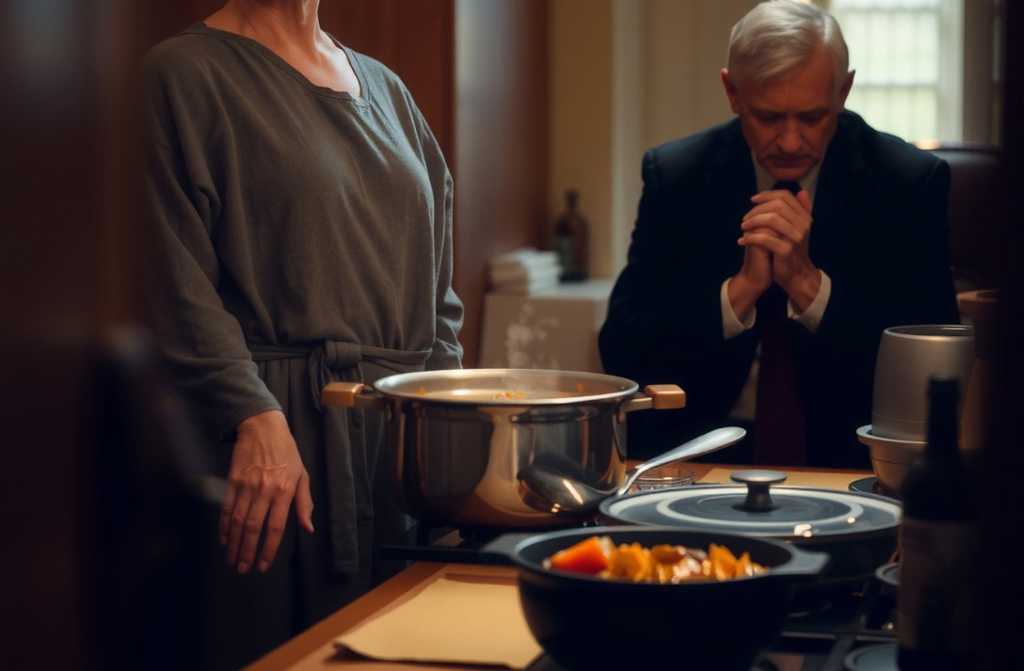
She heard through the window
Come on, be honesthasnt she gone completely sour? her husbands voice reached her from the balcony, muffled but clear enough that every word carried like a slap. Wife, mother, and nothing more. Theres simply nothing to talk to her about.
Helen froze at the stove. The wooden spoon hung over the simmering stew, its red gravy dripping onto the burner, where it hissed and spat. She didnt move.
Oh, John, thats a bit harsh, Tom replied, his tone awkwardlike a man embarrassed by someone elses words. Shes raised two children, keeps the whole house running
Shes raised the children, John repeated, and in that tired, condescending echo, Helen could feel something grow quiet and frostily cold inside. Exactly. The kids have grown up, but shes shes stayed behind. Do you see? Im off negotiating in Berlin, then Dubai, projects, the team, progress. And shes cooking stew. Honestly, we might as well live in parallel universes. Over dinner, I dont even know what to say to her.
There was a pause. The scratch of a lighter, then the sour curl of tobacco drifted through the open window above the sink.
I suppose so, Tom said, trying to placate.
I suppose so, John echoed. But it doesnt make things any easier, does it? Im climbing mountains, and shes stuck in the everyday. And thats her choice, mind you. I never forced her.
Helen set the spoon carefully on its rest, stepped to the window, and shut it with a soft click. She turned the heat down. The stew was gathering a slick of fat, deep rich brown edged with ochrealmost beetroot red.
Her choice, she repeated silently.
Fifty-four years old. Twenty-eight years married. Two childrenMichael and Lindseyeach grown, each in different cities now. A flat in Manchester, Eighth floor, overlooking the park. Lovely view. Helen watched it every morning, mug of coffee in hand, mentally ticking the days errands: buy bread, check the internet bill, ring Lindsey, who was once again upset about something she wouldnt say. This was her life.
The stew was ready. She sliced bread, set out a tub of crème fraîche, laid the table. Her hands moved by habit. Inside, there was an uncanny hush. Not emptiness, just that quiet hush before a decision takes form.
When John and Tom came in from the balcony, she smiled at both. Placed the pot on the table, ladled out the stew.
Helen, it smells divine, Tom said warmly, with sincerity, not pity.
Thank you, she answered evenly. Please, sit down.
John looked at her. Hed always been able to read her mood from how she held her shoulders. Today, she held them straight. He frowned briefly but kept quiet.
Over dinner, they talked business. Tom described some project, John nodded, interjected, laughed. Helen sipped at her stew, thinking of the bank trip she must make tomorrow.
That night, long after John started to snore beside her, Helen lay awake. The dark was broken only by the slice of light from the hall lamp. She stared at the ceiling, calling up not the hurt, not those balcony words, but just plain facts. Shed finished architecture school at thirtya distinction. Worked two years in a design firm, sketched housing layouts, once saw her drawing become the basis for a real build. Her boss praised her spatial instincts. Then Michael was born. Then Lindsey. Then theyd moved from Leeds to Manchester for Johns work, then again within the city, to this flat. Shed stored her design folders at the top of the hall cupboard, under winter quilts. For twenty-three years.
She rose at half six, before John. Made coffee, stepped onto the balcony. The park floated beneath a soft fog. She stood there, calmly, the way one reviews a floor plan or cost sheet: What have I? What do I need? How does it fit together?
Within a week, shed opened a bank accountone to which John had no access. For twenty-two years shed saved quietlya bit from groceries, from the household allowance, sometimes from the odd birthday from parents now long passed. Her just in case stash, without ever quite knowing what that case would be. It was a tidy sum. She transferred it to the new accounther hands steady.
Then she found a refresher course for architects and interior designers. Online, three months, hands-on assignments. She enrolled. Paid with her new card.
For the first two weeks, she said nothing to John. She simply studied in the evenings, as he disappeared into his office with his laptop. She spread books and paper over the kitchen table, switched on gentle music, brewed tea. The screen shone with detailed drawings. Something in her began to stir, so quietly at first she barely noticed, except that sleep came more easily.
One evening, John wandered into the kitchen for water. He saw the laptop, the notepads, the scale ruler.
Whats all this? he asked.
Courses, she said, not looking up. Interior design. Im regaining my certification.
He filled his glass.
Why?
I want to work.
There was a pause. She looked up. He was watching her like someone mindful of a child making plans adults had already dismissed.
Helen, youre fifty-four. Work?
Architect-designer, she replied steadily. Or do you mean that fifty-four is too late?
He set the glass down.
I mean, come on, its not serious. We dont have financial problems. If you need a hobby, go for it. Do some sketching. Go to galleries. But making a career at your age?
At my age, she repeatednot a question, just a statement. She went back to her diagrams.
John left. Helen sat still a moment, then picked up her pencil and went on.
When the course finished, she received a certificatehandsome, stampedtucked it in the drawer with her passport and marriage certificate. Then she registered on a freelance interior design platform, set up her profile, uploaded her old student work, added a few assignments from the course. Methodically, matter-of-factly, without any grand inner speeches. Simply, the next step.
The first job came three weeks later. A young couple wanted to convert a poky one-bed into an open-plan studio. Small budget, tight deadline. Helen went to see the place, measured up, took photos. On the way home by bus, she considered the light: how it shifted in the late afternoon, how taking down a wall and replacing it with vertical slats would divide the space and let in air. The plan assembled itself in her mindsomething like a muscle memory she half-forgot shed ever had.
The fee was modest. She didnt haggle. Did the job wellthey were delighted, left a glowing review on the platform.
John found out by accident, spotting her messages on the phone shed left on the table.
So, how much did you get paid for that? he asked at dinner.
She told him the sum.
He smirkednot cruelly, but like someone who considered the matter done and dusted.
Helen, thats less than you spend on the groceries in a week. Its hardly proper work.
First jobs rarely are, she said.
When youre twenty, yes. But at fifty-four, thats called a hobby. Theres nothing wrong with having a hobby, I dont mind if you enjoy it.
She looked at him. He ate without meeting her eye, busy, as if hed already moved on.
John, she said, do you have to diminish it that way?
He looked up, surprised.
Im just calling it as it is.
No, she replied quietly. Youre calling it as you want to see it.
He shrugged. Carried on eating. She ate too, though the taste was gone.
That autumn, she took on four more jobs. They were varied: a small hair salon in a shopping centre, a childs bedroom for a partially-sighted boy, a solicitors office redesign, and finally, a kitchen in a private house in West Didsbury. With each project, she felt her eye and hand recall themselves. And not just her eye and handsomething deeper, a sense she once called her spatial ear, meaning the way she could listen to a rooms potential.
She hired a cleanerAmy, twenty-six, who came three times a week, tidied, sometimes cooked basic meals, fetched the dry cleaning. John wasnt thrilled.
Why? Its not a big flat. Youve always managed on your own.
I dont want to manage alone anymore, Helen said. I need time for my work.
For your work, he repeated, with the same little smile.
Yes. My work.
Amy was quiet, careful, never touching Helens workthings. One afternoon, she asked what Helen did. Helen explained. Amy said simply, Thats beautiful. Id love my flat to look like that.
It was a small moment, but Helen remembered it.
In November, Lindsey called.
Mum, Dad tells me youve done some course and now youre doing flats and things?
Not decorating. Designing. Interiors.
Oh! And hows it going?
Interesting, Helen said, surprised at how easily the word came.
Dads a bit off about it. Acts like it bothers him.
I know.
Everything alright with you two?
Helen paused.
Everythings fine. It wasnt a liejust not the whole truth.
Michael texted in Decembersent a photo of his new place in Birmingham. Mum, want to help plan the refurb? She looked for ages at the angled window tucked into the cornera quirk of the block’s design. She messaged back a few paragraphs of suggestions. Michael replied, Mum, you really know your stuff. Seriously.
Know your stuff. She chuckled at the phrase, alone in her kitchen at 7am.
The winter passed in the hum of work. Jobs came steadily, carefully done. Her portfolio grew. There were twelve reviews on her profile, all positive. One client, an older woman named Mrs. Worthington, wrote, Helen understood me before Id said a word. She made my flat a place I want to livea real home, not just pass the time. Helen read that more than oncenot to savour it, but because it rang true.
In February, John came back from the continent in a foul mood. Some contract had gone wrong; he never gave the details. He was abrupt, remote, once snapped over her moving his folder that had been on the kitchen table because, she explained, she needed to set the dinner.
You cant just touch my things! he barked.
I moved it to lay the table.
I asked you not to.
She studied him. He looked exhausted, tensesomeone used to the world making way for him and frustrated when it stopped doing so.
John, she said evenly, if the folders on the dining table, Ill move it. Non-negotiable.
He stared at her, just a fraction longer than normal.
Youve changed, he finally said.
Yes, she agreed. I have.
He retreated to his office. She finished cooking, ate, cleared up, then worked for three hours on a new brief: a small city café whose owner wanted that grannys kitchen, but not kitsch feeling. Helen weighed the merits of timber finishes, homey fabrics that didnt cross into nostalgia, and lighting whose warmth felt almost domestic. The design absorbed her, and in that absorption came a subtle, quiet joy.
That spring, Lydia Roscoean architect, a little older than Helen, running a boutique agency for historic renovationscontacted her. Shed seen Helens portfolio through a client, liked what she saw, and emailed: Can we meet? Want a word.
They met in a café in Manchester city centre. Lydia, short with rimmed glasses and a cropped haircut, got to the point: You see space differentlymore about how people feel than how it looks. I appreciate that. She wanted Helen for a council bid: a full overhaul of the Westfield Community Centre, an old town hall. Competition was stiff; she needed someone for the interiors.
Helen hesitatedthis was a big leap.
Its large scale.
Yes.
I havent done anything this size in years.
You will, Lydia said, as fact. Will you keep up with the pace? Four months, heavy workload.
Im ready, Helen said. Whether or not it was true, she said it.
She told John nothing that night. She studied the emailed floor plans. Two stories, historic façade, seven hundred square metres to play with inside. She felt something long lost: not nerves, but readiness.
The next months, she worked harder than everlike her student days when everything seemed possible. She spent part of the week at Lydias studio, the rest working from home. Amy came more often, and Helen gave up feeling guilty about it.
One afternoon, John walked in on her laying out huge sheets of plans across the table.
Whats this?
Competition entry. City tender for the Westfield Community Centre.
He paused, looking at the drawings.
Helen, its a major project. Professional firms are in the running.
We are a professional team.
Its Lydia Roscoes firm, isn’t it? Even so, council bids are all politics, contacts, budgets.
Perhaps. Well see.
He left. She went back to her plans.
In May, an honest conversation happened at last. John started itlate at night as Helen was heading to bed.
We need to talk, he said.
Go on.
Youre avoiding me.
No. Im working.
We dont even talk anymore. We live like flatmates.
She paused.
John, thats how its been for years. You just didnt noticebecause you didnt want to.
He scowled.
Thats unfair.
Maybe. But its true.
Whats happening to you? He sounded genuinely bewilderedperhaps, for once, honestly so. Its like youre different.
Im not different. Im who Ive always been. You just never looked.
He was silent.
Youre angry with me.
She couldve told him about the balcony conversation. She didnt. Not to hold it as ammunitionit simply wasnt the point anymore. The real point was something else.
Im not angry. Im just living my life.
And what about our life together?
She looked hard at himso much weariness on his face, maybe even fear that everything was changing and he was falling behind.
John, let it be this way for now. We both need to get used to it.
He left for the bedroom. She stepped onto the balcony, taking in the city lights over the park. The leaves were out now, the trees black and feathery against a pale sky. It was quiet. She just breathed.
She came in, slept soundly.
That summer was stifling. She and Lydia developed the entire inside concept for Westfieldzoning, daylight, materials, flow. She thought deeply about who would use the centre: the older woman coming to a recital, terrified of crowds; the child needing a quiet reading corner; the teenager desperate for a space that didnt feel for old people. She designed from experience, not mere aesthetics.
John, in July, grumbled about a partner disputesome contract gone sour. He was short-tempered, twice snapped at her over nothing. Once she simply stood and left in the middle of his complaining; he never apologised. She didnt expect it.
In August, they submitted the bid. Helen was left with a feeling she eventually defined as contentmentplain, calm satisfaction.
There was a two-month wait for results.
She took more jobs in the meantime. Now she had enough for her own needsAmy, professional subscriptions, a pile of books that required another shelf. For the first time in marriage, her money was truly her own; shared money, in which John had always held the last word, was a thing of the past.
One weekend, Lindsey visited. They had the kitchen to themselves. John was away. Eating homemade scones, drinking tea, Lindsey looked over the new shelf of design books, Helens digital tablet, the lamp shed chosen for her workspace.
Mum, youre different, Lindsey remarked.
So everyone says, Helen laughed.
No, I mean it. Youre calm. You used to be slightly on edge, like you were always on duty.
Helen considered.
I suppose I did.
Dont you feel that way now?
This is a different kind of control. Mine, not someone elses.
Lindsey nodded quietly.
How are you and Dad?
Were managing.
Mum?
Helen studied her. Lindsey looked so much like Helen herself at that agethe same high cheekbones, the same way she tilted her head.
To be honest, its a difficult period. I cant say how itll end. I wont give you false hope either way.
Youre thinking of divorce?
Im thinking about my own life, Helen answered gently. Thats not quite the same.
Lindsey was thoughtful for a long while, then nodded as if understanding something she could not quite articulate.
They spent a long time at the kitchen tabletalking of other things: Lindseys job, her new London neighbourhood, Michaels plans to buy a flat. Helen realised these two had grown up seeing her always in the background: the backdrop for John, for their family. They loved her, but as a givena bit of the scenery you notice only when its missing. Now, they noticed. That was good. A touch sad too, for it meant things had once been different.
In October, the competition results arrived.
Lydia phoned at half-eleven, as Helen sat in the kitchen eating lentil soup shed made for herselfsimply because she fancied it.
Helen, Lydias voice came, calm yet rich with excitement. Weve won.
Helen put down her spoon.
Say that again?
We wongot the council bid. The jury gave us first place. They singled out your interior design concept. The chair said hed never seen design so attuned to how people experience a building.
Helen was wordless for ten seconds.
Lydia
I know, Lydia replied. Me too.
After the call, Helen sat for a while. The soup went cold. She stared out into the Manchester autumn, gold and russet against a leaden sky. Then, for no reason at all, she laugheda quiet, private laugh above her cooling meal.
Later, Lydia emailed formally: Helen was the lead interior architect on the project. An employment contract, a proper role, a salary. This was not freelance now. This was work.
She messaged Lindsey a single word: Won. Lindsey replied in a minute: Mum!!!!! Michael later texted, after hearing from his sister: Mum, I always knew you were awesome. No one ever saw it before.
She read that again and again, then set the phone aside.
She told John over dinner, without preamble.
Our team won the citys bid for Westfield Community Centre. Im the lead interior architect.
He looked up, chewed, swallowed.
Congratulations.
Thank you.
How long will it last?
Eighteen months, maybe two years.
He nodded. Looked back down at his plate. She ate too.
So, Amy will stay on? he asked.
Yes.
Alright then. Are you happy?
Yes.
Good.
They finished in silence. She cleared away. He retreated to his office. Everything was profoundly ordinary, and this ordinariness felt somehow final.
The project presentation to the citys cultural committee was set for November. A week before, John said hed like to attend.
Why? she asked.
I want to see. Its important to you.
She hesitated.
Alright.
The room was smallabout forty people. City officials, journalists, competing architects. Lydia presented the overall concept; budgets, historical preservation. Helen spoke about spacehow theyd thought through every user, how daylight would shape the mood, how corridors could be places to pause, not only pass through.
She spoke calmly, saw the audiences genuine attention.
Afterwards, at the reception, John came to her as she stood with members of the committee. Lydia was talking to others.
Helen, he said, voice gentler than usual, you did well. I didnt expect it.
Didnt expect what?
He looked awkward.
That youd be so professional.
I am a professional.
He nodded, then took her arm, leading her aside.
LookI want to talk. Seriously. I think maybe we should try again. I meanus, together. Youve changed, and perhaps thats good. You can keep your projects, I dont mind. But maybe you could not overdo it? Its really just a creative outlet. What matters is us, fixing what we had.
She regarded himhis face, lined, older, uncertain; his hand on her sleeve, too tight, too close.
For the sake of a hobby? she said quietly.
Well, yes. You enjoy it. Thats fine. But a career at your age, Helenits not the kind of burden you need. The important thing is, you have an interest, something for yourself.
She watched him, then replied,
John, once you told Tom I was lost in domestic things. That there was a gulf between us because you were conquering heights. I heard, you know. Through the window, as I stood cooking, you told him you had nothing to share with me. That I was just a housewifethat was my choice. Well, now Im making another. Also mine.
He fell silent among the clinking glasses and laughter around them.
Helen, that was a private chat. Men say things sometimes
Its not about what was said. Its what you think. Or thought. Perhaps still do. She gently moved his hand from her sleeve. I wont just do this for joy. This is my job. Im fifty-four, and its my career. Either accept it, or dont. But dont give me any more conditions.
Helen, wait. Not here
Here, there, its all the same. We need a real talkat home.
She left him, found Lydia.
The real talk came three days later. John tried several times and faltered, unused to not holding the upper hand. Finally, on Friday night, Helen spoke the thing shed known and only now said aloud.
JohnI want a divorce.
He stared at her, long and hard.
Youre serious.
Yes.
Because of that balcony talk?
Not because of that. Because of whats behind it. Because after twenty-eight years of being the background, I see it plain now. Im not angry. I just see, and I cant go on as before. And theres no changing it between us. Youre too used to the old way.
I can change.
John, she said gently. After we won the city contract, you offered to let me work for a hobby. As if that was a favour.
He looked down.
I didnt mean to insult.
I know. Thats the point.
They sat in silence. It was dark outsidethe lit windows of the surrounding blocks dotted the night. The kitchen tap dripped softlyshed meant to ask him to fix it. Didnt matter now.
Where will you go? he asked.
Here. If its agreeable. The flats in both our names. Im able to buy out your share. I have the means.
He regarded her with new eyesperhaps just realising shed worked this out. This was no whim.
I need time to think, he said.
Alright.
He moved to a friends, then got a flat nearby. They met from time to timesigning papers, collecting assorted things, the inevitable admin. No rows, no accusations. It was strange and calm, as if they were finalising something that had already been finished for years.
Michael came home in December, sitting at the kitchen table where Lindsey had before.
How are you, Mum?
Im okay, Michael.
Really?
Really. She poured him tea, set some shortbread before himbaked simply because she wanted to, for herself. Youre worried for me?
Well yes, in a way.
You dont need to be, she said. I’m coping.
Dad says he doesnt know what happened.
I know.
Have you told him?
Yes.
And?
She regarded him. He looked so like John at that agethe same shoulders, the same head tilt. But with more questions, less certainty.
Michael, sometimes no ones at fault. Sometimes its simply that two people see life differently, and eventually noticing it is impossible to avoid.
He nodded slowly.
Are you happy?
She considered.
I dont know if happiness is the word. I feel myself, though. That I do know.
He nodded again, picked up a biscuit.
Delicious, he said.
Mint, she explained. A touch in the dough.
They chatted a long whileof Birmingham, his new flat, the renovation shed already begun imagining, his plans for the year ahead. Helen sensed something shifting, becoming more honest between them.
The divorce was finalised in February. Quietly, without drama. She stood on the court steps, let the icy sleet melt on her face, then drove to work. A meeting with contractors was waiting, ready to discuss supplies for Westfield.
That spring, as work began on-site and she stood for the first time in the empty hall, she paused in the dust and echoes. There was so much history in that spacedecades of people, concerts, dances, classes. Now it was to be shaped anew.
She opened her tablet, checked the plans. Then looked up. Sunlight fell exactly as shed drawn it. Exactly.
In summer, Lydia offered her partnership. Not as a salaried architect, but an equal. Helen took three days to decide. Then said yes.
They signed the papers quietly one August evening. Lydia pulled out a bottle of dry English wine, saved for a special occasion.
To space, Lydia said, raising her glass.
To space, echoed Helen.
They drank.
You know, Lydia said, when I first saw your portfolio, I thoughtodd, someone with your eye and sense and all those years out of the game. Why?
Thats how it went, Helen answered simply.
Do you regret it?
She reflected honestly.
The years, maybe a little. Not the children, not the time itself. I couldnt do bothat least, I didnt think I could. Its complicated.
Complicated questions set the good apart, Lydia smiled.
Youre good at compliments, Helen laughed.
That autumnwhen Westfields ground floor was readythey ran a city tour. Afterwards, an elderly lady stopped Helen.
Did you design this? she asked, nodding to a nook by the window.
Im one of the team. Yes.
This corner hereyou made it?
Yes. Its a spot for sitting, if you want a bit of quiet. For a read, or just a breather.
The lady nodded, gazing at it.
I used to come here as a girlfor the handicraft club, but never anywhere to sit. Always a bustle. I hate a crowdso I stopped coming. Well. Ill come again now.
Helen watched her go, thinking this was the point of it all.
In November, Helen rearranged the kitchen. Not radically, but she pulled the table closer to the window, added a new shelf for her books, replaced the lamp with a warmer, focused light. Amy stayed on, twice a week. Helen cooked when she felt like itstew sometimes, because she loved it. Baking for the smell, not for obligation. No schedule, no shoulds.
One evening, stirring soup while dusk nudged the window, the kitchen fragrant with thyme and milk, she found herself thinking over a future projecta little guest house outside the city. The owners wanted something alive, not glossy. She pictured textures, the feel of walking into a warm hallway after a chill walk.
The phone buzzed. Lindsey: Mum, Im visiting next Fridayis that okay?
Of course, she typed back.
Then, Ill bake. What do you want?
Lindsey replied with three laughing pie emojis and: Everything! Youre the best.
Helen smiled, put the phone away. The soup was almost ready; she tasted, added a touch more salt. Outside, the darkness pressed in, and in the reflected window she glimpsed herselfa woman in a woollen jumper, spoon in hand, in a kitchen she had arranged precisely as she liked.
She wasnt thinking of John, or the last year, or lost time, or the future. She was thinking of tomorrows site meeting, of Lindseys visit, of soup exactly as it should be.
The next morning at half seven, she stood with her coffee at the open balcony door. Autumn had swept the parkrust and gold spilling into the green. The air was sharper and sweet.
The phone rang. An unknown number.
Is this Helen Graham? a womans voice asked.
Yes.
This is Jane Costello, from Cityscape Magazine. Were running a feature on women reshaping Manchester. We were given your name for the Westfield project. Could you give us an interview?
Helen held the phone a moment.
I could, she said. When suits you?
She took down the time, hung up, finished her coffee looking out over the trees, then went inside, placed her mug in the sink, collected her bag.