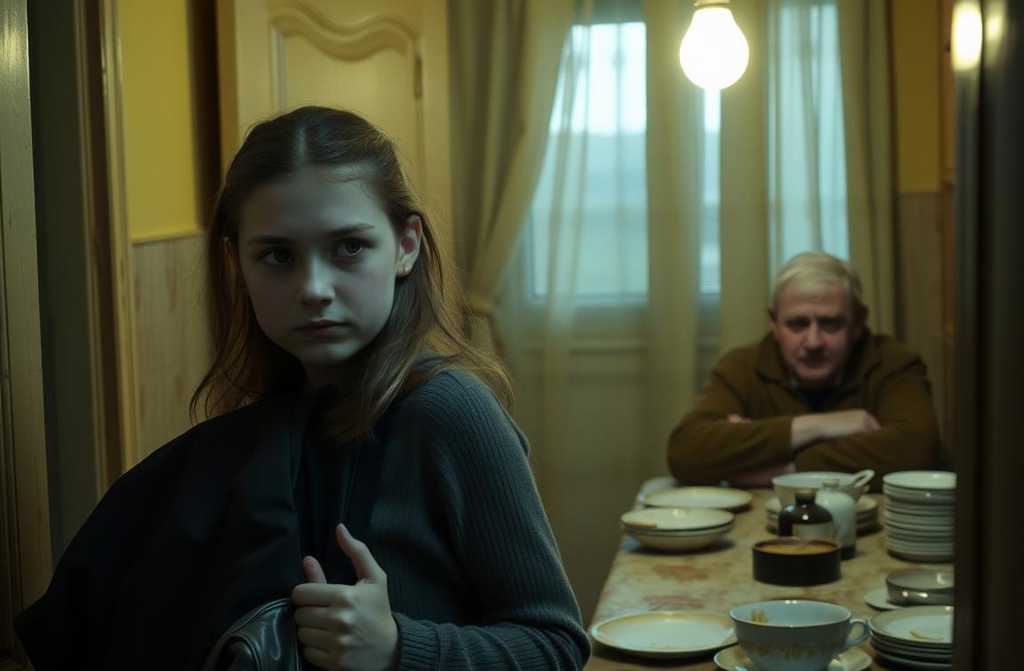
Call Me Dad

“Call Me Dad.”

“Mum, are you taking his side *again*?” Emily stood inches from her mother, her lips trembling as tears welled up.

“Emily, what do you mean *again*? And honestly, youre wrong! Youre completely wrong, love!” retorted Irene, her mum.

“Mum, those were *my* groceries! We had an agreement, and Im not made of moneyI cant just feed some random bloke!” Emily protested, now barely holding back the sobs.

“Ungrateful little madam! I raised you, fed you, and now youre begrudging me a bit of cheese and ham?!” slurred Nicholas, her stepdad, from the other roomhis usual halfway-to-drunk state.

“Exactly! Have you no shame?” Irene chimed in.

Emily buried her face in her hands. The tears won. Lately, her life had turned into a proper nightmare

…Emilys dad had left when she was barely three. As Irene later explained, she and Williamthe mans namehad never really loved each other. A whirlwind romance, an unplanned pregnancy, and pressure from Williams parents led to a rushed marriage. Predictably, the lack of love doomed it. They limped along for two years before William packed his bags and vanished.

Irene threw herself into raising Emily. Just the two of themuntil Emily turned twelve. One morning, Irene sat her down for *the talk*.

“Em, youre old enough to understand” Irene hedged.
“Yeah?” Emily replied, wary.
“Ive met someone. Were getting married. Hell be moving in soon.”

Emily wasnt thrilled, but she shrugged. Plenty of kids at school had stepdadsno one had *died* from it.

Then Nicholas walked in. Instant dislike. His face, his mannereverything about him grated.

“Call me Dad,” he announced.
Emily nodded but never did. From day one, Nicholas declared, “I wasnt spoiled as a kid, so I wont spoil you.” And just like that, her life became unbearable.

“Mum, Im going to the library with Lucy, then well hang out,” Emily said once.
“Oho, little Miss Bossy! Irene, why dyou let her walk all over you? Shell be riding you like a pony next!” Nicholas snapped.
“I am *not* a pony!” Emily shot back while Irene silently scrubbed dishes.
“Dont you smart-mouth me! One hour at the library, home by threeor youre standing in the corner on dried peas. See how you like *that*!” Nicholas roared, drunk on his own “parenting.”
“Mum, I *am* going out!” Emily insisted.
“Sweetheart, listen to your father. He *is* the head of the house,” Irene mumbled.

From then on, Emily lived for Nicholass business tripsbrief windows of freedom where she could breathe, have friends over, and pretend life was normal.

…Six miserable years passed. Emily turned eighteen, got into uni. Finally*freedom*! Student halls, her own space, escape from the chaos at home.

Then reality hit:

“Halls are for out-of-town students. No rooms left,” the uni office said.
“Shouldve picked a different city,” Emily muttered, trudging home.

By mid-September, shed befriended two classmatesJess and Miawho also wanted out of their parents places. They found a tiny flat to split three ways.

“Mum, I want to move out. Its closer to uni, and”
“Over my dead body! Next thing, youll be turning the place into awell, I wont say! Probably just an excuse to sneak boys in while your studies go down the drain!” Nicholas cut in.
“Whats it to *you*?” Emily snapped.
“Excuse me?! Is that how you speak to your father? Your student loan wont cover rent! Your mums on part-time, *my* wages got slashed, and *you* want a flat? Not a penny from me!”

“Ill earn it myself!” Emily yelled, slamming her bedroom door.

But evening jobs were scarce. The flatand freedomgot shelved.

Then, one morning, a stranger stood in the hallway. Nicholas hugged him like long-lost family.

“Emily, meet my son from my first marriageDanny. Lived with his mum in the countryside. Moving in with us,” Nicholas announced.
“*Where*? Weve only got two rooms!”
“Dont worry, Ill crash on the sofa bed in the lounge for now,” Danny said, smirking.

Horrified, Emily cornered Irene:
“Mum, hows four people supposed to live in this shoebox?”
“Well manage. Alls cosy when hearts are warm,” Irene parroted.
“Are you *serious*?”
“Emily, Nicholas pays the bills. I wont rock the boat. Danny stays.”

Now Danny “cosied up” on the kitchen sofa. No room for breakfast. Emily left hungry every morning. Returning, shed find Nicholas and Danny camped at the table.

“Oi, sis! Join the party!” Danny crowed once, grabbing her shoulders.
“Get *off*!” Emily wrenched free.
“How *dare* you speak to your elders!” Nicholas bellowed, breath reeking of whisky.

Emily spent the night crying. Next morning, she tried reason:

“Mum, didnt *Dad* buy this flat?”
“Well yes?” Irene frowned.
“So its partly *mine*?”
“Legally, its mine, but youre my daughter, so Why?”
“I want *them* out!”
“Ungrateful brat! Not another quid from me! Buy your own food!” Nicholas shrieked.

Emily did. Scrimped every pound. Yet Nicholas and Danny kept raiding her fridgeespecially the cheese and ham shed just bought.

“Mum, if Im wrong, pay me back for what they stole, and Ill *leave*!”
“Piss off, then!” Nicholas spat.

Done. Emily packed a bag and walked out.

Crashing at her mate Sophies for a while, she switched to part-time uni, got a job, and rented a flathalf with Sophie. Not perfect, but *clean*. No shouting, no theft, *no them*.

A year later, she bumped into Irene outside a block of council flats.

“Mum? Whatre you doing here?”
“Living here,” Irene murmured after a pause.
“What? What about the flat?”
“Oh, love Nicholas talked me into signing it over to himto stop you making claims, he said. Then Danny started bringing girls into *your* room. One day, I came home to some tart in *my* bed.”
“And you just?”
“What could I do? The flats *his* now. Council put me here. Wanted to tell you, but well, here we are.” Irene wept.

Emily sighed. “Right.”

She half-listened as Irene waffled about divorce and reclaiming half the flat. But Emily was *done*.

Home now was a rented two-bed. Small, sharedbut *peaceful*. And that was enough.

Rate article
Add a comment

;-) :| :x :twisted: :smile: :shock: :sad: :roll: :razz: :oops: :o :mrgreen: :lol: :idea: :grin: :evil: :cry: :cool: :arrow: :???: :?: :!:

Call Me Dad
Mum, Give Us a Smile Arina never liked it when the neighbours popped over and begged her mum to sing a song. “Come on, Annie, sing! You’ve such a lovely voice—and dance for us too, you’re wonderful at it,” they’d plead, and her mum would begin, neighbours joining in, sometimes all dancing together right in the garden. Back then, Arina lived with her parents in a small English village, in their own cottage, her younger brother Tony running about. Her mother, Ann, was warm and cheerful. When the neighbours left, she’d always say: “Do come again soon, that was lovely, really enjoyed myself,” and the neighbours would promise to return. Still, Arina felt uneasy about her mum singing and dancing—she almost felt embarrassed. She was in Year 5 and eventually told her: “Mum, please don’t sing and dance… I get embarrassed,” though she couldn’t really explain why. Even now, as an adult and a mother herself, Arina can’t quite put her finger on it. But Ann simply replied, “Don’t be ashamed, darling—rejoice when I sing! I won’t always be young enough to sing and dance, you know…” Of course, Arina didn’t understand at the time; life isn’t always full of joy. By the time Arina was in Year 6 and Tony was in Year 2, their father left. He packed his things and walked out for good. Arina never found out just why—when she finally asked as a teenager, “Mum, why did Dad leave us?” “You’ll understand when you’re grown,” Mum would say. Ann couldn’t bring herself to tell her daughter that she’d caught her husband at home with another woman—Vera, who lived just down the lane. Arina and Tony were at school; Ann had come home early for a forgotten purse, and found the bedroom door open. Her husband was supposed to be at work, but instead… That evening, Ann confronted her husband: “Your things are packed; go. I’ll never forgive you.” Ivan tried to make excuses for his actions, but Ann would have none of it; he took his bag and left as Ann watched from behind the corner of the cottage, heartbroken but resolute. “I’ll get by with my children—somehow…” she thought, tears falling. “I’ll never forgive him.” She never did. Left alone with two young children, Ann found things far tougher than she’d imagined—working two jobs, cleaning floors by day and working at the bakery by night. She barely slept; her smile vanished. Although their father had moved out, Arina and Tony saw him still—he lived just four doors down, with Vera and her own son, who was Tony’s classmate. Ann never forbade her children from seeing their father—they’d visit, play there together. But when it came time to eat, they’d head home. Vera never fed them. Sometimes Vera’s son would come with Arina and Tony to their home, with neighbours looking on in surprise. Ann would feed all the children, never begrudging her own husband’s stepson. But Arina never again saw her mother smile—she was still kind and caring, but distant and withdrawn. After school, Arina longed for her mum to talk to her, so she’d share her day’s news, trying to spark a smile. “Mum, guess what? Glen brought a kitten to class; it meowed throughout lessons. Our teacher had no idea where the noise was coming from—she even told Glen off, thinking it was him! But we told her it was the kitten in his bag, and she sent him (and the kitten!) out of class and called his mum in.” “Mm, I see…” was all her mum would say. Arina saw that nothing could cheer her. At night, she heard her mum weeping; standing at the window for ages, staring out at nothing. It was only as an adult that she understood. “Mum must have been so tired, working two jobs and never sleeping… She must’ve been run down, lacking vitamins. But she always made sure Tony and I were tidy, our clothes clean and ironed,” Arina would remember. Back then, she’d ask, “Mum, give us a smile—I haven’t seen your smile in so long.” Ann loved her children deeply, though not one for frequent hugs—she’d praise them when they did well at school, delighted in their good behaviour, cooked wonderful meals and kept a tidy home. Arina felt the depth of her mum’s love whenever she’d plait her hair—Ann’s touch soft but sad, her shoulders drooped with weariness. Poor dental health meant she lost her teeth early and didn’t replace them. After leaving school, Arina never considered going off to study—she didn’t want to leave her mum alone, and knew college would cost money. Instead, she took a job at the village shop nearby, doing what she could to help; Tony was growing fast and always needed new shoes. One day, a man named Michael came into the shop—visiting from another village, eight miles away. He liked Arina, though he was nine years older. “What’s your name, love?” he smiled. “I don’t recall seeing you here before.” “Arina. I haven’t seen you, either.” “I’m Michael—from the next village up,” he said. That’s how they met. Michael began visiting often after work, taking Arina for drives, introducing her to his home and ailing mum. He was recently divorced; his wife had left for town, taking their daughter, unable to care for his mother. Michael’s home was welcoming, the table loaded with fresh cream, meat, and sweets. His mother stayed in her room, resting, and Arina enjoyed his generosity. “Let’s get married, Arina,” Michael eventually proposed. “I warn you—caring for Mum is part of the deal, but I’ll help.” Arina hesitated, then agreed. “Why not? I’ll have proper meals, fresh cream and meat,” she thought to herself, though outwardly she simply nodded. “I’m so glad, Arina! I love you. I doubted you’d want to marry a divorced older man, but I’ll never hurt you—I promise we’ll be happy.” He kept his promise; she never regretted saying yes. After their wedding, Arina moved to Michael’s village. She didn’t much miss her old home—Tony was off training to be a mechanic in college, home only for holidays. Time went on. Arina was truly happy—she and Michael had two boys in quick succession. She didn’t work outside the home; there was plenty to do looking after children, animals, and the house. Michael’s mother passed away after two years together, but with a big farm to run, there was never a dull moment. Michael tried to spare Arina from heavy chores, insisting he’d handle them. Arina knew she was loved and cherished. Michael doted on their children, delighted in her domestic skills, and never hesitated to share their bounty: “Let’s take your mum some meat, fresh cream and milk. She has to buy everything, but we have our own.” Ann was always grateful, but her smile never returned. Even with her grandchildren, she remained solemn. They visited Ann often; Arina longed to bring joy back to her mother’s life. “Maybe you should talk to the vicar,” Michael once suggested. “He might have some advice.” The vicar said he would pray for Ann. “Ask God to send your mum a good companion,” he advised. Arina did, praying earnestly. One day, Ann asked Arina for some money—she wanted to get dental work done. “Of course, Mum. Let me pay for it all,” Arina exclaimed, delighted that her mum was finally doing something for herself. Ann only borrowed what she needed, promising to repay it. Not long after, Arina didn’t visit for a while—Michael was busy helping his Uncle Nick, recently moved to their village after being kicked out by his wife. Nick needed help settling in. Once or twice, Arina visited Nick’s new house with Michael. One day, Michael came home and said, “Reckon Uncle Nick’s got romance on the cards. I heard him on the phone and he sounded very cheerful…” “Good for him,” Arina said. “He’s not old—no point living alone in that lovely house.” Soon after, Nick himself invited them over. “My old school sweetheart and I reconnected. She’ll be moving in tomorrow—come see us both the day after.” When Arina arrived, she stood in shock—her own mother, Ann, was there, beaming with happiness. She’d blossomed, and her smile was back. “Mum! I’m so happy for you… But why keep it secret?” “I didn’t want to say anything—what if nothing came of it?” “Uncle Nick, why didn’t you tell us?” “I was scared Ann would change her mind… But now, we’re happy.” Arina and Michael were overjoyed for them—at last, Ann was radiant, her smile returned for good. Thank you for reading, subscribing, and supporting. Wishing you happiness always.