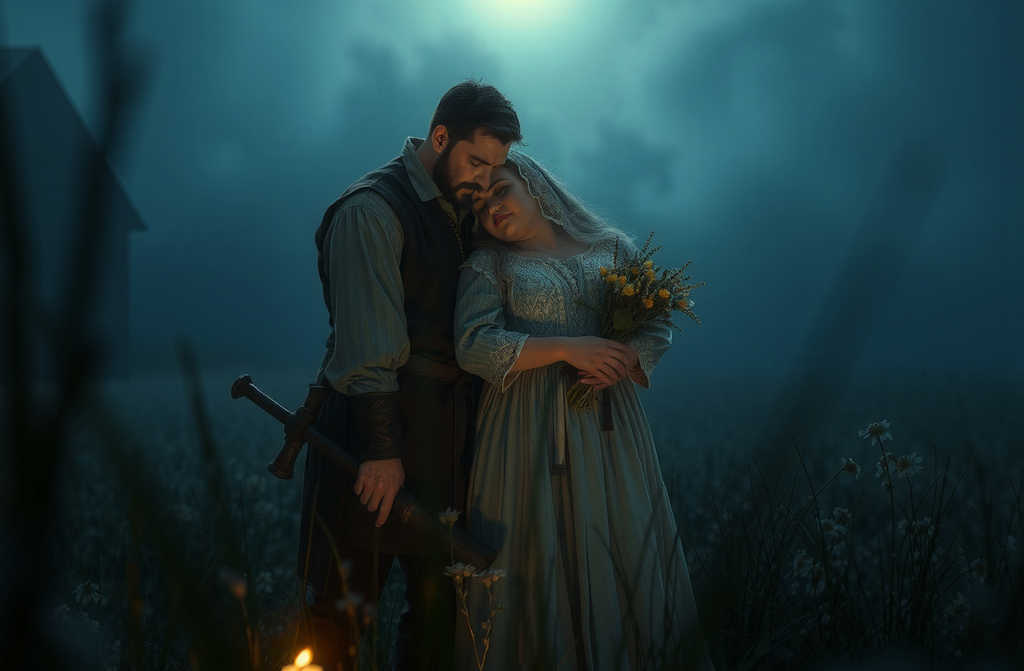
THE DOOMED MARRIAGE
In our village, the folk would whisper about Arthur: “A lone wolf.” Broad-shouldered, reserved, the village blacksmith whose hands could bend an iron bar or cradle a sparrow with equal ease. He had a loyal wife, gentle Margaret, and a home brimming with comforts. Life should have been a quiet contentment.
But then, as spring unfurled her green banners, Eleanor returned to Ashgrove Manor. Gone was the skinny girl whod left for London years before; in her place stood a woman with fathomless eyes and a laugh that made every mans blood run cold.
Fate had them meet by the old windmill. Arthur was repairing a gate while Eleanor wandered past, her skirts brushing the wild grass. She looked at himand that was the end of it. As though a red-hot poker had pierced his heart.
It was a love born in defiance of all:
In defiance of GodArthur, once a church regular, now skulked past the vicar, unable to meet the gaze of saints.
In defiance of folkhushed whispers behind doors became an angry murmur.
In defiance of reasonArthur, all too aware Eleanor was the gentry, flighty and fickle, while he was but a fleeting amusement.
Yet each midnight, Arthur would slip away to the woods. Eleanor waited in the tumbledown lodge, wild and dangerous as the summer grass. She kissed his work-rough hands, and he gripped broken branches as though to quench the beast within.
“Let us run,” hed murmur into her shoulder, lips bitten to blood. “Ill leave it all, EleanorIll take you north, away to the wilds.”
But she only laugheda laugh sharp with longing and regret.
“Where would you take me, blacksmith? My feet are used to velvet carpets, yours to dusty roads. Cursed is our lot, Arthurtogether its forbidden, apart its unendurable.”
The end came on an autumn night. Margaret, worn thin by suspicion, went to the forge and found them. No screaming, nor tearsshe merely watched as her husband, her anchor and her life, knelt before another woman.
Arthur returned home before dawn. The house was hollow, Margaret gone to her parents, taking the children with her.
And by noon, word arrivedEleanor had fled to London, to an officer fiancé, not so much as a goodbye note.
Arthur didnt drown himself in drink. Instead, he hurled himself into work. His hammer fell on the anvil with such fury it seemed he might shatter the memory of that reckless spring.
They say a love so blighted never truly dies, just smoulders on like embers beneath the ash. Stir the ashes and the fire flares anewbut now, all it brings is choking smoke. Love ought to mean two gazing heavenward together; doomed love is when one looks to the sky and the other to the grave, unable to tear their eyes away.
Where once was passion, only ruin and sepulchral chill remain. Cursed love knows no forgiveness: it takes either blood or everlasting torment.
After Eleanors departure, Arthur did not merely changesomething within him burnt out until nothing but a shell remained. His eyes became twin shadows, empty and dark.
Margaret never returned, telling her mother, “I cannot bear his sinful shadow, as though hes not been with a lady, but shared a tryst in the dell with Death herself.”
Arthur stopped crafting ploughshares and horse shoes. Villagers shunned the forge; the women crossed themselves at the sound of the hammer. It was rumoured he forged a chain, to shackle his soul to the one who deserted him.
Come November, with the fog thick as wool, Arthur trudged back to the abandoned mill, bearing a small bundle.
“Come,” he croaked, driving a great black nail into the old windmills wheel. “You promised, Eleanorwed be together, in silk or in a shroud makes no matter to me.”
And she did returnbut not the radiant woman whod once laughed in the sunshine. From the mist stepped a shadow, her dress in tatters, her face white as milk, her eyes nothing but void.
In London, Eleanor found no happiness. The officer was a gambler and a rogue. On learning she carried the child of a village bull, as he called it, he cast her out in only her nightgown. She froze to death in a roadside ditch, trying to make her way back to her blacksmith.
The shadow stretched its arms towards him.
“Arthur” whispered the reeds. “I am cold. Warm me.”
He did not recoil. He cradled that icy, earth-scented figure to his chest.
“Ill warm you, my love. Ill warm you to the very end.”
That night, the forge blazed so bright it lit the sky for miles. When the fire died, no bones were foundonly two crude iron wedding rings, fused for eternity.
Now its said that at the old mill, one soul sighs heavy through the night, while another weeps in silence.
A grim legend tells that iron tempered in the fire of damned passion never truly cools. The rings, found in the ashes, were snatched up by a travelling scrap dealera man with neither faith nor fear, keen on making a pound from the ancient black metal.
The scrap dealer never reached the city. They found him, knelt in prayer atop his cart in a field, horses frozen stiff. His hands were clenched tight, burned deep in the shape of those two rings, as though the dead metal had drawn the last warmth from him.
The rings scattered across the land, misfortune trailing in their wake:
StrifeIn any house that kept that iron, love turned to hatred by morning. Husbands saw witches in their wives, and wives tried to smother their men with their own hair in sleep.
WhispersThose who hid the rings at home swore they heard the heavy tread of the blacksmith and the shiver of tattered silk at night.
MelancholyWorst yet, the owners fell under a black sickness. They ceased to eat or drink, eyes fixed on the same spot, as if waiting for someone
Decades passed; the village fell empty, the mill rotted and slid into the river. Still, some murmur that, on occasion, a figure can be glimpsed where the forge once stood.
It is Arthurstill vast, but his heart now a burning ember. The blacksmith haunts the world in search of those cursed rings.
Holy love wears a crown, but doomed love bears a noose, impossible to escape even in deathsin being sweeter than life, and torment dearer than redemption.
Doomed love is not the stuff of rose petals and gentle sighs. It is the passion that burns out the soul, breaks all vows, and pulls one to the depths with a stone about the neckyet for all that, you go down smiling.