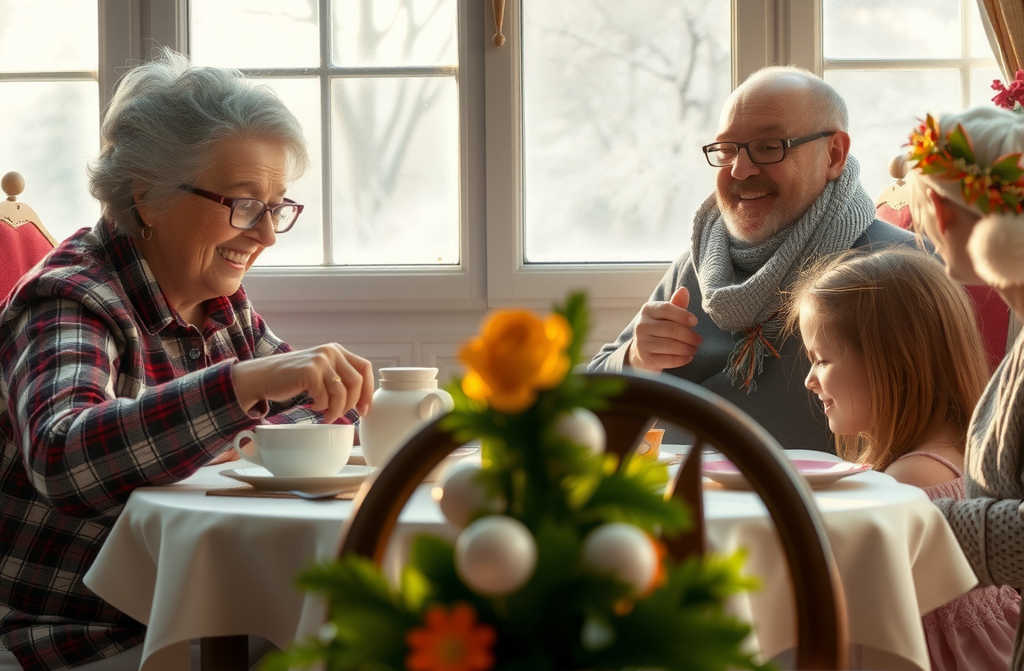
I placed the last plate on the table and took a step back. Twelve place settings. Twelve glasses. Twelve napkins, neatly folded into trianglesjust as my mother had shown me years ago. By eight oclock, the Robinsons would arrive, then later, Clare and her husband. Just the way Mum had liked it: a full house, laughter in every corner. The white tablecloth was still hers, embroidered with little snowflakes. It was part of her trousseau. I smoothed out the last stubborn crease, thinking to myself that this was already my third New Years Eve preparing our family table alone. Without her.
Granny Anna, what about the thirteenth chair?
I jumped. Sophie stood in the kitchen doorway, clutching a pile of extra plates to her chest. Her cheeks were rosy from the coldI imagined shed just darted out to fetch something from the garden.
What thirteenth? I pretended not to understand.
You always put one out for the unexpected guest when Great-Granny was alive.
I turned towards the window. Outside, thick, gentle snowflakes drifted downlike tufts of cotton wool, slow and silent. Mum used to love this kind of snow. She always said it brought visitors. I never asked what sort of visitor she meant. Id always thought it was just an old saying, a quaint tradition.
Shes been gone three years, Sophie.
Thats why we should still do it.
My granddaughter looked at me in that searching way of hersstraight, earnest, never unkind, but with questions. At ten years old, she was the one in the family who truly listened to Mums stories. Not just nodding out of politenessshe remembered every word. I hadnt listened in years; I was always so busy with work, ledgers, the accounts. And now Mum was gone, and there was no one left to ask.
Alright. Bring in the wooden chair from the box room by the wall.
Sophie grinned and dashed off. I went to the bureau and opened the top drawer. There, in its velvet case, lay Mums earringsamber drops set in silver. The only jewellery of hers I wore. David always said they suited me, but thats not really why I put them on. When I touched the cold silver at my earlobe, I could almost believe Mum was still close by.
I slipped the earrings in and caught my reflection. Fifty-two years old. Crows feet around my eyes, hints of grey at my temples. Mum, I thought, looked younger at this ageor maybe I only remember her that way.
Sophie brought in the thirteenth chair and set it at the end of the table, facing the front door. I wanted to tell her it would be awkward, sitting with ones back to the window, but I kept quiet. That was how Mum always placed it. Every year.
Great-Granny told me she had a brother, Uncle George, Sophie said, smoothing the tablecloth round the extra place. He left when she was twenty-seven. Never came back.
I stopped, salad bowl in hand. How do you know about Uncle George?
She talked to meback when I was little and stayed over at hers. All those nights, shed tell me stories about her childhood, her brother, the house. She said one day hed come. Thats why she always left an extra chair.
Forty years. For forty years Mum had kept that tradition, and Id always thought it was hospitalityjust an odd habit of an old woman. Really, she had been waiting. Every New Years Eve, she waited for someone in particular.
Why didnt she ever tell me?
Sophie shrugged. Maybe she was waiting for you to ask.
I hadn’t, not once in fifty-two years. Never asked why Mum set that extra place, never asked about her childhood, or the family, or anything before me. Id taken her for grantedMum was just Mum. Now she was gone, and I realised how little I actually knew about her.
The front door banged open. David came in, shaking snow off his coat. Then Paul and his wife, Helen, followed close behind. The house filled up with voices, the clatter of plates, laughter. Helen brought one of her famous cakes, Paul held a bottle of prosecco aloft. David hugged me, kissed my temple.
Youve really put on a spread.
I smiled, took their coats, poured out tea, listened to the usual chatter about traffic and the weather. But my gaze kept returning to the extra chair at the end of the tableempty, waiting.
Mum had waited every year for someone. For forty years. And I had never guessed.
The bell rang at six.
Wed just finished the starters. Paul was telling a story from work, Helen chuckled at his jokes. David had just uncorked another bottle. Sophie was quiet, pushing salad round her plate. The bell rang shrilly and unexpectedly.
Ill answer! Sophie leapt up.
I was in the kitchen, drying my hands, when I heard her call: Gran, theres someone here.
There was something about her voiceI went to the hallway.
An old man stood on the doorstep. He had a tangled white beard, a battered old overcoatonce fine, now threadbare, with a lost button. His woollen hat was thick with fluff, boots worn down, one tied with string. A vagrant, one of the many who wander around the station.
But he wasnt looking at us. He stared at the housethe leaded windows, the porch with peeling paint, the tree in the garden, strung with fairy lights. He looked as if he were searching for a memory.
Good evening, he said, voice quiet and cracked, but not rough. SorryIve just grown so cold. Would it be alright if I came in for a moment to warm up?
David appeared behind me. I felt him stiffen.
We dont give out charity, he said firmly, but I can bring you a mug of hot tea. Wait here.
Let him in! Sophie was in front of us both, eyes shining. Granny Anna, you set the thirteenth chair yourself. For an unexpected guest.
I looked at the old man. He didnt beg or plead, didnt tell a tale of starving childrensimply stood there, gazing at our home. At Mums home.
Then I noticed his hands. He had taken off a glovea knitted fingerless thingrubbing his cold fingers. The nails were clean, trimmed evenly for all the world. His skin was weathered, cracked from the cold, but his hands were neat. Long fingers, with old marks and calluses on the pads. Not the hands of someone who had lived rough foreverhands that knew delicate work.
Come in, I heard myself say, before Id even thought it through. Its New Years Eve. No one should be left standing on the doorstep in this cold.
David wanted to objectI saw the square of his jawbut I laid my hand gently on his forearmthe gesture Mum always used to calm Dad. It still worked.
Alright, David said, but not for long.
The old man stepped inside, pausing in the hallway, turning his head right towards the kitchen, then left at the lounge and the Christmas tree. His eyes flickered with somethingrecognition, or was it just my imagination?
Kitchen on the right? he asked, not really addressing anyone.
Yes, Sophie replied. How did you know?
Houses like this usually are, he murmured, Sorry. I havent been in a proper house for ages.
We led him through to the lounge. Paul looked peevedhe hated surprises. Helen edged away, clutching her husbands arm. Only Sophie hovered around our guest, smiling and bustling.
I sat him at the thirteenth chair. He eased himself down, wary, poised as if the chair might crumble under him. Hands resting on his knees, back upright with a dignity that even time and fatigue couldnt erase.
Ill fetch you something to eat, Sophie said.
Thank you. You are very kind.
His speech was correct, his accent clear. Not what youd expect from a man living rough.
Sophie placed a plate before himsalad, roast potatoes, a thick slice of cold ham. He took up the forkagain, I noticed the gentle, precise way he held it, the sure, practised grip, not crude or clumsy. He ate slowly, politely, not hurried or greedy. Like someone brought up properly.
Whats your name? Sophie asked, sitting across from him.
He looked up. George.
I nearly dropped my wine. My hand shook, spilling a splash on the tablecloth. George. Uncle George, Mums brother from all those old stories. A vaguely-remembered relation who left when I was a child. I barely recalled his facejust Mums tears when he left. Coincidence, surely. There must be thousands of Georges in England.
Whats your middle name? Sophie pressed.
Andrew.
My hand instinctively found my earringsthe cool amber drops. Andrew. Mums fathermy grandfatherwas Andrew Johnstone. He died before I was born. I only knew him from photographs.
Tasty, said the old man, pushing away an empty plate. Havent eaten a home-cooked meal in a long time.
Would you like some more? Sophie asked.
No, thank you. Thats plenty.
He settled, looking quietly at the Christmas tree, the trinkets, the gold star at the topeyes a faded blue-grey, a familiar flicker within. Something of Mum peered out from their depths. The very same eyes I saw in the mirror for fifty-two years.
Annie love, the old man said suddenly, regarding me kindly, could you pass the salt?
Annie. Only Mum ever called me that in my childhoodAnnie, dinnertime! Annie, come along, love. No one else, not David (he calls me Ann or Annie-bird), not Paul (he says Mum), not Sophie (Gran Anna), not colleagues at work (Anna Andrewson).
How do you know my name?
He froze, fork in hand. A flicker ofsomethingfear? Confusion?
II just heard somebody call you earlier.
No one had used my childhood name that evening.
I passed the salt, silent, turning back towards the window. Outside, the slow, steady snow was still falling.
Yet through the evening, my eyes kept drifting to his hands.
At quarter to midnight, we raised our glasses. David made the toastabout family, health, happiness in the new year. Everyone clinked glasses. The old manGeorgedrank quietly, small sips. Nearly left his prosecco untouched, just wetting his lips for the cheer.
As the clock struck midnight, Sophie cheered Happy New Year!, Helen wrapped her arms round Paul, David kissed me. The old man sat motionless, gazing at the tree, lips moving in silenceprayer or idle arithmetic, counting the chimes?
Afterwards, Sophie played music. Paul and Helen went to dance in the next roomdistant laughter, old songs. David dozed in his armchair, tired from the commotion. Sophie hurried off to phone friends.
I started to clear the table.
Our guest still sat, back straight, hands folded. Staring at the Christmas tree.
Then I heard a faint sound.
He stood and shuffled up to the tree. Carefully, touch gentle, he adjusted the old gold star Mums mother had bought, just tipping it slightly left. By only two centimetres.
Something broke inside me.
That gesture. Mum used to do it every New Yearsevery time we put up the tree, shed finish by adjusting that star, always just the tiniest bit to the left. Id ask her why; shed smile mysteriously. Its just right that way, Annie, just right.
I stepped close, heart thumping so I thought he must surely hear.
Why did you do that?
He withdrew his hand, turning to look at me, startled.
Force of habit.
Whose habit?
Silence. His faded blue-grey eyes searched mine. Age and care lined his face, but those eyesthey were my eyes. Mums eyes.
You knew my mother, I said, not as a question.
He dropped his gaze. Zena Andrewson? He nodded softly. Yes. I knew her.
How?
There was a long pause. He stared at the tree as if seeking an answer among the branches.
We grew up in this house together.
My heart missed a beat. That could mean anythingneighbours, distant family.
This very house? I prompted, though I already knew.
Yes.
My breath caught. I stepped closer.
Who are you?
No answer.
There was a childrens room here, he said finally, nodding towards the corridor. A little bedroom at the end. Window facing the garden. In winter, patterns would frost the glasswed stare at them for ages, making up what we saw.
Its a storage room now.
I know. He hesitated. Zena and I He stopped.
What?
He shook his head. Nothing. Forgive me. I need some fresh air.
He left for the porch, forgetting his coat.
I found him half an hour later, sitting quietly on the old bench by the fence, snow gathering on his coat, hat, beard. He sat motionless, simply gazing at the warmly lit windows.
I pulled on Mums old padded jacket and joined him outside.
Youll catch your death out here.
Wouldnt be the first time.
I sat beside him. The bench was icy beneath me, snow flakes melting on my cheeks.
Tell me, I said.
What?
Everything. Who you are. How you know Mum. Why you came.
A long silence. He looked at his handsthose same neatly kept hands.
Zena was my sister, he said at last, voice unsteady. My baby sister. I left when she was twenty-seven. I was thirty.
It was like the ground dropped away. I held the edge of the bench to steady myself.
Youre Uncle George?
He winced, looking at me.
She spoke about me to someone?
To Sophie, her great-granddaughter. Sophie told me tonight. She said Great-Granny waited for you. Thats why she always set the extra place at the table, every New Years. Forty years.
He covered his face with his hands, shoulders shaking.
Forty-three, he whispered. Forty-three years I was too afraid to come back.
Why?
He lowered his handshis eyes were red with grief. His voice faltered. We arguedDad and I. Badly. I said things I wish I hadnt. That I hated him, that Id never set foot in this house again. A sigh clouded the icy air. I left for Scotland, went to work in construction. I thought Id cool off, return in a year. A year became five; five became ten, then twenty. And after that he shrugged, After that, shame kept me away. Too much time had gone by. I thought itd be kinder for everyone if they imagined me dead.
And Mum?
He looked sick with memory. I thought shed hate me too, side with Andour father. I didnt write, not once. I was too afraid to find shed say not to come home.
She waited for you, I whispered, fighting tears. For all those years. Every New Years Eve, she set out an extra chair. Waiting for you.
He looked up.
I learned she died last year. Stumbled on her obituary in a discarded newspaper at the station. Saw her photomy Zena, old and grey. It said passed away after a long illness. That was when I knewit was too late. Forty-three years waiting, and I was too late.
So why did you come?
He sighed heavily. Because she waited. All that time, she waited. I had to see our house one last time. The house where we grew up togetherwhere I ruined everything.
We sat in silence. Snow covered us; I barely noticed. Mums old jacket still carried the scent of her favourite perfumesomething floral and warm.
I dont know if I believe you, I said quietly. Sorry. But anyone could claim to be a long-lost brother, tell us a tale.
He nodded, accepting. I understand.
Do you have any proof?
He studied the dark windows for a long time.
In the childrens roomthe old storage roomwe scratched something into the wall, Zena and I, when we were kids. Under the wallpaper. In 1962. I was eleven; she was eight.
The wallpapers been changed five times.
I know. But the mark should still be there, under it all, on the plaster. Next to the window, low down near the corner. We had to stand on a stool to reach.
My legs felt weak.
Lets go.
The storage room smelt of old books, woollen shawls, and dust. I switched on the light and made for the window.
The right corner? I asked.
A little above the floor. We stood on a stool.
I searched the shelves for something to scrape withfound an old blunt pair of scissors.
I worked at the edge of the wallpaper, peeling back the recent cream paper. Underneath, the blue print of the eighties, the faded green of the nineties, ochre-yellow from the seventies, then a rusty red that must be the oldest. Finally, bare plastergrey, deeply cracked with age.
I flicked on my phone torch. My hands trembled.
Therescratched deep into the plaster, childish and uneven: We lived here. George and Zena, 1962.
My fingers shook. I knelt. I traced the faded words, sixty-two years old, hidden under all these layers, their little secret, hidden for a lifetime.
I did that, George whispered behind me. Zena was scared Mum would catch us. I promised her the wallpaper would hide itour secret forever.
I turned to himhe stood silhouetted in the doorway. Old and worn. And yet completely familiar. Mums brother. My uncle. The one shed waited for.
You really are Uncle George.
I am, Annie. I am. You were just a tot when I left. Nine years old. I remember you bouncing on my knee. Zena would say, Annie, go to Uncle George now. Thats why it slipped out tonight.
We sat in the kitchen till dawn.
I brewed teastrong, with thyme, just as Mum liked it. I found some of her old raspberry jam from her last summer, just before she grew ill.
George told me everythingabout Scotland, about the tough years, about three years spent in prison for a foolish theft as a young man, then drifting from station to night shelter, too ashamed to come home.
I was a watchmaker by trade, he told me, showing his hands. Had a workshop in town. Repaired clocks and old watches. You see the old calluses? They never quite leave, even after all these years. I havent worked in ages, but the hands still remember.
He showed me, palms upneat, skilled, steady.
Do you know why I really stayed away? he asked when dawn had begun to pale the sky. It wasnt just shame. I was afraid. Afraid Zena would tell me to go away. That Id hear her say I was as good as dead to her. Well, it was easier to never know than to hear that.
She wouldnt have. I know she wouldnt.
How can you be sure?
I pressed my hand to the table. She kept the thirteenth chair out every year, forty years in a row, right till her last New Years, even when she was too unwell to stand. I never understood, thought it was just a quirk. But she waited for you.
He was silent thenoutside, the first pink of a new year coloured the sky.
The earrings, he said suddenly, glancing at the amber drops at my ears. I bought them for her 18th birthday. Out of my first wages. She promised to wear them forever.
I touched the cool silver. She did. She never took them outeven in hospital. The nurses tried to get her to, but she always refused.
George weptquietly this time, just tears freezing in his beard.
I got up and fetched Mums grey woollen scarf, still fragrant with her perfume and a hint of hay from the garden. I draped it around his shoulders.
Happy New Year, Uncle George.
He pressed my hand to his cheek, warming it with his tears.
She didnt wait long enough. Three years difference. If only Id come sooner
But you came. Late, maybe, but you came. Shed have wanted that.
He looked at me, eyes blazing.
Shed want you to stay herewith us.
He said nothing for a while. Outside, morning sunlight crept across the windowsour first dawn of the year.
When I walked into the lounge later that morning, Uncle George was sitting at the thirteenth chair, a steaming tea before him, Sophie by his side, telling him grand tales with her hands flying, and he, at last, was smiling for real.
The gold star on the tree was nudged ever so slightly to the leftjust so. Now I knew why. It was their signbrother and sister. The secret shed held for forty years, waiting for him to come home and turn the star himself.
Paul still eyed our guest warily from the corner. Helen clattered in the kitchen, pretending everything was fine. David slipped an arm around my waist.
So hes staying then?
Yes.
Anna He hesitated. Are you sure? We hardly know him. You never know
He knows about the inscriptionunder five layers of wallpaper. We lived here, George and Zena, 1962. You cant fake that.
David sighedthe careful, thoughtful man Id married, cautious but kind. He loved me enough to follow my lead.
Alright. But I did warn you.
I looked at Uncle George. He cupped his tea with those steady old handswatchmakers hands. The same hands that scratched a message into the plaster, that bought earrings for his baby sister all those years ago.
Mum set that chair for forty years, I said. It was empty for three. Thats enough.
Sophie caught my eye and waved.
Gran Anna! Uncle George says he knows how to fix clocks! You know Grannys old cuckoo clock thats broken? He says he can mend it!
I crossed to the table, laid my hand gently on Uncle Georges shoulderthe way Mum used to welcome guests and calm us all. Now it was my gesture.
Happy New Year, I said. To a new beginning.
He placed his hand over mine. His hand was warm.
Thank you, Annie. His voice cracked. Thank you for letting me in.
Outside, the snow still fellslow and thick. Mum always said that kind of snow brought visitors.
She was right, as always.
Forty years she waited. Three years after her time, he finally came.
And the thirteenth chair was empty no more.