Not My Boots
David, have you eaten?
He didnt answer. Just sat at the kitchen table, staring into the plate Id put in front of him twenty minutes ago. The potatoes were cold by now. So were the sausages. I stood in the doorway, watching the back of his head. Just an ordinary back of the head, nothing noteworthy. Grey dusting his templeshes always hated that. Ears sticking out a bit. My husbands head. Ive known it for thirty-one years.
David.
What?
Not a question. More like a sigh escaping into air.
Are you going to eat?
Im not hungry.
I walked over, picked up the plate. The potatoes really were stone cold. I scraped them into the bin, turned on the tap. The sausages I wrapped in foil and put in the fridge. The whole while, he just sat there, gazing at the empty table now, where there was nothing left.
This had been going on for nearly three weeks.
I remembered exactly how it had started. Couldnt tell you the date, but I know it was a Wednesday. Mid-February, damp greyunpleasant weather. He came home from work an hour late, shuffling his shoes off quietly in the hallway. Usually, hed call out: Susan, Im home! Always, thirty-one years. Even if we were rowing, even if wed spent a week not speaking over something silly, still hed shout it from the door. A habit. But that nightsilence. I peeked out from the kitchen. He was standing by the coat hanger, just staring at his jacket, as if uncertain whether to hang it up or not.
David? Why so late?
Got held up.
Everything alright?
Yeah, fine.
And I believed him. Why wouldnt I? New boss at work, plenty going on. I just served up his dinner. He ate, nothing unusual. Maybe a bit quieter than normal, but I put it down to tiredness.
Then it happened again the next day, and the day after that. And again the next week.
I tried not to see it. Its something women get good at, especially after fifty, when youve already survived so much. You tell yourself: hes tired, hes getting on, its work. You explain things away. Its easier not to see, because if you notice, you have to do something, and youre never sure what.
But eventually, you cant unsee it anymore.
I remember waking up one nightthree in the morning, pitch black. David wasnt beside me in bed. I lay there for a while, listening. Quiet. Then I got up, padded to the kitchen. He was sitting there in darkness, facing the telly. The telly was switched off, black screen. He was just looking at it. Hands on his knees, back straight, like a man expecting something.
David its three in the morning.
He turned, looked at me as if I were from another worldhonestly, as if he was so far inside himself that he couldnt believe I was even real.
Go back to bed, he said.
What are you doing out here?
Nothing. Just go back to bed, Susan.
I didnt go. I went over, put a hand on his shoulder. His shoulder was coldhe was just wearing a T-shirt, in February. He didnt react, didnt flinch, nothing. He used to always cover my hand with his. Always. Automatic.
Whats the matter?
Nothings the matter… just cant sleep.
You never struggle to sleep.
Theres a first time for everything.
I left him and lay there for ages, staring at the ceiling. He came back around five, got into bed, didnt touch me. I could hear by his breathing that he wasnt sleeping. Neither was I, but we both pretended.
Thats when I realised: something was seriously wrong.
In the following days I kept thinking. Picked over everythingan unpleasant business, because your thoughts drag you into the darkest places. Im not some young fool who only hopes for the best. Im Susan Margaret Turner, fifty-six, married thirty-one years. I know life.
The first thing that crossed my mind, obviously, was another woman.
I felt ashamed of the thought. Because this is David. David, who never, in thirty-one years, had given me a shred of cause to doubt him. But when a husband goes silent, loses his appetite, stares into the black at night, a womans imagination fills in the blanks. Nothing can be done about it.
I started watching him. His phone. He used to leave it wherever he was; now he always had it in his pocket. I noticed that. But nothing else. No strange perfume. No late-night calls. No odd excuses. In fact, he came home on timesometimes earlier. Came in, sat down, went silent.
The affair theory dropped away. Or nearly dropped away. These things never fully disappear.
Second thought: illness.
I was afraid even to let myself think it. Hed turn sixty in April. Men at that age. It could be his heart, or something even worse. Something too frightening to even say out loud. I remembered he hadnt been to the GP in ages. Men avoid doctors til theyre desperate. Maybe hed found something out and was hiding it from me, not wanting to scare me.
That sounded like him. Very much like David.
One day I broached it, tentatively.
Youve not had a check-up in a while. Maybe just for a bit of reassurance?
Im fine.
How do you know if you havent been?
Susan, Im fine. Leave off.
He said leave off in a flat tone, no heat, but it hit me all the same. He almost never spoke to me like that.
The third thought: money.
We always managed. Not wealthy, but okay. David worked as a supervisor at the local furniture factory, I was in accounts at the GP surgery. We put both kids through uni, got them married. Theres Emily, our granddaughter, just three. The mortgage paid off years ago. The cars ancient, but runs. We get by.
Still, I began to wonder: had he built up debts somewhere? Maybe borrowed behind my back? I checked our joint accountfine. I couldnt check his, and didnt dare ask outright. Why? Because hed just say leave off or say nothing, which, coming from him, could be worse than a slap.
Several more days went by. At work, I held it all in. Our chief accountant, Judith, asked me once:
Susan, youre miles away. Everything alright?
Yes, Judith. Just tired out.
Husband? she asked, like women our age do.
No, no, everythings fine.
She just nodded. Shed been married forever too. She knew: fine almost never means fine. But she graciously left it there.
At home, I tried to act normal. Cooked, cleaned, asked about his day. He gave me short answers. Alright. Yeah. Fine. We went on as two strangers sharing a home. Wed never lived like that, even through the worst rowsthere was always some passion, life, movement. Nowjust cotton wool.
Then, once, he snapped at me.
I asked him to fix the leaky tap in the kitchen. Itd been dripping for a week, Id mentioned it several times. He nodded, but never got round to it. That evening I said again:
David, the tap.
He looked up, eyes full of somethingweariness, anger, I couldnt really say.
Susan. Not now.
But its been leaking for a week.
I said, not now!
He slapped his hand on the tablenot hard, but I jumped. It wasnt the force, just the shock. David Turner never slammed tables. Never. That wasnt my husband.
We both fell silent. He left for the bedroom. I stood listening to the sound of the dripping tap.
Then, quietly, I fetched the wrench from beneath the sink and tightened it myself. Not as well as he, obviously, but it stopped dripping.
That night, I couldnt sleep for ages. I lay there thinking: Who is this? Where is my husband? That David who laughs too loud at the wrong moments, who knows every line from old British comedies by heart, who makes pancakes on Sundays and oversalts them, who rings me from work just to say hi. Where is he?
That feelinghaving someone there, but not really thereis worse than any argument. Its worse than if hed gone away somewhere. Because if they go away, at least you know. But this: hes here, he breathes, he answers, but hes not here.
The words marriage crisis bobbed up in my head, late at night, as if it had named itself. I actually marvelled thats what it was called. But I couldnt see how it had started. We were alright. Werent we?
From the outside, nothing had changed. That was the worst of it.
One evening Ill remember forever.
I got in from work about six. His coat was missing from the rack; he hadnt come home yet. I took off my boots, went to the kitchen, popped the kettle on. Pulled some things from the fridge to start dinner. Then I heard the door, opening so quietly, almost silently. I peeped out.
He was taking off his shoes, mute again, same as the last three weeks.
Youre back, I said. You want dinner?
He didnt answer. Went into the kitchen, I followed. He opened the cupboard above the fridge where we kept a bottle of whiskyfor guests and just in case, though that case had never arisen. It had probably been there since last New Year. He took it out.
I stopped dead. My heart did something awfulI wont say what, just awful.
He set the bottle on the table. Set out a glass beside it. Sat. Stared at the wall.
I waited. He didnt open the bottle. Just sat, watching the wall. Didnt pour, didnt drink. Just sat there.
It wasit was scary in its own way. He clearly meant to do something, had fetched it out, and now satdoing nothing. As if arguing with himself inside.
I went over quietly. Took the glass away. Put the bottle back in the cupboard.
He watched me. Didnt object.
I poured him a cuppa, set it before him. He just sat.
David, I said, I dont know whats happening. But Im here, and youre here. Well figure the rest out.
He looked at mea long look. There was something in his eyes I hadnt seen for ages. Pain? Guilt? Exhaustion?
Go to bed, Sue, he said quietly.
And you?
Ill be there soon.
I left. I knew you couldnt force a person to talk if they werent ready. But I also knew this couldnt go on.
It didnt go on. But not as I expected.
It was a Friday. I was getting ready for work, fixing my scarf in the hallway mirror. He was still sleeping. Lately, hed been sleeping much later than he used to. As I checked my reflection, I thought about how Id spent the last three weeks feeling something had brokenand not knowing how to fix it. That he was, despite everything, still my closest person.
And I made up my mind.
I took out my phone and texted Judith: Judith, I need the day off. If possible, please. She responded at once: Of course, Susan. Take what you need. God bless her.
I left the flat as usual. Lift, out into the street. Waited five minutes, then turned back.
Slipped my key in, silent. Took off my boots quietly, stepped into the hallway
And saw strange boots.
Womens. Dark brown, a low heel. Neatly set by the wall. Not mineI know my own. These werent mine.
I stood in the hall, just looking at them.
Then I heard voices from the kitchen. Womans and mans. The woman was crying. The manDavidwas speaking softly, soothingly.
I needed only a second to decide. Just one. I walked into the kitchen.
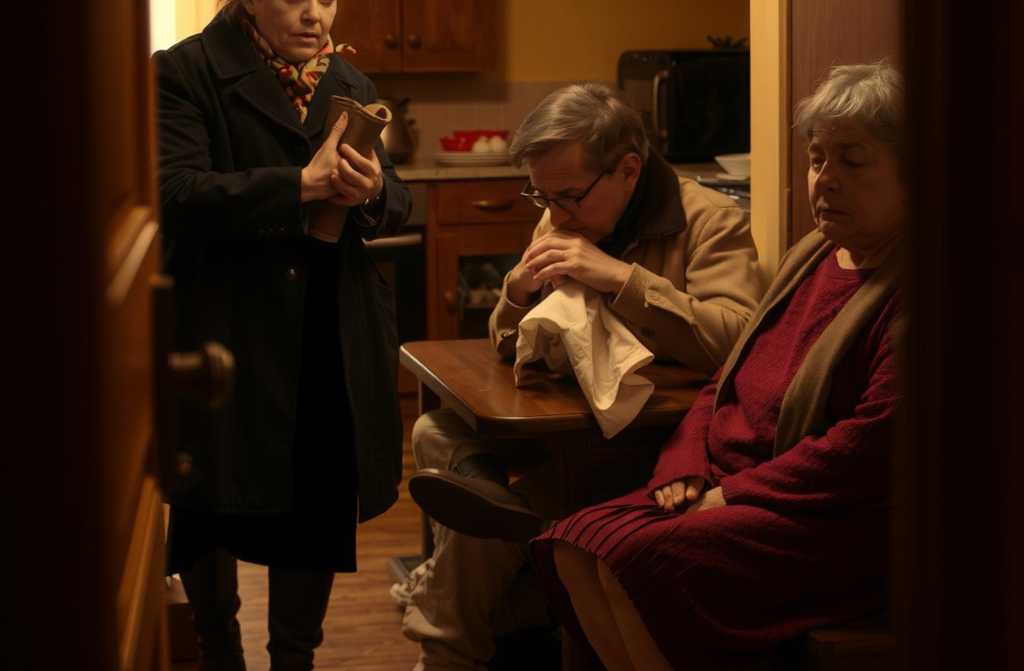
There they were, at the table. My David. And Evelyn, the wife of Davids best mate, Simon. Evelyn sat crying into her hands. David was beside her, not touching, just there. Two mugs of tea before them, a packet of biscuitsour biscuits.
David looked up and saw me.
He didnt jump up, didnt look scared. Just looked at melike a man whos been caught, but is almost relieved to be caught.
Evelyn raised her head too. Eyes red, puffy. Her handkerchief soaked through.
We all three sat silent for a few seconds. Or five. Or an eternity.
Finally, Evelyn said: Susan, Im sorry. I didnt know where else to go.
I didnt answer her. I was looking at David.
Explain, I said.
He stood, went to the window. Back to me. Through the window: February, grey, no snow, only drizzle.
David.
Yes, he said. Ill explain.
He turned. Evelyn stared at the table, David at me.
Simonhe got into trouble yesterday. Out front of the office. Three blokes. Said: tell your friend to keep his mouth shut. Hes in hospital now.
A sudden, sharp feeling. Simon Webb. Thirty-year mateship. Ive known him as long as Ive known David.
What does keep his mouth shut mean? I asked.
David looked down. Rubbed his facethe thing he does when things are tough.
I put in a report. Early February. On the new factory manager.
And?
Andhes a thief, Sue. Systematic. Stealing from the store rooms, materials. I saw, I tallied, I gathered evidence for three weeks. Then I filed a report.
To whom?
To HR. And your departmentaccounts.
I waited.
And Simon David spoke slowly, each word a struggle, Simon found out Id filed it, right at the start. I told him. I thoughtI thought, as mates, hed understand.
David.
He told the manager everything. For two months. He told him what I was up to, what Id collected, things I said, all of it. For two months.
The kitchen was suddenly so quiet. Only the fridge humming.
I got the sack, David said. Three weeks ago. The day I came home late. Missing items in the records. I hadnt touched a thing, Sue. You know that. But the paperwork was donewitnesses, signatures, everything sorted. All tidy.
Youve been silent three weeks, I said.
Yes.
Stayed quiet, acted normal. Going out as if to work. All the while silent.
Yes.
So, where did you go every day?
He was silent for a bit.
Anywhere. At first the park. Then the library. Sometimes just riding the busjust anywhere.
I looked at him. My husband. Sixty in April. Master craftsman. Golden hands, not my wordseveryones. Thirty-one years together. He spent three weeks riding buses to nowhere, silent.
Why? I asked.
He rubbed his face again.
Didnt know how to say. Was thinking. Afraid youd
Id what?
Youd fall apart, Sue. That Id break you. Youd He hesitated, searchingYoud worry. Desperately.
Desperately worry, I echoed.
Yes.
David.
What?
David, youidiot.
It just escaped, out of my mouth. I even surprised myself. Evelyn looked up. David, too.
And I hit him. On the cheek. Not hard, justdidnt know why. Maybe three weeks’ worththree weeks of untouched whisky, and silenced television, three weeks of me lying awake, thinking: is it an affair, illness, debts, what? Three weeks of hollow eyes. Now this.
He didnt dodge. Just took it.
I slapped him againagain, just a light one on the cheek. Like letting air out of a balloon. Then I dropped my hand.
Sorry, I said.
Dont be, he replied.
No, I shouldnt have. Never right.
I deserved it.
No one deserves it. I justsorry.
I turned, filled a glass from the tap, drank. Then another. Clutched the sink, steadying myself. Breathed and calmed.
Evelyn still sat at the table, quiet.
David didnt move.
I let go of the sink. Turned around.
Right, I said. My voice didnt even tremble. That actually surprised me. Youve been silent for three weeks. Fine. Now we talk.
Sue
No. Im talking now. Then you.
He closed his mouth.
You handed in a report because you were right. He was stealing, you did the right thing. Fact one. You were framed and sacked, false charges. Fact two. Simon spent two months grassing you up to that manager. Fact three. He got battered because they thoughtwait, let me checkam I right?
I looked at Evelyn.
She nodded, wiped her eyes.
Yes she whispered. They reckon Simon knows too much. That he could blab. That they can pressure him. Thats why
Thats why they jumped him at the office, I finished.
Yes.
I kept quiet, gathered my thoughts.
Evelyn. Is Simon terribly hurt?
Broken arm. Pair of ribs. Hes in hospital, I came straight here from there. I didnt know where to go. Im scared to go home.
Why scared?
Well they said tell your friend. Means they know our address. They might
At that moment, I understood the scale. Evelyn was afraid of going back home because those men knew where they lived. All this because of one manager at the factory, embezzling, and David wouldnt let it slide.
Right, I said, Youll stay here for now, Evelyn. My daughters spare room is freeshes at her husbands, theres room. Well figure the rest.
Susan, I don’t want to
Evelyn. Youre staying. End of.
She wept anewsoftly, almost soundless.
I turned to David.
Your turn now, I said.
He sat. Not just in body, really satback present at our table for the first time in weeks.
Tell me everything. From the very top.
He talked for ages. I just listened. Thats my rule: first you listen, then you think. If you talk over, youll miss what matters. And it all mattered.
The new factory manager turned up in September. David sensed something off. Not that he seemed a bad person at first, not easy to clock. Just noticed little things. More stock was missing than reaching production. The paperwork didnt add up. Davids a sticklerhe sees those numbers in his head, thirty years at it. He started keeping his own tallies, quietly.
In November he confided in Simon. Old Army mate, not even working at the factory but trusted him outright. Told him: Im thinking of putting in a complaintwhat do you reckon?
Simon said wait, dont be hasty, could be a mistake.
David waited. Gathered more evidence. At the start of February, he wrote the formal report. Detailed. With numbers.
And then, a week later, called up to see the director. A committee. Documents showing missing goods. Statements. Everything spotless. David said he couldn’t believe his eyeshis own signature forged. He was offered a choice: resign or face a full investigation. No lawyer, no money for a solicitor, the manager had all the leverage. He resigned.
Came home. Couldnt tell me.
Why? I asked, more gently. Why, David?
He paused.
You remember back in 1998? When I was made redundant?
I did. How could I forget. The kids were young, money gone, me taking two jobs. He spent so long looking for work. I saw what it did to a manto not be able to provide for your family.
I remember.
You never complained, not once. But I sawwhen you thought I wasnt looking. Gazing out the window, your whole face changed. I just didnt want to see you like that again.
That was it.
Thirty years. And he remembered my face at the window in 1998 and, for three weeks now, rode buses to nowhere just so he wouldnt have to see it again.
I didnt know what to say. Just silently looked at him. At those hated grey temples. The large hands, folded.
Did Simon know? I finally asked. Youd lost your job.
Yes. Rang me the next day, asked how I was. I told him. He said it was unjust. He was sorry.
He fell quiet. The word sorry hovered in the air.
He spent two months… I said quietly.
Two months. Yes.
I glanced at Evelyn. Head bowed. She knew. Shed come here already knowing.
Evelyn, did you know about Simon?
She slowly raised her head.
Only yesterday. When when he was well. He told me in hospital. Said hed let David downtold me to say sorry for him. Thats why Im here.
A long pause.
He didnt come himself, David said, voice barely there.
Hes in hospital, David, Evelyn replied.
I didnt mean that.
We didnt talk more about Simon just then. Too much to say for one conversation. I could feel the knot inside DavidSimon was part of it, and wouldnt unravel soon.
I stood. Switched the kettle on. Thats always what I do when I dont know what else to do. Not that it helps, but its something. Moving. Life goes on.
So I said, standing by the cooker, youre out of work now.
Yeah.
How long?
Three weeks.
You cant go back to the factory.
No.
Right.
I set mugs out. Got the teabags. David watched me.
Sue, I know how bad this is. I know
David.
What.
Shut up a moment. Im thinking.
He did, and Evelyn blinked. The kettle boiled.
I brewed strong, proper loose-leaf. We always did, since we met. David had said, even on our first date, he couldnt stand tea bags. It made me laugh then. Still does.
I poured three mugs. One for David. One for Evelyn. One for myself.
I sat.
Listen, I said. Very carefully.
Im listening.
Youre a master craftsmanwoodwork, furniture, youve done more in thirty years than most fitters do in a lifetime. Thats one. Two: youve got hands people would fight over. Not just the factory, anywhere that needs a master. Do you know that?
He kept quiet.
Do you know it?
I do, he said reluctantly.
Good. Third: remember Mr. Collins? He offered you, two years ago, to start a workshop togetherrestoration.
David lifted his head.
I remember.
You turned it down because it was a risk, less stable than the factory.
Susan.
No, dont. You were right back thenkids still settling down, mortgage hanging. But now its different. Kids sorted. Mortgage gone. Just us. Im working. It isnt 1998.
He looked at me. I saw something moving insideslowly, quietly, but movement all the same.
Is Mr. Collins still doing it? The workshop?
No idea. Havent spoken to him in a while.
Ring him. Today. Or tomorrow.
He might have found someone else by now.
Ring and find out.
It wont be quick. Need a space, tools
David.
What?
Have I ever failed to organize something when I really set my mind?
Pause. A twitch of a smiletiny, but there. The first in three weeks.
No. Never, he conceded.
So now. We have tea and think. Then we plan. Weve got all night.
All night, he echoed.
You thought alone for three weeks. Now we think together. Like always. How it should have been from the start.
Evelyn stifled a sob.
I looked at her.
Thinking about Simon?
Yes.
Is he getting treatment?
Yes. They say the fractures arent serious. A month, tops.
Good. A monthitll pass. Then you sort things out. Thats between you two.
I dont even know if I can, she whispered.
I dont know either, David added, honest, not angry. Not sure yet.
We were quiet then. A different quiet. Not the kind from the previous weeks. The quiet of things said and weighing up. A good silence.
Evelyn eventually excused herself to the spare bedroom. She looked exhausted, and I was glad. Not because I disliked herjust because I needed David to myself.
When she left, we sat in silence a bit longer.
Are you angry? he asked.
At you?
Yes.
I thought.
Im angry. But not the way you think.
How do you mean?
Im angry you carried all this alone for three weeks. You decided I couldnt take it. Youunderestimated me.
I didnt.
You did. You thought Id break.
He shook his head.
No. I was never afraid for you. I was afraid for me.
What do you mean?
I was afraid if you saw if you saw my eyes, nownot in 1998, but nowif you saw how bad it was inside, it would break me completely. Do you see?
I did. Thats the strange thing about people. Sometimes, you hold together better when youre alone. But if someone close sees youthe real, broken youyou fall apart. Because now you can, finally.
I see, I said.
I didnt want to fall apart.
And now?
He looked at his hands.
Now it doesnt seem quite as frightening.
That not quite as frightening stuck with me. The first real phrase Id heard in weeks. Proper, alive.
Right, I said. Lets think.
So we started to. First, the money. We had a bit of savingsnot much, but somethingjust for this kind of thing. David mumbled about not wanting to touch my savings. I said: our savings. He scowled, but agreed.
My wages from the surgery would keep us afloatenough for bills, for foodif not luxuries. Wed cope.
Next, Mr. Collins.
David Collins. Davids old colleague from years back. Opened a little furniture restoration shop after leaving the firm. David had done odd jobs for him before. Two years ago, Collins offered to go into partnershipold furniture restoration is popular again. The old sideboards, wardrobes, cupboardspeople wanted to keep them, restore, make them pretty again. David had said no, back then. Now
Ring him tonight, I said.
Its late.
Its not. Its only nine. Call him.
David hesitated, then got up, went to the next room with his phone. I sipped tea and, through the door, heard his voicefirst quiet, then brighter. Even laughter. Actual laughter.
He came back in twenty minutes.
Well? I asked.
He was delighted. Says the shops going strong, plenty of work, but hes desperate for hands. Says I can start as early as Monday. To see how it goes, maybe even discuss partnership.
Good, I said.
Doesnt pay what the factory did.
David.
What?
First, get a foot in the door. The rest will sort itself. You know that.
He sat opposite, wrapped both hands round his mug. It was the blue mug with white polar bears we bought in Cornwall, twenty years agoa holiday. Why did I remember that now? Maybe thats what anchors us. The blue mug from Cornwall, twenty years together. Still alright.
Sue, he said.
What.
Im sorry. For not speaking sooner. For keeping it all in.
Youre speaking now. Thats what matters.
Three weeks late.
Lets forget about the three weeks. Not because it doesnt matter, but because whats next matters more.
He looked at me for a long time.
Are you angry about Simon? About me telling him everything?
Now that was unexpected.
I thought.
You trusted him.
I did. Thirty years.
You acted the way friends act. He behaved differently. Not your fault.
I shouldve seen it.
How could you? He was your friend, thirty years. Not one year, thirty.
Still.
David. People do things sometimes youd never imagine. It hurts. But youre not to blame for believing in someone.
He was silent.
I dont get why he did it, he whispered. Truly. What did that manager mean to him? Whats in it for Simon?
Dont know, I admitted. Maybe a promise. Maybe he was scared. Well never know.
Thirty years.
Yeah.
We went fishing together. Last summer.
I remember.
Caught that trout.
I remember, Simon brought us round some.
Yeah. Trout, fishing and this.
He trailed off. No need to say more. Thatmaybethat was the deepest cut. Not the sacking, not being framed. To have the man you fished trout with last year turn into someone else.
Betrayal, he said.
I nodded.
Betrayal. And yes, it hurts. More than anything. Itll take time.
Will it get easier?
The pain will. Some part will always be there. But youll get through. We both will.
He stared at his mug again.
You know whats strange? he said. Im angry with him. And yet, when I think hes in hospital…
Its not strange. Thats normal.
Doesnt make it easier.
I know.
We sat there, in the deep silence of nearly eleven at night, darkness outside, February almost finished, March soon upon us.
Then I got my notepad. I always kept one in the kitchen, for shopping lists. And a pen.
Lets write this down, I said. Step by step.
David looked at the notepad. Then took the pen himself.
Ill do it, he said.
Go on.
First: ring David Collins again in the morning. Confirm details.
Yes. Next?
Second: P45. Need to check what they put on the papers. Could be nasty.
A lawyeryou know anyone?
Our neighbour, Mr. Bailey, knows about this stuff. I can ask him.
Good. Write that too.
He wrote. I watched his hands, how he held the pen. Neat writingalways neat. A craftsman. Everything tidynails, wood, paperwork.
Third: the money, he said.
We have it. For now. You start with Mr. Collins, wages will start. Well be fine.
Well manage, he echoed, testing the words.
David. We made do in 1998, with two kids and a mortgage. Well be alright now.
He wrote: Moneykeep tabs, dont panic.
I smiled at the dont panic.
Fourth, he said, that manager. My report. Its still out there.
Where?
In HR. And accountsyour lot.
So, its still with them.
Their move, not ours. I did what was right. What happens next is up to them.
You could go higher. Report it to regulators, or?
I could, he said. But not now. Dont have the strength. Later, maybe.
Dont write it yet. Later.
Later, he agreed.
He left the fourth bullet half-blank. An empty line in the notebook. Well fill it, sometime.
We talked some more. About Mr. Collins, about how the restoration business works. Davids spirits began to lift as he spokehe explained the demand for 60s and 70s furniture, how people wanted their granddads old wardrobe made lovely again, how if you work well, word spreads, and in London you can earn decent money, how Mr. Collins nephew handled the web side.
I listened, didnt interrupt. Because he was speakingalive, animated, gesturing. He was my David again. The one whod vanished for three weeks.
About one in the morning, I made more tea. He drank it.
Time to sleep, he said.
Time, I agreed.
But we didnt go yet, just sat there. He told stories about restoration, why old veneer couldnt be finished with modern chemicals, about a sideboard hed restored years ago, discovered hidden compartments and old papers. Phoned up a historian to check what they werewhole story to it.
I listened, honestly interested. This was his thing, his craft.
Then I asked, Why didnt you go freelance back then? After that sideboard?
Habit, he replied. The factory, the lads, stability. I worried I wouldnt make it on my own.
And now?
Things feel different now.
Why?
Because theres nothing left to lose, he said, almost chucklingbittersweet, but a laugh all the same. Losing everything makes it easier to do anything.
I didnt say the bit about when one door closes Hes smart, he knows it already. I just nodded.
He got quieter. Words slowed. He started to nod off, right there, head on hands.
He slept.
I watched him a while, asleep at the table. His face at rest, those hands, the notepad with four points and a blank one.
I got up. In the hall, on the hook, was the tartan throw we always kept for chilly evenings. I draped it over him, gently. He didnt stir, only shifted a little.
I switched off the main kitchen light, left the little one above the hob. Left it mostly dark, but just enough.
I poured myself a last mug of tea, sitting by the window.
Outside, it was getting lighternot dawn yet, but a sense that the darkness was thinning. The first hour of March. February, gone without us noticing.
March. It feels different.
From the flats opposite, water dripped from the eavesthe first thaw. Quiet, but there: drip, drip. Not snow, not frost. Just water. Alive.
I sat by the window, clutching the warm mug in both hands, listening to the dripping.
What was I thinking? Many things. That Evelyn was asleep in the spare room, her husband in hospital, a hard conversation ahead for them. That Davids P45 might be ruined, needing sorting. That the factory manager hadnt gone anywhere and was probably still making trouble. Simonwell, I couldnt even think about Simon clearly yet. One day I would.
I thought about thirty-one years. Its a long timelong enough to stop seeing each other, to take each other for granted. Wed done it a bit, I suppose. Me with my ledgers, him with his toolsmeet for dinner, talk about potatoes or the tap. Life, ticking on. Safe. Predictable.
And then something happens. And you realise theres still something real beneath it all. That he remembers my face in 1998. That I remember a blue mug with polar bears from Cornwall.
I wont say everything will be fine. Who knows? The job with Mr. Collins could fall through. The work record could be tarnished forever. That manager could still be dangerous, well-connected. Simona wound that wont heal easily. So much could go wrong.
But right now, at four in the morning, the first day of March, David sleeps at the kitchen table with a tartan shawl over him. Beyond the window, water drips. In the notepad, four points and one empty line.
Its not an ending, and not a beginning. Just what it is.
The dripping outside grew a little louder. Or maybe things had grown quieter inside.
I thought about our daughter, Kateshes with her husband, Emily with them. I should call tomorrow. Just to check inhi, how are you? No need for explanations yet. Later, when weve got our bearings.
Thought about our son, James, in another city, always busy, ringing Sundays. A good lad, hell be told in his time.
Mr. Collinsfifteen years since he last popped round for tea; Davids kept in touch, but I havent. Time to reacquaint myself.
A thought came of furniture restoration: an old sideboard with a secret drawer. Thats something I understanda fine trade. Taking something battered and weather-beaten and returning it, not new but itself, restored. I like that.
David shifted in his sleep, the tartan slipping. I got up, tucked it in. He didnt wake.
I sat again.
Just the slow dripping outside, Marchs darkness no longer utter black.
Davids notepad was open on the table. The pen beside it. I picked up the pen, looked at the empty line after the fourth note.
I thought. Wrote nothing. Put it back.
Some lines should just stay empty. For now. Theyll fill in, when the time comes.
The dripping continued. March was only beginning.