Choke on It “Shall we begin?” The solicitor adjusted his glasses and opened the file. Anna nodded, though her throat was tight. For half an hour she had been twisting her father’s old, checkered handkerchief in her fingers, still faintly scented with his cologne. Dmitri placed his hand over hers and Anna squeezed his fingers gratefully. Three days ago, her father was alive. Three days ago they had spoken on the phone, and he’d laughed at her joke about the neighbour’s cat. Now she was sitting in this stuffy little office, waiting as a stranger read out her father’s final will. Her mother sat upright at her right, composed and unblinking—she hadn’t shed a tear all morning. Svetlana, her younger sister, was beside their mother, nibbling a nail and glancing at her watch. Running late for something, apparently. “I, Geoffrey Corfield, being of sound mind…” Anna listened, but the words didn’t register. She pictured her father: gentle, thoughtful, always a little apologetic. He had known, of course he’d known, that their mother loved Svetlana more. But he kept silent—years, decades. Sometimes, though, he’d look at Anna with such sadness she’d wanted to hug him and say, “Dad, it’s alright. I’m alright.” “…the flat at 12 Baker Street, Unit 47, shall pass in its entirety to Svetlana Corfield.” Anna blinked. “I’m sorry?” The solicitor patiently repeated himself. Central London. One-hundred and twenty square metres. To Svetlana. “As for Anna Corfield, I leave the country cottage in Surrey, with all outbuildings…” The cottage? That run-down place they used to visit as children, no heating, outside loo. Dmitri sat up straight. “There must be some mistake.” “The document is in order,” the solicitor replied. “It’s a valid signature.” Anna looked at her mother, who studied her own rings as if seeing them for the first time. Later at their childhood home, packing up her father’s things, Anna turned to her mother. “Mum. Explain this to me.” “There’s nothing to explain, Anna.” Her mother turned to the window. “Your father’s decision.” “His decision? Or was it yours?” Silence. Then, that familiar syrupy voice, at once sweet and poisonous: “Svetlana needs it more, you see. Her salon folded, her boyfriend left her. She’s nowhere to go. You have Dmitri, a good job…” “I came to see you every week,” Anna’s voice shook, but she kept it even. “I gave you money. Paid for Dad’s medicines. How many times did Svetlana visit in the last six months? Twice?” “Don’t keep score, Anna. It’s unseemly.” Hearing this, Dmitri burst in: “Unseemly? Really? Anna’s held this family together for years and you leave her a shack? That’s what you call fair?” “Dmitri—” Anna tried to calm him. “No, Anna. Enough. We’re contesting this will.” Her mother’s lips thinned to a hard line. “You wouldn’t dare.” “We absolutely would. We’ll prove you forced your husband’s hand, find the old will! We’ll fight this!” They left. Anna stared out the car window the whole way home, forehead pressed to the glass. That night, sleepless, she studied the ceiling. Betrayal, she realised, is not so much a knife as a slow, throbbing ache. Childhood memories flashed before her eyes. Tenth birthday: Svetlana got a bicycle, Anna received a book. “Anna’s clever, she prefers books.” Graduation: Mum spent hours with Svetlana choosing a dress, Anna went alone. “You’re independent, Anna.” Svetlana broke Grandma’s vase—“It was an accident, never mind.” Anna got a B in maths—“You’ve let us down.” Always. Her entire life. “The solicitor says we have a case,” Dmitri said, sitting on the bed. “We can prove coercion. Neighbours saw the arguments.” Anna closed her eyes. Sue her own mother. Airing the family’s dirty laundry in front of strangers, the last threads of love pulled apart. “I don’t know, Dima.” “You’re just scared.” Yes, she was. Not of losing. Of utterly destroying what little remained binding her to them. Was there anything left to destroy? Next day Anna found herself at her mother’s door, searching for a way forward. Her mother answered as though Anna was there to beg for money. “Mum, can’t we just talk about this calmly?” “What’s there to talk about?” her mother snapped, striding to the drawing room. “You’d have your sister out on the street.” “On the street? The central London flat we both had a stake in?” The front door banged open. Svetlana stormed in, flushed, phone in hand. “Oh look, a family conference without me!” Kicked her heels off at the door. “Mum, I heard everything. Anna throwing her weight around again?” “Svetlana, I want to understand…” “What’s to understand?” Svetlana sunk into the sofa. “Why do you always get everything so easy? Rich husband, decent job. And me? Who’s helping me?” Easy? Fifteen years in accounting, nights over ledgers, a mortgage paid off only last year? “You see,” their mother stroked Svetlana’s hair, “my poor girl’s suffered enough. Salon gone, boyfriend gone…” “He left because you cheated on him,” Anna said before she could stop herself. “How would you know? Spying on me?” “You bragged about it at New Year’s. Remember?” “Mum! She’s shaming me!” Her mother rounded on Anna. “That’s enough, Anna. You’ve crossed a line.” Something snapped. “No, Mum. You crossed the line—decided one daughter mattered more than the other.” Anna picked up her bag. “I won’t contest the will. Keep your flat—choke on it. But you won’t see me again.” “Anna! You don’t dare! After everything we’ve done for you!” Anna paused at the door. “What have you ever done, Mum? Specifically?” Silence. Dmitri was waiting in the car. Seeing her face, he asked nothing—just took her in his arms. “I’m not suing,” Anna whispered into his jacket, “but I’m not coming back either. Never.” “Are you sure?” he asked. “Absolutely.” He nodded. “Let’s go see this cottage, then. See what you’ve got.” The cottage met them with the smell of damp and dust. Three rooms, a veranda with a broken window, a garden grown wild. Dmitri whistled. “There’s a lot to do…” “We can do it.” And they did. Anna hammered nails with a fury: each blow built something new into her life. New roof, insulation, running water. By summer’s end the cottage was transformed into something different, entirely her own. In the evenings, Anna read her father’s diary. “Anna came by again with medicine. Lena didn’t even ask how I was. Hard to watch. Wish I were braver…” And later: “My eldest is the strongest person I know. Shame she doesn’t realise it.” Tears fell onto the yellowed pages. Her father had seen. He’d known. He’d loved her—silently, apologetically, but loved her all the same. Four months on, the phone rang. Her mother’s number. “Anna…” “Yes?” “Svetlana… she’s sold the flat. Some business venture, an investment… She’s lost everything. No home, no money…” Anna looked out at the garden—young apple trees, tidy beds, a gazebo she and Dmitri built with their own hands. “And what do you want from me, Mum?” “Help! You can’t just abandon your sister when she needs you!” “No.” “What do you mean, ‘no’?!” “I mean no. This is your problem. I told you before—you won’t see me again.” She hung up and went back to her flowers. The dahlias were stunning this year—full, bright, golden in the autumn sun. The animal shelter was expecting her tomorrow: eight dogs and fourteen cats needed walking. Dmitri came onto the porch with two mugs of tea. “They called?” “Yes. Svetlana’s thrown it all away—lost the flat.” “And?” “And nothing.” Her husband smiled and sat beside her. The evening sunlight gilded the apple trees. Somewhere in the grass, crickets sang. The pain didn’t disappear. But it no longer ruled Anna’s life. Ahead were new friends, new hobbies, new sunrises above her own garden. And nobody would ever again tell her she wasn’t good enough.

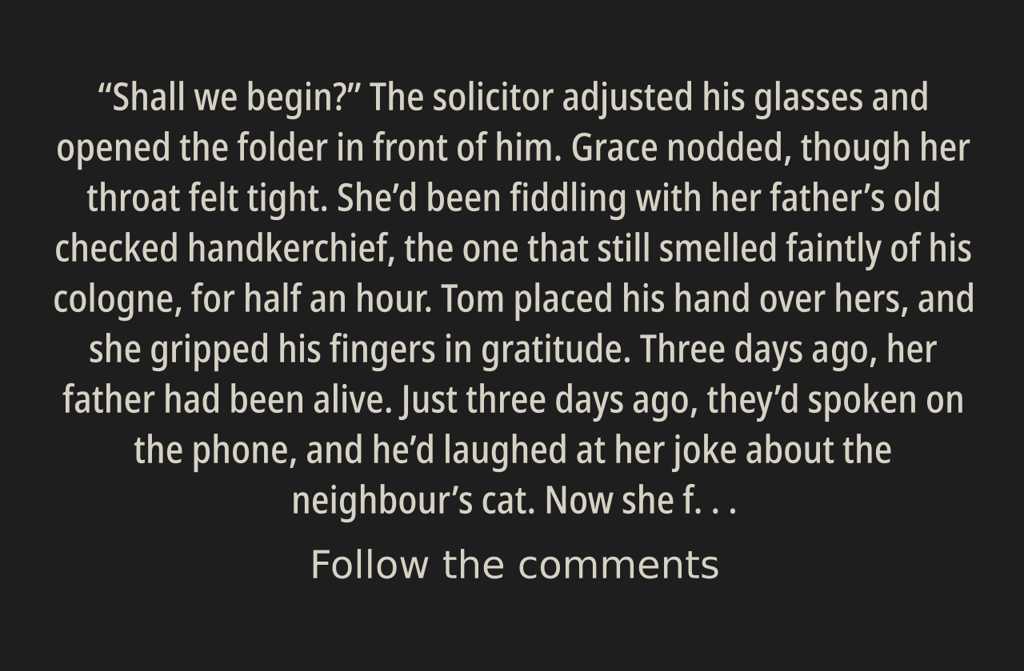
Shall we begin? The solicitor adjusted his glasses and opened the folder in front of him. Grace nodded, though her throat felt tight. Shed been fiddling with her fathers old checked handkerchief, the one that still smelled faintly of his cologne, for half an hour. Tom placed his hand over hers, and she gripped his fingers in gratitude. Three days ago, her father had been alive. Just three days ago, theyd spoken on the phone, and hed laughed at her joke about the neighbours cat.

Now she found herself in this stuffy office, waiting as a stranger read out her fathers final wishes.

Her mother sat straight-backed to her right, composed and unreadable. Not a single tear shed all morning. Next to her, her younger sister, Lily, chewed her fingernail, glancing impatiently at her watch. Clearly, she had somewhere better to be.

I, Edward Chapman, of sound mind…

Grace listened without really hearing. Her father appeared in her minds eye: quiet, thoughtful, always carrying a hint of regret. He knew, of course he knew, that Mum favoured Lily. But hed kept quietyear after year, decade after decade. Sometimes he would simply look at Grace with such sad longing that shed want to hug him and say, Dad, its alright. Im coping.

…the flat at Grosvenor Street, number twelve, flat forty-seven, is to become the property of Lily Chapman.

Grace blinked. She cleared her throat and asked, Sorry, could you repeat that? The solicitor obliged, just as patient, the words echoing in her ears. Prime central London. One hundred and twenty square metres. To Lily.

Grace Chapman is bequeathed the holiday cottage in the Cotswolds with all outbuildings…

The cottage. The ramshackle little house in Chipping Norton they used to visit as children. No heating. Outdoor loo.

Tom straightened abruptly. There must be some mistake.

The document is entirely valid, the solicitor replied with a shrug. The signature is genuine.

Grace looked at her mother. Margaret scrutinised her own rings as if shed never seen them before.

Back at her parents flat, gathering her fathers things, Grace approached her mother.

Mum. Please explain.

Theres nothing to explain, darling, Margaret turned away to the window. It was your fathers decision.

Was it really, or was it yours?

Silence. Then the all-too-familiar sickly-sweet tone: Lily needs it more. Her beauty salon failed, Stephen left her… Shes got nowhere to go. But youve got Tom, and a good job…

I came every week, Mum. I gave you money. Paid for Dads prescriptions. And how often did Lily show her face in the last six months? Twice?

Dont count, Grace, its unseemly.

Tom burst into the room, hearing the last bit. Unseemly? For years Grace has held this family together, and you palm her off with some damp cottage? Is that proper?

Tom, Grace touched his shoulder.

No, Grace. Enough. Well contest the will.

Margaret pursed her lips. You wouldnt dare.

We most certainly would. Well prove you coerced Edward, get the previous will brought up. Well fight this.

They left. Grace kept silent the whole drive home, her head pressed to the cold window. That night, staring at the ceiling, she thought: so this is how betrayal feels. Painful. Unpalatable.

Memory produced childhood snapshots: her tenth birthdayLily got a bicycle, Grace got a book. Grace is clever, she likes books. At the school leaving dance, their mother spent hours helping Lily pick a dress; Grace sorted herself. Youre so independent.

Lily smashed Grandmas vase never mind, she didnt mean it. Grace got a B in maths were disappointed in you.

Always. All her life.

The solicitor reckons we have grounds to contest the will, Tom said, sitting beside her. We can prove your father was under pressure. Even the neighbours knew there were rows.

Grace closed her eyes. To take her mother to court. To air the familys dirty linen in front of perfect strangers.

I dont know, Tom.

Youre just scared.

Yes, scared. Not of losing the case, but of shattering whatever fragile thread was left tying her to this family. But was anything really left to break?

The next day, Grace decided to go to her mothers houseone last try at talking, at finding some resolution. Margaret opened the door with all the enthusiasm of a woman expecting a beggar.

Mum, can we have a calm conversation?

Whats to discuss? Margaret strode to the sitting room without a backward glance. You want to deprive Lily of everything.

Everything? You mean the central London flat we both had a right to?

The front door bangedLily swept in, cheeks flushed and phone in hand. Oh, is it a family summit without me? She left her shoes in the hall and breezed through. Mum, Ive heard it all. Grace causing a scene, again?

Lily, I just want to understand

Whats to understand? Lily collapsed onto the sofa, legs tucked under her. Everything always comes easy for you. Rich husband, decent job. What about me? Who helps me?

Grace froze. Easy? Fifteen years in accounting, long nights spent over spreadsheets, the mortgage she and Tom had finally paid off just last year?

See? Margaret stroked Lilys hair. Shes been through enough. The salon failed, Stephen left her…

Stephen left because she cheated on him, the words tumbled out before Grace could stop them.

Lily sat bolt upright. How would you know? Spying on me?

You bragged about it last New Years. Remember?

Mum! Shes shaming me now, are you hearing this?

Margaret faced her elder daughter. Grace, thats enough.

Something inside Grace broke.

No, Mum. You crossed the line when you decided one daughter mattered more than the other.

Grace grabbed her bag and headed for the door.

I wont contest the will. Keep the flat. Choke on it, if you like. But you wont be seeing me again.

Grace! Dont you dare! After all weve done for you!

What have you done, Mum? Specifically?

Silence.

Tom waited outside. Seeing her face, he just hugged her.

I wont go to court, Grace whispered into his shoulder. But Im not coming back, either. Not ever.

Are you sure?

Absolutely.

Tom nodded after a pause. Lets go to the cottage then, see what youve inherited.

The cottage welcomed her with the scent of damp and neglect. Three small rooms, a porch with a cracked window, a garden choked with weeds. Tom gave a low whistle. Plenty to do…

Well manage.

And they did. Grace hammered in nails with determinationeach blow nailing something new into the foundation of her life. New roof, insulation, plumbing. By the end of summer, the cottage was transformed. Something altogether different and new.

Evenings, she read her dads journal. Grace came again, brought my tablets. Margaret never even asked how I felt. Hurts to watch. Wish Id been braver… And: My eldest is the strongest person I know. Shame she doesnt realise it.

Tears splashed onto the faded pages. Dad had seen her. Dad had known. Dad had loved herquietly, guiltily, but truly loved her.

Four months on, her phone rang. Her mothers number.

Gracie…

Yes?

Lily… she sold the flat. Poured it all into some businessshes been swindled. No money, no home now…

Grace gazed out at her gardenyoung apple trees, neat vegetable beds, the arbour she and Tom had built themselves.

And what do you want from me, Mum?

Help! You cant leave your sister in the lurch!

No.

What do you mean, No?!

It means no. Sort it out yourselves. I told youyou wouldnt see me again.

She hung up, then returned to her flowers. The dahlias were spectacular that yearrich, bright, sun-warmed. At the animal shelter, eight dogs and fourteen cats waited for her shift tomorrow.

Tom brought out two mugs of tea to the porch. That was your mum?

She called. Lilys lost everything.

And?

And nothing.

Her husband smiled and settled beside her. The setting sun gilded the apple trees. Crickets sang in the grass.

The pain hadnt gone, but it no longer ruled Graces life. Ahead, there was so much left to discover: new friends, new passions, new dawns over her very own garden. And no one would ever again tell her she wasnt enough.

Sometimes, closing one door is exactly whats needed to open a better oneone you build with your own hands and heart.


Rate article
Add a comment

;-) :| :x :twisted: :smile: :shock: :sad: :roll: :razz: :oops: :o :mrgreen: :lol: :idea: :grin: :evil: :cry: :cool: :arrow: :???: :?: :!:

Choke on It “Shall we begin?” The solicitor adjusted his glasses and opened the file. Anna nodded, though her throat was tight. For half an hour she had been twisting her father’s old, checkered handkerchief in her fingers, still faintly scented with his cologne. Dmitri placed his hand over hers and Anna squeezed his fingers gratefully. Three days ago, her father was alive. Three days ago they had spoken on the phone, and he’d laughed at her joke about the neighbour’s cat. Now she was sitting in this stuffy little office, waiting as a stranger read out her father’s final will. Her mother sat upright at her right, composed and unblinking—she hadn’t shed a tear all morning. Svetlana, her younger sister, was beside their mother, nibbling a nail and glancing at her watch. Running late for something, apparently. “I, Geoffrey Corfield, being of sound mind…” Anna listened, but the words didn’t register. She pictured her father: gentle, thoughtful, always a little apologetic. He had known, of course he’d known, that their mother loved Svetlana more. But he kept silent—years, decades. Sometimes, though, he’d look at Anna with such sadness she’d wanted to hug him and say, “Dad, it’s alright. I’m alright.” “…the flat at 12 Baker Street, Unit 47, shall pass in its entirety to Svetlana Corfield.” Anna blinked. “I’m sorry?” The solicitor patiently repeated himself. Central London. One-hundred and twenty square metres. To Svetlana. “As for Anna Corfield, I leave the country cottage in Surrey, with all outbuildings…” The cottage? That run-down place they used to visit as children, no heating, outside loo. Dmitri sat up straight. “There must be some mistake.” “The document is in order,” the solicitor replied. “It’s a valid signature.” Anna looked at her mother, who studied her own rings as if seeing them for the first time. Later at their childhood home, packing up her father’s things, Anna turned to her mother. “Mum. Explain this to me.” “There’s nothing to explain, Anna.” Her mother turned to the window. “Your father’s decision.” “His decision? Or was it yours?” Silence. Then, that familiar syrupy voice, at once sweet and poisonous: “Svetlana needs it more, you see. Her salon folded, her boyfriend left her. She’s nowhere to go. You have Dmitri, a good job…” “I came to see you every week,” Anna’s voice shook, but she kept it even. “I gave you money. Paid for Dad’s medicines. How many times did Svetlana visit in the last six months? Twice?” “Don’t keep score, Anna. It’s unseemly.” Hearing this, Dmitri burst in: “Unseemly? Really? Anna’s held this family together for years and you leave her a shack? That’s what you call fair?” “Dmitri—” Anna tried to calm him. “No, Anna. Enough. We’re contesting this will.” Her mother’s lips thinned to a hard line. “You wouldn’t dare.” “We absolutely would. We’ll prove you forced your husband’s hand, find the old will! We’ll fight this!” They left. Anna stared out the car window the whole way home, forehead pressed to the glass. That night, sleepless, she studied the ceiling. Betrayal, she realised, is not so much a knife as a slow, throbbing ache. Childhood memories flashed before her eyes. Tenth birthday: Svetlana got a bicycle, Anna received a book. “Anna’s clever, she prefers books.” Graduation: Mum spent hours with Svetlana choosing a dress, Anna went alone. “You’re independent, Anna.” Svetlana broke Grandma’s vase—“It was an accident, never mind.” Anna got a B in maths—“You’ve let us down.” Always. Her entire life. “The solicitor says we have a case,” Dmitri said, sitting on the bed. “We can prove coercion. Neighbours saw the arguments.” Anna closed her eyes. Sue her own mother. Airing the family’s dirty laundry in front of strangers, the last threads of love pulled apart. “I don’t know, Dima.” “You’re just scared.” Yes, she was. Not of losing. Of utterly destroying what little remained binding her to them. Was there anything left to destroy? Next day Anna found herself at her mother’s door, searching for a way forward. Her mother answered as though Anna was there to beg for money. “Mum, can’t we just talk about this calmly?” “What’s there to talk about?” her mother snapped, striding to the drawing room. “You’d have your sister out on the street.” “On the street? The central London flat we both had a stake in?” The front door banged open. Svetlana stormed in, flushed, phone in hand. “Oh look, a family conference without me!” Kicked her heels off at the door. “Mum, I heard everything. Anna throwing her weight around again?” “Svetlana, I want to understand…” “What’s to understand?” Svetlana sunk into the sofa. “Why do you always get everything so easy? Rich husband, decent job. And me? Who’s helping me?” Easy? Fifteen years in accounting, nights over ledgers, a mortgage paid off only last year? “You see,” their mother stroked Svetlana’s hair, “my poor girl’s suffered enough. Salon gone, boyfriend gone…” “He left because you cheated on him,” Anna said before she could stop herself. “How would you know? Spying on me?” “You bragged about it at New Year’s. Remember?” “Mum! She’s shaming me!” Her mother rounded on Anna. “That’s enough, Anna. You’ve crossed a line.” Something snapped. “No, Mum. You crossed the line—decided one daughter mattered more than the other.” Anna picked up her bag. “I won’t contest the will. Keep your flat—choke on it. But you won’t see me again.” “Anna! You don’t dare! After everything we’ve done for you!” Anna paused at the door. “What have you ever done, Mum? Specifically?” Silence. Dmitri was waiting in the car. Seeing her face, he asked nothing—just took her in his arms. “I’m not suing,” Anna whispered into his jacket, “but I’m not coming back either. Never.” “Are you sure?” he asked. “Absolutely.” He nodded. “Let’s go see this cottage, then. See what you’ve got.” The cottage met them with the smell of damp and dust. Three rooms, a veranda with a broken window, a garden grown wild. Dmitri whistled. “There’s a lot to do…” “We can do it.” And they did. Anna hammered nails with a fury: each blow built something new into her life. New roof, insulation, running water. By summer’s end the cottage was transformed into something different, entirely her own. In the evenings, Anna read her father’s diary. “Anna came by again with medicine. Lena didn’t even ask how I was. Hard to watch. Wish I were braver…” And later: “My eldest is the strongest person I know. Shame she doesn’t realise it.” Tears fell onto the yellowed pages. Her father had seen. He’d known. He’d loved her—silently, apologetically, but loved her all the same. Four months on, the phone rang. Her mother’s number. “Anna…” “Yes?” “Svetlana… she’s sold the flat. Some business venture, an investment… She’s lost everything. No home, no money…” Anna looked out at the garden—young apple trees, tidy beds, a gazebo she and Dmitri built with their own hands. “And what do you want from me, Mum?” “Help! You can’t just abandon your sister when she needs you!” “No.” “What do you mean, ‘no’?!” “I mean no. This is your problem. I told you before—you won’t see me again.” She hung up and went back to her flowers. The dahlias were stunning this year—full, bright, golden in the autumn sun. The animal shelter was expecting her tomorrow: eight dogs and fourteen cats needed walking. Dmitri came onto the porch with two mugs of tea. “They called?” “Yes. Svetlana’s thrown it all away—lost the flat.” “And?” “And nothing.” Her husband smiled and sat beside her. The evening sunlight gilded the apple trees. Somewhere in the grass, crickets sang. The pain didn’t disappear. But it no longer ruled Anna’s life. Ahead were new friends, new hobbies, new sunrises above her own garden. And nobody would ever again tell her she wasn’t good enough.
Ingen trodde att något skulle gå fel.



