Upstairs Neighbour
“Emma, where have you put my saucepan? The big one I use for stews?”
“Mrs Sutton, it was right in the middle of the walkway. I popped it down there, on the bottom shelf.”
“The bottom shelf?! My back can’t cope with that! Do you ever think before moving someone else’s things?”
I stood at the sink peering through the window. Outside, October drizzle ran down the glass. Everything was dull and grey. Inside me, something also started to drizzle. Not quite anger yet. More the sense you get when you realise: this is only the beginning.
***
Mrs Sutton arrived on a Friday evening. My husband, Michael, met her at the lift, lugged up two heavy holdalls and a large tartan shopping bag the sort people call a shopping granny. I smiled, genuinely, because I understood: she was seventy-eight, her flat unexpectedly condemned after the water from upstairs flooded right through, the management company took six months to get off their backsides, and now everything was stripped down to concrete. She had nowhere else to go. Its not an invasion, I told myself. Its temporary.
Id remember the word temporary with particular affection later.
Im fifty-six. Not old, not young. The perfect in-between confident enough to know my worth, flexible enough not to shatter in a gust of wind. I work from home: bespoke embroidery commissions for private collectors and small galleries. Its not a hobby, its my wage, and a decent one. I also run an online course for those keen to learn the finer points of satin stitch and goldwork. My workspace a corner in the bedroom with natural light from a north-facing window, needles, frames, threads, fabrics, printed patterns this isnt just where I work. This is my studio. My livelihood.
Michael and I have a two-bed flat, but its well-designed. We moved in eight years ago, after the children left home, and for the first two years I shed everything unneeded. Calmly, without drama or regret. I gave away, sold, or chucked whatever didnt work for us. Only whats useful and beautiful remained. Pale walls, minimal furniture, no carpets on the walls, no bulging sideboards with crystal, no dried flowers for memories. Three living plants on the windowsills a ficus, a snake plant, and a small pot of rosemary in the kitchen. Every shelf knows what it holds. Every drawer closes easily, never overstuffed.
Michael grumbled at first. Complained he felt like he lived in a hotel. But then he adapted and now gets irritated if anythings out of place. We found our rhythm, our air, our way to co-exist in this space.
And into this air stepped Mrs Sutton.
***
The first two days were tolerable. She sorted out the guest room which wed hastily furnished with a folding sofa and cleared half of the wardrobe for her. I put an extra lamp by the bed, left a glass of water and a book on the table what I hoped felt kind and considerate.
But on the third day I found a lacy, cream-coloured doily on the window ledge in the corridor, just under Mrs Suttons phone as if that ledge had always been hers.
I took the doily away, folded it neatly and left it in her room.
The next morning, it was back on the ledge.
Thats when I realised this wasnt some passive-aggressive war. Mrs Sutton wasnt fighting me. She was simply living as she always had. For her, a crocheted doily under the phone is order, is comfort, is correct. She grew up believing a well-filled house is a prosperous one. A bare sill signified poverty or indifference. Five jars of dried lentils in varying sizes meant thrift, not clutter.
Id grown up with the same beliefs but had very consciously left them behind.
***
By the end of the first week, the kitchen was unrecognisable. Three enamel saucepans cluttered the worktop, too big for any cupboard. Next to them, a bright yellow, plastic tree-shaped lid rack. And in the fridge? A jam of preserves: her own pickled onions (brought from her daughters allotment), a tub of dripping in garlic marinade, a bag of soaking beans, and a Tupperware wrapped in enough cling film to terrify a turtle contents unknown. My yogurts, demoted to the bottom door shelf, crammed in beside a jar of horseradish and a bottle of homemade ginger beer.
I moved my yogurts back. Mrs Sutton moved them away again.
Come evening, the kitchen filled with the aroma of braised cabbage, fried onions, and something else rich, hefty, old-fashioned. Not that this was unpleasant; it just wasnt my smell, not my evening, not my homes air.
Michael would come in, take a sniff and declare:
Oh, Mums been cooking! Smells great, that.
I said nothing.
***
By weeks end, a small synthetic rug with faded roses appeared by the sofa in the lounge the sort you buy at the supermarket for a fiver. Mrs Sutton explained shed always had a rug by her bed: her feet got cold in the mornings. What could I say? That I hated the rug? Even I thought that would sound petty.
So I said nothing.
Soon, her cardigan appeared on the coat rack in the hall. Not in the wardrobe space I cleared for her, but right next to Michaels overcoat. An oversized checked fleecy one beige with blue stripes drooping over Michaels jacket.
I moved it to a free hook by the bathroom door.
She found it and returned it to its place. Thats awkward; I cant reach over there, she commented.
I nodded.
That evening Michael asked:
Are you all right? Youre very quiet.
Its fine, I said.
It wasnt. We both knew it. And neither of us did anything about it.
***
Now, about the bedroom. This wasnt about taste or rugs; it concerned my work, and thus, our income.
My desk stands under the north window custom-built pale birch, shelves for designs, drawers for spools. A daylight lamp clipped above not for show, but for colour precision. Next to it, an organiser tower with neat rows of wool and silk threads, ranked like a rainbow. This isnt decoration. Its my workflow.
On my big embroidery frame was a serious project: for a private collector in London, a replica of a mediaeval church banner in goldwork, with Japanese silk and gilded threads. Deadline: end of November. Deposit already paid. Fee: £360.
Id worked on it for three months.
I never let anyone touch the frame. Explained the fabrics tension mustnt be disturbed or everything unravels. Michael knew. No cat. Kids far away. Everything under control.
Until Mrs Sutton.
***
It was Thursday, about noon. Id popped out to the haberdashers for a specific terracotta-gold shade; impossible to order without seeing in real life. I was out perhaps an hour, plus a quick stop at Boots.
Home again. Into the bedroom. Saw it.
Mrs Sutton stood by my thread tower, sorting my wools and silks, rearranging everything by her logic. On the desk, next to the frame, lay a reel of the Japanese silk, partly unwound, the thread looping and tangled. This was my only reel of rose-gold, not easily replaced. Most worrying: the corner of the taut embroidery cloth had a faint dent, as if someone leant on it a moment.
I stood in the doorway, speechless.
Mrs Sutton turned around, completely at ease.
Emma, it was all such a muddle in here. I thought Id help sorted them all by colour. Looks lovely now, doesnt it?
Mrs Sutton, I said, quietly, please leave the room.
What? I only wanted to help
I understand. Please, just go.
She left, lips pursed in wounded silence.
I shut the door, knelt by the frame and checked the work. Thankfully, the thread wasnt snagged. The crease in the fabric was minor; I eased the drum tight again. The spun silk? I had to cut off a third the snag ruined it. The strands fragile as cobweb; too much tension and it snaps.
Not a catastrophe. But the turning point. I could go on no longer.
***
That evening Michael asked why his mum was so quiet at dinner.
I told him.
He listened, chewing his lip.
She didnt mean to. She was only trying to help.
I know she didnt mean it.
Em, try and bear with her for a bit. Its not easy for her. Shes in someone elses space.
Michael, its my workspace. It pays the bills.
I know. Mum wont be here forever.
Id already been hearing not forever for two weeks. So I asked directly:
How much longer?
Builders say December, apparently.
December so another month and a half. I looked at my husband. He looked at me, a look I knew well. He loved us both and didnt want to choose. Hes one of those men who really believe that, if he smiles and asks everyone to be patient, things sort themselves out.
But this wouldnt sort itself. I realised Id have to.
***
I lay awake that night, mind racing. What were my options? Confront Mrs Sutton directly? Shed take umbrage, burst into tears, tell Michael I was pushing her out. Cause a row? Only make things worse. Ultimatum for Michael? Put him in an impossible position. Suffer in silence? No. That option ended with my ruined silk thread.
So a fourth way careful, quiet, the only sane way forward.
I needed to keep Mrs Sutton busier outside the flat and speed up her flats refurbishment, so shed want to return home herself.
This wasnt a revenge plot. It was survival. Diplomatic, honest, quietly purposeful: I meant no malice. I just needed my home back.
***
First, I tackled her social life.
Mrs Sutton was an active sort. Back in her neighbourhood, she went to the library, sometimes to church, helped out at her daughters allotment in summer. Here, she was bored and bored older people become hyperactive in the only space available: our flat.
I called my friend Julia at the local community centre. Whats there for the elderly?
Loads! she said. Walking club in the mornings, choir on Wednesdays and Fridays, craft classes, health talks every Tuesday. All free just need proof of address and NHS number.
How do you sign up?
Just turn up!
I didnt tell Mrs Sutton, here are some activities, off you go! That would seem pushy, obvious. I sowed the seed differently.
At dinner, I casually mentioned, Mrs Sutton, Michael says you sang when you were young?
She perked up did, in fact, sing, and had a decent voice.
I heard the choir round the corner is run by a lovely conductor, supposed to be very good for adults. A friend said its free, friendly, the choirmaster is great. Maybe youd like it? Would be nice to meet people while youre here.
She waved it off Oh, itd feel odd, going to something like that alone.
I didnt push. Just left the idea floating.
Three days later, I brought it up again mentioned the choir sings at local fêtes, gets in the parish newsletter. At the word newsletter, she brightened. I could see something click.
Next week, she asked me for directions to the community centre.
I drew her a proper map from the tube, nice and clear.
Wednesday, she left at ten and got back at three, glowing.
Such a lovely group of ladies, she said over tea. And the choirmaster, Josh, hes young but ever so patient. They sing old songs and folk tunes. I sang a bit, he told me to come back youve a fine mezzo! he said.
Really? I replied, honestly glad.
Now, every Wednesday and Friday, shed go out for hours. And then Nordic Walking on Tuesdays, at the suggestion of her new friend, Mavis, from choir, who lived one block over and was a real gem.
Suddenly, home was quieter. Not empty, but easier.
***
Phase two required more work and a little cunning.
I phoned Mrs Suttons daughter, Helen. We had a cordial relationship; nothing more. I was upfront:
Helen, were happy to have your mum, but you know shes better off back in her own place. She needs her neighbours, her routine. Living in limbo is hard for her.
Helen explained the builders were slow, constantly moving deadlines.
I asked, Are you handling it directly?
No her husbands mate was looking after it and occasionally phoned the crew. So basically, no one really in charge.
I can help, I offered. I know some people in the trade they can have a look, tell you honestly whats doable and whats just them stalling.
Helen agreed. She was sick of it all, too.
I did have connections: our downstairs neighbour, Mr Porter, was a retired foreman and still gave advice locally. I explained the situation over a coffee in his kitchen.
So, new floor, paint the walls, refit the loo? he repeated. Three weeks with the right lads, not three months.
He visited, spoke to the company. As usual, they worked several jobs at once, appeared at Mrs Suttons when it suited them, and half the cash was already paid, so they werent in a rush.
Mr Porter had a blunt chat with the boss. Three weeks, every day, or else. And threatened pop-ins for spot checks.
Helen followed up with a stern email. The builders, realising the game was up, suddenly made progress.
I didnt tell Michael not hiding anything, just sparing him the drama. This was my doing now.
***
Three weeks passed some good, some strained.
There were lovely evenings when Mrs Sutton came home from choir, cheeks flushed, telling stories about Mavis, about tea after practice, about Joshs praise. She was light, cheerful, and over supper, wed share stories, the three of us, and it felt genuinely warm.
There were also bad days.
One morning, I found my precious ficus banished from the kitchen windowsill to the floor in the corner. In its place, Mrs Suttons geranium, smuggled in her shopping bag, blooming pink and proud. Her reasoning: The ficus blocked the light, geraniums need the sill.
By evening my ficus was already curling its leaves in protest.
I carefully returned the ficus to its place, shifted the geranium onto a table in her room. As we crossed paths, she met my gaze.
You might at least have asked, she huffed.
And you, I replied.
That was the only time we clashed properly no rows, no tears, just a moment of clarity, each seeing the other, plainly, for the first time.
She retreated to her room. I headed for the kitchen. We both calmed down. At dinner, we discussed other matters.
Michael noticed, said nothing. Sometimes I found his silence more annoying than any geranium invasion. He preferred to ignore the cracks running down our dinner table. Men often do; if you dont look at the fracture, maybe itll heal itself.
It doesnt. Ever.
***
One evening, with Mrs Sutton in bed early, I worked at my desk under the lamp, needle running smooth. Michael entered, hovered behind, then perched on the bed.
Youre cross with me, he said. Not as a question.
A bit, I admitted. Not with you. With all this.
I know its difficult for you.
You do, I agreed, not pausing. But knowing and sharing the burden are two different things.
He was quiet.
What do you want me to do?
Nothing, Mike. Im handling it.
He didnt ask what. Maybe he didnt want to know. Maybe he was scared hed have to pick sides. He read for a while and fell asleep. I worked another hour, listening to the clock and Mrs Suttons quiet breaths through the wall. She wasnt here out of spite just with habits that collided with mine.
I realised then: the most damaging thing in family conflict isnt anger at least angers honest. No, its when everyones decent, good-hearted, everyone loves each other, but its still intolerable. Because theres no-one to blame, no obvious target for your rage.
***
The builders finished early even beating Mr Porters estimate.
Helen called me, not Michael, on Saturday. Dads mate finished up last night, everythings ready just needs an airing and a wipe down.
I thanked her. We chatted, and I felt something shift as if she saw me, not just as Michaels wife, but someone who gets things done.
Now I needed to tell Mrs Sutton in a way that didnt feel like eviction.
I thought about it all Saturday.
At dinner, the three of us at the table while Mrs Sutton described an upcoming choir concert for Christmas, I smiled and said:
Mrs Sutton, I have something to tell you but dont worry, its good news.
She stopped, looked at me.
I arranged a little surprise an old foreman friend of ours went to help at your flat, talked to the builders. Helen says its all finished now. You can go home whenever youre ready.
She looked at me, then at Michael, then back.
You did all this yourself?
Well, not quite. Mr Porter helped. I just didnt want you feeling uncomfortable with us any longer than you had to. I know youll feel better in your own place its yours, after all.
Michael stared at me as if seeing me for the first time.
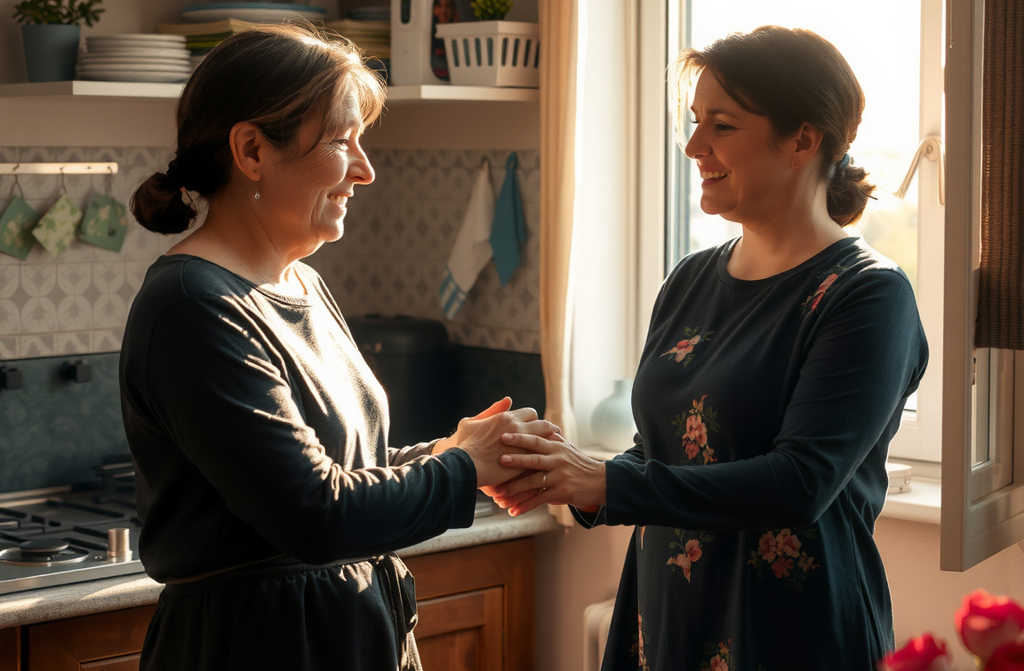
Mrs Sutton fell silent, then strode over and took my hand in both of hers dry, warm, weighty from years of living.
Emma, she said, youre a good one.
I didnt know what to say just squeezed her hand in return.
***
She left on Sunday. Michael drove her over, helped settle her in. I stayed behind to sort dinner really, I just wanted the flat to myself again.
For half an hour after they left, I wandered the rooms. Touched the walls, stood by my desk under the north window, gazed at the frame.
Then I rolled up the rose-patterned rug left behind in the guest room, now orphaned. Picked the last doily off the windowsill one shed probably forgotten. Opened wide the window, let Octobers air fill the room.
In the fridge, a neatly wrapped Tupperware sat on the second shelf her parting gift. I opened it. Inside: our favourite thick stew, sour and meaty, Michaels beloved version Mrs Sutton always made her own way. Enough food for two days.
I closed the fridge and leant against it.
People are odd things. You can make each others lives hell for three weeks and still leave a homemade stew as a parting gift.
***
Michael came back that evening. We ate quietly, calmly. He did the washing up; I dried. Business as usual.
As we turned in, he stared at the ceiling and said:
So youve been up to something all this time. The building work.
I have.
Why didnt you tell me?
I paused.
You kept asking me to be patient. I wasnt patient I acted. I thought if you got involved, youd feel guilty towards your mum. I wanted to spare you that.
He was silent for a while.
That was smart, he said at last. And a bit hurtful.
I get that. Sorry.
We lay side by side in the dark, and I thought: this isnt the perfect story. None of us said everything we felt. Nobody had the grand, honest conversation you read about in self-help books. Everything was arranged quietly, sidestepping confrontation, through effort barely visible.
Good or bad? Im still not sure.
***
Mrs Sutton called a week later. She sounded happy. Told me the flat was now bright, fresh, beige walls as shed wished. She unpacked her favourite teacups, set them in their place. Visited her neighbour, Doris, whod been lonely and poorly for weeks and was glad to see her.
Ill keep up choir, you know, she said. Josh says he wants our group for the borough concert in February. Mavis and I will go together.
Thats wonderful, I replied.
She paused.
Emma, she said, slower now, I know I must have been a bother, living with you.
I didnt say, of course not, it was fine. That would have been a lie; shed have known.
Were just different, Mrs Sutton, I said. Thats normal. The important thing is youre well now.
She was silent.
Yes, she agreed. Thats the important thing.
***
Sometimes I think about those seven weeks. Not often, but it crosses my mind.
The rose-patterned rug. The saucepans on the counter. The geranium on my windowsill. The leftover stew in our fridge. The way Mrs Suttons hands felt in mine dry, warm. The way Michael said, a bit hurtful, and it was the most honest thing hed said in weeks.
I didnt win a war. There wasnt one. There was a problem I solved. I got my home back without shouting, without humiliating anyone.
It wasnt heroism. Sometimes, you just have to hold the shape of your own life, when someone else, without malice simply from habit tries to push it out of shape.
Protecting boundaries isnt about building walls or making a scene. Sometimes, its just quietly knowing what you want, and gently, insistently, inching toward it.
And family? Its a strange thing. Survives in the oddest situations. Breathes through the cracks. And sometimes, after it leaves, it puts stew in your fridge.
***
That November, I handed the goldwork commission to the collector. He wrote that he was delighted and transferred the final payment. I bought myself a new skein of Japanese silk, gold as an autumn leaf, and placed it in my drawer. In its own place.
The windowsill holds three pots: ficus, snake plant, rosemary. No doilies.
The flat is quiet. Smells of coffee and a little scented wax from the candle I light in the evenings. Michael reads in his chair. Its nearly winter outside.
Everything is in its place.
***
A month later, we visited Mrs Sutton. I brought her a box of fruit jellies from that bakery shed mentioned visiting with Mavis. She opened the door and immediately showed us the renovations. The rooms were as shed wished: light, beige walls. And yes, there were crocheted doilies on every window ledge. The same old rose-patterned rug lay by her sofa.
I took it all in and felt nothing. No irritation, no condescension. Just a simple acceptance: this was her home.
Over tea, she said to us:
You two must come in February to the concert. Well be singing Hope by Alexandra Armstrong. I want you there to hear.
Michael said, Of course, Mum. Wouldnt miss it.
And I said, Of course.We finished the tea and said our goodbyes. Outside on the step, winter dusk settling soft and blue, Michael squeezed my gloved hand. You did well, he said, and for once, I believed itnot because he said it, but because it rang with something that felt true.
Walking home, the streetlights flickered on, golden in the dusk. Windows glowed above with their own little worldssome neat, some messy, some crowded with knitted throws and plastic plants. Through one, a radio crooned. Through another, laughter shimmered against the glass.
It struck me: every home, an island of order or chaos or compromiseeach shaped by its people and their stubborn, hopeful ways. You share space, and then you reclaim it, and then you visit each others islands across the little sea between.
At the crossing, I looked up and caught my own reflection in a shop window: a woman carrying nothing in her arms, not even a bag, as if the weight was gone. Behind me, Michael smiling, the world moving on.
Change doesnt always come with storms or slammed doors. Sometimes, it arrives quietly, bowls of stew left behind, songs learned in borrowed halls, a new skein of silk resting in a tidy drawer. Sometimes, you come out of it quieter than before, but stronger at the core.
As we climbed our stairs, I smiled at the echo of musicimagined nowfrom Mrs Suttons flat, and felt, finally, that I was home.






