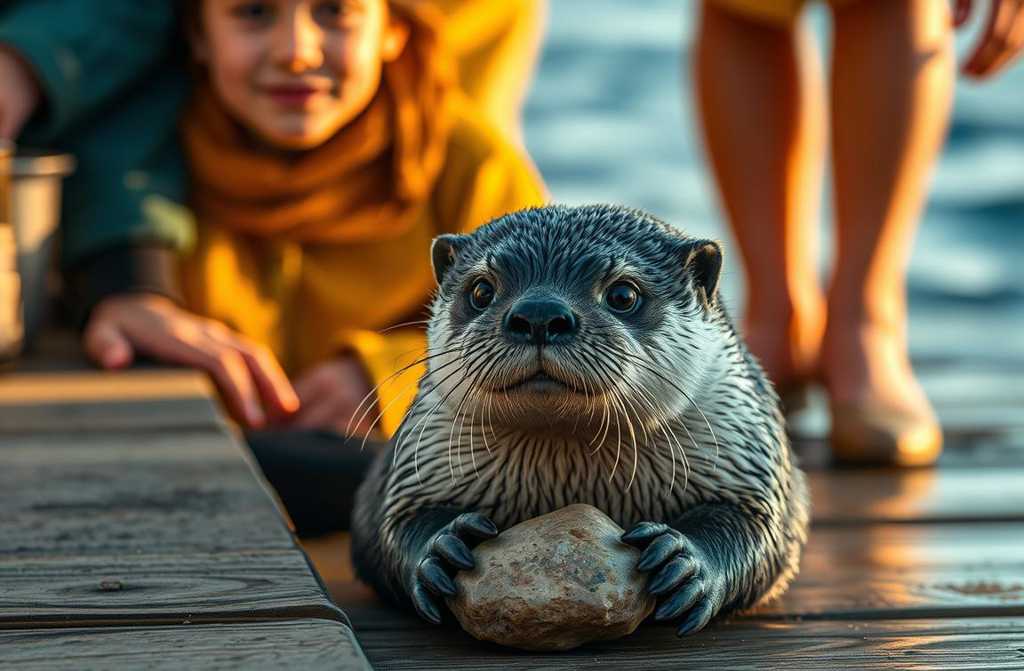
A sleek otter with knowing eyes emerged from the water, pleading for help, and in gratitude left behind a treasure.
It happened last August. A warm, briny breeze off the sea brushed the faces of the fishermen as the sun, still untired of summer, danced in glimmers upon the waves. The harbour in the cove was unremarkableworn planks, creaking ropes, the scent of seaweed and salt. Here, each day began and ended in the same weary rhythm: mending nets, hauling the days catch, murmurs about the weather and luck. Nothing hinted at the extraordinary.
Yet magic came from the deep.
First, they heard the splashsomething swift and sodden slithered from the water and bounded onto the dock. Heads turned. There stood an otter. A male. Dripping, trembling, eyes wide with terror and desperation. It did not flee, nor hide, as wild creatures do. No. It darted between the men, pawed at a boot, whined like a lost child, then dashed back to the waters edge.
What in blazes? muttered a sailor, setting down a coil of rope.
Leave it be, itll go.
But it did not go. It pleaded.
An old man named Edmund, his face etched by years of wind and sun, suddenly understood. He was no biologist, had read no scholarly papers. Yet in his eyes flickered something primalan instinct whispering of days when man and beast still spoke the same tongue.
Wait he murmured. It wants us to follow.
He stepped toward the edge. The otter bolted forward, glancing backchecking.
Then Edmund saw.
Below, tangled in a snare of old nets and shredded rope, thrashed another otter. A female. Her paws were trapped, her tail flailing helplessly. Each struggle only tightened the bindings. She gasped, eyes brimming with terror. Beside her, bobbing on the surface, clung a pupa tiny ball of fur pressed close, uncomprehending but sensing death.
The male otter, the one who had come for aid, sat motionless on the dock. Silent. Watching. In that gaze lay more humanity than in most men.
Quick! Edmund bellowed. Here! Shes caught!
The sailors surged forward. Some leapt into boats; others slashed the nets. All unfolded in a breathless hush, broken only by the otters ragged gasps and the slap of waves.
Minutes stretched like hours.
When they finally freed her, she was near gonelimbs trembling, breath shallow. But her pup nuzzled close, and she weakly licked its head.
Toss them in! someone shouted. Now!
Gently, they lowered them into the sea. In an instantmother and pup vanished beneath the waves. The male, still as stone, plunged after.
A hush fell. No one spoke. They only breathed, as if emerging from battle.
Then, minutes later, the water stirred again.
He returned.
Alone.
Surfacing by the dock, he regarded the men. Then, slowly, laboriously, he drew from beneath his forepaw a stone. Smooth, grey, worn by timea cherished thing. He laid it upon the wood. The very planks where he had begged for mercy.
And vanished.
Silence.
Not a soul stirred. Even the wind held its breath.
He left us his stone? whispered a young lad, barely more than a boy.
Edmund knelt. Lifted it. Cold. Heavynot in weight, but meaning.
Aye, he said, voice unsteady. He gave us all he had. To an otter, this stone is like a heart. Their tool, their weapon, their plaything, their memory. They carry it all their lives. Each finds oneand never lets go. They crack shells with it but they love it. Sleep with it. Pass it to their young. Its family. Its life.
And he gave it to us.
Tears traced Edmunds cheeks. No one mocked them.
For in that moment, all understood: this was gratitude. Not barks, not tail wags. Not gestures or sounds. He had given his most precious possession. Like a man parting with his last coin to save a stranger.
Someone filmed it. Twenty seconds. Twenty seconds that shattered a million hearts.
The clip spread like wildfire. People wept:
Cried like a babe.
Never thought beasts could feel like this.
And here I was cross over a neighbours noise while an otter gave all for love.
Scientists later said otters were among the most emotional creatures. That they weep for lost young. That they sleep paw-in-paw to stay united. That they play not for food, but joy. That they have souls.
But in this actthis stone upon weathered woodlay more than soul.
It was gratitude. Pure. Selfless. Rare even among men.
Edmund keeps the stone still. On a shelf, beside his late wifes photograph. Sometimes, in quiet hours, he gazes at it and wonders:
Might we learn a thing or two from beasts?
For in a world where all think only of themselves, where kindness hides like a shadowone small otter showed that love trumps instinct.
That the heart isnt in the chest. Its in the deed.
And the stone?
The stone is memory.
Proof that even in the wild, beneath the waves, there lives more than survival.
There lives a heart.
If youve a momentshare this tale. Perhaps someone, reading it, will pause. See a stray dog not as a nuisance, but a friend. Hear not noise in a birds song, but music. See in beasts not vermin, but kin.
And maybe, one day, we too shall leave upon the shore not rubbish but something truly precious.
A stone.
A heart.
A love.