The Forsaken
Oi! Look there! There’s… there, a child! A kid. Oi! Tom called out for the driver, waving his hand, unable to tear his eyes from what he’d seen.
I recall how Tom sat on the cracked, wooden floor of the engine room, legs dangling over the iron steps, his gaze fixed on the thick pine woods flashing past and the neat, golden squares of harvested fields. The wind, chilled and pure, billowed through his trousers, cooling his soot-streaked cheeks after the heat of the firebox. In those moments, Tom would say, he felt as if he were flying strong, free, and untouchable.
Tom the stoker adored his old shunting locomotive. On the line to Amberley, you could take things slow, even catch your breath.
At Amberley, throw another shovelful in, but just sit for now, old Bert, the driver, liked it when Tom reclined there with an air of contemplation, even if his face was black with soot.
Tom held a respect for Bert, but Berts cocky mate, Jack, Tom simply could not abide a self-important, sneering sort.
Shall we have a bite, then? Jack grunted, rummaging about in his old canvas satchel. He pulled out a sandwich wrapped in the mornings newspaper.
Bert unwrapped his own as well. Tom, however, had overslept and dashed out in a hurry forgetting his food entirely.
Come on then, have some, Jack called, but Tom shook his head. There were still three hours left in the shift. He could waithed made cabbage stew the day before, and perhaps, when he was done, he might call round to Emily, his neighbour.
But the thought of her unsettled him. There was something heavy and wrong in his dealings with Emily, something that left Tom feeling low and unworthy.
Even now, as sunlight poured through the silver birches, the memory of Emily brought a certain heaviness to his heart.
And then
Oi! Look! Theres a kid! A youngun. Oi! Tom called to Bert again, frantic, waving, unable to look away from what hed seen.
A child sat on the ground, back to a pine tree, bare feet stretched forward, head bowed. But Tom was certain he saw the boys head turn as the engine passed. Alive, watching.
Where? What you on about? Jack craned to see out the window, but by then the bushes had swallowed the child from sight.
Tom dashed to Bert, pulling the whistle.
Weve got to report it! To the station, quick!
Whats got into you?
Theres a child all alone, back there.
What makes you so sure? Could be pickers its mushroom season. Lots about.
Didnt look that way. He was by himself.
Might be his mum nearby, or nan, Bert mused.
Doesnt add up, Tom insisted.
Oh, will you stop with your doesnt add up, Jack grumbled. People wander all over round here. Blowing the whistle for nothing.
Tom said nothing. He wanted to spit back something sharp at Jack, but words failed, which left him even more annoyed. He couldnt explain, not even to himself, how he knew the boy was in trouble. Maybe it was the way the child sat, or perhaps Toms young eyes saw in the boys stare a silent appeal
Bert, at Amberley, lets ask if anyones missing a child. Maybe hes lost. Im telling you he watched our train go by, almost hopeful. I saw it.
Well ask, then. No harm. Weve got time before we fill up with water, Bert agreed.
With a heavy sigh, Tom yanked the firebox open and started tossing coal inside with a hidden sense of hurt fuelled by the memory of that child.
That childhe reminded Tom of himself, years ago
***
Tom – my! Tommy! You little brute! Why havent you fed the hens? Devil! Destroyer!
When Tom was six, hunger drove him to drink raw eggs, steal rowan berries, sleep out in the cold shed when hed been banished. He was often punished at home, left to fend for himself. Once, his mother set him on the doorstep in the freezing cold with barely a stitch on. He remembered how hed wept, tearing up frozen straw from the barn floor trying to cover himself, before dashing barefoot through the snow to the neighbours cottage. He knew his mother would kill him after that, yet he went.
But she didnt. He stayed with the neighbours two days. After that, he was sent to the hospital, and from there to the orphanage. The neighbour would recall how he found a stale old biscuit under their table, gripped it in his teeth, and wouldnt let go.
Oddly, Toms mother would come to visit at the childrens home, pleading and weeping for her boy to return. Will you go back? theyd ask Tom. Hed shake his head, eyes down, shrinking away from his mother. She wasnt a drunk, justsomething inside her, a churning, foolish anger.
So began Toms orphanage years. It was no easy life. He grew reserved, took to hiding in cupboards so the older boys wouldnt beat him he was freckle-faced, and that was enough to make him a target.
As he grew, he learned to stand up for himself, his fists always scraped and bruised. Still, whatever happened, he always seemed to be the one in the wrong.
One line he could never crosshe would never strike a woman. Though they could strike him, like Miss Harris, one of the carers; shed kick him for telling tales, and send him on errands into her office. Once, Tom spilled the beans in the corridor about her, out of fear of the stern headmaster, and she thrashed him terribly after. He knew he could have hit back sent her flying but she was a woman. He spat blood and sobbed in the lavatory instead.
Those years left their mark.
When Tom, after the home, was sent to the railway, he lived in a hostel, a ten-man room. But for all the crowding, he at last breathed the air of freedom.
After his national service, he got transferred to Eastbourne as a stoker. They gave him a railway cottagehis own place at last! Tom could have been happy forever.
His two-room cottage stood by a tiny crossing with just a green-painted school, a little nursery in a converted house, and twenty houses roofed in slate. So what if his house was draughty, sand sifted in through the window cracks and the rats gnawed the floors? None of that troubled him. He simply had not known better.
The only one to fuss or teach him was his neighbour, Emily, divorced, raising her eight-year-old boy alone.
Oh, you soft old thing! shed scold gently. You need to ask for some clay or cement from the station, or youll freezehonestly, what did they teach you in that orphanage?
She took him in, out of sympathy, maybe from longing for affection.
So, now well have to marry, yeah? Tom stammered after their first night together.
Emily burst into laughter. Well! Marry?! Searched everywhere and found you, did I? Marry oh, thats rich!
Tom got dressed, grinning so as not to look too foolish, realising it wasnt requiredand felt oddly relieved. He didnt much fancy marrying.
No, Tom, not for me. Ive one child as it is dont need a second! But stop here this February, else youll freeze, Emily said, Lord, what were you taught at that home of yours!
Their affair waxed and waned with Emilys humour, but for Tom, it was already becoming a burden.
***
Soon their engine crested the hill and the little station of Amberley lay below, nestled among fields.
Going to ask, Bert? Tom leaned over the handrail.
Ill see.
The driver and Jack headed for the dispatchers office. Tom fetched his battered tin teapot, soap, and leapt down to wash at the water tower. No need for him to go inside; Bert would ask about the child.
Tom prized off his shirt, scrubbed up, and rinsed cool water over his aching arms, letting suds run between his toes. Still wet, he climbed back up to the cab.
Bert and Jack returned in haste.
Well? Any news?
Whats that?
About the child
Oh, Tom! Not now, lad. Stations in a state were to move the freight, sharpish Get the fire roaring!
Tom flicked the stoker on, and the furnace crackled to life.
The lines clear! Jack bellowed.
Were not coming back then? Tom called above the racket, concerned.
No… Heading straight home. Dont fancy your bed tonight? Jack jeered.
Tom glared but stayed silent. How could men like Jack ever understand someone like him or like that poor, pale child?
As the train shifted lines, Tom sidled up to Bert. Ought I slip to the station, just ask proper about the child? Ill be quickone foot here, one there…
You fool, if youre late, thats it we cant hold, the yards on a tight schedule!
Ill be quick as a fox, honest
No
Yet as the delay stretched on, seeing Tom biting his lip, Bert relented. Fine, but dash! If youre late, were off without you!
Tom went flying, hurtling between the tracks to the dispatchers hut. He burst in, breathless.
Afternoon! Im from the shunter Theres a child, out in the woods. Anyone reported missing? Is someone looking?
A young woman and an elderly stationmaster exchanged glances. No, they heard nothing amiss no lost children. Tom described where hed seen the child, in case someone came asking, and dashed back. He made it.
They shunted the wagons and the engine rolled homewards.
Drop me off at the hundred and thirty-sixth,” he murmured to Bert, as Jack stepped out onto the platform for a smoke.
You mad? Youve finished your shift and want more? Howll you get back?
Ill flag a lift, easy as you like.
Youre daft Seen something and now youre making it up Bert muttered.
I know what I saw. The boy wasnt alright. I cant sleep for worrying. Pull up, Bert.
Lord, Tom, you are a fool! Here have a sandwich at least; else I wont allow it.
Jack cursed their names when he found out.
The locomotive slowed to a crawl, Tom hopped down with his canvas bag, the greasy wheels looming over him as the engine clouded him in steam and rumbled away.
As silence returned, birds began to sing, crickets chirped, and it was as if the old iron monster had never passed.
Tom made his way along the edge of the woods, recalling precisely where hed seen the child. The area was familiar.
He skirted bracken, clambered over a rise, briskly leaping logs and roots. The pine, the gully, he recognised. No sign of the child.
He called out, walked the clearing, but only wind replied. Where the child had been, pine needles were flattened and a little hollow dug in the earth.
Tom sat to catch his breath. Maybe Jack had been right. Just mushroom pickers with a child. Tom was conjuring trouble that didnt exist. Now hed have to cut through the woods to Ashcombe, the nearest hamlet, then track to the main road and hitch a lift.
Hed never walked these woods alone, only glimpsed such villages on the map.
Following the gulleys edge was easiestthe stream would guide him to Ashcombe, he thought.
Summer was cooling; though tired and hungry, he felt peace amid the green and dappled shade, glad to be out walking.
He remembered Berts advice he should train as an assistant driver. Steams done for. Soon, stokers won’t be needed all electric.
But Tom dreaded learning. The very word study put his teeth on edge. Orphanage life had never encouraged it. Physics, he managed the mistress said he had a knack. The English teacher despised his awkwardness.
As the maths mistress shrieked about all of them, urging them into technical college, she spent the other half of the lesson with her back turned, rambling through problems to herself as the boys messed about.
Without roots, its hard to find your path. Tom felt at home only when shovelling coal his strength powering the train. Anything else, he floundered. Making plans never came naturally; he often went hungry, forgetting to shop, not for want of money, but lack of thought.
My hopeless dear, Emily teased in her softer moments, when Im gone to the village, what will you do?
How would he live? Tom often wondered, never quite finding an answer. His job that was his lifes meaning.
…
Tom might have walked on if he hadnt noticed the rushes stirring. Someone crouched there, and stood. Tom doubled back and saw it was the child.
A girl. Her scarf askew on her shoulders, hair matted, grey cardigan slid to one side, tights drooping, barefoot and muddied. She seemed to have bent for water, wiping her lips with her sleeve, staring fearfully at Tom.
There you are! Ive been looking for you, Tom said, touching his chest.
She didnt move. The reeds hid her slight form.
Come now, lass. Are you lost? he asked.
She lowered her head, saying nothing. Tom waded toward her, but she shied away, pushing through the reeds along the brook.
Its alright, lass; don’t be scared. Ill walk you home. Wait up now!
He caught up, grabbed her hand. She stiffened, frowning. Her feet were sodden shed no doubt been walking in the stream.
Youll catch your death. Up you come, he said gruffly.
He lifted her onto the bank, sat her on his lap firmly he knew how to handle little ones. The orphanage boys had all looked after the tiny ones at one time.
Barefoot in the woods, whatever next? Youll catch a chill, and all, he chided, whipping off her wet tights, taking her cold feet in his hands as Bert would.
Look at the state of you ice for toes! Well fix that, dont fret!
He held her close, afraid shed run, and tugged off his boots, stripping off his socks to pull over her little feet. The long socks warmed her to the knees, falling down but snug.
Were not going far, are we, pretty miss? he muttered, half-amused.
From the moment hed found her, a sense of purpose had flooded Tom not fear, but a deep contentment at the weight of responsibility.
He needed a moment to think, so he fetched out his packet, unwrapped his sandwich, and handed it to the girl. But thinking was hard, watching her.
The bread fell to pieces in her tight fists. She ate fixedly, staring only at the bread. When a crumb dropped, she snatched it up, popping it in her mouth with a scrap of grass.
No rush now… slow, easy… Tom urged softly.
He remembered then what the neighbour had said about the dry biscuit he’d found as a child. Heaven help anyone who tried to take bread from this hungry, haunted girl, he thought. He cupped his soot-darkened palm for her crumbs.
Dont hurry.
She wasnt sated, looked up, eyes wide, expectant.
No more; thats enough for now. You mustnt. Trust me, I know.
He knew remembered two boys whod absconded from the home, wandering a month until found. The kitchen workers, overjoyed, fed them until they nearly died: one needed an operation. When they came back, they were only skin and bone.
Tom took his pocketknife, cut the strap from his satchel, and tied her socks up to keep them from slipping.
Ill carry you a bit, then you’ll walk,” he said.
He hoisted her, but slogging through the forest with a child was hard going. She soon walked a ways herself, silent as before, answering no questions, not even with a nod. Tom wondered if she was mute.
Come on, hop on my back, piggyback! he invited, kneeling by a fallen log.
She climbed up promptly, her arms locking around his neck. It was almost fun, though they soon needed a break Ashcombe couldn’t be far.
By the stream, Tom cupped handfuls of icy water to drink, feeling his hunger but even more his thirst.
Would she bolt, he wondered? A branch snapped she was there beside him.
Mind the water, or you’ll soak your feet again, he said sternly, then flicked a splash at her face, joking.
She squealed and scampered up the bank, stopping halfway, glancing back with the ghost of a smile shed caught his joke at last.
Hed overshot Ashcombe; instead, they came out onto fields, one side a small cluster of cottages, the other the main road. It made sense to head for cover the village.
At the first gate, a dog barked, and a pleasant woman in a dirty apron came to the door, the grunts and snuffling of pigs behind her.
Tom explained quickly.
Youre sure youre not up to mischief? the woman challenged, kindly enough.
No, miss, Im railway staff from the shunter; we pass here often enough.
Goodness, youve come a fair way. Come in. Whys she no shoes?
Her name was Mary. She, like Tom, watched as the girl ate, carefully scooping up the last shreds of noodle with heavy breaths and licking her fingers.
Bless me… Sit with her, Ill ask about maybe someone knows where this child belongs. Up on the settle, there. Look fallen asleep!
The girls fingers still in her mouth, nodding over the bowl, Mary picked her up and set her by the stove, Tom drifting to sleep, too, against the warmth.
The slam of the door woke him. Mary was back with an old lady, walking stick tapping.
They greeted quietly. The old woman peered intently at the child.
Yes, shes one of ours. I could be wrong, but, just look at her eyes…
One of whose? Tom asked.
Theres a derelict little place not far, St. Annes, its called. Or was. Theres barely three homes left; all ruins, no water, no power, just a stream. The girls mum left long ago and only came back to drop her with the old gran. She’s hers, if were not mistaken, Mary explained. The grans well gone in the head, poor dear. No one else there at all.
Is it far? The day was growing late; Tom was anxious.
Itll be dark soon. Ill ask my neighbour Peter hell take you on his bike. Hell run you to the main road after, or wherever you need.
Peter was swift nearly Toms age and good-natured. Arrangements made, Tom returned for the girl.
Old Mrs. Agatha stroked the childs hair; she didnt stir.
Ill carry her. She may not wake
Carefully, Tom lifted her, limp and warm.
Youre the forsaken, both of you… Agatha whispered behind him.
Sorry?
Forsaken…
Whats that to mean? It was a word Tom half-knew, but now, in the dusk, it unsettled him.
Nothing to your names. Just sorrow, both, the old woman replied.
Outside, the bike with its sidecar waited. The little girl stirred only to blink before sleep claimed her again.
Evenings light faded as Tom peered over Peters shoulder, loving the rush of wind. Giant pines sped past wise, ancient, and kindly.
And Tom thought, what joy there is in the wild wind, flying with purpose, a goal clear ahead. He was glad hed leapt from the train glad hed acted, whatever the cost. Let Jack spend his night snug at home; here, Tom felt a victor.
He glanced at the girl her wild knotted hair, pale and lonely. Warmth for her welled up inside him; he wanted to shield her from hardship, keep from her all he had suffered and all she might yet bear.
There they are, Peter called.
Where?
On the hill, among tangles of wild cherry and blackthorn, the houses were barely visible. The last, rough mile took them down a rutted path, over a rotting bridge, to St. Annes or what was left.
A crooked man came out to meet them.
Well now wheres she been? he muttered, seeing the girl. Grans been crying calling and calling.
Evening! Yours, is she? Peter asked sharply.
Shes ours, yes. Grans crying, I told you. We looked for her. Got a basket of ceps, mind, but no child.
Is Liza her granny? Tom tried.
Nah, Liza lives here younguns, you know… Gran Shushes in that house, but not what she was, not any more.
The old mans rambling answers offered little sense, but after a word with Peter, they led the bike up, climbed off.
Were home, little foundling. Come home to your gran.
Tom gently woke the girl.
The door fought them, warped by damp. A musty reek hit them. The floor, trodden earth…
Do they even survive the winter in here? Peter marvelled. Tom only shrugged.
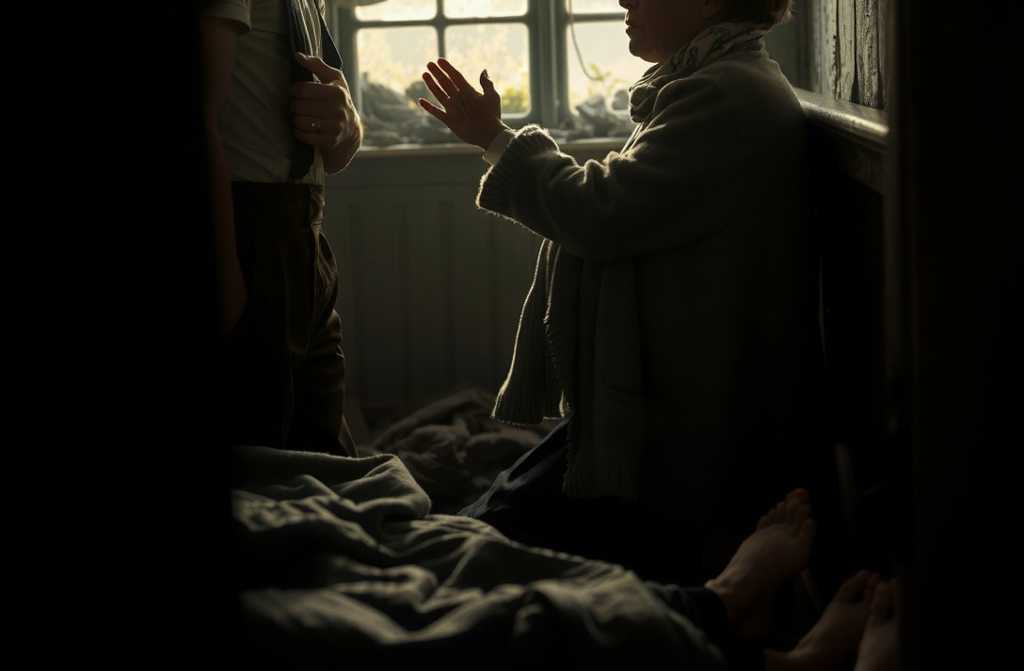
A shriek rang from a shadowed bed. The child clung to Peter, closest to her.
Behind the stove, bundled in patched coats and scarf, an old woman lay on a pile of faded bedding strewn with rags.
She lifted her arm to the girl and wailed again.
Hush, gran, hush Peter soothed her. Your girls come home. See? Shes here.
The child crept up, climbed quietly onto the bed, curling close, while the old womans rigid arm settled tenderly over her, and she closed her eyes.
The sun sank; their mission was done. The lost child was home.
It was time to leave.





