The Yard Table
When Peter Smith turned sixtyfive, he suddenly sensed that the back garden of his block had grown too quiet.
Back in the eighties, childrens shrieks used to echo from the flat windows, a ball would bounce along the path, and heated arguments over a lost goal were commonplace. Then the garage cooperative moved in, with its cars and alarm horns. Now the most frequent sounds were the rustle of supermarket bags, the thud of car doors, and the occasional cough of a smoker leaning against the stairwell.
Peter sat at the kitchen table, sipping tea, while the click of high heels belonging to the young neighbour on the third floor faded into silence. Occasionally, on weekends, a group of teenagers would haul a portable speaker into the yard, blast music and claim the space for themselves, forming a circle that no one could breach with casual conversation.
He finished his tea, let out a sigh, and felt a strange tingling in his chestnot from the heart, but from the feeling of being redundant. His pension had been coming for three years, and no one would take him on for extra work because of his age. His wife had passed five years earlier, and his son lived in another city, visiting only once a year. Time seeped through his flat like water down a tabletop.
He walked to the window. Below, a lone swing creaked in the wind on the childrens playground. The sandpit was overgrown with grass. On a bench by the entrance, a man in a dark jacket stared at his phone, a cigarette smouldering between his fingers.
A memory flashed: the green table for tabletennis stored in the basement. Years ago, when they were still boys, Peter and his flatmates had hauled it down themselves, believing it was only a temporary solution to keep it out of the yard. Then everyone drifted apart, started families, some moved away. The table stayed down there, tucked under the boiler, its corner dented.
A thought, barely formed at first, grew insistent. What if he pulled it back out and set it at the end of the block, where the paving was even? Perhaps someone would come to playchildren, adults, anyone.
He paused to consider the effort. The table was heavy; he could not lift it alone. But he could ask the neighbours, perhaps the same teenagers. He didnt want to paythey were tight on cashbut he could promise to teach them the game. In his youth he had played for the factory team and still kept a certificate somewhere.
Peter pulled the curtain aside, cracked the kitchen window, and breathed in the fresh air mixed with the faint scent of exhaust. He made up his mind.
The basement smelled of dust and old rags; a bulb flickered from the ceiling. He wrestled with a stubborn lock, then shoved the heavy door open. The table lay against the wall, covered in a layer of dull grey. One leg was taped with ductband, a piece of chipboard at the edge was swollen and soft.
He ran his hand across the surface, wiping a clean stripe. Something resonated deep inside him. The table remembered his shouts, his laughter, his arguments with friends. It recalled summer evenings when they played until darkness fell and mothers called them home.
Alright, old chap, he muttered to himself, shall we give it another go?
He stepped back into the yard and spotted two teenagers by the entrance: a skinny boy in a black hoodie and a broadshouldered lad in a sports jacket, each glued to their phones and a cigarette.
Hey lads, Peter called, moving closer, I could use a hand.
The skinny one glanced up, frowned slightly, but stayed.
What kind of help? the broadshouldered one asked.
I need to get the table out of the basement and set it here so we can play.
They looked at each other, then the broadshouldered teen shrugged. Come on, Danny, he said to his friend, weve got nothing better to do.
The three of them descended into the basement. The teenagers hefted the table with grunts, complaining that it felt like a coffin. Peter followed, steadying the edge and guiding them around the low beams.
They placed the table at the far end of the block, beside a wilted lilac bush. The paving there was fairly level and far from the parked cars.
Good enough? Peter asked.
Good enough, the skinny teen replied. Thanks, sir.
The teens headed back toward the stairwell while Peter lingered, tracing the tabletop, imagining how he might sand, repaint, and reinforce the legs. A breath of relief filled himhe finally had something to do.
That evening he fetched an old sandpaper, a hammer, a few screws, and a tin of green paint left over from a balcony renovation. He worked slowly, pausing every ten minutes. Passersby stopped to watch.
Is that a pingpong table? asked a woman pushing a pram, adjusting her blanket over her child.
Its a tabletennis one, Peter corrected. Well be playing.
She smiled. The kids will love it.
By nightfall one side of the table gleamed with fresh paint, the other still bore the old grey. Peters back ached, but a warm sense of usefulness settled over him.
The next day a neighbour from the third entrance, a lanky man in his forties named Kevin, approached. Peter Smith, right? I remember you from the football days back when we were kids.
Peter recognized Kevin as the boy who used to chase every stray ball. Kevin, yes. Im fixing the table. Got any rackets?
Kevin nodded. I have a pair in my storage, a bit battered but still work. Ill bring them over.
By lunch the table was fully repainted and drying. Kevin delivered two rackets and a box of yellow balls.
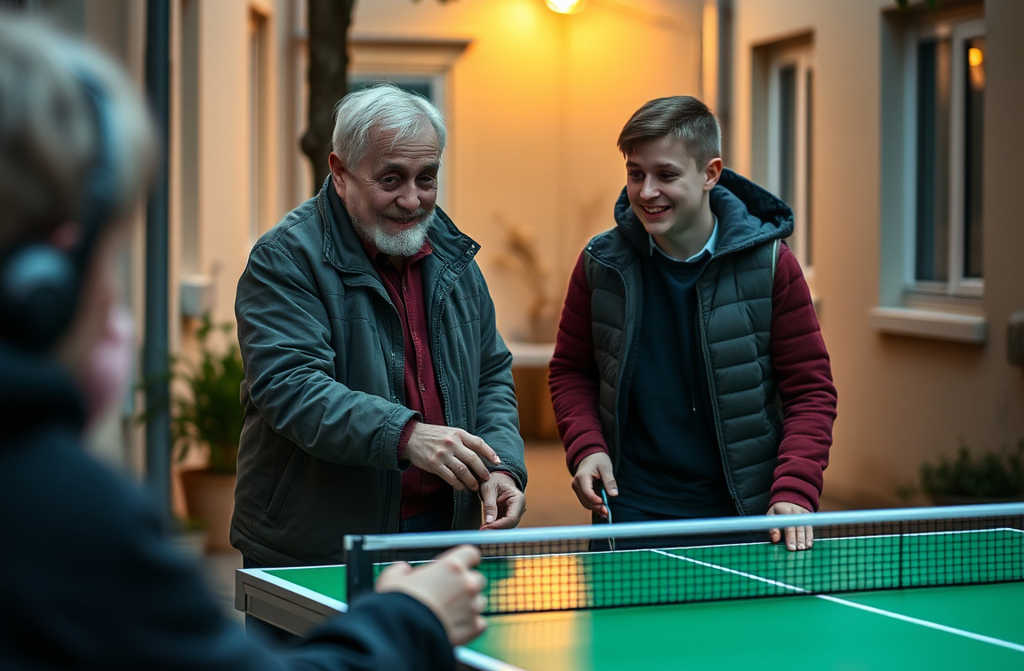
Peters first serve was awkward; the ball flew off the table. He adjusted his grip, tried again, and the ball bounced cleanly over the net.
Not bad, Kevin said, impressed.
Neighbors began to gather on the balconies, children ran closer, and even the teenagers who had helped lingered, curious.
Can we have a go? asked the skinny teen.
Just finish this set, then youre on, Peter replied, and later Ill show you how to play properly.
Soon a modest queue formed. Someone brought plastic chairs, another fetched bottles of water. The yard came alive.
A week later Peter realised that playing alone wasnt enough; people started arguing over who got the table for how long. He sat at his kitchen table, opened a plain notebook, and wrote on the cover: Community TableTennis Club Our Yard. He listed participants on the first page.
The following day he posted a notice on the blocks door: Amateur TableTennis Club meeting here. Signup with Peter Smith, flat 4B. Schedule to be agreed together. He added, Games to run from 5pm to 9pm on weekdays, later on weekends.
That afternoon a tenyearold girl with braids and glasses knocked on his door. Are you Peter Smith? she asked, holding the flyer.
Yes, come in.
Id like to join. Im Poppy, flat 4C.
He seated her at his kitchen table and asked her details. Do you play? he inquired.
Just a little at school, but the table there is wobbly, she admitted.
No matter. Well teach you.
One by one, Kevin signed up, as did his teenage son, a lady with a pram, and the two teenagers, Danny and Tom. By evening the list held fifteen names.
Peter began drafting a timetable, noting work hours, school, and pensioners free time. He used a ruler to draw columns for each day and time slot.
At first the schedule ran smoothly. Seniors and children played during the day; working adults joined in the evenings. Peter walked around the yard with his notebook, ticking off attendance. Neighbours nodded appreciatively; he felt like a club secretary.
Quips floated around. Watch out, weve got the district champion here, teased Kevin when Poppy took a fierce forehand. Dont mess up my serve, she retorted with a grin.
Peter offered tips. Dont swing like a shovel; keep the paddle gentle, he advised Danny. And aim low on the ball.
The yard gradually grew accustomed to the steady pingpong rhythm, mixing with the occasional car horn. After a month someone suggested a tournament.
What if we have a competition? A draw, a modest prize? Kevin asked.
Prize? Danny laughed. No one has cash.
The prize can be pride and a cake. Ill bake one, Peter offered. And maybe a little fame.
The tournament was set for Saturday. Friday night Peter drew up a bracket in his notebook, recalling the same careful charts he once made for factory contests.
Saturday morning the yard buzzed. Children darted around the table, adults discussed matchups, and a portable cooler held tea and biscuits. Kevin clapped his hands. Ladies and gentlemen, welcome to our first yard tournament. Two games win, eleven points each. The goal is fun, not victory.
Poppy chimed in, And lets keep it quiet after nine, please.
Games began. Kids lost to adults but cheered each other on. Teenagers argued over a disputed point, then agreed to replay. Peter acted as referee, sometimes joking, sometimes raising his hand to halt an overzealous rally.
By midday his back hurt, his legs throbbed, but his chest swelled with satisfaction. He looked around at the crowd and realized his effort was worthwhile.
As evenings grew shorter, complaints resurfaced. Some neighbours grumbled about late noise; a man from the neighbouring block shouted, Its already ten! Shut it down! The yard fell silent, the teenagers froze midrally, and Peter felt a chill run down his spine.
He checked the clock9:45pm. Well finish this set, he said calmly. Then well close.
The man snapped, You always say that. My child cant sleep because of this racket.
Peter tried to explain the schedule, but the mans tone grew sharper. This isnt a gym, its a yard!
Peter swallowed the tension. Alright, everyone, thats it for tonight. Tomorrow well continue.
The teenagers lowered their paddles, muttering. We were just having fun, Danny grumbled.
Peter watched the man walk away, still fuming.
A week later a similar dispute erupted, this time with a woman demanding the games end before nine because her windows faced the table. Poppy protested, Our school finishes at three, then we only have evenings. Peter felt the notebook in his hands grow heavier with responsibility.
He reshuffled the timetable: childrens sessions earlier, adult games later, weekends extended to ten but without loud music. He invited the complaining neighbours to help draft the new rules.
Lets agree on quiet after nine, and no music after ten on weekends, Kevin suggested. Well keep a slot on Saturday afternoon for newcomers.
All nodded. They posted the revised schedule beside the table, pinned to a wooden frame so the wind wouldnt tear it off.
Do you think theyll stick to it? Danny asked.
If we all follow it, they will, Peter replied. We set the example.
In the following weeks the new rules settled in. When the clock neared nine, Peter would stroll over and say, Times up, friends. Most complied, some grumbled but obliged. Once Danny snapped, It feels like a curfew, Peter answered calmly, but its respect for those sleeping behind the walls. One day youll need the same courtesy.
Gradually the yards chatter turned from complaints to friendly banter. The man who once shouted now joined a match, introducing himself as Mark. He thanked Peter for the table, saying it had given him a reason to talk to his neighbour, Kevin, beyond the lift.
Winter came, and the table stayed under a tarpaulin. The yard was quieter, but the club persisted. New faces appeared: two women from the next street, their dogs trotting by, who signed up after seeing the notice. We thought it was only for you lot, one admitted, but you welcome anyone.
Peter smiled. No ones a stranger here, he told them.
Spring brought fresh leaves and a renewed buzz. The queue at the table lengthened again. Poppy, now more confident, volunteered to help with the schedule, suggesting that Kevin and Mark play together on Tuesdays to avoid clashes. Peter trusted her judgment.
One day Peters son arrived unexpectedly with a suitcase, saying he was in town for a few days. Dad, whats this racket? he asked, eyeing the table.
Its our community tabletennis club, Peter explained. Everyone gathers, plays, and talks.
Peter introduced his son to the group. A lady with a child joked, No cutting in line, even for guests! The son laughed, Fine, Ill wait my turn.
That evening his son said, I thought yards here were just cars and drunks. This feels… lively. Peter chuckled, Weve got our share of both, but now we also have a table and a reason to meet.
Autumn arrived, the leaves carpeted the pavement, and games slowed as people hurried home earlier. Yet at dusk, the soft thud of a ball could still be heard. Peter stood at his window, watching Poppy and Danny rally under the streetlamp. The yard had become a small community hub, not just a space for cars.
The next morning he returned to his bench by the table. The man who once complained about noise sat beside him, sipping tea. You know, he said, pulling that table out has given us something to talk about, instead of just shouting through windows. Peter nodded. Its easier to chat when we share a game.
Peter opened his notebook, glanced at the tidy schedule, and felt a quiet confidence. He didnt know how many more years he would tend the table, but he trusted that when his back finally gave out, someone else would step in. If disputes arose, they would first gather at the table to talk, not rush to complaints.
He poured another cup of tea, heard the distant laugh of a child, and thought of the simple truth that had emerged: a shared purpose can turn strangers into neighbours, silence into conversation, and a forgotten piece of furniture into the heart of a community. The lesson was clearwhen you bring a bit of yourself into the world, the world gives you back a place to belong.