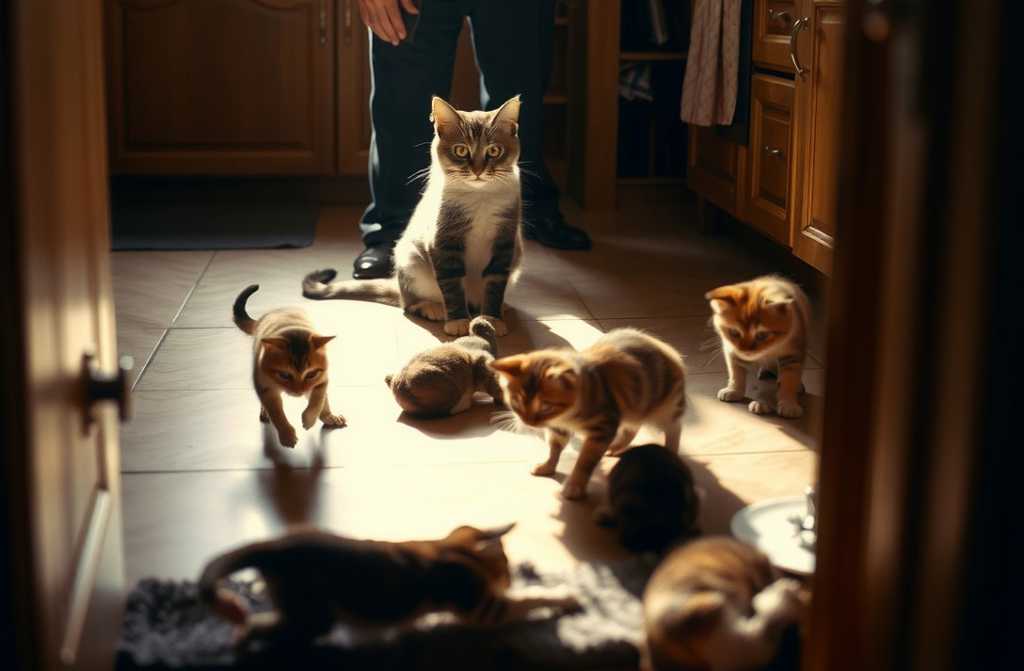
Dad! Come and see this spectacle. Bennys brought his family home
Benjamin was brushed with the classic marquis markings, as folks say: his back shimmered with a blue so dark it might have been dipped from the midnight sky, the same hue curling across his ears and sweeping down his tail. His bib, cheeks, neat little socks, tummy, the tip of his tail, and a strange white triangle between his eyes gleamed so brightly theyd catch sunbeams that werent there. Altogether, with the natural suppleness of the feline, he gave the impression of being as graceful as a grand piano moving through a velvet curtain. His eyesgreen, pensive, and soulfulseemed meant for composing the most stirring, moonlit alleyway serenades in the style of cat-country ballads.
This tom carried himself with rare decorum. He never leaped onto the table or sharpened his claws on the armchairs. Nor did he, with the gravity of a feline Newton, nudge ornaments from the sideboard, testing gravitys law with every fall. What sort of kitten hed been before was anyones guess: perhaps hed climbed curtains and felled Christmas trees, or chased baubles in wild, clattering fits. But he joined us fully grown, already a distinguished personality. And before us, he didnt come from some leafy suburb.
Before he entered our peculiar family, Benny had lived on the other side of the Thames, in a shed behind a fishmongers, with the scents of brine and old motor oil. All was well until the foreman changeda man with an almost evangelical passion for dogs, and an equally fierce aversion to cats. That spelled Bennys fate. My brother-in-law, a welder in the lot, spirited him away for safety.
The new blokes huskies will tear him to bits, he pleaded. Can you take him in?
So we did. Benny, a dashing young fellow, quickly set about improving the local cat gene pool, bestowing his blue-and-white legacy upon all the tabby ladies in the neighbourhood.
Now, dont throw your slippers at me for letting him roam. This was the end of the 1980s, not London but the shadowy edges of Essexfolk didnt really know about cat clinics or castration back then. Bring it up with the decrepit farm vet, and hed probably think youd lost the plot.
Despite his amorous pursuits, Benny grew attached to none of his conquests. He was even-handed, a true egalitarian. Until one day, she strolled into his lifeMaisie.
That day, Id staggered home after a midnight shift, showered, and tumbled headfirst into dreams. Sometime near noon, I was roused by my daughter, just back from her village school.
Dad, youve got to see this. Bennys brought a family home
I shuffled down the hallway and turned into the kitchenand there I stopped dead. Benny sat upon the tiles in perfect, stately form: back arched like a coiled spring, paws tucked, tail swept round his toes, ears and whiskers bristling forward, as if conducting an unseen orchestra.
Just in front of him, three kittens tumbled about. Their coats screamed their heritagemidnight backs, white socks, neat bibs, and bright little brush-tips on their tails. I shuffled closer and stared. The next moment took my breath.
At Bennys dish, and not merely nibbling but gulping down fish mashed with barley, was an emaciated, battered tabbystripes dull, one ear chewed ragged, and a hunted glint in her single, shining eye.
As she looked up at me, I froze. She had only one eye.
I just got back from school, my daughter stammered, apologizing. Saw them all huddled by the doorMaisie included, Benny in front. I thought to chase them out, but noticed her poor eye
And well you let them in! I snapped.
I tried to stroke the tabby, but she flinched, hissed, and drew back. She had forgotten how to trust people, surely due to past hardships. She hadnt met our kind beforethe lucky kind, like Benny. I shuddered to think what would have happened if the local terriersrough, half-wild, as working dogs can behad found her, one-eyed and alone. Her scars spoke volumes about her history.
In the end, we kept the entire family. And strangely, Benny became a model house-cat! Before, hed spar with other toms for lady-cats in the shared green by our three-storey block. Now, his energy shifted. He only fought for territory, not affection. Wearied and tousled, he returned always to the tabby with the wounded gaze.
At night, they curled up together in a battered cardboard box under the kitchen table. There, Benny, with the tenderness of a nursemaid, groomed Maisie, especially the scar around her forlorn eye.
Eventually I persuaded the local animal expert to treat herthough it took a bit of strong-arming and a bottle of whisky (a scarce treasure given the regulations of the day).
We found homes for the kittens quicklyword spread round the fishmongers, and the men from the depot took them off in a flash, proud to adopt Bennys bloodline. The rest queued for the next litter, certain Maisie would have more.
So the years rolled by: the grey one-eyed Maisie brought more kittens twice more, and then, one day, she slipped away and vanished. Loyalty had never been her hallmark.
We searched for dayscalling beneath windows, pacing the green, searching derelict sheds and prodding bramble patches on the hillside. All for naught. At least, by then, her last litter had grown. Off they went, to the eager arms of villagers, signed up well in advance.
But Benny was left bereft. Sometimes he gazed for hours at the garden beyond the window pane, as though waiting for a shadow to reappear. Sometimes hed stalk the paths, engaging in furious scuffles, but his victories brought no joy. He never led home a new friend.
The only evidence of his former romantic adventures were the young tomsappearing like clockwork every spring and autumn, clad in his signature marquis hues. They were living proof that old Benny, even as he faded, had not let his legacy go.
By 1998, Benny settled into a proper retirement. He rarely left the house, dozing eighteen, sometimes nineteen hours a day, barely eating, as though ageing in soul as much as fur and bone.
Then, in July 1999, the unexpected. He began to wail by the door, scratching the paintwork, insistent to go outside. Knowing something was unusual, I followed him, apprehensive he might encounter an ill fateperhaps at a dogs jaws.
Benny tottered slowly down from our third floor, moving like a pensioner exhausted by life, stumbling at each step, his limbs not always obeying him. Around the building he went, onto the steep grassy tuft behind the flatsa rise thirty yards out. I reached to carry him, but he bristled, determined: I must walk this path myself.
On the plateau, he paused by a tangled ditch filled with small burrows and shadowed crevices. He turned suddenly to look straight at me, his green eyes seeming to bore into my heart, as if trying to communicate a final message. Then, with surprising speed, he darted into one dark hole under the roots, and melted away.
I waited, called, pleaded with his name echoing through the hush. I tried to squeeze in, but earned only muddy clods down my collar and fingers sticky with who-knows-what. In the end, I walked home.
Later, I returned with a torch and a bagful of cat biscuitsnow easy to buy in any shop. I called into the dusk, but Benny never emerged. I left, suspecting Id seen him for the last time.
He was gone for good. Perhaps those old wives tales are truethat ancient cats wander off to die far away. Only the certainty remained: the next summer, a wild dog-rose burst into violet bloom by the ditchs southern edge. And I like to imagine, just for comforts sake, it was no ordinary bush. It was Bennycome back as living colour, graceful as ever, blooming in a dream full of cats and strange, silent hope.