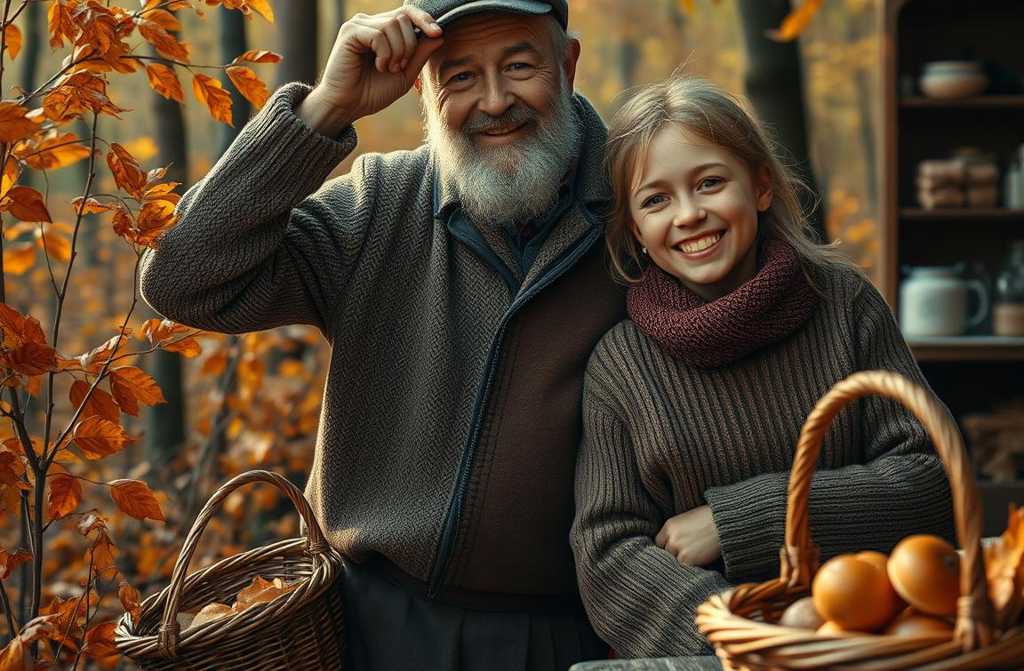
The Family Trail: A Journey Through Generations

The parents paused at the garden gate, the engine of their old Ford humming a little longer in the crisp September air. William stood on the faded path between the flower beds, his battered backpack sewn with a tiny airplane pin. Yellow leaves swirled around him, slipping into his boots and catching on his heels.

Grandfather Arthur stepped onto the porch, tipped his flat cap, and smiled; the lines around his eyes deepened instantly. William felt a shiver of anticipation, as if something important, unlike the everyday, was about to begin.

His mother, Helen, pressed a kiss to his crown and brushed his shoulder.

Dont frolic too far, alright? And listen to Granddad, she said.

Of course, William replied, glancing shyly toward the windows where Grandmother Margaret had just flickered into view.

When the car disappeared down the lane, silence settled over the yard. Arthur beckoned his grandson toward the shed. Together they chose two wicker baskets for the forayone larger for Arthur, the smaller for William. Nearby lay an old rainproof coat and a pair of rubber wellies; Arthur checked them for leaks after the nights drizzle. He inspected Williams jacket, zipped all the fastenings and straightened the hood.

September is mushroom season, Arthur declared with the certainty of someone opening a secret nature diary. The birch boletes are hiding under the leaf litter, the chanterelles love the moss by the pines, and the honey fungi have already started to appear.

William listened intently; the feeling of preparing for something real thrilled him. The baskets creaked in his hands; the wellies were a shade too big, but Arthur only noddedwhat mattered was that his feet stayed dry.

The garden smelled of damp earth and the lingering smoke of past campfires. A thin mist rose over the puddles along the fence; when William stepped on the wet leaves they stuck to his soles, leaving dark prints on the concrete steps.

Arthur spoke of old walks: how once, with Margaret, theyd stumbled upon a whole meadow of honey fungi beneath an ancient birch; how its vital to watch not only beneath ones feet but all around, for mushrooms sometimes hide right beside the trail.

The road to the woods was shorta narrow lane cutting through a field of wilted grass. William walked beside Arthur, who moved at a leisurely, confident pace, the basket snug against his hip.

In the forest the scent changed: fresh sap from damp timber and the sharp perfume of moss between pine roots. The ground cushioned his steps with a mix of soft grass and fallen leaves; somewhere off to the side, dew dripped from twigs onto the earth.

Look herethats a birch bolete, Arthur said, bending to point at a mushroom with a pale cap. See the stem? Its covered in dark scales

William knelt, brushed the cap with a fingertipit was cool and smooth.

Why is it called that? he asked.

Because it loves to grow near birches, Arthur smiled. Remember the spot!

They twisted the mushroom free; Arthur sliced the stem openinside it was white, spotless.

Further on, a tiny yellow chanterelle lay among the grass.

Chanterelles always have that wavy edge, Arthur explained. And they have a distinct scent

William inhaled cautiouslythe aroma was faintly nutty.

What if it looks similar?

False ones are brighter or odorless, Arthur warned. We never take them.

Gradually the baskets filled: a firm birch bolete here, a cluster of honey fungi peeking from a spruce moss patch theredelicate stems, tiny sticky caps edged with pale rims.

Arthur taught the difference between real honey fungi and impostors.

The fakes are bright yellow or even orange underneath, he showed. The true ones are white or creamy below

William loved finding mushrooms on his owneach time he called Arthur over to see his find; sometimes he made a mistake, and Arthur calmly explained the distinction again.

Along the path they passed vivid red fly agaricslarge caps dotted with snowy spots.

Theyre beautiful, William whispered. Why cant we pick them?

Theyre poisonous, Arthur answered gravely. Just admire them.

He skirted the agaric carefully. William began to understand: not everything pretty belongs in a basket.

Sometimes Arthur would ask, Do you remember the differences now? If youre unsuredont pick it! William nodded, wanting to be careful, feeling the responsibility for his own basket and for staying beside his grandfather.

Deeper in the woods, thin shafts of sunlight pierced the low branches, throwing long ribbons of light across the damp ground. It was cooler there; Williams fingers sometimes tingled on the basket handle, yet the thrill of the hunt warmed him more than any gloves could. A squirrel darted past, birds chattered in the canopy, and somewhere ahead a twig snappedmaybe a hare, maybe another forager on his own path. The forest felt like a living labyrinth of trunks, moss, rustling leaves, and muted sounds. The earth was soft even where it was carpeted with last years foliage, and dark wet patches glimmered between roots. Arthur showed where to step to keep his feet from soaking. William tried to follow, scanning all around, hunting for new mushroom spots to impress Grandmother Margaret later at home. He felt like a helper, almost an adult companion, though he still wanted to hold Arthurs hand now and thenfor reassurance when the wind grew louder or darkness fell between the trees, as if the woods were revealing their secrets only to the two of them.

One day, between two towering pines, William thought he saw a burst of orange speckles among the moss. He stepped a little farther from the trail, sat down to examine, and discovered a whole cluster of chanterellesexactly the kind Arthur had praised earlier. Joy surged through him; he gathered the mushrooms one after another, slipping them into his basket, forgetting to look around. When he finally rose, his eyes met only the high trunks surrounding himno familiar silhouette, no voice, no footsteps, only the hushed rustle of leaves and the occasional crack of a branch off to the side. William froze; his heart hammered faster than usual. It seemed he was truly alone in the great autumn wood, even if only for a moment. Fear rose instantly, yet Arthurs words echoed: stay put if you lose me, call out loudlyIll answer. He tried to shout, his voice thin, barely louder than his breath. Then, with more resolve:

Granddad, where are you? Hey, Im here!

A mist hung between the trunks, making the trees blend together, the sounds softer, muffled. From the left a familiar voice called back:

Oi! Im here, come toward me, follow my voicejust stay calm!

William inhaled deeply, moved toward the sound, called again, listening for a reply. His steps steadied, the ground felt familiar again, and the panic gave way to relief as a figure emerged ahead. Arthur stood a short distance away, leaning against an ancient oak, smiling warmly, waiting as if nothing had happened. The forest sounds revived, and Williams pulse settled into a steady rhythm. He realized he could trust the adults words, just as he trusted himself.

Well, there you are! Arthur patted William on the shoulder, his gesture free of reproach or worryjust quiet joy. William stared at the wrinkled face, which seemed as familiar as his own bedroom. His heart still raced, but his breathing evenednext to his grandfather he felt safe again.

Scared you? Arthur asked softly, lifting the basket from the ground.

William noddedbriefly, honestly. Arthur crouched to be eyelevel with him.

I once got lost in these woods when I was a bit older than you, he said. I thought Id been wandering for a whole day, but it was only ten minutes The trick is not to run blind. Stop, call out, and listen. You did exactly right.

William looked down at his mudsplattered wellies, streaked with bits of moss. He felt Arthurs pride. The lingering anxiety slipped deep inside, becoming a memory rather than a fear.

Shall we head back? Its getting dusk. We need to get to the path before dark, Arthur said, adjusting his cap and gripping the basket handle. William fell into step beside him, his stride now close. Every crunch of leaf underfoot felt intimate. They walked together; William liked feeling part of a shared purpose, even in such simple decisions.

At the forests edge the evening air turned fresh; a wind drove dry leaves along the lane between the trees, and ahead a cottage roof peeked through the thin branches of hawthorn. Dark streaks from the damp grass clung to the basket handles; Williams palms tingled after the long walkbut the joy of returning warmed him more than any hot tea could.

Home greeted them with a soft glow from the windows and the scent of fresh bakery wafting from the kitchen. Grandmother Margaret waited on the porch with a towel draped over her shoulder.

Goodness! Look at you two! Come, show us what youve brought! she chuckled, helping William out of his bootsleaves clung to the solesand taking Arthurs basket, placing it beside her own bowl for cleaning the finds.

The kitchen was warm from the stove; the window panes fogged in thin streaks, revealing only vague lantern lights outside and the silhouettes of hedges. William sat near the table while Margaret deftly sorted the mushroomsbirch boletes here, chanterelles therewhile Arthur produced his pocketknife for the meticulous work on the honey fungi.

Evening fell quickly outside, yet the house felt especially cosy. William listened as the adults recounted the days walk, then told his own tale of the forest and his calls for Arthur. They listened attentively, and William felt he had truly become part of this family tradition. A kettle whistled, the air smelled of mushrooms and fresh scones. Outside darkness deepened, but inside the light stayed steady, calm, and comfortingjust as it does after a small trial thats been faced together.


Rate article
Add a comment

;-) :| :x :twisted: :smile: :shock: :sad: :roll: :razz: :oops: :o :mrgreen: :lol: :idea: :grin: :evil: :cry: :cool: :arrow: :???: :?: :!:

The Family Trail: A Journey Through Generations
Where Are You?! My Parents Are Here and There’s No Dinner! Get Home Immediately! – Roared My Husband Down the Phone Svetlana slipped on her shoes only by the lift, having walked barefoot across the cold tiles. Decency could wait—her feet mattered more. As she reached the bus stop, her phone buzzed. “Sveta!” Andrej barked so loudly she pulled the phone away. “Where on earth are you?” “Just finished work, Andy.” “Don’t care about your work! We’ve got guests! My parents arrived! The table is empty!” Svetlana closed her eyes. He hadn’t said a word yesterday. Nothing at all. “When did they get here?” “Two hours ago! They’re waiting for dinner! Mum’s already hinting I made a bad match!” “Andrej, maybe…” “What maybe? You don’t get it? Family matters more than your patients!” Just a dial tone. He’d hung up. Svetlana sat on the bench, thinking. The bus would arrive in twenty minutes. At home: strangers she had to feed, a shouting husband. And herself, stuck in between as always. “What can I cook fast?” Ideas spun: pasta, sausages, canned salad. The simplest, the quickest. “Or…I could just not go.” The thought came unbidden. Terrifying. What if she simply…didn’t go? No, of course she would. Where else? At home, voices from the lounge greeted her. Andrej told some joke, his parents laughed. “Oh! Svetlana’s home!” her father-in-law announced. “At last!” She entered. Her mother-in-law—plump, bright scarf—gave her a critical once-over. “Oh, dear, you look so thin! Don’t they feed you at work?” “Hello,” Svetlana managed. “Sorry I’m late.” “Oh, don’t worry!” waved her mother-in-law. “We understand. But now you’re home! Andy says you make fantastic pies!” Svetlana glanced at her husband. He sat in his chair, grinning like a proud owner showing off a trained pet. “Sveta,” he said sweetly, “set the table. People are hungry.” “Of course.” And she headed to the kitchen. To cook dinner for people she’d only met a handful of times. By nine, Svetlana placed the last dish on the table—potatoes with meat. Her mother-in-law’s favourite, or was it her father-in-law’s? She couldn’t remember. “Oh, Sveta!” her mother-in-law clapped. “We thought we’d starve!” “Sorry,” Svetlana muttered. “Took longer than I thought.” “Oh, never mind! The food’s what matters.” Andrej poured vodka. “Well, here’s to family! And to this reunion!” Svetlana perched on the edge of her chair. She wanted just one thing—to lie down and not move until morning. “Sveta, could we have some bread please?” asked her mother-in-law between mouthfuls. Svetlana got up, fetched bread. “And the pickled cucumbers!” shouted her father-in-law. “Saw some in the fridge!” “And mustard!” Andrej added. She scurried back and forth, bringing whatever was asked. No one said “thank you.” They expected it—a wife serves. Conversations drifted: work, children, prices. No one asked Svetlana anything. She was just the staff. “Remember, Andy,” chuckled his mum, “the cottage holidays as kids? Grandma’s pies were legendary!” “Yes, those were good times,” he agreed. “By the way,” her mother-in-law looked at Svetlana, “Andy’s lucky—good housewives are rare now.” Svetlana forced a smile. Inside, something shrivelled. That’s all they thought of her. At one, the guests left. More hugs and farewells. “Thanks for dinner!” her mother-in-law shouted. “Delicious! Especially the coffee—real Brazilian!” Door closed. Andrej stretched. “That was nice. Haven’t seen them in ages.” Svetlana quietly started clearing dishes. So many plates, glasses, salad bowls. “Andrej,” she asked softly, “can you help?” “What?” He was undressing. “Oh, the dishes. You’ll manage. I’ve got an early start.” “So do I.” “Sveta, don’t start,” he frowned. “My job’s important. And really, you find washing up hard?” She stood in the kitchen with a greasy pan in hand. Tears slid down her cheeks. “Wash the dishes.” Twelve hours at the hospital, saving lives. Then three hours cooking. Now scrubbing until two in the morning. “Wash the dishes.” In the morning, Andrej left without saying goodbye. Svetlana drifted to work, sleepwalking. “You okay, Svetlana?” asked her colleague, Marina. “You look tired.” “I’m fine. Had guests last night.” “Ah,” Marina nodded sympathetically. “Know all about those family get-togethers.” All day, Svetlana worked on autopilot. Injections, rounds, procedures. “Sveta,” Dr. Petrov called, “are you going to the conference? They’re discussing new treatments tomorrow.” “Not sure. Got things at home.” “Shame, really. Looks good. And it’s nice to get out of the routine sometimes.” That evening, Andrej was talkative. “Mum rang. Said thanks for yesterday. Reckons you’re a brilliant cook.” “Uh-huh.” “And she said I’m lucky to have you,” he announced proudly. “Andrej,” Svetlana said suddenly, “there’s a conference at the medical centre tomorrow. Can I go?” “What conference?” “New treatment techniques.” “So who’s making dinner?” “You can, just this once.” “Sveta, stop being silly. What conferences? Isn’t your work enough? There’s plenty to do at home.” “But it’s my field!” “What else is left to learn?” Andrej scoffed. “You’ve been giving injections for twenty years. Enough with the conferences.” Svetlana fell silent. She got up and cleared the table. “Enough with the conferences.” Once she’d dreamed of being a doctor. Got into med school. Then met Andrej, fell in love, married. “Why be a doctor?” he said then. “Nurse is good enough. Gives you time at home, too.” She’d listened. Marina went to the conference the next day. Came back inspired. “Sveta, did you hear the local clinic does free yoga for medical staff? Evenings!” “Yoga?” “Yep! They say it helps with stress. Fancy it?” Svetlana looked at the bright flyer. “Yoga for your soul. Find your balance.” “Not sure…” “Oh, come on!” Marina hooked her arm. “Just try it. We’ve got nothing to lose!” So Svetlana went. Just because she was tired of always explaining why she couldn’t, didn’t, didn’t have time. Fifteen people in the room. Women unrolling mats. The instructor—soft-spoken, gentle—asked everyone to lie down, close their eyes. “Feel your body. Hear your breath.” For the first time in years, Svetlana felt her body. Her aching shoulders, stiff neck, clenched jaw. And—for the first time in years—her mind was quiet. “Did you enjoy it?” Marina asked after. “Yes. Very much.” “We’ll go again Thursday?” “I’ll come.” At home, Andrej was irritated. “Where have you been? I’ve waited half an hour for dinner!” “I was at yoga.” “Yoga?” he scoffed. “At your age? Sveta, are you mad?” Two weeks went by. She kept going, claiming overtime. Every Thursday, she felt alive. Then came that phone call. Svetlana was balancing—tree pose—when her phone rang. “Don’t answer,” said the instructor. “This is your time.” But voicemail clicked on. “Where are you?! My parents turned up unannounced and dinner’s not ready! Get home now!” her husband bellowed. Everyone looked round. Svetlana was bright red. “You can call back later,” the instructor said quietly. Svetlana saw five missed calls. And suddenly—something snapped. “No,” she said. “I won’t.” She switched off her phone. “Let’s continue,” the instructor encouraged. She walked home slowly, braced for a fight. “Where have you been?!” Andrej fumed. “My parents left without eating! Humiliation!” “I was at yoga.” “At yoga?! Why didn’t you answer your phone?!” “Yoga is my time. And I turned it off on purpose.” “What?!” he yelled. “When I call, a wife is supposed to answer!” “Supposed to,” Svetlana nodded. “A wife. Not a servant.” “What are you on about?” “If you get guests—make something yourself. Or order food.” “I don’t know how to cook!” “I didn’t know how to give injections, once. I learned. You can learn too.” “Sveta, are you crazy?” “On the contrary,” she smiled. “I’ve finally come to my senses.” Andrej stared, confused. This calm woman was nothing like his subservient Sveta. “Do you not love me anymore?” he asked. “I do,” she replied honestly. “But now, I love myself too.” A month later, Svetlana applied for holiday leave. “Sveta,” Andrej said at breakfast, “are you sure? Work’s frantic for me, you could stay home.” “I’ve already booked it.” “Booked what? Where?” “A hotel. Ten days by the English seaside.” “Alone?!” “Alone.” “But that’s not right! Wives don’t do that!” “They do,” smiled Svetlana. “I checked.” At the hotel, for the first time in thirty years, she woke without an alarm. The sea murmured outside. Her phone lay switched off on the bedside table. At breakfast—buffet style—she picked up a croissant with jam. The sort she never bought at home. At the next table, a woman her age read a book. “Is it good?” Svetlana asked. “Fantastic!” the woman smiled. “About a lady who, at forty-five, decides to change her life.” “And does she?” “Still reading. But I think—yes.” After breakfast, Svetlana walked to the beach. Sat in a deckchair, closed her eyes. “What if I just didn’t go back?” The thought was scary. Also tempting. Of course she’d go—her job, her flat, her life. But now she knew: she could choose not to, if she wanted. She returned home sun-kissed, with a new haircut. “Well, well!” Andrej greeted. “I missed you!” He hugged her. She didn’t push him away, but didn’t melt into him either. “How are you?” she asked. “Okay, though I lost a little weight. Been living on sandwiches.” “Didn’t try making soup?” “How was I supposed to do that?!” “The same way I learned thirty years ago. By following a recipe.” She went to the kitchen. Sink piled with dirty dishes. Table littered with takeaway cartons. “Andrej,” she said calmly, “I’m back to work tomorrow. And yoga every Thursday.” “But—” “No buts. That’s my time.” Andrej watched, realising—something fundamental had changed. This woman would no longer jump at the first summons. “What about dinner?” he asked uncertainly. “We’ll cook together. Or take turns. Like grown-ups.” She poured herself tea and looked at her husband. “Well then? Ready to learn? Or stick with takeout?” Andrej sighed. “Guess I’d better learn.” “Great,” Svetlana nodded. “Let’s start with the classic—chicken casserole. And later—who knows.” Who knows what else might change in her new life? In this life, where she’d finally found the strength to say: “I have the right to be happy, too.” And you know what? It turned out she really does.