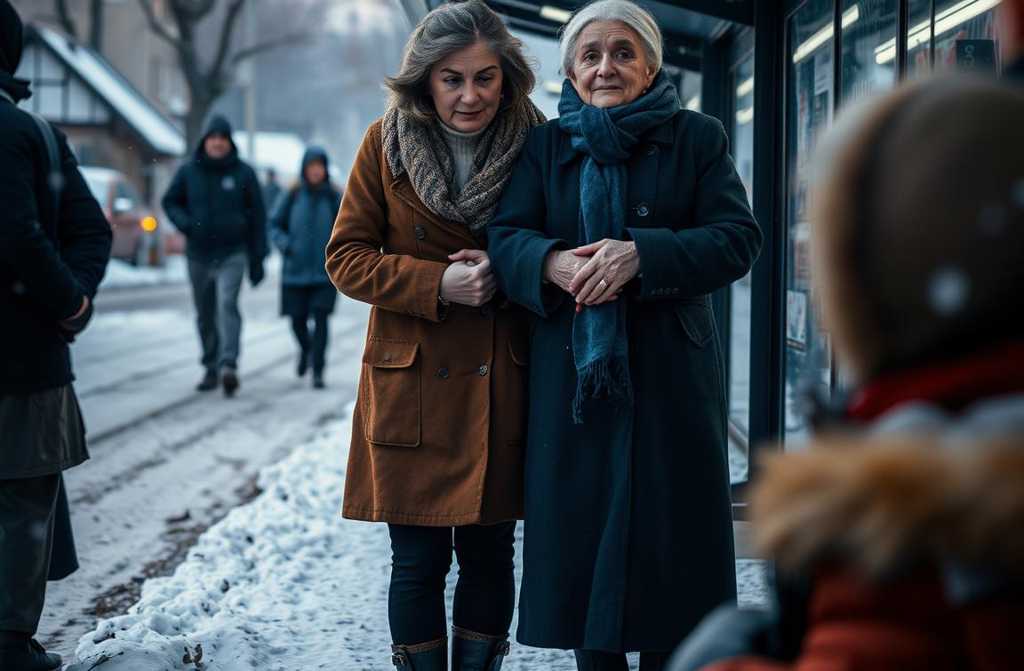
The Route to the Village
The bus arrived as it always didby its own reckoning rather than any timetable. I remember standing at the stop, clutching a bag of medicine and thick woollen socks for my aunt, watching the driver scribble his signature onto a logbook balanced on his knee, hardly glancing at the passengers. The snow near the kerb was grey, packed down, streaked with grit. A sharp wind swept across the fields, and I caught myself, as I used to as a girl, counting the paces to home: from the stop to the bend, then to the shop, and finally along the lane to my aunts gate.
Id left the village long ago, when the city seemed less a place and more a promise. Life there ran smoothly, like carriages on rails: purchasing ledgers at work, reports, terse emails, deadlines, the familiar route on the Underground, the brief chats with the man whod lived with me for two years nowwho kept asking when I would stop living two lives. Now my second life had become the first. My aunt had taken ill, and the neighbours phone call, so ordinary in tone, took a few moments to sink in: Your ones not well at all. I cant manage alone anymore.
In my aunts house it was warm and dry, the coal stove blazing since morning. In the kitchen, a basin of potatoes waited next to tablets in their torn carton on the table. My aunt lay in her room, where a threadbare rug hung on the wall and beneath the window stood an old chair draped with a cardigan. She recognised me by my voice, but kept her eyes shut, as if the light hurt her thoughts.
Youve come then, she exhaledas if speaking was work.
Sitting on the edge of her bed, I took her hand in mine, and the skindry, fragile, pulsing with a warmth that gave me hopebelied the doctors words from the surgery: her heart, her age, see how she fares.
Next day, I made my way to the local surgery. The door stood open, thick with the tang of bleach and weariness. The paramedicstocky, red-fingered, about fiftysat over a ledger, barely glancing up as he asked:
Who are you after?
Ive come for my auntMargaret Bennett.
He looked up, as if he had been awaiting just that name.
Ill drop round this evening. Only you know how it is He paused, fiddling with his pen. Theres talk round here. Budget cuts. They reckon this surgery isnt worth it. Im to be moved to the district, if it comes down to it.
His if sounded like when. My eyes drifted over the deskstacked forms, a thermometer in a clouded jar, a squat fridge for vaccines. None of it felt like an institution, but a single thread keeping the village on the map.
And what aboutthe people? I ventured.
Oh, peoplell manage, he replied, without heat. Bus to the district. If the bus is still running, that is.
I heard about the bus in the shop that very afternoon. Two women argued over whod go out for breadin case they dont bring it again. The shopkeeper, ringing up cheese and tins, muttered: Theyre saying theyll be cutting the line. Not enough passengers. Subsidys shrunk, apparently.
A bubble of familiar city irritation swelled inside mehow could they speak of it so blandly, as if it were the weather? But annoyance gave way to anxiety. No bus meant there was no way to get my aunt to the surgery, or to hospital if it came to that. Without the surgery, even measuring her blood pressure would fall to the neighbour and her battered old device, which always lied.
That evening, I found a folder stuffed between gas bills and yellowed letters in my aunts dresser. On a creased letterhead from the County Council, I read the dry announcementplanned reorganisation of local healthcare provision and optimisation of transport links. The dates were soon, much too soon. I read it again and again, as if that might change what it said.
My aunt, hearing paper rustle, called from the next room, Whats that?
I sat down beside her. They say they might close the surgery. And the bus too.
She studied the ceiling a long moment. They will, she said quietly. Theyre closing everything. And youyou think turning up here will keep it all together?
Her words cut deeper than Id expected. I hadnt come to save the village. Id come to care, to do my duty, and return to the city, where life made sense and my absence was probably already marked on calendars.
On the third day my supervisor rang from workher voice was precise, brisk, as in emails, no censure, just numbers.
Were waiting on you. Weve a shipment, the paperworks piling up. If youre not in by Monday, Ill have to make a decision.
I looked out and watched the neighbours boy tug a sledge through the patchy snow, no one riding. Decision and Ill have to sounded every bit as final as optimisation.
Ill try, I said. But here
Family comes first, I know, she cut in. But we arent a charity.
That evening, the man from the city sent a short message: When are you coming home? I replied, I dont know. At once I felt the distance in those words, like a widening gap between us.
Next morning, I went to the Parish Office, housed above the library, notices for litter-picking tacked to the noticeboard, a rota for surgery hours in the window. The parish headshort, neat-hairedoffered me a seat and peered over his specs.
Its about the surgery and the bus, I said, showing him the letter. What does this mean?
He sighed as if hed had this conversation a hundred times. Means the countys counting up costs. You know what its likethis is a small parish.
But people live here. My aunts houseboundhows she meant to get to the district?
Ambulance, if its urgent, he shrugged, barely.
They dont come for jabs and blood pressure. The bus is more than hospitalits work, school, the shops.
He scrutinised me then. Youre from London, arent you? Think writing letters will fix things. But theres a system here. I wont stop you writing, not my place, but be careful. People around heredont much care for a fuss.
I left, feeling Id been politely put in my place. But there was something else too: if I walked back to my aunts and pretended away my concern, Id be complicit in this hush.
So I began with a petition. At first I felt awkward, asking neighbours, explaining, requesting their details. People listened, nodded, but most looked away.
I dont mind, said one old gent, just dont write my name. My lad helps out at the office.
And what if it just makes things worse? a scarfed woman asked. Theyll do what they want. And well get blamed.
In their words I heard not cowardice, but experience. Life here had taught them that standing out meant standing alone.
The first to sign was the shopkeeper. Im tired of keeping quiet. If they cut the bus, Ill have to close up shop. How am I to get supplies?
The paramedic signed quickly, as if he were writing a sick note. Just dont make a fuss of meId like to keep my job.
In two days, there were thirty signatures. A lot for the village. Nothing for the county. I photographed the pages, scanned them on the rickety library machine, sent them off: to county, to the NHS trust, to MPs and the ombudsman. I wrote nightly on my aunts kitchen table while she breathed restlessly in the next room.
But with every message, the tension inside me grew, as though I were inviting the problem in instead of out.
A week later, a letter arrived from County: Your concerns have been noted. Optimisation processes are in line with The rest was filleraccessible healthcare on loop, never saying how my aunt was to see a doctor when the bus stopped running.
People started to talk. My neighbour, whod always brought over a pint of milk, stopped coming so often. On the street, people offered a stiff hello, conversation turning away.
One evening, a distant cousin of my aunts arriveda heavy-faced man. He sat down, cap still on.
What are you playing at?
Im only
Youre tryingand youll get us in trouble. The boss says some committees coming down now, all because of your letters. Hell cop itand then us. You think you can just bugger off to London and thatll be that? Weve got to live here.
I kept my voice steady. And how do you expect people to live with no bus, no surgery?
The old way. Someonell give you a lift. Those who can, will go.
Not everyone can, I said, glancing at my aunts door. And not everyone should have to.
He stood, jaw clenched. Youre city now. You all want justice. Its not like that here.
After hed gone, my aunt called weakly. Dont quarrel with them, she said. Theyre our own.
Our own shouldnt let us be erased, I answered, realising I spoke not just for her or the village, but for myself. How many years had I agreed for the sake of peace?
The committee arrived that Friday: two from County, one woman from the health board. They toured the surgery, leafed through logbooks, questioned the paramedic, then summoned the villagers to a cold, draughty hall.
The village hall was chilly, the faded stage curtain drooping. People sat with coats on benches. I huddled with my folder, the signed petitions fluttering inside. The parish head spoke firstwarily. The health board woman smiled, but her eyes did not.
We understand your concerns, she said. But there are guidelines. Not enough staff. The surgery could be covered by a travelling team.
And the bus? someone called.
Thats a matter for transport. The route isnt viable financially, answered a County man.
I raised my hand. It took them a while to yield.
You say its not viable, I managed, voice even. But have you counted how many will be left with no doctor, how many children will miss school if the bus goes? A travelling team once a week? And if someone takes ill in the night?
The health board lady inclined her head. We cant run a surgery for just a handful.
Its not a handful, I said, my voice trembling. Its lives youre asking us to give up.
Someone murmured, Thats right. But most sat in silence.
The parish head gave me a wary look. Lets keep this constructive.
I opened my file. We have signatures. And replies that say nothing. Ill write morehigher up, if I must. To Westminster, even to the press. And to the ombudsmanaccess to care is a right.
From somewhere, a whisper: Whys she doing this… And I felt the cost: I could not back down. Even if I left for the city tomorrow, my village would remember me as the one who had spoken up.
Afterwards, the parish head caught me at the door, under the flickering light.
You think youre the hero? he asked quietly.
I think you also need that bus, I answered.
He gave a joyless half-smile. What I need is a balanced budget. And peace with county. You want me to go against them? Youll be gone soon enough, back to your city.
That stung. I could leave. My flat, my job, my routineall awaited me. Here I had my aunt, my memories, and suddenly a responsibility Id never asked for.
That night, my aunts breath grew ragged, lips turning blue. I called for an ambulance. They were at the other end of the districtwait, they said. I sat on the bed, steadying her shoulders, willing air into her chest.
Dont make a fuss… dont… not for me, she whispered as her breathing eased.
Not just for you, I said. For us all.
The ambulance arrived over an hour later. The young doctor checked her, gave her an injection, murmured, No point taking her injust watch her. The house sank into silence, an emptiness not of peace but of absence.
The next morning, my supervisors message: If youre not in by Monday, Ill have to bring in a replacement. Matter-of-fact, but the threat unmistakable.
I wandered to the bus stop, a parcel for the driver to take to a friend in the district. Standing by the road, I ran through two lists: what would happen if I left, and what would happen if I stayed. Both meant loss.
The bus did come, in the end. Few passengers. The driver, taking my parcel, remarked, Looks like Im only on till the end of the month. After thatwho knows.
And what will you do? I asked.
He shrugged. Ill find a way. Im used to it. And youwhy are you fighting?
Because otherwise, therell be nothing left for us. I was surprised by the simplicity.
That day, I did something Id dreaded: I filmed a short video outside the surgeryno slogans, no shouting. Just showed the building, spoke of my aunt, the bus, our petition. Asked those whod left the village to back us, write to the county. I sent the video to a journalist Id once chatted with outside the offices in London.
The reply took time. Then: I can run a piece. But the council will be angry. Are you sure?
Sitting in my aunts kitchen, listening to her faint coughing, I realised I wasnt sureI just couldnt go back now.
Do it, I replied.
The next day, open smiles vanished. The shopkeeper murmured to me: Parish head says if theres trouble, they might cut funding. I dont believe it, but people
The paramedic rang in the evening. You know theyll move me for certain, now. Not angryjust weary.
I dont want you to lose your job, I said. Only for the surgery to stay.
Wanting isnt enough. But all right. Ill stop by for your aunt.
A few days later, a letter from the county: Your issue is under review. Unsatisfying, but more than silence. The parish head grew guarded. Outside the shop, someone said for the first time theyd sign again, if needed.
But with action came cost. My boss let me go by mutual agreementthere was even a touch of pity in her voice, but that changed little.
Then, unexpectedly, the man from London arrived. He hung up his coat, studied me as if to find the person hed known.
Do you even hear yourself? Would you really give up your job for the sake of a bus service?
Id do it if it meant my auntand everyonecould still get help, I answered.
And us? he said. We had a life.
Something in me clenched. I hadnt wanted to choose between him and the village, but the choice was before me, as stark as an open folder.
Im not asking you to stay, I said. Im asking you to understand.
He was silent for a long time. I cant live like thisin constant struggle.
I nodded. It hurt, but not as much as Id feared. He left in the morning, leaving my flat keys on the table. I added them to my aunts folder, as if they belonged to this new reality.
The bus timetable was put back up, with temporary scrawled across it. The surgery stayed open, though the paramedic said he was still being offered posts elsewhere. Life went on, taut and wary, everyone slightly changedlearning they neednt always say nothing.
I was standing by the surgery door when the health board woman emerged. There was no pretence of a smile now.
Pleased with yourself? she asked.
I dont know if theres much to be pleased with, I replied. I just want us to have at least something.
She looked at me, appraising. Youve energy. But there are only so many resources. Sometimes choices have to be made.
I have chosen, I said. Just not as you have.
That evening, I checked on my aunt, straightened her covers. She slept, breathing easier. On the kitchen table: new petition forms, printed-out replies, phone numbers to try next. Out of habit, I opened my calendar and saw Monday in London had passed without me.
The next morning, again, I made my way to the stop. The bus was late. People stood quietlyone with a bag of groceries, another with pharmacy packets. I gazed down the lane, no longer expecting anyone to step in and sort it all out. I waited for the bus as part of what was now my work.
As it rounded the bend, I stepped forward, hand raised for the driver, then let it fall and retrieved pen and clean paper. Next to me stood the scarfed woman who once feared to sign.
Would you sign again? I asked softly.
She looked at me, at the bus, at the road stretching to and from the district, and nodded. Without looking back, she took the pen and, in a careful hand, wrote her name.