The Door Left Ajar He didn’t notice at first that something was wrong. He stepped out of the lift onto the ninth floor, reached into his pocket for his keys, and wandered towards his flat, the hum of champagne and salads still buzzing in his head. The hallway was quiet, unusually so for this night—the only sounds were laughter and slamming doors drifting up from a floor below. At his own flat, he paused, bracing his palm against the wall so as not to miss the keyhole, and only then caught, out of the corner of his eye, the flickering to his left. The neighbours’ door, just across the wall, was left slightly ajar, open by a hand’s width. In the dim corridor, coloured fairy lights were draped over the coat stand inside their hallway, and from within, almost inaudibly, drifted an old song—a woman’s voice singing, “Snowflake, snowflake, don’t melt away.” He froze with his key still in the air. The stairwell felt cool, scented with something fried lingering from someone’s kitchen, and the deodorant trapped in his jacket. Fragmented toasts from friends echoed in his mind: “To health, to us, to staying young,” and the emptiness pressed sharper for it. At the friends’ gathering, it had been noisy, the room bustling, children racing between beds and windows, someone setting off streamers. He’d laughed, drank, listened to chat about mortgages, Turkey, endless renovations. At midnight, glasses clinked, hugs were shared, tears spilled after the third glass. Then the taxi ride through a half-empty city, garlands twinkling in the trees, and here he was, in pinching leather shoes, a gentle throb in his temple and strange clarity: for all of it, he was going home alone. The neighbours. He knew their faces, not their names. The man was about sixty, greying at the temples, a slight paunch under his sweater, always nodded politely in the lift. The woman was a bit shorter, cropped hair and a mesh shopping bag, forever carrying groceries. They’d lived here before him. When he’d moved in fifteen years ago, their surname was already on the brass plate beside the door, but he’d never really read it. A hello, a nod, the odd exchange about hot water hoses, and that was it. He stared at the door left ajar. The music played softly. The fairy lights blinked as if half asleep. Inside it was dark, just the faint glow of a corridor lamp, and the door didn’t move. The logical first impulse was simply to walk past; maybe they were airing out the flat, maybe they’d forgotten, not his concern. He’d already begun turning his key in his own lock, but something pricked at him. An open door on New Year’s night, when everyone else was holed up with guests, wary of strangers and stray fireworks. Old songs drifting from the darkness, just like his childhood. And a nagging sense: if he simply disappeared inside his own flat, kicked off his shoes and set the TV to reruns, his life might remain just that—beside people he’d never really known, separated only by a wall. He withdrew the key and listened. No voices, no laughter, only the tail-end of one song and another starting, about a little blue carriage. He grimaced. What if something was wrong? Someone fallen, unable to reach the door? You read stories all the time about elderly neighbours only discovered after days. He remembered seeing the man a few weeks earlier, hunched in the pharmacy, fumbling for coins, apologising to the queue. “All right,” he murmured to himself and took a step towards their door. He tried gently pressing it with his fingertips. The door moved slightly, then stopped against something soft. Peering through the gap, more of the hallway came into view: a worn rug, a pair of boots, fluffy ladies’ slippers. It smelled of cold roast chicken and mandarins, the scent already fading but still holding on. Coats hung from the rack, the fairy lights dangling haphazard over hangers to the floor. “Hello?” he called, cautiously. “Er…are you at home?” No answer. The music played steadily, so electricity and devices were fine. He rapped on the wood. “Neighbours, you alright in there?” A muffled sound inside, then footsteps approached. The door widened and the lady of the house appeared in the gap: pink-cheeked, her eyes tired, festive curls falling limp. A sparkly sweater draped her shoulders, a thin chain at her neck. “Oh,” she said, instantly grabbing for the handle as if to close it. “Sorry, we were just…” He raised his hands, apologetic. “I…um…door was left open. Just thought…you never know. Is everything okay?” She gave him a once-over, clocked his slightly crooked tie, and the leftover salad bag in his hand—and seemed, finally, to recognise him. “Oh, you’re from the ninth, right?” she said. “Yes, yes, all fine. We just…had the window open and…” From deep inside, a man’s voice shouted: “Who’s that, Lyd–is it more party poppers?” “Neighbour!” she called back. “Ours, from the floor.” The door nudged wider and there was the man—shirt untucked, top button undone, clutching a glass of something amber. His face was creased, but his eyes clear. “Oh, hello,” he said. “Happy New Year.” “And you too,” replied Anton, realising he still didn’t know their names. “I…saw the door. Thought maybe a draft had blown it, or you’d stepped out.” “We just…” The woman—Lydia—smiled weakly. “Force of habit. I go to bin the rubbish and never bother to shut it all the way. Today I got distracted, left it open. Sorry if we startled you.” He nodded, already backing away. “Well, if all’s well, I’ll let you get back. Happy New Year…” “Wait a minute,” the man—Victor—suddenly said. “Come in for a minute, since you’ve stopped by.” Anton hesitated. “I…was just with friends. Ate, drank. I’d be intruding…” “No intrusion,” Victor waved it off. “Neighbours, aren’t we? Twenty years’ worth of hellos, never once sat down together. Lydia, let’s pour him a shot?” Lydia shrugged, but the gesture was more welcoming than not. “Come on in. Nothing fancy. Shoes off, kitchen’s through there.” Anton glanced reflexively at his own door. Keys heavy in his pocket, his leftover salad and unopened champagne still in hand. The cold emptiness of his own flat felt suddenly sharper. “All right,” he said. “Just for a minute.” He left his shoes by theirs: two pairs of men’s boots, old but smart, woman’s boots, but no children’s. Took his bag with him out of habit, not sure where to leave it. “Let me take that,” Lydia offered. “What have you got?” “Oh, you know,” he stammered. “Salad and champagne. Didn’t finish it.” “Perfect,” she smiled. “We’re out of bubbly. Looks like you brought a present.” The kitchen was small but welcoming; salads and herring under a fur coat, slices and tangerines still set on the table. Between the plates, a vase of fir branches with a couple of ornaments. On the windowsill, another set of fairy lights flickered. A woman of fifty or so sat at the table, glasses perched on her nose as she scrolled her phone. Next to her, an empty glass on a stool. “This is my sister, Tanya,” Lydia introduced. “Tanya, this is our neighbour from nine. What’s…” “Anton,” he supplied. “Anton Sergeyevich.” “Oh, so formal!” Victor chuckled. “We’re never that posh here. I’m Victor,” he said, reaching out. “Just call me Victor.” Warm, rough handshake. “Sit down, Anton,” Tanya said, pulling over a stool. “Lydia’ll get you a plate.” Anton settled in, self-conscious. He noticed the black-and-white photo on the wall—Victor, young, in uniform, Lydia with long hair, holding a boy by the hand. Magnets on the fridge of cities he’d never visited. “Well then,” Victor splashed glasses with clear liquid. “A toast—to opening doors sometimes, and not just closing them.” Anton smiled; it sounded grand, but Victor was sincere, more tired than pompous, somehow determined. They drank. The vodka was surprisingly gentle, warmth spread in his chest. From the next room, music played on—a man’s voice now singing of “three white horses.” “So, where were you tonight?” Lydia asked, doling out salad. “With friends,” Anton replied. “Busy, noisy, with kids.” “Home alone then?” Tanya peered over her glasses. He nodded, avoiding detail. “My daughter’s with her husband in Manchester,” he blurted, half out of habit, and checked himself—he hadn’t meant to talk about it tonight. “Family there, you know. And I’m…just me, really.” “I get it,” Lydia said quietly. “Our son’s out in Kent. Says he’s spending New Year’s with the in-laws. It’s fine – young people have their own plans.” Victor snorted. “We don’t mind,” he echoed. “Just, haven’t seen the grandkids in half a year. But we don’t mind, of course.” Tanya’s smile carried a flash of sadness. “How long have you lived here, Anton?” she asked, peeling a tangerine. “Fifteen years,” he said. “Since I…since I divorced. Bought the flat, moved in.” “Gosh,” Lydia shook her head. “I always thought you were new. You seem…young for it.” He grinned. “Thanks. I’m fifty-two.” “Victor’s sixty-two,” Tanya tossed in. “Keeps saying he’s just a lad at heart.” “And I am—at least inside,” Victor laughed, pouring another round. Quiet but genuine laughter. Anton felt his shoulders relax a little. He began to notice details: folded napkins, the old clean tablecloth lamped with beetroot stains, a plate topped by a cold, half-eaten drumstick. “I remember you,” Lydia ventured. “Saw you come up in the lift once, all boxes and books. Thought, ‘We’ve got a clever one moving in.’” “When I moved in, yes,” Anton nodded. “Did it all myself. My back complained for a week.” “I remember you came home one night covered in snow,” Victor recalled. “Ten years back now. I’d just come in, saw you wrestling a Christmas tree stuck in the door. Helped you free its branches.” Anton was taken aback. He’d vaguely remembered the tree, never thought anyone else had. “It’s odd,” he said. “We live side-by-side, but we only know odd fragments about each other.” “What else do you need?” shrugged Tanya. “As long as there’s no noise or rubbish left about.” “And flooding’s the main thing!” Victor added. “Students on the seventh floor—now them, we know all too well.” They laughed over tales of parties below, the old lady on eight who scolded for bin mess. The talk flowed, slow at first, then easier, like warm tea. Anton talked about the office, how he’d been switched to remote work and then hauled back in. About office parties he didn’t care for but attended (“got to show your face”). How it felt strange to be in a team where half were younger than his daughter. Victor spoke of the factory, of closures, attempts to find work elsewhere, finally patching up bits for neighbours. Lydia chipped in little stories—Victor wallpapering the neighbour’s lounge at midnight to fund a fridge, their weekends tending to an allotment they’d had to sell. Tanya recalled old New Year’s Eves—a trio in another flat, real pine tree, a houseful of guests. The guests had faded off over the years, everyone splitting for their own families, their own gardens and habits. “We always thought,” Lydia said, topping up his glass of champagne with his own bottle, “that you, Anton, were some important manager. Always so put together, suit and briefcase…” He snorted. “Not at all. Ordinary office person. Suit’s a dress code. Briefcase holds my laptop.” “Still,” she insisted, “you always looked like a man who knew what he was doing.” He pondered. Did he know what he was doing? Tonight, here, sitting at a stranger’s kitchen table, he felt more like a man who’d made a wrong turn and stopped in someone else’s story. “So—guessing games now—what did you imagine I did?” he asked. “I figured lawyer,” Victor admitted. “You have that walk…businesslike.” Tanya smiled. “I thought you were a teacher. Saw you once talking to a lad who’d drawn on the wall. You just calmly explained why he shouldn’t.” Anton remembered. That was the neighbour’s boy from six, ten or so. He’d intervened, spoken gently and moved on. Forgotten in a week—but not by everyone, apparently. “How strange,” he said. “We invent whole other people from little snapshots.” “And what did you think about us?” Lydia rested her chin in her hand. He hesitated, sheepish—he’d never really thought much at all. “Well…” he paused. “I figured…just an ordinary family. Children, grandkids, all of you together at holidays.” Victor sighed. “So you pictured singing and accordion, did you? But it’s just us—three at the kitchen table, telly on in the lounge.” “And the music,” Tanya said. “Had to have my songs on tonight.” A hush for a moment as another tune finished, the radio host introducing the next. “There used to be a full house here,” Lydia said quietly. “Our son, his friends, my parents visiting. We didn’t fit in the kitchen, had to use the table in the lounge. Now…well, everyone’s scattered. My parents gone, our son far off, his life elsewhere. Not saying it’s bad. Just…different.” Anton nodded, recalling his own lost holidays—back when he was married, a packed table, in-laws and friends. Then divorce, the odd years of visiting his daughter, sometimes alone, sometimes taking up colleagues’ invitations just to avoid his empty flat. This year he’d chosen a noisy party, still feeling a guest at someone else’s celebration. “When I left friends’ tonight,” he found himself saying, “it felt like I was heading to a hotel—not home. The flat, the stuff…it’s mine, but…” He trailed off, words escaping. “I understand,” Tanya nodded. “When my husband died, I lived like that a while. Everything was mine, but felt borrowed.” Lydia squeezed her shoulder, and Anton felt a knot in his throat. “Sorry,” he said. “I didn’t know.” “And why would you?” Tanya replied softly. “We only nod in the lift.” Talk lingered on, time stretching gentle and relaxed. They remembered old New Years: the blackout in the ‘90s warming food on a gas flame, the upstairs flooding that had Victor collecting drips in a bucket midnight, Anton’s year spent on a train home where everyone toasted with plastic cups. Gradually, the bottles emptied and salads cooled; the room slipped into slow songs as the clock pushed past three. No-one hurried to send Anton off. He realised he felt good—not jubilant like at the loud party, but peaceful. He listened as Lydia shared stories about working at the library, how fewer folk borrow books now. Victor joked about his ailments, comparing them to a car’s MOT checks. Tanya talked of her job in housing accounts—endless complaints from residents. “You know,” Victor mused at one point, “I always said folks in this building were like on the Tube: get in, ride along, get off. But here we are together, talking, and it doesn’t feel so scary—getting older.” Anton smiled. “Scary isn’t ageing,” he said. “It’s ending up alone.” “Exactly,” Lydia agreed. “Sometimes at night, I worry—if something happened and Victor was at the shop or the allotment, who’d know? And you, Anton—if something happened to you, who’d check in?” He hesitated. Colleagues, friends, his daughter—everyone far off, busy. “No one,” he answered honestly. “Maybe my boss if I missed a week of work.” “That’s just it,” Tanya replied. “There’s three of us right here. We could at least know each other’s numbers.” Victor snorted. “Now you’re getting ideas, sis?” “Just practical,” Tanya said calmly. “Not to ring all the time, just in case.” Anton nodded. It seemed sensible–but now, somehow, it felt important. “Let’s do it,” he agreed. “Would be silly not to.” They got their mobiles. Lydia dictated her number, Anton saved it as “Lydia, neighbour.” Victor gave his, “Victor, neighbour.” Tanya too, another new name in Anton’s contacts—not just a face in the corridor anymore. “Be sure to save mine,” he added. “If you ever need anything.” Lydia wrote his out, stuck it with a magnet on the fridge. “There—now we know your name, not just ‘the chap from nine’.” At four, fatigue washed over the group; Lydia yawned, Victor rubbed his eyes, Tanya watched the clock. “You should get home,” Lydia smiled. “We’ve kept you too long.” Anton checked his phone: twenty to five. He felt heavy from the day. “Yes, probably,” he agreed. “Thank you. For…” He paused, searching for the word—for food, for company, for letting him in. “For the company,” Tanya prompted. “We enjoyed it too.” Victor got up, swaying a little. “I’ll walk you to your door,” he said. “Can’t have you lost in the hall.” They stepped into the corridor; music barely audible, the fairy lights blinking lazily as if ready to sleep. Anton tugged on his shoes, zipped his coat. Victor leaned a hand on the wall. “Listen, Anton,” he said, lowering his voice. “If you ever—well, whatever—knock, don’t be shy. We’re right here.” Anton nodded. “You too,” he said. “If you need anything lugged, fixed, computer issues—I’m good with that.” Victor cheered up. “Ah, the computer! Our laptop freezes all the time. Lydia always says I’ve broken it.” “I’m not blaming you,” Lydia called from the kitchen. “Just stating the facts.” Both men grinned. “Deal,” Anton said. “I’ll pop round and look at it.” A handshake. “Happy New Year, neighbour,” Victor said. “May it be—at the very least—as good as tonight.” “And you,” Anton replied. “Happy New Year.” He stepped onto the landing. Their door closed softly, not guarded as before. His own door greeted him with its usual silence. He unlocked, switched on the light. The flat looked just as always: sofa, telly, table with his untouched morning mug. Tangerines on the windowsill, the empty vase. He hung his coat, sat for a moment on the edge of the sofa, eyes closed. Faces flashed—Lydia, kindly tired, Victor with rough jokes, Tanya’s attentive smile. Their stories, gripes, their laughter. For all these years, a whole small world had lived just beyond his wall. He glanced at the wall behind which their kitchen sat. Perhaps now, Lydia was clearing plates, Victor shutting off the music, Tanya laying out a bed. It no longer felt so impassable, but somehow thinner. He made himself a glass of water, set it quietly in the sink. Back to the lounge, lights out. Sleep arrived swiftly, but before it took hold, Anton promised himself: tomorrow he’d buy something for tea and drop by—no reason needed. … Three days later, coming home after work, the hallway smelled of boiled potatoes and something sweet. All was quiet on his landing. He slipped out his keys—just as the neighbours’ door swung open. Lydia, in a dressing gown, towel in hand. “Oh, Anton,” she said, already on first-name terms. “Good thing you’re—back.” He paused, key hovering at the lock. “Something wrong?” he asked, bracing for trouble. “Oh, no.” She smiled. “I made an apple pie. Remembered you said you fix computers. Fancy popping in for a minute? I’ll feed you pie.” Anton felt a gentle warmth uncurl inside. He nodded. “Of course,” he said. “Let me just drop my bag.” He went into his own flat, left his briefcase in the hall, and returned to Lydia. She carried a dish fragrant with home-baked apples and pastry. “Come through,” she said. “Victor’s already complaining at the laptop.” He crossed the threshold. The fairy lights were still looped over the coat rack, but switched off. No music tonight. The kitchen was plain and everyday. But Anton knew: that door, once left ajar on New Year’s night, would never close on him in quite the same way again. He smiled and stepped into the kitchen.

The Slightly Open Door

He couldnt make sense of what felt odd at first. He just got out of the lift on the ninth floor, fumbled for his keys in his pocket as he walked to his flat, head humming with the residue of prosecco and potato salad. The hallway was unusually quiet for this nightjust the distant echoes of laughter and doors banging from the floor beneath.

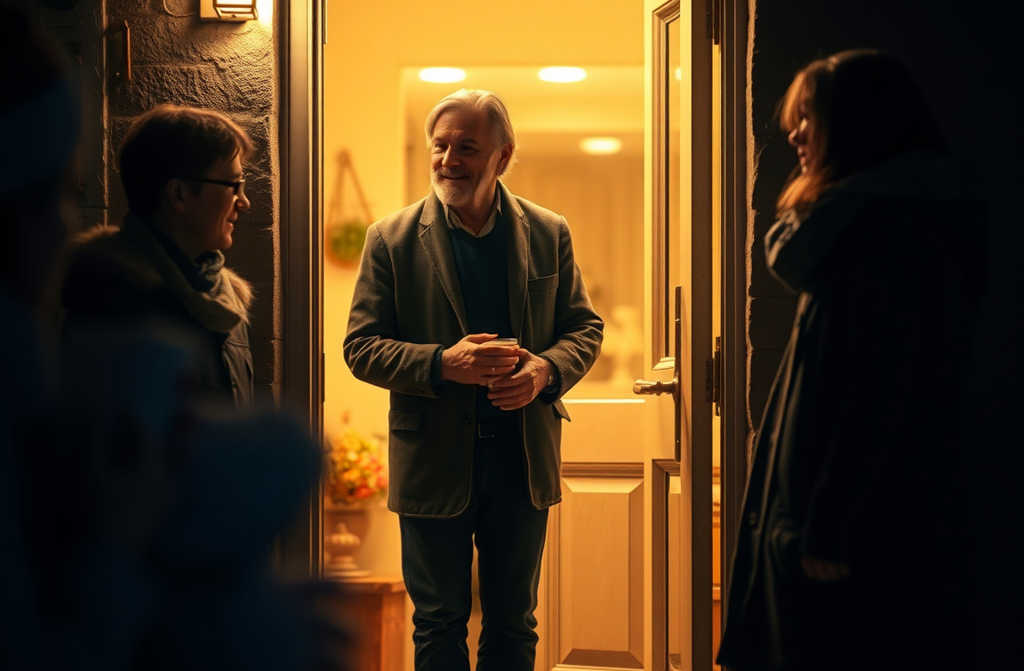
At his front door, he pressed his palm against the wall so he wouldnt miss the keyhole, when he caught, out the corner of his eye, a flickering to his left. The neighbours door, just past the wall, was ajar by a hands breadth. Hazy coloured fairy lights shimmered from the hallway inside, dangling over a coat rack, and a faint old song played somewhere deep within, a womans voice singing about snowflakes, snowflakes, dont melt away.

He froze, key held aloft. The landing was chilly, smelled like someones fried sausages merging with the deodorant from his own jacket. Snatches of his friends toasts flickered in his mind: To healthmay we stay young! And, for a moment, he felt acutely hollow. At his friends earlier, it had been loud and crowdedchildren darting about, party poppers set off out the window. Hed laughed and drunk and listened to talk of mortgages, Spain, renovations. When the clock struck midnight, they clinked flutes, embracedsomeone sniffed sentimentally over a third glass. Then the taxi, a quick ride through the half-asleep city, twinkling lights on bare trees, and now he was here, shoes pinching, ears ringing, home alone.

He knew the neighbours by face, not by name. A man about sixty, grey at the temples, a paunch beneath his jumper, always nodding politely in the lift. A woman, a bit shorter, cropped hair, always carrying a netted shopping bag and some parcels. Theyd lived here longer than him; when hed moved in fifteen years ago, their surname was already on the plaque beside the door, but hed never paid real attention. Just a nod, a hello, perhaps a brief exchange about the heating being off. That was it.

He looked at the neighbours slightly ajar door. The music was subdued, lights flickered lazily. Inside, all was dark except for the faint lamp in the corridor. The door sat still.

His first instinct was to carry on. They might be airing out the flat, or forgotnone of his business. He was already slipping his key in his own door, just about to go in, when something jabbed at him. A neighbours door left open on New Years night, when everyones either with guests or locked in against errant fireworks. Old songs from his childhood. And a strange sense that if he simply goes inside, kicks off his shoes, puts on the concert rerun, then thats all his life will be: people just beyond the wall whom he never truly knows.

He drew his key out, listening. No voices, no laughter. The song ended and another, about a blue train carriage, began. He winced; what if someone inside was unwell? Had they fallen and not reached the door? The news always ran stories of old folks found days later. He remembered seeing his neighbour at the chemist a fortnight prior, fiddling with coins, apologising to the queue as he paid for medicines.

All right, he murmured under his breath, and stepped towards their door.

At first, he just pressed his fingers against it; it edged open a smidge, stopping against something soft. Through the gap, he could see more of their hallway: a faded rug, battered boots, womens slippers lined with fluff. The smell of roast chicken and oranges lingered in the cooling air. Coats hung on the rack, the strand of fairy lights draped over hangers.

Hello? he called gently. Um Are you there?

No answer. The music played evenly, the electricity was still on. He rapped his knuckles on the door.

Neighbours? Everything all right?

Inside, there was a dull thud, followed by footsteps. The door swung a few inches further, revealing the womans facecheeks flushed, eyes tired, hairdo festive but tired. Her sparkly jumper shimmered, a delicate chain at her neck.

Oh! she said, immediately reaching for the handle as if to shut it. Sorry, were just

He lifted his hands, shrugging.

I your door was open. I thought well. Is everything all right?

She took a moment, eyed his crooked tie, the bag of salad leftovers in his hand, and recognition flickered.

Oh, youre from Number Nine! she exclaimed. Yes, yes, its fine. Id opened the window a bit

A mans voice called from inside

Whos there, Lydia, more party-poppers?

Neighbour, she shouted back. From our floor.

The door wobbled further, and the man appearedshirt untucked, top button undone, clutching a glass of something amber. Wrinkled face, clear eyes.

Oh, evening, he said. Happy New Year.

And you, replied Anthony, then realised he didnt know their names. Saw your doorthought it might be a draft, maybe youd gone out.

Oh no, the womanLydiasmiled. Habit, really. I nip out with the rubbish, always forget to shut it fully. I got distracted, sorry if we worried you.

He nodded, half-stepping back.

Well, if alls well, Ill be off then. Happy

Hang on, the neighbour said unexpectedly. Drop in for a minute, since you popped by.

Anthony hesitated.

Ive already been round to friends, eaten, drunk. Wouldnt want to impose.

Nonsense, the man waved. Neighbours, arent we? Twenty years of hellosnever once a sit-down. Lydia, shall we offer our guest a quick tipple?

Lydia shrugged, but her gesture was more welcoming than not.

Come in, she said. Nothing fancy. Shoes off, just pop through to the kitchen.

Anthony glanced at his own door. The keys weighed heavily in his pocket; his bag still held leftover salad, plus the bottle of prosecco never opened at his friends. The flat next door felt especially cold now.

Right, he agreed. Just for a moment.

He slipped off his shoes, parked them beside theirs. Not much footweartwo pairs of mens boots, old but well-cared for, a pair of womens boots, no hint of childrens shoes. He took his bag with him out of habit, unsure where to leave it.

Here, let me, Lydia reached for it. What have you got?

Oh, umsalad leftovers and some prosecco. We didnt finish.

Perfect, she said. Were out of bubbles. Call it a gift!

The kitchen was compact but cosy. Plates of salad lingered on the table, a bit of herring and beetroot (English-style), sliced meats, some clementines. Among plates, a vase of pine branches holding stray baubles. Another strand of fairy lights glowing on the windowsill. A woman in her fifties, glasses, soft-eyed, scrolled through her phone, empty glass beside her.

My sister, Jane, Lydia introduced. Jane, this is our neighbour from Number Nine. Er

Anthony, he supplied. Anthony Smith.

Oh, proper! the husband chuckled. Were all first names here. Im Victor. He offered a handshakegrip warm, rough-edged.

Take a seat, Anthony, Jane said, sliding over a stool. Lydiall get you a plate.

Anthony settled, a bit awkward. He noticed a black-and-white photo hanging on the wallyoung Victor in army dress, Lydia beside him, holding a five-year-old boys hand. The fridge sported magnets from towns hed never visited.

Well then Victor splashed clear liquid into little glasses. To opening doors now and then, not just shutting them.

Anthony smiled. It sounded theatrical, but Victors tone was more weary resolve than bravado.

They drank. The vodka was unexpectedly gentle, a warmth in his chest. Through the wall came the chorus of another song, something about three white horses.

Where did you celebrate? Lydia asked, spooning him more salad.

With friends, he replied. Big group, kidslots of noise.

And home alone now? Jane peered over her glasses.

He nodded, not wanting to dive into details.

Daughters up in Manchester with her husbandher own family there. I he trailed off, remembering hed meant to avoid the subject. Its just me, really.

Ah, Lydia said quietly. Our sons down in Kent. Hes off to his in-laws with the grandchildren tonight. Of course, were not upset. Young ones, their own plans.

Victor snorted.

Not upset, he mimicked. Just havent glimpsed the grandkids in half a year. Not upset, though!

Jane smiled, though sadness flickered in her eyes.

Have you been here long, Anthony? she asked, splitting a clementine.

Fifteen years, he replied. Came afterwell, after my divorce. Bought the flat and moved in.

My, really? Lydia shook her head. I thought you were new. You seem youthful.

Anthony grinned.

Thank you. Im fifty-two.

Victors sixty-two, Jane interjected. He insists hes still a lad.

I am, inside, Victor helped himself to another tipple.

They chuckled, laughter soft but genuine. Anthony felt a releaseshoulders lightening. He saw little details: neatly folded napkins, well-worn but clean cloth, stains from beets, a plate with half a cold drumstick left to one side.

I remember you, Lydia said out of the blue. Once you moved in with boxes full of books in the lift. I thoughtweve got ourselves an intellectual neighbour!

That was my moving day, Anthony nodded. Carried it all myself, gave my back no end of trouble.

And I recall you once returning covered in snow, Victor chimed in. About ten years agoI was just entering, you had a Christmas tree caught in the lift doors. I helped you yank it through.

Anthony was surprised. He vaguely remembered that tree, never knew anyone had noticed.

Strange, he mused. We live side by side, but all we knows just scattered little memories.

What more is there to know? Jane shrugged. As long as folk arent noisy and dont dump rubbish.

And dont flood the place, Victor added with a waggle. Weve got those students on seventhey throw parties, we know them too well.

They shared some neighbourly tales, laughed about the rowdy crew below, the old lady from eight who scolds everyone for rubbish in the stairwell. The conversation ambled like warm teaslow at first, then easier.

Anthony mentioned his office job, being sent home for remote work then dragged back inhow he hated the office dos, but turned up anyway. How odd it felt, walking among colleagues mostly younger than his own daughter.

Victor regaled them with stories about the factoryhis workshop closed, pushing him into odd repair jobs. Lydia chimed in with tales of him wallpapering neighbours flats at night to save up for a new fridge, how they used to drive out to their garden plot before selling it.

Jane remembered past New Years Eves in a different flat, a living tree, a house packed with guests. But then everyone got families, their own gardens, their own routines.

We always thought, Lydia said, pouring Anthony a glass of his own prosecco, that you must be some kind of high-flyer. Always so composed. Suit, briefcase

No, nothing grand, Anthony laughed. Just an ordinary manager. Suits company policy. Briefcase for the laptop.

Still, she insisted, You always seemed like someone who knew exactly what he was doing.

He pondered. Did he know? Tonight, sitting in a neighbours kitchen, he felt more like someone whod wandered accidentally into someone else’s life.

And what did you guess I did? he asked.

I thought you were a solicitor, Victor confessed. You walk like a man with business.

Jane tutted.

I guessed you were a teacher. Saw you one day chatting calmly to a boy drawing on the wallyou spoke to him gently, told him not to scribble.

Anthony remembered. That had been a neighbours kid from sixhed just had a quiet word. Forgotten all about it, but here was the memory, cherished.

Odd, isnt it, he repeated, how we build entire biographies from two moments.

And you? Lydia prodded, hand under her chin.

He was embarrassed. Truthfully, hed barely thought at all.

Well he hedged. Supposed you were a regular family. Children, grandchildren, celebrations together.

Victor sighed.

So you imagined were a riotous crowd with an accordion, he said. Realitys just three folks in the kitchen and a telly in the lounge.

And music, Jane added. Cant have New Year without the songs.

They paused. In the room, another tune finished; the radio presenter announced the next.

Used to be a full house, Lydia said softly. Our son, his mates. My folks visiting. We couldnt fit in here, had to move the table into the lounge. Now its everyones gone. My parents gone, our son far away, living his life. Not complainingit just feels strange.

Anthony nodded. He remembered his own old celebrations, married daysa big table, mother-in-law, father-in-law, friends. Then the split, the strange yearssometimes at his daughters, sometimes alone, sometimes joining work colleagues to avoid sitting alone. This year hed chosen friends for the noise, but deep down he felt like a guest at someone elses bash.

When I left my friends tonight, he said, surprising himself, I realised I was coming home as if to a hotel. Things there, but

He trailed off.

I get it, Jane nodded. When my husband died, I lived the same way. All mine, but all temporary.

Lydia squeezed her shoulder. Anthony felt a lump in his throat.

Sorry, he murmured. Didnt know.

No reason you would, Jane replied kindly. We only nod in the lift.

They talked on, time stretching softlynot heavy, just gentle. They swapped old New Year stories: the nineties blackout, heating soup on the gas stove; the night upstairs flooded them, Victor running with a bucket at midnight; Anthonys train journey, celebrating with strangers, clinking plastic cups.

The bottles on the table gradually emptied, salads cooled, music drifted into slow late-night radio. Outside, distant fireworks popped. Past three, and yet no one hurried him away.

Anthony realised he was not happy in the boisterous way of a crowd, but comfortable. He listened to Lydias stories of working in a library, her worries about books gathering dust. Victor joked about his ailments, likening them to a dodgy car engine. Jane detailed her job in the housing companys accounts office, eternally fielding tenant complaints.

You know, Victor said suddenly, I always thought neighbours were like passengers on the Tube. Get on, ride together, get off. Now, here we are, chattingits less scary getting old.

Anthony smiled.

Not ageing thats frightening, he countered. Its being alone.

True, Lydia agreed. Sometimes I wake at night and wonderwhat if? If Victors out, whod know? And you, Anthony, whod pop in?

He wasnt sure what to say. Faces in his mindcolleagues, friends, his daughter. All far off, all busy.

No one, really, he admitted. Work might worry if I didnt show up for a week.

There you go, Jane said. We three herewe could at least swap numbers.

Victor chuckled.

Whats your angle, sis? he asked.

That we should share phone numbers, Jane said serenely. Not for chit-chat, just in case.

Anthony nodded. The idea was simple, but now felt oddly significant.

Lets do it, he said. Seems silly otherwise.

Out came the mobiles. Lydia dictated her number; Anthony tapped in Lydia, neighbour. Victor gave hisVictor, neighbour. Jane too, adding a third person, less anonymous now.

Youd better jot ours down, too, Anthony reminded. You know, if you ever need anything.

Lydia wrote his number on a notepad, stuck it on the fridge with a magnet.

There, she said. Now we know you as Anthony, not just the one from Number Nine.

By four oclock the chat faded, tiredness descending. Lydia yawned, Victor rubbed his eyes, Jane checked the time ever more often.

Best let you get home, Lydia said. Weve kept you up.

Anthony glanced at his phone. Twenty to five. His body felt suddenly leaden.

Yes, I suppose so, he said. Thank you. For

He fumbled for a word.

For company, Jane offered. Its been good for us too.

Victor rose, a bit unsteady.

Ill walk you to the door, he said. Don’t want you lost in the corridor.

They passed into the hallway. The music was little more than a whisper now, the fairy lights drooping wearily.

Anthony slipped on his shoes, shrugged on his coat. Victor leaned on the wall.

Listen, Anthony, he said quietly, if everjust knock, all right? Were right here.

Anthony nodded.

And you too, he said. If you need something carried, fixedcomputer help. Thats my area.

Victor perked up.

Oh, our laptops always freezing. Lydias certain I broke it.

I never actually said you broke it, Lydia called out, just stating facts.

They both grinned.

Sorted, Anthony said. Ill drop in soon and take a look.

Victor shook his hand.

Happy New Year, neighbour, he said. May it bewell, at least as decent as tonight.

And you, Anthony replied. Happy New Year.

He stepped into the landing. Their door closed soft and easy, no longer wary. His own door greeted him with its familiar hush. He opened up, flicked on the light.

Flat was just as alwaysa battered sofa, telly, table with an unfinished mug of tea from the morning. Oranges on the windowsill, an empty vase nearby. Anthony went into his room, hung his coat over the chair-back. The pipes in the kitchen gave off a faint hum. He perched on the sofa, closed his eyes.

Faces floated up: Lydia, worn yet kind; Victor, with his blunt jokes; Jane, watching attentively. Their tales, their laments, their laughter; the realisation that all these years, a slice of life had whirred next door, unexplored.

He looked at the wall behind which their kitchen lay. Lydia might be tidying up, Victor shutting off the music, Jane making up her bed. The wall seemed thinner now, less solid.

He went to the kitchen, poured himself a glass of water, set it back without running the tapso he wouldnt disturb. Returned to his room, turned off the light, lay down. Sleep claimed him quickly; before drifting under, he decided that tomorrow, hed get something nice for tea and pop round. No excuse needed.

Three days on, home from work at dusk, the hallway smelled of boiled potatoes and something sugary. All was quiet on his floor. He climbed, reached for his keyand the neighbours door swung open.

Lydia, in a dressing gown, towel in hand.

Oh, Anthony! she said, switched to you without thinking. Perfect timing.

He paused with his key mid-air.

Everything all right? he asked, instantly concerned.

Oh yes, she smiled. I baked an apple pie and remembered you promised to help with the computer. Fancy popping in a minute? Ill feed you pie.

Warmth uncoiled inside him. He nodded.

Certainly, he said. Let me just put my things down.

He opened his own door, parked his briefcase by the hallway, and, without taking off his coat, returned to Lydia. She held out a steaming pie, scent of apples and real pastry filling the air.

Come in, she said. Victors already cross with the laptop.

He crossed the threshold. The fairy lights still hung by the coat rack, but off now. No music. Domestic and ordinary. Yet Anthony realised that, ever since New Years Eve, that doorleft slightly ajarwould never quite close to him as it had before.

He smiled and stepped through, heading for their kitchen.

Rate article
Add a comment

;-) :| :x :twisted: :smile: :shock: :sad: :roll: :razz: :oops: :o :mrgreen: :lol: :idea: :grin: :evil: :cry: :cool: :arrow: :???: :?: :!:

The Door Left Ajar He didn’t notice at first that something was wrong. He stepped out of the lift onto the ninth floor, reached into his pocket for his keys, and wandered towards his flat, the hum of champagne and salads still buzzing in his head. The hallway was quiet, unusually so for this night—the only sounds were laughter and slamming doors drifting up from a floor below. At his own flat, he paused, bracing his palm against the wall so as not to miss the keyhole, and only then caught, out of the corner of his eye, the flickering to his left. The neighbours’ door, just across the wall, was left slightly ajar, open by a hand’s width. In the dim corridor, coloured fairy lights were draped over the coat stand inside their hallway, and from within, almost inaudibly, drifted an old song—a woman’s voice singing, “Snowflake, snowflake, don’t melt away.” He froze with his key still in the air. The stairwell felt cool, scented with something fried lingering from someone’s kitchen, and the deodorant trapped in his jacket. Fragmented toasts from friends echoed in his mind: “To health, to us, to staying young,” and the emptiness pressed sharper for it. At the friends’ gathering, it had been noisy, the room bustling, children racing between beds and windows, someone setting off streamers. He’d laughed, drank, listened to chat about mortgages, Turkey, endless renovations. At midnight, glasses clinked, hugs were shared, tears spilled after the third glass. Then the taxi ride through a half-empty city, garlands twinkling in the trees, and here he was, in pinching leather shoes, a gentle throb in his temple and strange clarity: for all of it, he was going home alone. The neighbours. He knew their faces, not their names. The man was about sixty, greying at the temples, a slight paunch under his sweater, always nodded politely in the lift. The woman was a bit shorter, cropped hair and a mesh shopping bag, forever carrying groceries. They’d lived here before him. When he’d moved in fifteen years ago, their surname was already on the brass plate beside the door, but he’d never really read it. A hello, a nod, the odd exchange about hot water hoses, and that was it. He stared at the door left ajar. The music played softly. The fairy lights blinked as if half asleep. Inside it was dark, just the faint glow of a corridor lamp, and the door didn’t move. The logical first impulse was simply to walk past; maybe they were airing out the flat, maybe they’d forgotten, not his concern. He’d already begun turning his key in his own lock, but something pricked at him. An open door on New Year’s night, when everyone else was holed up with guests, wary of strangers and stray fireworks. Old songs drifting from the darkness, just like his childhood. And a nagging sense: if he simply disappeared inside his own flat, kicked off his shoes and set the TV to reruns, his life might remain just that—beside people he’d never really known, separated only by a wall. He withdrew the key and listened. No voices, no laughter, only the tail-end of one song and another starting, about a little blue carriage. He grimaced. What if something was wrong? Someone fallen, unable to reach the door? You read stories all the time about elderly neighbours only discovered after days. He remembered seeing the man a few weeks earlier, hunched in the pharmacy, fumbling for coins, apologising to the queue. “All right,” he murmured to himself and took a step towards their door. He tried gently pressing it with his fingertips. The door moved slightly, then stopped against something soft. Peering through the gap, more of the hallway came into view: a worn rug, a pair of boots, fluffy ladies’ slippers. It smelled of cold roast chicken and mandarins, the scent already fading but still holding on. Coats hung from the rack, the fairy lights dangling haphazard over hangers to the floor. “Hello?” he called, cautiously. “Er…are you at home?” No answer. The music played steadily, so electricity and devices were fine. He rapped on the wood. “Neighbours, you alright in there?” A muffled sound inside, then footsteps approached. The door widened and the lady of the house appeared in the gap: pink-cheeked, her eyes tired, festive curls falling limp. A sparkly sweater draped her shoulders, a thin chain at her neck. “Oh,” she said, instantly grabbing for the handle as if to close it. “Sorry, we were just…” He raised his hands, apologetic. “I…um…door was left open. Just thought…you never know. Is everything okay?” She gave him a once-over, clocked his slightly crooked tie, and the leftover salad bag in his hand—and seemed, finally, to recognise him. “Oh, you’re from the ninth, right?” she said. “Yes, yes, all fine. We just…had the window open and…” From deep inside, a man’s voice shouted: “Who’s that, Lyd–is it more party poppers?” “Neighbour!” she called back. “Ours, from the floor.” The door nudged wider and there was the man—shirt untucked, top button undone, clutching a glass of something amber. His face was creased, but his eyes clear. “Oh, hello,” he said. “Happy New Year.” “And you too,” replied Anton, realising he still didn’t know their names. “I…saw the door. Thought maybe a draft had blown it, or you’d stepped out.” “We just…” The woman—Lydia—smiled weakly. “Force of habit. I go to bin the rubbish and never bother to shut it all the way. Today I got distracted, left it open. Sorry if we startled you.” He nodded, already backing away. “Well, if all’s well, I’ll let you get back. Happy New Year…” “Wait a minute,” the man—Victor—suddenly said. “Come in for a minute, since you’ve stopped by.” Anton hesitated. “I…was just with friends. Ate, drank. I’d be intruding…” “No intrusion,” Victor waved it off. “Neighbours, aren’t we? Twenty years’ worth of hellos, never once sat down together. Lydia, let’s pour him a shot?” Lydia shrugged, but the gesture was more welcoming than not. “Come on in. Nothing fancy. Shoes off, kitchen’s through there.” Anton glanced reflexively at his own door. Keys heavy in his pocket, his leftover salad and unopened champagne still in hand. The cold emptiness of his own flat felt suddenly sharper. “All right,” he said. “Just for a minute.” He left his shoes by theirs: two pairs of men’s boots, old but smart, woman’s boots, but no children’s. Took his bag with him out of habit, not sure where to leave it. “Let me take that,” Lydia offered. “What have you got?” “Oh, you know,” he stammered. “Salad and champagne. Didn’t finish it.” “Perfect,” she smiled. “We’re out of bubbly. Looks like you brought a present.” The kitchen was small but welcoming; salads and herring under a fur coat, slices and tangerines still set on the table. Between the plates, a vase of fir branches with a couple of ornaments. On the windowsill, another set of fairy lights flickered. A woman of fifty or so sat at the table, glasses perched on her nose as she scrolled her phone. Next to her, an empty glass on a stool. “This is my sister, Tanya,” Lydia introduced. “Tanya, this is our neighbour from nine. What’s…” “Anton,” he supplied. “Anton Sergeyevich.” “Oh, so formal!” Victor chuckled. “We’re never that posh here. I’m Victor,” he said, reaching out. “Just call me Victor.” Warm, rough handshake. “Sit down, Anton,” Tanya said, pulling over a stool. “Lydia’ll get you a plate.” Anton settled in, self-conscious. He noticed the black-and-white photo on the wall—Victor, young, in uniform, Lydia with long hair, holding a boy by the hand. Magnets on the fridge of cities he’d never visited. “Well then,” Victor splashed glasses with clear liquid. “A toast—to opening doors sometimes, and not just closing them.” Anton smiled; it sounded grand, but Victor was sincere, more tired than pompous, somehow determined. They drank. The vodka was surprisingly gentle, warmth spread in his chest. From the next room, music played on—a man’s voice now singing of “three white horses.” “So, where were you tonight?” Lydia asked, doling out salad. “With friends,” Anton replied. “Busy, noisy, with kids.” “Home alone then?” Tanya peered over her glasses. He nodded, avoiding detail. “My daughter’s with her husband in Manchester,” he blurted, half out of habit, and checked himself—he hadn’t meant to talk about it tonight. “Family there, you know. And I’m…just me, really.” “I get it,” Lydia said quietly. “Our son’s out in Kent. Says he’s spending New Year’s with the in-laws. It’s fine – young people have their own plans.” Victor snorted. “We don’t mind,” he echoed. “Just, haven’t seen the grandkids in half a year. But we don’t mind, of course.” Tanya’s smile carried a flash of sadness. “How long have you lived here, Anton?” she asked, peeling a tangerine. “Fifteen years,” he said. “Since I…since I divorced. Bought the flat, moved in.” “Gosh,” Lydia shook her head. “I always thought you were new. You seem…young for it.” He grinned. “Thanks. I’m fifty-two.” “Victor’s sixty-two,” Tanya tossed in. “Keeps saying he’s just a lad at heart.” “And I am—at least inside,” Victor laughed, pouring another round. Quiet but genuine laughter. Anton felt his shoulders relax a little. He began to notice details: folded napkins, the old clean tablecloth lamped with beetroot stains, a plate topped by a cold, half-eaten drumstick. “I remember you,” Lydia ventured. “Saw you come up in the lift once, all boxes and books. Thought, ‘We’ve got a clever one moving in.’” “When I moved in, yes,” Anton nodded. “Did it all myself. My back complained for a week.” “I remember you came home one night covered in snow,” Victor recalled. “Ten years back now. I’d just come in, saw you wrestling a Christmas tree stuck in the door. Helped you free its branches.” Anton was taken aback. He’d vaguely remembered the tree, never thought anyone else had. “It’s odd,” he said. “We live side-by-side, but we only know odd fragments about each other.” “What else do you need?” shrugged Tanya. “As long as there’s no noise or rubbish left about.” “And flooding’s the main thing!” Victor added. “Students on the seventh floor—now them, we know all too well.” They laughed over tales of parties below, the old lady on eight who scolded for bin mess. The talk flowed, slow at first, then easier, like warm tea. Anton talked about the office, how he’d been switched to remote work and then hauled back in. About office parties he didn’t care for but attended (“got to show your face”). How it felt strange to be in a team where half were younger than his daughter. Victor spoke of the factory, of closures, attempts to find work elsewhere, finally patching up bits for neighbours. Lydia chipped in little stories—Victor wallpapering the neighbour’s lounge at midnight to fund a fridge, their weekends tending to an allotment they’d had to sell. Tanya recalled old New Year’s Eves—a trio in another flat, real pine tree, a houseful of guests. The guests had faded off over the years, everyone splitting for their own families, their own gardens and habits. “We always thought,” Lydia said, topping up his glass of champagne with his own bottle, “that you, Anton, were some important manager. Always so put together, suit and briefcase…” He snorted. “Not at all. Ordinary office person. Suit’s a dress code. Briefcase holds my laptop.” “Still,” she insisted, “you always looked like a man who knew what he was doing.” He pondered. Did he know what he was doing? Tonight, here, sitting at a stranger’s kitchen table, he felt more like a man who’d made a wrong turn and stopped in someone else’s story. “So—guessing games now—what did you imagine I did?” he asked. “I figured lawyer,” Victor admitted. “You have that walk…businesslike.” Tanya smiled. “I thought you were a teacher. Saw you once talking to a lad who’d drawn on the wall. You just calmly explained why he shouldn’t.” Anton remembered. That was the neighbour’s boy from six, ten or so. He’d intervened, spoken gently and moved on. Forgotten in a week—but not by everyone, apparently. “How strange,” he said. “We invent whole other people from little snapshots.” “And what did you think about us?” Lydia rested her chin in her hand. He hesitated, sheepish—he’d never really thought much at all. “Well…” he paused. “I figured…just an ordinary family. Children, grandkids, all of you together at holidays.” Victor sighed. “So you pictured singing and accordion, did you? But it’s just us—three at the kitchen table, telly on in the lounge.” “And the music,” Tanya said. “Had to have my songs on tonight.” A hush for a moment as another tune finished, the radio host introducing the next. “There used to be a full house here,” Lydia said quietly. “Our son, his friends, my parents visiting. We didn’t fit in the kitchen, had to use the table in the lounge. Now…well, everyone’s scattered. My parents gone, our son far off, his life elsewhere. Not saying it’s bad. Just…different.” Anton nodded, recalling his own lost holidays—back when he was married, a packed table, in-laws and friends. Then divorce, the odd years of visiting his daughter, sometimes alone, sometimes taking up colleagues’ invitations just to avoid his empty flat. This year he’d chosen a noisy party, still feeling a guest at someone else’s celebration. “When I left friends’ tonight,” he found himself saying, “it felt like I was heading to a hotel—not home. The flat, the stuff…it’s mine, but…” He trailed off, words escaping. “I understand,” Tanya nodded. “When my husband died, I lived like that a while. Everything was mine, but felt borrowed.” Lydia squeezed her shoulder, and Anton felt a knot in his throat. “Sorry,” he said. “I didn’t know.” “And why would you?” Tanya replied softly. “We only nod in the lift.” Talk lingered on, time stretching gentle and relaxed. They remembered old New Years: the blackout in the ‘90s warming food on a gas flame, the upstairs flooding that had Victor collecting drips in a bucket midnight, Anton’s year spent on a train home where everyone toasted with plastic cups. Gradually, the bottles emptied and salads cooled; the room slipped into slow songs as the clock pushed past three. No-one hurried to send Anton off. He realised he felt good—not jubilant like at the loud party, but peaceful. He listened as Lydia shared stories about working at the library, how fewer folk borrow books now. Victor joked about his ailments, comparing them to a car’s MOT checks. Tanya talked of her job in housing accounts—endless complaints from residents. “You know,” Victor mused at one point, “I always said folks in this building were like on the Tube: get in, ride along, get off. But here we are together, talking, and it doesn’t feel so scary—getting older.” Anton smiled. “Scary isn’t ageing,” he said. “It’s ending up alone.” “Exactly,” Lydia agreed. “Sometimes at night, I worry—if something happened and Victor was at the shop or the allotment, who’d know? And you, Anton—if something happened to you, who’d check in?” He hesitated. Colleagues, friends, his daughter—everyone far off, busy. “No one,” he answered honestly. “Maybe my boss if I missed a week of work.” “That’s just it,” Tanya replied. “There’s three of us right here. We could at least know each other’s numbers.” Victor snorted. “Now you’re getting ideas, sis?” “Just practical,” Tanya said calmly. “Not to ring all the time, just in case.” Anton nodded. It seemed sensible–but now, somehow, it felt important. “Let’s do it,” he agreed. “Would be silly not to.” They got their mobiles. Lydia dictated her number, Anton saved it as “Lydia, neighbour.” Victor gave his, “Victor, neighbour.” Tanya too, another new name in Anton’s contacts—not just a face in the corridor anymore. “Be sure to save mine,” he added. “If you ever need anything.” Lydia wrote his out, stuck it with a magnet on the fridge. “There—now we know your name, not just ‘the chap from nine’.” At four, fatigue washed over the group; Lydia yawned, Victor rubbed his eyes, Tanya watched the clock. “You should get home,” Lydia smiled. “We’ve kept you too long.” Anton checked his phone: twenty to five. He felt heavy from the day. “Yes, probably,” he agreed. “Thank you. For…” He paused, searching for the word—for food, for company, for letting him in. “For the company,” Tanya prompted. “We enjoyed it too.” Victor got up, swaying a little. “I’ll walk you to your door,” he said. “Can’t have you lost in the hall.” They stepped into the corridor; music barely audible, the fairy lights blinking lazily as if ready to sleep. Anton tugged on his shoes, zipped his coat. Victor leaned a hand on the wall. “Listen, Anton,” he said, lowering his voice. “If you ever—well, whatever—knock, don’t be shy. We’re right here.” Anton nodded. “You too,” he said. “If you need anything lugged, fixed, computer issues—I’m good with that.” Victor cheered up. “Ah, the computer! Our laptop freezes all the time. Lydia always says I’ve broken it.” “I’m not blaming you,” Lydia called from the kitchen. “Just stating the facts.” Both men grinned. “Deal,” Anton said. “I’ll pop round and look at it.” A handshake. “Happy New Year, neighbour,” Victor said. “May it be—at the very least—as good as tonight.” “And you,” Anton replied. “Happy New Year.” He stepped onto the landing. Their door closed softly, not guarded as before. His own door greeted him with its usual silence. He unlocked, switched on the light. The flat looked just as always: sofa, telly, table with his untouched morning mug. Tangerines on the windowsill, the empty vase. He hung his coat, sat for a moment on the edge of the sofa, eyes closed. Faces flashed—Lydia, kindly tired, Victor with rough jokes, Tanya’s attentive smile. Their stories, gripes, their laughter. For all these years, a whole small world had lived just beyond his wall. He glanced at the wall behind which their kitchen sat. Perhaps now, Lydia was clearing plates, Victor shutting off the music, Tanya laying out a bed. It no longer felt so impassable, but somehow thinner. He made himself a glass of water, set it quietly in the sink. Back to the lounge, lights out. Sleep arrived swiftly, but before it took hold, Anton promised himself: tomorrow he’d buy something for tea and drop by—no reason needed. … Three days later, coming home after work, the hallway smelled of boiled potatoes and something sweet. All was quiet on his landing. He slipped out his keys—just as the neighbours’ door swung open. Lydia, in a dressing gown, towel in hand. “Oh, Anton,” she said, already on first-name terms. “Good thing you’re—back.” He paused, key hovering at the lock. “Something wrong?” he asked, bracing for trouble. “Oh, no.” She smiled. “I made an apple pie. Remembered you said you fix computers. Fancy popping in for a minute? I’ll feed you pie.” Anton felt a gentle warmth uncurl inside. He nodded. “Of course,” he said. “Let me just drop my bag.” He went into his own flat, left his briefcase in the hall, and returned to Lydia. She carried a dish fragrant with home-baked apples and pastry. “Come through,” she said. “Victor’s already complaining at the laptop.” He crossed the threshold. The fairy lights were still looped over the coat rack, but switched off. No music tonight. The kitchen was plain and everyday. But Anton knew: that door, once left ajar on New Year’s night, would never close on him in quite the same way again. He smiled and stepped into the kitchen.
The Best Woman Who Raised Me Wasn’t My Mum—She Was My Stepmum




