The Betrayal
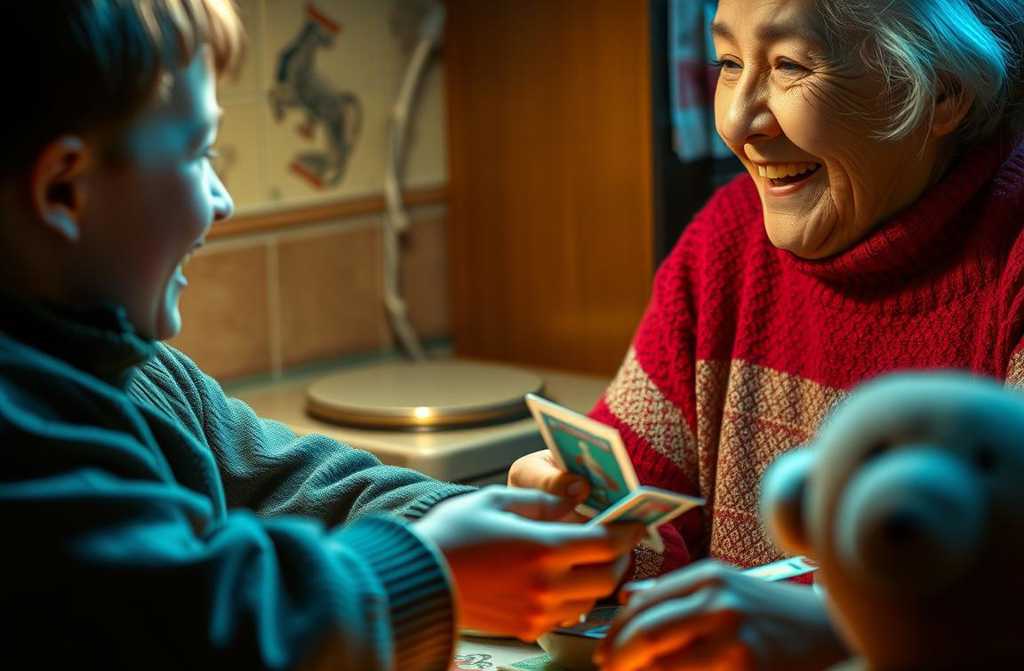
“I taught your little Alfie to play cards!” Granny Polly announced cheerfully.
“Why?” Exhausted from work, Marianne frownedAlfie had only just turned six.
“Well, imagine! He visits someone, and they sit down to play cards,” Granny explained. “Hell join ingood for socialising, isnt it?”
It made sense in a way. Granny Polly had grown up in post-war Britain, where a game of cards or dominoes was considered perfectly wholesome entertainment. And this wasnt happening nowit was decades ago, back when life moved slower. So why not learn a proper game of whist?
Granny Polly had come to babysit her great-grandson, baby Tommy, while Alfie loitered nearby, scowlinghe hated nursery. The boy was fiercely independent, with a house key around his neck and lunch in a thermosnormal back then, though nowadays parents couldnt pry their grown children from their grasp.
The estate was decenta cosy square of brick blocks enclosing a courtyard with a ping-pong table and a proper playground, complete with swings and a sandpit.
One block housed a shop called “Bright Lights,” which inexplicably sold furniture alongside lamps and chandeliers.
And furniture was heavy. Unloading it didnt inspire much cheer.
So the children often came home with colourful new vocabulary: “Mum, what does *bloody* mean?”
These were dubbed “enlightening words.”
But it was a small price to pay for the safety of the courtyard. No one worried about kids playing outsideeven the deliverymen kept an eye on them.
Marianne had married firstfallen hard for a classmate and gotten pregnant. Later, her mother-in-law, who worked at a nursery, took little Alfie during the week so Marianne could finish medical school.
After graduation, both she and her husband became GPsback when job placements were still assigned.
Her sister, pretty little Helen, didnt marry until twenty-fivelate by the standards of the time.
The sisters couldnt have been more different: Marianne, quick and sharp with raven-black hair, was the opposite of Helen, who was slow, plump, and golden-blonde.
Yet both were strikingly beautifulone dark, one light, two halves of a whole.
People often asked: *Are you sure you have the same father?*
“Not at all!” the sisters would snap, though they got on famously.
Their father had died years ago. Their mother had long since moved on, leaving the flat to her grown daughters while expertly dodging questions: *Why does it matter? Of course he was your only father! Absolutely only one!*
Until twenty-four, Helen had men wrapped around her fingerher heart still asleep, though she had her flings.
She met her future husband at a party a few years after schoolPeter was a friend of their old classmate, Alex.
Helen even agreed to a date. But she came back disgusted.
“Hes so *boring*!” she fumed. “Youll never guess what he asked me.”
“What?” Mariannes heart skippedthis must be scandalous.
“*Did I wear warm knickers?* Can you believe it?” Helen wrinkled her nose. “How *common*!”
Yes, the manthree years older and utterly smittenhad merely shown concern. It was freezing out, and everyone wore thermal underwear.
Nothing scandalousjust care for a silly girl who didnt dress for the cold. But youth is cruel. So Peter, kind as he was, got rejected along with his sensible advice.
He reappeared seven years later. By then, Helen had sifted through countless suitors but remained alone, still living in the sisters two-bedroom flat.
Then, suddenly, the men vanished. After New Years, she stayed homeno invitations.
Then Marianne found a needle hidden in her sisters quilt. Someone had cursed hera love spell, or worse.
Helen had plenty of friends who often stayed overthe flat was near the Tube, perfect for commuting.
The needle was removed, and Helen bumped into Peterfate, surely! And this time, when he asked about warm knickers, she swooned. *How thoughtful!*
She married himnow a PhD in mathematicsand he promptly moved in, marking the occasion with a new enamel kettle and a sofa.
“But we already *have* a kettle,” Marianne said.
“This ones yours,” Peter explained. “That ones *ours*.”
For the first time, tension flickered between the sistersPeters kettle was nicer.
And his parents were comfortably offunlike Mariannes husband, whom her mother called *that layabout* behind his back.
Plans were made to swap the flat for two smaller onesPeters parents would help with the difference.
Time passed, and baby Tommy arrived. Helen went back to work, while clever Peter enlisted Granny Polly to babysit.
One evening, Marianne came home earlyrunning a fever. Her shifts had been handed to a colleague. *Get well soon, Doctor Harris!*
The flat was darkprobably asleep.
Inside was a makeshift infirmary: Helen had taken leave to care for Tommy, and her husband, John, was down with a slight fever. Alfie, as always, was home.
Quietly turning the key, Marianne frozeodd noises. *Please, let the kids be alright.*
Still in her coat, she peeked into the room. In the fading light, six-year-old Alfie and drooling Tommy sat on the carpet, cards in handAlfie teaching his brother whist *”for society.”*
“Wheres Daddy?” Marianne asked.
“Daddy and Aunt Helen are washing clothes in the bath!” Alfie chirped, then turned to Tommy, who clutched a single card: “Ill go firstcover me!”
Granny Pollys lessons had borne fruit.
“How long have they been washing?” Mariannes heart pounded.
“The big hand was on six, now its on nine!” Alfie said.
*Fifteen minutes. He never takes that long with me.*
Her stomach twisted. *So this is why she wont move out.* Helen had always found excusesthe door was wrong, the flat too far. Now she knew.
Did Peter know? Unlikely. His parents wouldve throttled her.
Still in her coat, Marianne stood outside the bathroom, waiting.
Soon, flushed and breathless, John and Helen emerged.
“Youre supposed to be at work!” they blurted.
“Thought Id help with the washing,” Marianne said icily. “Done already? Hang it up, then.”
“Its not what you think!” John stammered.
“Fine. Show me the laundrymaybe you can talk your way out.”
*Come on, think of something! Say you had a fever, and Helen was cooling you with compresses!*
They stood dumbstruckno excuses prepared.
“Both of youout.”
Helen snatched Tommy and fled. John sent Alfie outsidestill lightthen begged Marianne: *It was a mistake! I love only you! She came onto me!*
But his wife was ice. *Cheated. Probably for ages.*
Later, she learned “laundry days” were frequent.
John, feverish at 37.2°C, was thrown out. Contact with Helen dwindled.
Marianne said nothing to Peterif she told him, hed divorce Helen. Then shed be trapped in that flat with her treacherous sister.
Instead, Helen agreed to the first available swaptwo tiny flats.
Divorced, Marianne ended up in a cramped council flat with a four-foot kitchen and a *glorified cupboard* for a bathroom.
But it was hers. *Better a humble home than a borrowed palace.*
John crawled back to his parents.
Months later, working at a new clinic, Marianne returned to silenceAlfie was playing.
He was self-sufficient, her Alfie. Though he missed his cousin.
Now he sat on the rug, a stuffed bear propped against a chair. Cards fanned out before itAlfie teaching his plush friend whist *”for society.”*
Then Marianne heard him coo: *”Alright, you daft bear, whyd you lead with a trump?”*
Cheers, Granny Polly. He grinned, shifting the bears paw to play another card. “Because youre supposed to follow suit, you daft thing!” Marianne whispered, slipping off her coat. She poured a cup of tea, the steam curling like old memories, and watched her sonher clever, stubborn, heartbroken boylaugh at a game only he and a threadbare bear could understand. Outside, the city hummed on, indifferent. But here, in this small room, the rules still mattered. And sometimes, that was enough.






