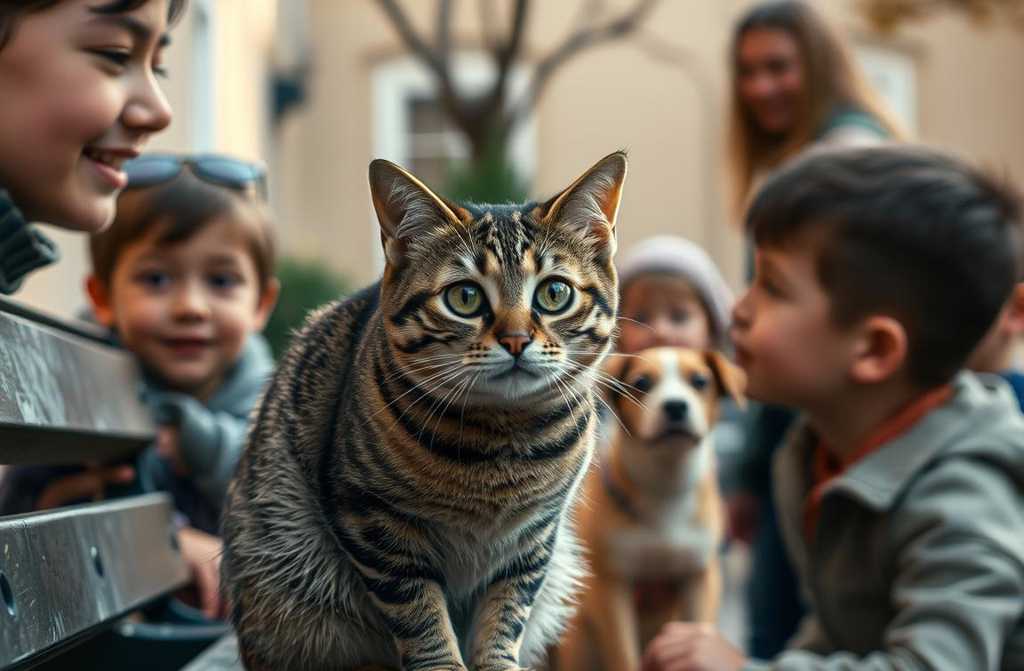
The Striped Guardian of the Square
In that square, everything was plain to see: windows faced one another, children knew not just their neighbours’ names but their habits too, and the adults kept track of who left and returned at what hour. By late September, the grass still clung to its green, though the mornings left it flattened under the weight of heavy dew. Come evening, the square filled with voicesboys kicked a football between the kerbs, girls set up a “shop” on the bench beneath the old chestnut tree. Moving among them, smooth as if following a map only she knew, was the cat: large, striped, with white patches on her paws and chest. She belonged to no one, yet everyone knew herMittens, or simply, the Cat.
The children were drawn to her like a living charm: some brought scraps of sausage from home, others stroked her back or whispered secrets to her beneath the rustle of the wind. The women treated her kindly toosome left a bowl of food by the doorstep, others invited her to shelter in the porch during bad weather. Even newcomers, still unfamiliar with the squares ways, soon noticed: without this cat, something vital was missing from the daily bustle.
But there was one familyThomass mother and fatherwho saw the Cat differently: warily, even with irritation. His mother often said aloud,
“Its dangerous! Who knows what germs she carries Stray animalsno telling where theyve been!”
His father silently agreed with a glance or a short sigh; he rarely spoke on matters concerning animals. Their fears were simple: cleanliness came first, and a child should play without risk of catching something “from the streets.”
Thomas watched the Cat from the corner of his eye. If his mother noticed his interest, hed look away or pretend to be busy with his toy cars. But the moment his parents turned their backs or got caught up in grown-up chatter by the door, hed follow the Cat to the edge of the flowerbed or wait for her by the sandpit.
Evenings transformed the square: the sun dipped quickly behind the rooftops, the pavement cooled. The children lingered, as though summer hadnt quite left Yet the air grew noticeably chillier after sunsetsuddenly, you wanted to pull your jacket tighter or tuck your hands into your sleeves.
The Cat knew every soul in the square: she responded only to certain voices or footsteps. If Thomas called softly from behind the bushes, shed approach cautiously; if Mrs. Eleanor tapped a spoon against a bowl by the entrance, shed appear faster than any other feline in the neighbourhood.
Life moved steadily: mornings saw schoolchildren vanish around the corner with their backpacks slung over their shoulders, afternoons left toddlers with their grandmothers in the sandpit, and evenings brought the square together again beneath the first-floor windows.
Sometimes, Thomass mother tried to warn the other women about the dangers of strays:
“No one knowswhat if shes carrying some disease? If only she were a proper house cat”
But the women just shrugged.
“Shes harmless! We look out for her!”
“Without her, the mice wouldve taken over by now!”
And the conversation fizzled outeach holding to their own view.
This went on until one September evening. The day had been damp after rain: the pavement had dried by afternoon, yet puddles still caught reflections of window frames between the paving stones. The chestnut leaves had begun to yellow, and a heap of them had blown beneath the swings.
Thomas was playing near the house with two older girls and the younger brother of one. The Cat lay nearby on the warm concrete ledge by the doorstepshe always sought the warmest spots as evening fell.
Then, from the direction of the garages, came a low, muffled bark: one sharp sound, then another, then a third in quick succession. The children froze by the swings; even the adults by the door turned at once.
From around the corner burst a dog: a large black mongrel with a torn collar, its fur bristling with tension. It moved fast, jerking its head as if searching for someone among the squares residents.
Thomas stiffened, then stepped back behind the older girl.
“Dont worry Itll go away”
But the dog came too quicklythe children retreated toward the house, calling for the grown-ups. Thomass mother was the first to rush out.
“Come here!”
She sprinted toward her son across the rain-damp grass. His father, still in the kitchen, hadnt noticed the danger yet.
At that moment, the Cat did something no one expected: she shot forward, low to the ground, straight toward the dog, so fast even the adults were stunned by her charge. The dog turned from the children, bared its teeth, and chased the Cat away from the sandpit, past the bushes along the garage wallout of the reach of the lamplight.
The boy was safethe dog vanished around the corner after its quarry, and the children stood trembling, staring into the shadows where the striped guardian had fled.
His mother clutched Thomas tightly, feeling his heart hammer beneath his jumper.
“Its all right Its all right”
But no one saw where the Cat had gone after her dash through the bushestoo quick for even the keenest eyes to follow.
As dusk settled and the square grew quiet, the children searched for her: around the doorstep, by the benches, along the hedges where she used to sit. Boys peered under cars, adults shone torchlight into flowerbed corners, calling her name.
Beneath the thick lilac bush, where leaves gathered after the wind, Thomas was the first to spot her: the Cats striped flank, her limbs curled awkwardly, white belly trembling faintly in the dew-damp grass. Her breathing was laboured, her blinks slow, her eyes half-lidded. The children gathered close; the adults knelt in a circleno one dared touch her at first, fingers stiff with cold, until Mrs. Eleanor carefully lifted her, wrapped in a coat to shield her wound.
In the flat where Mrs. Eleanor took her, several neighbours gathered. Thomass mother held his shoulders, keeping him from getting too close, yet her gaze never left the animal. His father stood aside, phone in hand, searching for the nearest vet.
The Cat lay on an old towel, curled tight as she could manage. The wound on her side wasnt deep, but longher fur matted with blood and damp. The women found iodine, bandages, and cotton wool; someone set a bowl of water nearby in case she wanted to drink. As some gently cleaned the wound, others whispered about the nearest clinic and whether it was still open.
Thomas watched wide-eyedhed never seen the adults so focused, so careful with a creature not their own. Even his mother, usually so stern about strays, now held the Cats paw steady to keep her from flinching.
“Hold her firm Gently now” she murmured to herself.
The room smelled of damp fur and iodine. Outside, night had long since fallen. Thomass father slipped into the hall and returned with a clean sheet, spreading it beside the towel.
“The vet will see her first thing tomorrow Ive just checked,” he said quietly to his wife.
“Thank you”
And in her voice was something new: an admission that this stray cat needed their help. What was happening bound them all faster than words.
“Lets keep her here tonight and take her to the clinic at dawn,” he suggested.
“Yes, thats best.”
They lifted the Cat, towel and all, onto the sheet and carried her to their flat.
The night passed uneasily: Thomas lay awake, listening for any sound from the next room. Every rustle might mean a change in the Cats state. His mother checked on her oftenadjusting the towel, refreshing the water.
Morning came early, before sunrise. The kettle hissed in the kitchen. His father sliced bread for sandwiches almost soundlessly. The Cat lay where theyd left hereyes half-open. When Thomas reached to stroke her head, her ears twitched faintly, and she gave a soft mewas if thanking him for the warmth.
The vets visit was quick; Mrs. Eleanor went with them. The wound wasnt life-threatening, the vet said, but needed time to heala few days of rest under watchful eyes. They left with antiseptic, diet instructions, and a leaflet on first aid for strays”just in case.”
Back home, duties were shared: his mother kept the Cats space clean, his father brought fresh water and food, even Thomas was allowed to help change the bandages under supervision. Neighbours dropped by with treats or hand-drawn cards.
Day slipped into evening unnoticedoutside, darkness fell fast, but inside, a quiet calm lingered, the kind that follows a shared trial or a grand celebration, where everyone feels needed. Mittens slowly improved: she ate from Thomass hand, let him stroke her back, sometimes rose to sniff at the door as if testing the bounds of this new refuge.
Within days, she was healing faster than expected. The fur around the wound dried, her appetite returned, her movements steadied, her gaze sharpened once more.
One crisp autumn evening, his mother opened the window wide to air the room after supperand Mittens approached the sill, pausing by her water bowl to stare outside, as if remembering every scent of the square.
“Perhaps we should let her out? She wont stay here forever”
His mother spoke without her old worry or reproachsoftly, as one might when seeing off an old friend after a long visit.
His father nodded silently; even Thomas understood what it meant.
Mittens leaped lightly from the sill into the squarelanding softly on the dry grass by the wall before vanishing into the lilac bushes evening shadows, just where theyd found her after the fight.
By the next morning, the square was alive again with voiceseveryone searching for their striped guardian among the flowerbeds or the chestnuts bench. When she appeared near the sandpit by noon, the children rushed to greet her; women smiled across the square as if sharing something wordless but important.
Even Thomass family treated her differently now: his mother left food by the door, his father spotted her first from the kitchen window, and the boy no longer hid his smiles when he stroked Mittens or played beside her.
The Cat remained the squares free-spirited guardianindependent as ever. Yet now, everyone knew the value of her presence. No more debates about “cleanliness” or the dangers of straystheyd all witnessed a small miracle, how one striped cat had united an entire neighbourhood to save a life, however fragile, in this vast world.