“Oh, my dear, you’re wasting your time greeting him—he’ll never marry you. And even if he does, you’ll suffer. Just wait till summer, when all the city girls flock in—what will you do then? You’ll be burning with jealousy. That’s not the boy you need,” Auntie Mary would say. But what lovestruck youth listens to the wisdom of age? Vera was barely sixteen when she lost her mother. Her father had left for work in the city some seven years ago and never returned—no word, no money. Nearly everyone in the village came to her mother’s funeral and helped however they could. Aunt Mary, Vera’s godmother, visited often, reminding her what needed doing. After Vera finished school, they set her up with a job at the post office in the neighboring village. Vera was a hearty village girl, often called “the picture of health”—round rosy cheeks, a potato-shaped nose, but radiant grey eyes. Her long, thick, fair braid reached her waist. The most handsome young man in the village was Nick. Two years out of the army, he’d had no shortage of admirers—girls from the city would arrive for the summer and compete for his attention. He should’ve been in Hollywood films, not working as a driver in the village. He hadn’t sown his wild oats yet and was in no rush for a bride. One day Aunt Mary came to Nick and asked him to help Vera fix her fence, which was starting to collapse. Life’s hard in the village without a man’s strength. Vera managed the vegetable patch, but the house was another story. Nick agreed without fuss. He arrived, inspected the fence, and started directing Vera: “Bring this, fetch that, hand me this.” She obeyed without complaint, cheeks turning redder and braid swinging behind her as she moved. When Nick tired, she’d serve up rich borscht and strong tea, watching as he bit into black bread with firm white teeth. Nick worked on the fence for three days, and on the fourth, he came by just to visit. Vera cooked him dinner, one thing led to another, and he stayed the night. Soon it became a regular thing, Nick leaving before dawn so nobody would see, though nothing stays secret in a village. “Oh, girl, you’re wasting your time on him—he’ll never marry you. And if he does, you’ll suffer. Come summer, those city beauties will arrive, and your jealousy will eat you up. You need a different kind of boy,” repeated Aunt Mary. But who in love listens to the wisdom of age? Then Vera realised she was expecting. She thought she’d caught cold or eaten something bad, but the truth dawned—she was carrying handsome Nick’s child. In a desperate moment, she considered ending the pregnancy—she was too young to be a mother. But then she decided it was for the best. She wouldn’t live alone. Her mother raised her alone, and she’d manage. Her father wasn’t much help, just drank. People would talk, but then they’d get over it. In spring, Vera shed her winter coat and everyone saw her belly. Village women shook their heads—trouble had come to the girl. Nick stopped by, asking what she’d do. “What’s there to do? Have the child,” she replied. “Don’t worry, I’ll raise it myself. You just live your life.” Flames from the stove flickered red on her cheeks and in her eyes. Nick admired her but left. She’d made her choice, brushing him off like water off a goose. Summer came, city girls arrived, and Nick’s attention drifted away. Vera kept on with her chores quietly, Aunt Mary helping in the vegetable garden—bending with her belly was tough. Vera carried half-buckets of water from the well, her belly large enough that the old women forecasted a strong boy. “Whoever God sends,” Vera would joke. Mid-September, she woke to a sharp pain, as if her belly had split in two. The pain faded but returned; she ran to Aunt Masha, who immediately understood. “Is it time? Sit tight, I’m coming.” Aunt Mary rushed out. She ran to Nick—his truck stood by the house. The city folks had all left for the season. Nick, having drunk a bit too much the night before, was sluggish but soon got the urgency. “It’s ten miles to the hospital! By the time I fetch a midwife, she’ll have the child—let’s go now! Pack her up.” “But by truck?” Aunt Mary protested. “You’ll shake her to pieces and deliver the baby on the bumpiest stretch!” “Then you’ll come with us, just in case,” he insisted. Nick drove two miles cautiously over rutted roads, cradling every pothole. Aunt Mary rode in the back on a sack. Once they hit asphalt, they sped up. Vera writhed in pain in the passenger seat, biting her lip and clutching her belly, Nick sobering up fast, jaw clenched, knuckles white as he gripped the wheel. They made it. Vera was left at the hospital. On the drive home, Aunt Mary berated Nick the whole way: “Why did you ruin that girl’s life? She’s alone, no parents, still a child herself, and now she’s got more worries—how’s she to cope with a child on her own?” Before their truck reached the village, Vera had already given birth to a healthy, strong boy. The next morning, she was handed her son to nurse. She didn’t know how to hold him or how to feed him, gazing at his red, wrinkled face with anxious eyes, biting her lip but following every instruction. Inside, her heart beat with joy as she inspected his tiny features, breathed on his forehead, delighted and awkward. “Will someone come for you?” a stern, older doctor asked before discharge. Vera shrugged and shook her head, “Probably not.” The doctor sighed and left. The nurse swaddled the baby in a hospital blanket and insisted she bring it back. “Fyodor will drive you home in the hospital car. You can’t possibly manage the bus with a newborn,” she admonished. Vera thanked her, walking down the corridor with her head lowered, cheeks flushed with embarrassment. In the car, she held her son close, anxious about how they’d cope. Her maternity pay was scant, barely enough to get by. She pitied herself and her innocent son, but one look at his sleeping face flooded her with tenderness and she pushed aside dark thoughts. Suddenly, the car stopped. Vera watched Fyodor, a short man in his fifties. “What’s wrong?” “Two days of rain—look at these puddles! No way to drive through or around. We’ll get stuck. Only a truck or a tractor could manage.” “Sorry. It’s not far, maybe two miles left. Can you make it?” He nodded toward the road, where a massive puddle spread out endlessly. The child slept in her arms. Even sitting, she was tired from holding him—a true little prodigy. How could she walk that road? She climbed out, adjusted her hold, and began edging along the ditch. Her feet quickly sank ankle-deep into mud, every step treacherous. Her worn shoes squelched with every step. If only she’d worn wellies to the hospital. One shoe got stuck in the muck; Vera paused, thinking it hopeless to retrieve it carrying her baby, and walked on with only one shoe. By the time she reached the village, dusk had fallen. Her legs were numb from cold; she was too exhausted to be surprised by the lights in her windows. She stepped onto the dry porch, legs frozen and body dripping with sweat. She opened her door and froze. Inside by the wall stood a cot, a pram, and neat rows of baby clothes. At the table, Nick sat with his head in his arms, asleep. He must have sensed her arrival; he lifted his head. Vera, flushed, disheveled, and barely upright, stood in the doorway with her child in her arms, dress sodden and legs caked with mud above her boots. Seeing she was missing a shoe, Nick rushed to help, took the baby, gently laid him in the cot, and fetched a pot of hot water for her feet. He helped her out of her muddy clothes, cleaned her up, and as she changed by the stove, he set a pot of boiled potatoes and a jug of milk on the table. The baby began to cry. Vera hurried over, picked him up, and without embarrassment, began to feed him. “What’s his name?” Nick asked in a hoarse voice. “Sergey. Do you mind?” she asked, looking up with her clear eyes. So much longing and love were in Vera’s gaze that Nick’s heart ached. “That’s a good name. Tomorrow we’ll go, register him, and get married.” “It’s not necessary…” Vera started, watching her son feed. “My son needs a father. I’ve sown my wild oats. I don’t know what kind of husband I’ll be, but I won’t abandon my son.” Vera nodded, head lowered. Two years later, they had a daughter, named Hope, after Vera’s mother. It doesn’t matter what mistakes you make at the start—what counts is that you can always set things right… This is just one of life’s stories—share your thoughts in the comments and give us a like if you enjoyed it.

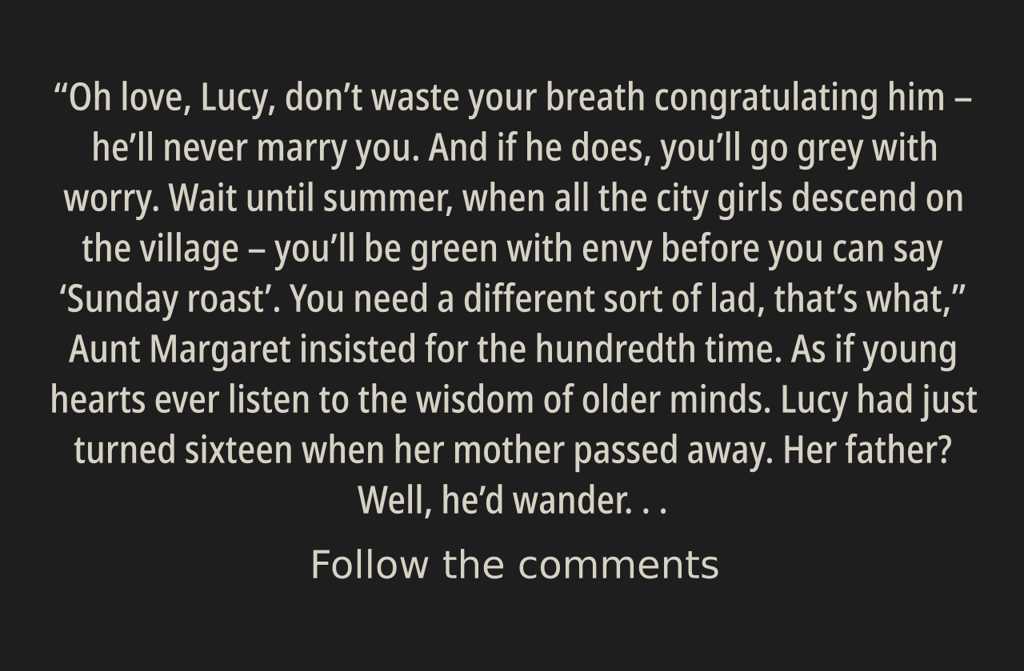
Oh love, Lucy, dont waste your breath congratulating him hell never marry you. And if he does, youll go grey with worry. Wait until summer, when all the city girls descend on the village youll be green with envy before you can say Sunday roast. You need a different sort of lad, thats what, Aunt Margaret insisted for the hundredth time. As if young hearts ever listen to the wisdom of older minds.

Lucy had just turned sixteen when her mother passed away. Her father? Well, hed wandered off to Birmingham about seven years ago to earn a living and promptly vanished off the face of the earth. No letters, no pounds just the rustle of the trees to keep her company.

The whole village turned up for the funeral, bringing shepherds pies and sad, sympathetic nods. Aunt Margaret, Lucys godmother, popped in like clockwork to remind Lucy of how laundry should be done properly, and to tut whenever she missed a spot. Once Lucy finished school, she landed a job as a clerk at the post office in the neighbouring village.

Lucy was what locals called rosy-cheeked and hearty. Her face was round and apple-pink, her nose button-like except it had ever so slightly veered into potato territory. Her eyes sparkled grey, and her thick, mousy braid tumbled down to her waist.

The handsomest lad in the village, according to just about everyone, was Jack Parker. Back from the army two years now, he had to beat off the admirers with a stick. Even the city girls visiting for summer couldnt help but flutter their eyelashes in his direction.

If there was any justice, Jack would be starring opposite Helen Mirren, not driving the village bus or fixing fences. He liked his freedom and wasnt exactly rushing to pick his future Mrs. Parker.

So when Aunt Margaret traipsed over to Jacks and asked him to help Lucy fix her fence, no one was surprised. Living in the countryside without a gentleman around is asking for trouble Lucy could wrestle cabbages into submission but brickwork was another matter.

Jack agreed with a shrug no drama, no strings. He showed up, inspected the damage, and instantly started barking orders: Fetch me this, dash over there, pass me that. Lucy, embarrassingly eager to please, ran errands up and down the garden path.

Her cheeks burned brighter with each order, her braid flapping about like it wanted to take off. When Jack needed a pick-me-up, Lucy fed him a hearty stew and strong tea, watching with quiet fascination as he chomped away on thick slices of wholemeal bread.

Jack worked on the fence for three days, and on the fourth, he turned up for no real reason except to visit. Lucy made him dinner, one word led to another, and he ended up staying the night. After that, he started coming around regularly, always slipping away before sunrise so the neighbours wouldnt natter. Not that they missed much you cant keep secrets in an English village.

Oh Lucy, youre wasting your time congratulating him hell never marry you, and should you force the issue, he’ll just drive you batty. Wait till summer arrives the city girls will give him the full flirty treatment, and youll be wringing tea towels in jealousy. Wrong chap for you, you mark my words, Aunt Margaret said again.

But does a smitten teenager listen to Aunties pearls of wisdom? Not on your nelly.

Soon Lucy twigged something was amiss. First she worried shed caught one of those mysterious countryside illnesses or maybe food poisoning. Felt weak as a kitten and queasy as a student after a night out. Then the penny dropped with a clunk: she was expecting Jack Parkers child.

She brieflyvery brieflyconsidered taking drastic action. Far too young, surely, for nappies and sleepless nights. But then she thought, Why not? Beats rattling round the cottage alone. Her mum coped with her, shed manage. Her old dad had been no help at all, drinking more than thinking. The gossips would have their moment, and then get bored, as they always did.

Come spring, Lucy hung up her winter coat and, lo and behold, the village spotted her bump before she could hide behind the hydrangeas. They clucked and muttered about trouble befalling the poor lass. Jack did pop by to ask what she planned to do.

What else? Ill have the baby. Dont stress, Ill manage on me own. Live your life, she said, pottering about the kitchen, her cheeks glinting in the firelight.

Jack gazed at her a moment perhaps moved by her resolve or just trying to recall when he last felt so sober and left. Lucy had decided, simple as that. Like water off a ducks back. Summer rolled around, the city girls arrived in floaty dresses, and Jack was too busy flirting to bother with Lucy.

Meanwhile, Lucy did what country girls do: weeded the veg patch, fetched buckets of water from the well, and accepted Aunt Margarets help with weeding since bending over was now more of a performance art. Her bump grew impressively, and the old ladies predicted shed have herself a strapping lad.

Whatever the good Lord sends, Lucy quipped.

Mid-September, Lucy woke with a pain so sharp she thought she might split in two. It ebbed then surged again. She dashed to Aunt Margarets, who took one look and rushed out the door.

What, already? Stay here! cried Aunt Margaret, and she dashed off to find Jack. His battered van was parked out front, amid empty wine bottles and a lingering hangover.

Aunt Margaret jabbed him awake. Jack blinked, confused, only to groan, It’s ten miles to the hospital! By the time I fetch the doctor, shell have delivered the baby on the doorstep. He decided to drive Lucy himself.

But youll rattle her to bits in that van! Shell give birth at fifty miles an hour, Margaret fussed.

Youre coming too, in case, Jack insisted, and off they went.

For two miles, Jack tiptoed over potholes. Every ditch dodged was followed by another bump. Aunt Margaret perched in the back on a sack, and Lucy clenched the passenger seat, struggling not to cry out. Jack was as sober as a judge now, his knuckles white on the steering wheel.

They just about made it, dropped Lucy off at the hospital, and headed home. Aunt Margaret lectured Jack all the way; What did you do to the poor girl? No parents, just a child herself, now saddled with a baby. Howll she manage?

The van hadnt even reached the village when Lucy became proud mother to a bouncy baby boy. The next morning, a nurse handed him over for feeding, and Lucy stared at his scrunched-up, red little face, unsure how to hold or feed him.

Instructions rang out, Lucy nodded mutely, but her heart brimmed with joy. She stroked his tiny forehead and felt herself almost swooning with happiness.

Will anyone come for you? the stern doctor asked before discharge.

Lucy shrugged, Doubt it.

He sighed and left. The nurse put her boy in a hospital blanket and told her to bring it back next time. Fredll give you a lift in the hospital van you can’t take a newborn on the bus, she said.

Lucy thanked her, face burning as she walked the corridor. Back in the van, Lucy cradled her baby and fretted about how theyd scrape by now.

Maternity pay was a joke barely enough for a bag of crisps. She felt rather sorry for herself and her innocent little boy. But gazing at his sleepy face, Lucy found herself enveloped in a fierce tenderness.

Suddenly the van stopped. Fred, a stout man of about fifty, looked apologetic.

Rains been pelting down two days straight. Look at that lake, Ill get stuck if I try it! Only a tractor or a lorry could manage.

Sorry, but its only two miles to go. Youll have to walk them, he said, nodding towards the floodwater stretching to the horizon.

Lucys arms ached just holding her son. He was a bruiser great if youre sitting, less so if youve got to slog through mud. But she had no choice.

Lucy edged out of the van, juggled her baby, and picked her way around the giant puddle. Her shoes sank into the clay, squelching with each step. Why didnt I wear wellies? she grumbled as one shoe disappeared into the bog. She tried to fish it out but had to march bravely onward in just one shoe.

By the time she reached the village, dusk had fallen, her feet were numb, and she lacked the energy to be surprised by the glowing lights in her window.

She staggered up the steps, shivering, sweat and mud coating her from the journey. Lucy opened the door and froze.

A babys cot stood by the wall, a pram next to it piled with little outfits. Jack slumped at the table, head on his arm, snoring.

Maybe it was her presence, maybe the draught, but Jacks head shot up. Lucy, bright red and bedraggled, baby clutched to her chest, stood shivering in the doorway. Her skirt was sopping wet, and she was, embarrassingly, minus one shoe with her muddy socks on full display.

Jack jumped up, took the baby, tucked him in the cot, and busied himself at the stove with a saucepan of hot water.

He helped Lucy off with her cold clothes, washed her feet, and handed her fresh pyjamas. By the time shed changed behind the stove, hed set out boiled potatoes and a pitcher of milk on the table.

The baby started howling. Lucy rushed to him, picked him up, and sat down to feed him with not a shred of embarrassment.

Whats his name? Jack asked, voice scratchy.

Edward. That alright? Lucy replied, her grey eyes searching his face.

So much longing and love lingered there that Jack felt his heart twist.

Nice name. Tomorrow, well get him registered and sort out the paperwork and well get married, right then.

Thats not necessary Lucy began, watching Edward feed.

My son needs a dad. Ive had my fun but I wont miss out now. I dont know if Ill be much of a husband, but Ill never leave my boy.

Lucy nodded, head down, a shy smile sneaking onto her lips.

Two years later, they welcomed a daughter whom they named Hope, after Lucys mum.

In the end, it doesnt matter what missteps you make at the start you can always set things right.

And thats how life unfolded here in our little English village. What do you reckon? Pop your thoughts in the comments, and dont forget the likes!


Rate article
Add a comment

;-) :| :x :twisted: :smile: :shock: :sad: :roll: :razz: :oops: :o :mrgreen: :lol: :idea: :grin: :evil: :cry: :cool: :arrow: :???: :?: :!:

“Oh, my dear, you’re wasting your time greeting him—he’ll never marry you. And even if he does, you’ll suffer. Just wait till summer, when all the city girls flock in—what will you do then? You’ll be burning with jealousy. That’s not the boy you need,” Auntie Mary would say. But what lovestruck youth listens to the wisdom of age? Vera was barely sixteen when she lost her mother. Her father had left for work in the city some seven years ago and never returned—no word, no money. Nearly everyone in the village came to her mother’s funeral and helped however they could. Aunt Mary, Vera’s godmother, visited often, reminding her what needed doing. After Vera finished school, they set her up with a job at the post office in the neighboring village. Vera was a hearty village girl, often called “the picture of health”—round rosy cheeks, a potato-shaped nose, but radiant grey eyes. Her long, thick, fair braid reached her waist. The most handsome young man in the village was Nick. Two years out of the army, he’d had no shortage of admirers—girls from the city would arrive for the summer and compete for his attention. He should’ve been in Hollywood films, not working as a driver in the village. He hadn’t sown his wild oats yet and was in no rush for a bride. One day Aunt Mary came to Nick and asked him to help Vera fix her fence, which was starting to collapse. Life’s hard in the village without a man’s strength. Vera managed the vegetable patch, but the house was another story. Nick agreed without fuss. He arrived, inspected the fence, and started directing Vera: “Bring this, fetch that, hand me this.” She obeyed without complaint, cheeks turning redder and braid swinging behind her as she moved. When Nick tired, she’d serve up rich borscht and strong tea, watching as he bit into black bread with firm white teeth. Nick worked on the fence for three days, and on the fourth, he came by just to visit. Vera cooked him dinner, one thing led to another, and he stayed the night. Soon it became a regular thing, Nick leaving before dawn so nobody would see, though nothing stays secret in a village. “Oh, girl, you’re wasting your time on him—he’ll never marry you. And if he does, you’ll suffer. Come summer, those city beauties will arrive, and your jealousy will eat you up. You need a different kind of boy,” repeated Aunt Mary. But who in love listens to the wisdom of age? Then Vera realised she was expecting. She thought she’d caught cold or eaten something bad, but the truth dawned—she was carrying handsome Nick’s child. In a desperate moment, she considered ending the pregnancy—she was too young to be a mother. But then she decided it was for the best. She wouldn’t live alone. Her mother raised her alone, and she’d manage. Her father wasn’t much help, just drank. People would talk, but then they’d get over it. In spring, Vera shed her winter coat and everyone saw her belly. Village women shook their heads—trouble had come to the girl. Nick stopped by, asking what she’d do. “What’s there to do? Have the child,” she replied. “Don’t worry, I’ll raise it myself. You just live your life.” Flames from the stove flickered red on her cheeks and in her eyes. Nick admired her but left. She’d made her choice, brushing him off like water off a goose. Summer came, city girls arrived, and Nick’s attention drifted away. Vera kept on with her chores quietly, Aunt Mary helping in the vegetable garden—bending with her belly was tough. Vera carried half-buckets of water from the well, her belly large enough that the old women forecasted a strong boy. “Whoever God sends,” Vera would joke. Mid-September, she woke to a sharp pain, as if her belly had split in two. The pain faded but returned; she ran to Aunt Masha, who immediately understood. “Is it time? Sit tight, I’m coming.” Aunt Mary rushed out. She ran to Nick—his truck stood by the house. The city folks had all left for the season. Nick, having drunk a bit too much the night before, was sluggish but soon got the urgency. “It’s ten miles to the hospital! By the time I fetch a midwife, she’ll have the child—let’s go now! Pack her up.” “But by truck?” Aunt Mary protested. “You’ll shake her to pieces and deliver the baby on the bumpiest stretch!” “Then you’ll come with us, just in case,” he insisted. Nick drove two miles cautiously over rutted roads, cradling every pothole. Aunt Mary rode in the back on a sack. Once they hit asphalt, they sped up. Vera writhed in pain in the passenger seat, biting her lip and clutching her belly, Nick sobering up fast, jaw clenched, knuckles white as he gripped the wheel. They made it. Vera was left at the hospital. On the drive home, Aunt Mary berated Nick the whole way: “Why did you ruin that girl’s life? She’s alone, no parents, still a child herself, and now she’s got more worries—how’s she to cope with a child on her own?” Before their truck reached the village, Vera had already given birth to a healthy, strong boy. The next morning, she was handed her son to nurse. She didn’t know how to hold him or how to feed him, gazing at his red, wrinkled face with anxious eyes, biting her lip but following every instruction. Inside, her heart beat with joy as she inspected his tiny features, breathed on his forehead, delighted and awkward. “Will someone come for you?” a stern, older doctor asked before discharge. Vera shrugged and shook her head, “Probably not.” The doctor sighed and left. The nurse swaddled the baby in a hospital blanket and insisted she bring it back. “Fyodor will drive you home in the hospital car. You can’t possibly manage the bus with a newborn,” she admonished. Vera thanked her, walking down the corridor with her head lowered, cheeks flushed with embarrassment. In the car, she held her son close, anxious about how they’d cope. Her maternity pay was scant, barely enough to get by. She pitied herself and her innocent son, but one look at his sleeping face flooded her with tenderness and she pushed aside dark thoughts. Suddenly, the car stopped. Vera watched Fyodor, a short man in his fifties. “What’s wrong?” “Two days of rain—look at these puddles! No way to drive through or around. We’ll get stuck. Only a truck or a tractor could manage.” “Sorry. It’s not far, maybe two miles left. Can you make it?” He nodded toward the road, where a massive puddle spread out endlessly. The child slept in her arms. Even sitting, she was tired from holding him—a true little prodigy. How could she walk that road? She climbed out, adjusted her hold, and began edging along the ditch. Her feet quickly sank ankle-deep into mud, every step treacherous. Her worn shoes squelched with every step. If only she’d worn wellies to the hospital. One shoe got stuck in the muck; Vera paused, thinking it hopeless to retrieve it carrying her baby, and walked on with only one shoe. By the time she reached the village, dusk had fallen. Her legs were numb from cold; she was too exhausted to be surprised by the lights in her windows. She stepped onto the dry porch, legs frozen and body dripping with sweat. She opened her door and froze. Inside by the wall stood a cot, a pram, and neat rows of baby clothes. At the table, Nick sat with his head in his arms, asleep. He must have sensed her arrival; he lifted his head. Vera, flushed, disheveled, and barely upright, stood in the doorway with her child in her arms, dress sodden and legs caked with mud above her boots. Seeing she was missing a shoe, Nick rushed to help, took the baby, gently laid him in the cot, and fetched a pot of hot water for her feet. He helped her out of her muddy clothes, cleaned her up, and as she changed by the stove, he set a pot of boiled potatoes and a jug of milk on the table. The baby began to cry. Vera hurried over, picked him up, and without embarrassment, began to feed him. “What’s his name?” Nick asked in a hoarse voice. “Sergey. Do you mind?” she asked, looking up with her clear eyes. So much longing and love were in Vera’s gaze that Nick’s heart ached. “That’s a good name. Tomorrow we’ll go, register him, and get married.” “It’s not necessary…” Vera started, watching her son feed. “My son needs a father. I’ve sown my wild oats. I don’t know what kind of husband I’ll be, but I won’t abandon my son.” Vera nodded, head lowered. Two years later, they had a daughter, named Hope, after Vera’s mother. It doesn’t matter what mistakes you make at the start—what counts is that you can always set things right… This is just one of life’s stories—share your thoughts in the comments and give us a like if you enjoyed it.
Veronika följde med sina kunder på visning av en lägenhet och allt gick bra tills det uppstod en förväxling med golven.