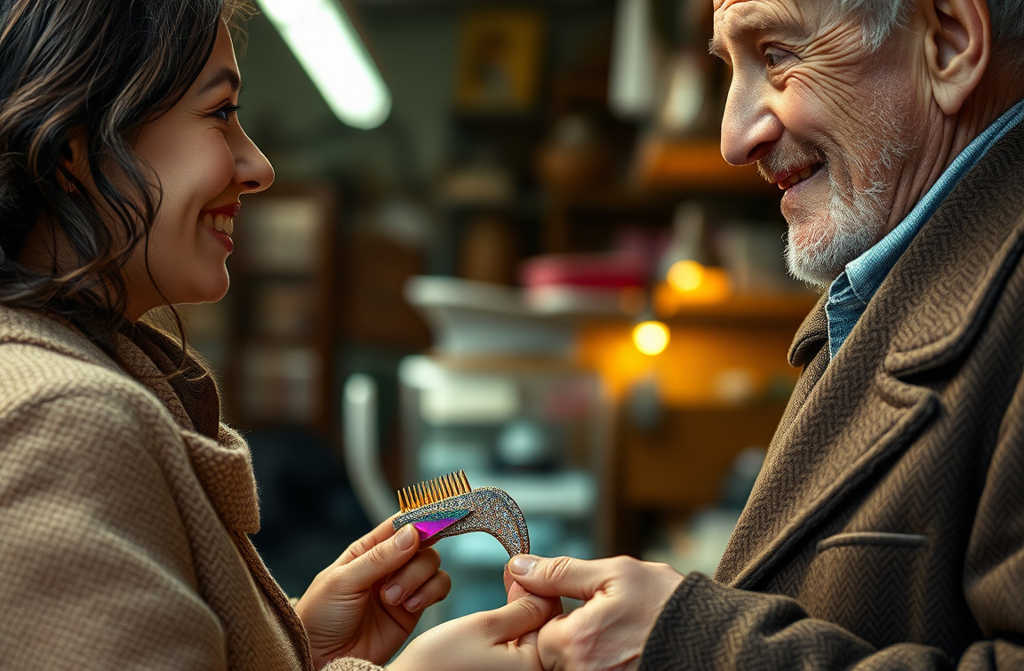
Hed handed me a comb, that cantankerous old man, and everything that happened after turned my whole life upside down.
It was perched on a shelf in the farright corner of the little corner shop on Abbey Street, as if itd been waiting just for me. A strip of fluorescent light caught it, and it flashed with a cold, silvery gleam. I froze. It was just a comb, but unlike any Id ever seen a smooth, mattemetal handle, perfectly cut, and the teeth werent ordinary at all. They shimmered with every colour of the rainbow, like ice carved by sunshine.
I reached out, but my fingers stopped a breath away. Inside me something clenched. Why? a stern voice inside me asked. Youve got a perfectly good, practical comb at home. Dont waste money on this nonsense.
I sighed and pulled my hand back, yet I couldnt tear my eyes away. It seemed alive, hypnotic. I imagined it gliding through my wild, ginger curls and a grin slipped onto my face.
Miss! Lovely comb, take it! the shop assistant called, beaming. She rushed up to the counter.
Weve sold out of most of them, honestly. Only two left. Not only pretty, but wonderfully practical wont snag your hair, she assured.
Im just looking, I muttered, stepping back. Ive got my own, its fine too.
I turned away, tried not to stare at the shelf, and headed for the door. A tiny mirror by the exit caught a glimpse of me a few stubborn orange tufts poking out from under my hat. The silly urge rose again.
No, I told myself firmly. I have to be sensible. Learn to say no to things you dont need.
I stepped out onto the stoop, the sharp January wind biting my cheeks. The chill cleared the fog in my head. Down the slick cobblestones shuffled a familiar silhouette Parker Grimble.
His real name was Paul Timothy, but everyone in the neighbourhood knew him by his grim nickname. An old man whose cold, distant stare sent children scurrying. He never talked much, and if you met his gaze it was so hard, youd look away quickly.
He was in his usual getup: a threadbare rabbitfur coat, a wornout overcoat, ragged boots. The only thing that didnt fit his dour image was the bag slung over his shoulder not a battered knapsack but a tidy grey cloth satchel, its flap embroidered with an odd pearlescent flower, clearly stitched with care.
I stared at that otherworldly bag and didnt blink. Our eyes met. In his faded blue eyes flickered a spark of ancient irritation. I hurried back to the display, pretending to examine something, my heart thudding in my throat.
Hey! You up there! a hoarse, croaky voice called close by. I pretended not to hear.
Hey! Im talking to you! the voice got louder.
I turned slowly. Parker Grimble, creaking, was climbing the steps of the stoop, looking straight at me.
You from this block? he asked, pushing his bushy, silvergrey eyebrows up with his nose. He smelled of old cloth and a hint of mint.
I felt my cheeks flush. I um yeah, I suppose, I stammered, feeling like a complete fool.
Suppose that a yes or a no? he pressed, his eyes lighting up with that familiar mischief.
I just nodded, bracing for a scene.
Then his breath deepened, and his anger melted into a strange, exhausted weariness.
Could you help me pick a little present? Youre a girl, after all. Ive got a granddaughter, Marjorie. She lives far away, I havent seen her in years, he murmured, his voice dropping to a whisper.
A flash of that same cold fire seemed to pass through his eyes not malice, but raw, animal desperation.
Maybe you should call Marjorie and ask what she wants? Even just on the phone? I suggested cautiously. Im not sure what shed like
I cant call her, he snapped, his face hardening again for a heartbeat. Its just how it is. Will you help? Choose something?
And the thought struck me again: the comb. That strange, beautiful comb, just like that satchel. It would be perfect.
Even though fear still gnawed at me, a little something inside stirred. I dared to touch the sleeve of his coat.
Lets go, I whispered. I saw something that might be right.
We walked back into the shop, my fingers feeling the rough weave of his coat. He leaned on an old wooden cane Id never noticed before. We reached the same counter.
Here, I said, pointing at the sparkling item. I think shed like this.
Paul Timothy reached out slowly, his large, knobby fingers trembling as he lifted the comb. He turned it over, looking not at the comb but through it, as if seeing some distant memory. In that moment he wasnt Grimble any more; he was just a tired, lonely old man.
The shops out of them only two left, the shop assistant called, echoing like a distant bell. Good combs sell fast.
His blue eyes flickered. A corner of his mouth twitched into something like a smile, as if an old pirate had remembered a hidden treasure.
Ill take both, he said suddenly, firm. He fumbled in the inner pocket of his overcoat and pulled out a worn leather wallet.
I opened my mouth to protest, but the words stuck. He counted the pounds and pence with the meticulous care of someone who knows the value of every penny.
The shop assistant wrapped the combs in two little paper bags. One she slipped into his ornate satchel, cradling it gently as if it were something fragile. The other she handed to me.
Here, take it.
I pulled my hand back as if it were a hot coal.
No, you dont need it for me for your granddaughter, right? I could manage without it.
Take it, he pressed, his gaze steady, almost stern. Its a little gift. From me, for you and for Marjorie. Ill try to send her a parcel, maybe shell accept And thank you, you helped me today.
His voice carried that same note of hopelessness about his granddaughter. I stood there, speechless, and took the comb. The plastic was surprisingly warm, almost alive.
We left the shop and walked in silence toward our block of flats. I clutched the bag as if it might fly away. My head kept asking, Why? Why did he do that? No answer came.
The quiet between us was tense at first, then softened. He breathed heavily up the hill, his steps the only sound breaking the streets hush. I stole a glance at his shoulders usually so stiff, now sagging under an invisible weight.
Thank you, I finally managed. Its lovely. Ill use it.
He simply nodded, not meeting my eyes.
Marjorie will be pleased, I added cautiously.
He slowed, letting out a deep sigh that seemed to rise from the soles of his old boots.
I dont know if shell be happy My daughter, Yvonne She wont give it to her. She wont want anything from me.
He fell silent, and we walked a few more steps in a heavy hush.
She blames me for her mothers death, he burst out suddenly, as if a dam had broken. For not saving my wife, Olwen
His voice cracked, and he coughchoked, pretending to choke.
She died in my arms. They said appendicitis, then peritonitis. The young doctor messed up. Two precious days lost. If Id taken her to the right hospital
He wiped his face with his sleeve, and I pretended not to notice his trembling fingers.
My daughter only came back after everything was over. Its been five years. We never spoke. She tried to call, but Yvonne stopped her. She loved her mother and I loved them both. My life ended that day.
We reached our building. He stopped at the doorstep, turned to me, his face twisted in a silent agony that made my chest tighten.
Dont be shy, love, come in. Ill show you what Olwen used to make. Its all still there. Come on, okay? he pleaded, his eyes full of hope and a quiet begging for human kindness.
I nodded without words. Fear melted away, replaced by a bitter understanding of his sorrow. I followed him up the stairs, the cool glass comb still tucked in my pocket, feeling a strangers grief become a part of me.
He opened the heavy iron door, and a still, unmoving air greeted me not stale, but timestuck, scented with dried herbs, old paper and a faint, lingering perfume.
Inside, the flat was frozen like a photograph. The floors shone, lace napkins lay perfectly on every surface. A vintage gramophone with a huge horn stood by a stack of records. The windowsills bore neat geraniums, their leaves polished to a shine.
On the back of an armchair hung a pink floral dressing gown, as if the lady had just taken it off. On the vanity sat a small pile of rings, a strand of pearl, an open powder box, and a dried mascara. It felt more like a museum than a home, a shrine to a day five years past.
Paul removed his coat and hung it next to that pink gown. He drifted to the kitchen, moving with a slower, almost ritual grace.
Sit down, love, Ill put the kettle on. Olwen liked tea with jam. We have our own cherry jam, he said, his voice softer, like a library whisper.
I perched on the edge of a chair, careful not to disturb the fragile peace. My eyes fell on a stack of envelopes tied with a thin cord on the windowsill. I leaned in; each bore his shaky, aged handwriting: To Yvonne, my dear daughter. All carried a stamp: Return to sender addressee deceased.
He returned with a tray of two antique teacups, a tiny teapot and a jar of that cherry jam.
I sipped; the tea smelled of mint and wild thyme, the jam surprisingly exquisite.
Its wonderful, I said sincerely. Ive never tasted anything like it.
He smiled sadly, looking past me. She was a jackofalltrades sewing, knitting, gardenwork. She even made bags from scrap cloth. This one, he tapped his flowerembroidered satchel, she begged me not to forget it when I went to the shop.
He fell silent, the quiet returning with his unspoken yearning. I finished the jam, then, on a sudden impulse, asked,
Would you teach me how to make that jam? My mum cant get it right.
His eyes lit up, as if Id said something vital. Of course. Its not hard.
And he began to tell stories not of grief but of life: how he and Olwen planted the garden, how she scolded him for buying too much fabric, how theyd wander the woods for mushrooms. I listened, and the phantom Grimble faded, leaving an ordinary lonely man whod hoarded love for decades, unsure where to put it.
Leaving, I glanced once more at the unopened letters. The spark that had lit in the shop now solidified into a firm resolve I couldnt let that go.
Ill pop by for the recipe again? I called as I reached the door.
Come back, love, youre always welcome, he replied, his eyes finally warm, not icy. Ill even tell you about my secret zucchini jam its a trick.
I stepped onto the stairwell, the door closing behind me, sealing him again in his quiet museum. I went back to my flat, and only then, in the hush of my own room, allowed myself to breathe.
I pulled the comb from my pocket and set it on the table. It still glistened with its rainbow teeth, no longer just a pretty trinket but a key the key that unlocked a door into someone elses tragedy.
I sat down, grabbed a notebook and a pen. I couldnt write the whole letter in one go; emotions overflowed. I started with the first lines, the most important:
Dear Yvonne, weve never met. My name is Blythe, your neighbour. I beg you to read this to the end
Outside, night fell completely. I wrote, crossed out, rewrote, feeling the heavy weight of responsibility but also a strange confidence that I was doing the only right thing.
Three weeks passed. The letter was mailed, and nothing came back no call, no reply, just the same oppressive silence that filled Pauls flat.
I visited him a few more times. We shared tea and jam, and he, brightening, narrated new details of his recipes. I pretended to be keen, avoiding his gaze, fearing hed see the deceit in my eyes. Each goodbye left his stare a little softer, his gratitude deeper, and my guilt grew.
One afternoon, returning from the university, I spotted a familiar scene by our buildings entrance. A group of the local ladies league were chatting, pointing at the bench where Paul usually sat. He was absent, but they continued, unashamed.
no wonder they called him Grimble. He fought with everyone, kept to himself. They even say his wife
I froze, blood rushing to my head. All that pain, that tragedy Id glimpsed, surged like a wave. I walked straight to them.
They fell silent, eyes wide with surprise.
Youre talking about Paul Timothy? I asked, my voice louder than I intended.
One of the bolder women, her hair in a tidy bun, answered, Whos asking?
Im Blythe, his neighbour, I said, feeling my cheeks burn.
We wanted to thank you, she began, voice trembling, for the letter and everything.
Behind her, a younger woman, Marjorie, smiled a sunlit grin.
If it hadnt been for you, we probably never would have come back. Mum read your letter all the way home.
The older woman dabbed at a corner of her eye, exhaling.
We were blind, she said. I was so angry I blamed him for everything. Hed lost the most precious thing and was left alone. He didnt deserve that.
She pulled a small parcel from her bag, wrapped in the same grey cloth with the pearlflower.
This is from Paul, and from us. He asked us to give it to you.
I took the bundle automatically. They nodded once more and slipped away down the stairs.
Inside the cloth I found a second comb the twin of the one Id taken. A note in Pauls firm handwriting lay beside it:
Thank you for helping us find each other. All the best. Paul, Yvonne and Marjorie.
I clenched the cool plastic, two identical combs two keys that opened the same door.
That evening I sat by the window, watching the street lights flicker on. I thought about how odd life is a chance meeting, a seemingly useless object, a timely word can change everything, break down walls of misunderstanding and bring light back.
I tucked one comb into a little tin box as a keepsake, a reminder that miracles often sit quietly, unnoticed, but theyre real. I held the other to my hair, feeling that same inner warmth spread outward a warmth of hope that had thaws a lonely mans icecold heart and his familys grief.
Looking into the dark glass, I saw my own reflection messy hair, sleepy eyes, but a smile tugging at my lips.
Everything felt right.