Thirtytwo years and one day
Molly stood by the rainsplattered window, watching the heavy drops race down the glass, merging into tangled patterns. Behind her, the steady snores of her husband echoed from the armchair in front of the telly.
Thirtytwo years of marriage. The number rang in her mind like a tolling bell, not measuring time but a single moment stretched over decades. It felt as if their whole life together were a dimly lit hallway lined with identical doors.
Year after year she turned each one, hoping to find a different viewa new landscape, a fresh scent, a different roombut each time she stepped into the same setting: the sofa, the chair, the window, him, her, and the thick, quiet sediment of years settled on every surface.
Outside the world breathed, shifted, moved. Inside, time seemed frozen, clutching its own clocks with a dead hand.
From that numbness a memory rose, bright and warm, smelling of distant summer and fresh paint. Not the spacious, solidfurnished flat they now lived in, but the first cramped room in a council house, twelve square metres of cramped happiness. The scent of drying oil paint on the sill mixed with the aroma of cheap bangers she fried in the communal kitchen and lugged back to the room for dinner.
She saw him then, twentyfiveyearold Victor, in a faded Tshirt, his face set as he nailed a shelf into place. He caught her eye, and a nervous hammer blow thudded against his own fingertip. She laughedclear, unrestrainedand that laugh seemed to fill every corner of their little cage, pushing any fatigue or doubt aside.
Now he snored. And he was silent. Their conversations reduced to the mundane: a broken tap, a bill to pay, a call from their daughter, the endless what are you making?
Molly sighed and drifted to the kitchen. On autopilot she set the kettle, fetched two mugs, grabbed biscuits, pulled a packet of sliced sausage from the fridge and began to cut it. Then she stopped, staring at her hands. Her whole life fit into that kitchen: kettle, mugs, biscuits, sandwichesa ritual looping without meaning.
Enough, she said, and the word hung in the quiet.
She didnt brew the tea, didnt touch the sliced meat. She took an old coat from the rack, slipped on her shoes, left a note unseen, and stepped out into the hallway. The door clicked shut behind her with a soft, final snap, as if not a lock but an inner latch had released.
Rain still drummed, cloaking the evening city in a grey veil. Molly moved fast, almost ran, not caring about the road, just fleeing the house, the snore, the sliced sausage on the board. Her feet carried her two blocks to the pinkbrick block where on the fourth floor lived Nora.
Noraher schoolday friend, divorced long ago, a tour guide who lived alone and, astonishingly to Molly, never saw her solitude as a sentence. Im not alone, Im free, she would say, and Molly had always thought Nora merely made excuses. Yet now Molly desperately craved that excuse, or better yet, understanding.
She knocked, and the door swung open almost instantly.
Molly! Oh my God, what a surprise! Nora stood in a bright housecoat, a book in her hand, her face free of sleep or irritation, only genuine surprise and joy. She didnt ask whats wrong? or cast a worried glance down the empty hallway behind Molly. She simply grinned, hugging her, scented with perfume, coffee and something indefinably lively. Come in, come in, what a meeting! Youre soaking!
Molly shrugged off her coat in the hallway, feeling something inside her melt like thawing snow. The hug was not out of duty or habit but from the heart.
Sorry for dropping in unannounced, she began, stepping into the cosy, slightly chaotic sitting room where books piled on the floor and reproductions of paintings and travel photos adorned the walls.
Come off it! What warning? I was just looking for someone to chat with, not a boring Stendhal, Nora waved a hand at a stack of books. Now, well sort it out. This calls for something special.
Nora disappeared into the kitchen, and Molly heard the clink of glasses and the pop of a bottle. She sank into a deep armchair, a strange lightness washing over her as if an invisible, heavy load had been lifted from her shoulders.
Nora returned with a bottle of red wine, two large glasses, a plate of cheese, grapes and crackersnothing like sausage.
Here, she announced, pouring the dark ruby liquid. Cabernet. Remember that night in Brighton when we drank it? Feels like a past life.
Molly lifted her glass, swirling it, watching the legs run down the sides.
I remember, she whispered. We ran away from your conference and ended up at that little seaside bistro.
And you said it was too pricey for us, Nora teased, clinking glasses. I said sometimes you have to allow yourself a little luxury. Even if its just a glass of wine and a view of the waves. Drink, warm up.
The wine soothed her throat with pleasant heat, spreading through her body like a gentle wave. Molly closed her eyes.
Nora, arent you ever scared? Being alone? she blurted.
Nora leaned back, eyes fixed on her glass.
Sometimes. Not from being alone, but from emptiness. Its the difference between silence and quiet. Silence can be full. Quiet is when even in a crowd you have nothing to say. Youre not really alone, are you?
Im more like quiet, Molly murmured. Thirtytwo years and all we talk about now is what sort of sausage to slice. I watched him today as if through watersaw the familiar shape but no person behind it, and I didnt even see myself.
Nora fell silent, then poured more wine.
Where have you been all those years? Not just physically, but inside?
The question lingered. Molly had no answer. Shed been at the clinic, the shop, the kitchen, the window. But where was she, Molly, the woman, not the wife, mother, housekeeper?
I walked out today and said enough. I dont know what thats enough for. Everything? Or just the start of something new?
Maybe both, Nora said softly. Enough is a good word. It draws a line. Heres the old, heres the new. What the new holds, who knows. But at least it isnt sausage.
They laughed, and Mollys laugh this time felt real.
You know what I do when I feel stuck? Nora raised a finger. I do something Ive never done. I have coffee at fivep.m., I go to the cinema alone, I buy a silly but pretty thing, I sign up for Italian classesnot to learn, but to hear beautiful speech. Its like a pinch of salt in a bland dish. Small, but it changes the flavour.
Molly listened, not with judgment but with a hungry, almost childlike interest. Noras world was bigger than hers, a place where wishesnot just dutieshad room, even the small, even the foolish.
What about Victor? Nora asked, saying the name aloud as if testing its sound. A pause followed.
Victor, Nora answered herself, is probably stuck in his own hallway too. He might not even realise its a hallway. He thinks its the whole world. You can only get out from the inside, or shout loudly so someone hears.
They finished the wine, the conversation flowing from trivialities to memories to Noras plans for a trip to Italy. Molly watched Noras animated face, the spark in her eyes, and thought, Shes alive. And I?
A sudden ring cut through the quiet. The oldfashioned landline on the kitchen walla relic Nora stubbornly keptbuzzed.
Whos calling at this hour? Nora grumbled, standing.
She lifted the receiver. Hello?
Molly saw Noras expression shiftfrom a business mask to surprise, then to a soft, deep understanding tinged with quiet sorrow. Nora glanced at Molly, then turned to the wall, lowering her voice but making every word audible in the hushed flat.
Its Victor? Yes, hes here alive, dont worry No, everythings fine, we just had some wine, chatting.
A pause. Nora nodded, listening to a voice she could not see.
I understand Ill tell him Alright, take care.
She hung up, eyes gentle and probing.
Your knight in the armchair, she said lightly. Hes panicking. He realized youre not there, the phones sitting on the table. Hes called Kateshes clueless too. His voice sounded tight, not the usual sleepy drawl. She never goes out alone at night, he kept saying. He kept asking if shed said anything.
Molly sat, clutching an empty glass, the ringing still echoing in her ears. She imagined Victor, large and clumsy, wandering through their rooms, pausing at the empty bedroom, the quiet bathroom, not finding her. She pictured his hand trembling as he dialed their daughter, trying to sound calm while his breath faltered. He was searching for hernot for a missed dinner, but for her absence.
Why are you so quiet? Nora asked softly. Hes not just noticing a cold kettle. Hes scared. Really scared.
I didnt think, Molly exhaled honestly. I thought hed stopped noticing anything. To him I was like a wallthere, there, never gone. A wall cant disappear.
A wall can crumble, Nora said, placing a hand on Mollys shoulder. And the foundation shakes. He said, Please tell her Im waiting. Im worried. Not go home and cook, but waiting and worried. Those are wordswhat youve been missing.
Molly rose. A sudden urge to go home surged, not from duty but to see his face, to look past the everyday mask.
I have to go, she said.
Go, Nora nodded. And Molly a shout isnt always a fight. Sometimes its just leaving without warning so people start looking. Looks like it worked.
Nora hugged her again at the door, whispering, Good luck. Remember, a wall isnt you.
Molly walked back slowly. The city, an hour ago cold and indifferent, now felt like a path home. Streetlamps cast long trembling shadows, each one shaping Victors tall, slightly stooped silhouette peering into the darkness.
The lights in their flat burned in every roombright, impatient, eager. She stopped at the entrance, breathless, then realised she was scared. Scared that when she opened the door, hed be back in the armchair with the paper, and everything would be a dream. Scared that this crack, this flicker, would be smoothed over by the usual seamless silence.
She climbed the stairs, turned the key, and the door opened silently.
In the hallway a lamp glowed. He stood there, midstep, in trousers and a coat, as if about to set out. His face was pale, eyes edged with unfamiliar worry.
They stared at each other across the threshold, mute.
He was the first to speak, his voice hoarse from disuse. I thought He swallowed. I thought something had happened. Then Nora called I was worried
In those simple words, in his bewildered gaze, Molly saw the twentyfiveyearold Victor who once feared hurting her and whispered, Are you happy? He wasnt just waiting. He was afraid. And that meant he still felt. She was not a wall.
She stepped across. The door clicked shut behind her.
I was at Noras, she said, shedding the wet coat. The act seemed ordinary, yet in the hush it rang loudly. Just left.
Without your phone, he replied, not as blame but as a statement of fact, as if the meaning were incomprehensible to him. You always have it on you.
It was true. Her phone always lay on the nightstand, a silent witness to her predictable life.
Yes, she said simply. Forgot it.
Victor moved forward, then stopped, as if recalling something. He shrugged off his coat, tossed it on the rack, then walked to the kitchen, to the table. Molly followed.
On the table, beside her untouched mug and a plate with perfectly sliced, now wilted sausage, sat the kettle, two clean cups, and biscuits laid out.
Molly sat, her legs suddenly weak.
Victor?
I was scared, he interrupted softly, sitting opposite. He didnt look at her; his eyes drifted over the familiar tabletop. Woke up, you werent there. It was dark. Too quiet. Like the house had emptiednot just a room, but the whole place.
He lifted his gaze to her. In it lay the longforgotten vulnerability.
We never said anything, did we? he asked, genuine confusion in his tone. I fixed the tap yesterday maybe I said something wrong?
He tried to find a rational cause. The broken tap, the missing wifewhat to fix? Like the shelf hed once nailed.
No, you didnt do anything, she sighed. And you said nothing. Thats the point. Weve stopped talking. Its been years I dont even know how many.
He sat, absorbing.
What about? he finally asked, his voice stripped of accusation, filled instead with bewildered curiosity. Work is the same, no news. Daughter calls, alls well. The house is fine. What am I supposed to say?
Fear slipped into her thoughtstime slipping away, strangers in each others lives, dreams she never shared, the terror of silence, the rainbow shed seen in the park but not with him. Yet she said something else.
Remember that tea we had in that little room after you nailed the shelf and hit your finger?
Victors face flickered. A sparkmore surprise than memorycrossed his eyes.
I remember, he rasped. You laughed. Then we spilled the tea because He trailed, a faint blush lighting his cheeks.
Because you kissed me and I flinched, Molly finished for him, surprised at how sharply the scene resurfaced: cheap tea, sugar on the lips, his sudden, awkward resolve.
They stared across the kitchen table. In that moment there was no sausage, no utility bills, no thirtytwo years of quiet. Only two young people in a sundappled room scented with paint and happiness.
Victor reached for the kettle, feeling the cold metal.
Its cold, he noted, then set it down. Now?
No tea, Molly said. Lets just sit.
He placed the kettle back and sat. They remained at the table in silence, but the silence had changed. It was no longer an empty void but a pausea space where old chatter died, making room for something new.
I could go to the cinema tomorrow, Victor said suddenly, looking past her at the wall. Like we used to. I dont even know whats on.
It was awkward, naive, as if he were speaking a forgotten language, recalling first phrases.
Molly watched his large, workworn hands on the table, the hands that once brushed hers shyly, now trembling as they dialed Noras number.
You can only get out from the inside or shout loudly, she thought. She shouted, she left. And he heard.
Lets go, she said. Well see whats on later.
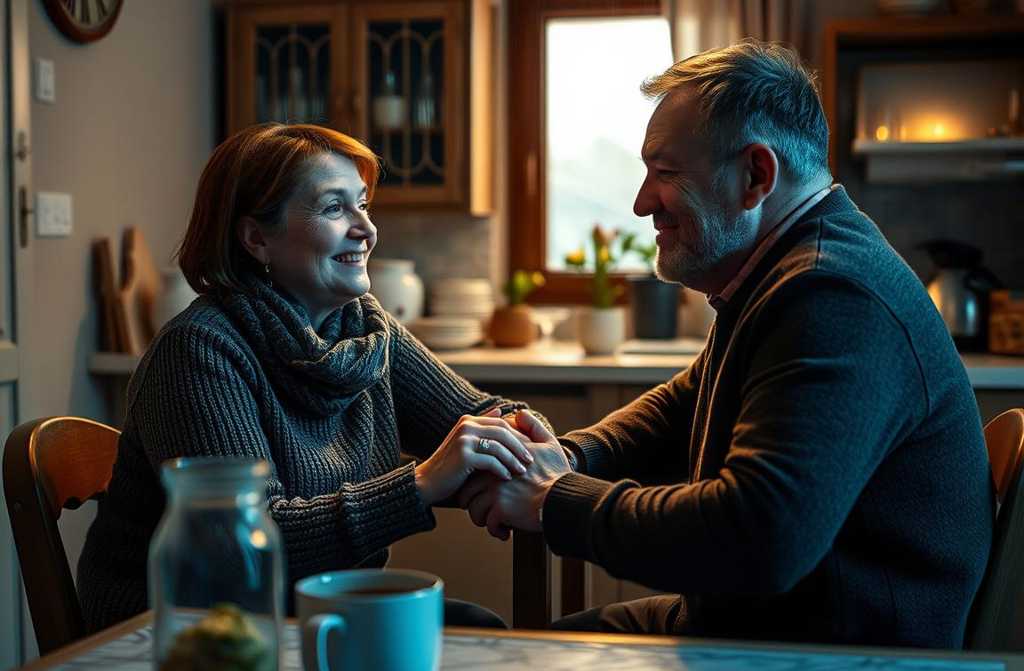
She reached across the table, covering his hand with hers. He flinched, then his fingers closed around hers, firm, still.
They sat like that, hands intertwined beside the nowirrelevant plate of sausage. Outside, the night sky, dark as velvet, lit up with dim city starsfaint but real. The rain had stopped. In a house that had known silence for far too long, a quiet, vital conversation begannot yet in words, but in the warmth of palms and the promise that tomorrow would be more than another day. It would be a film, an attempt.
And Molly realised that was the true beginning. Not an ending, but the second, mature chapter of their story, where the protagonists, after a long slumber, finally awaken, squint at unfamiliar light, and rediscover each other.





